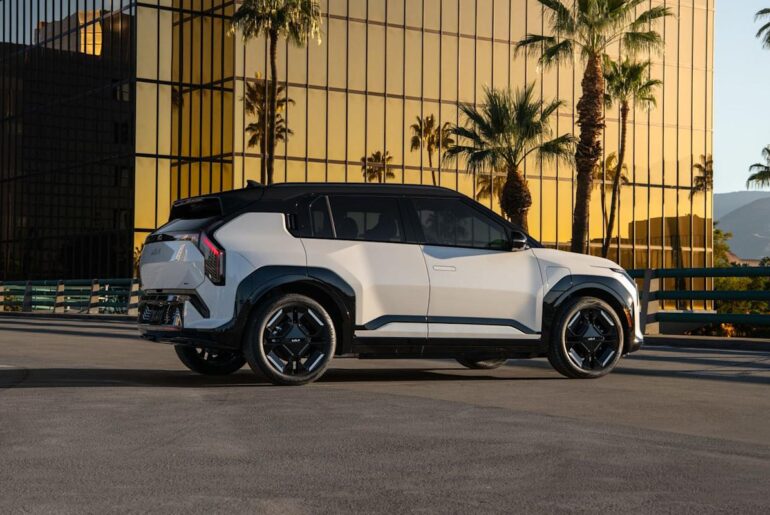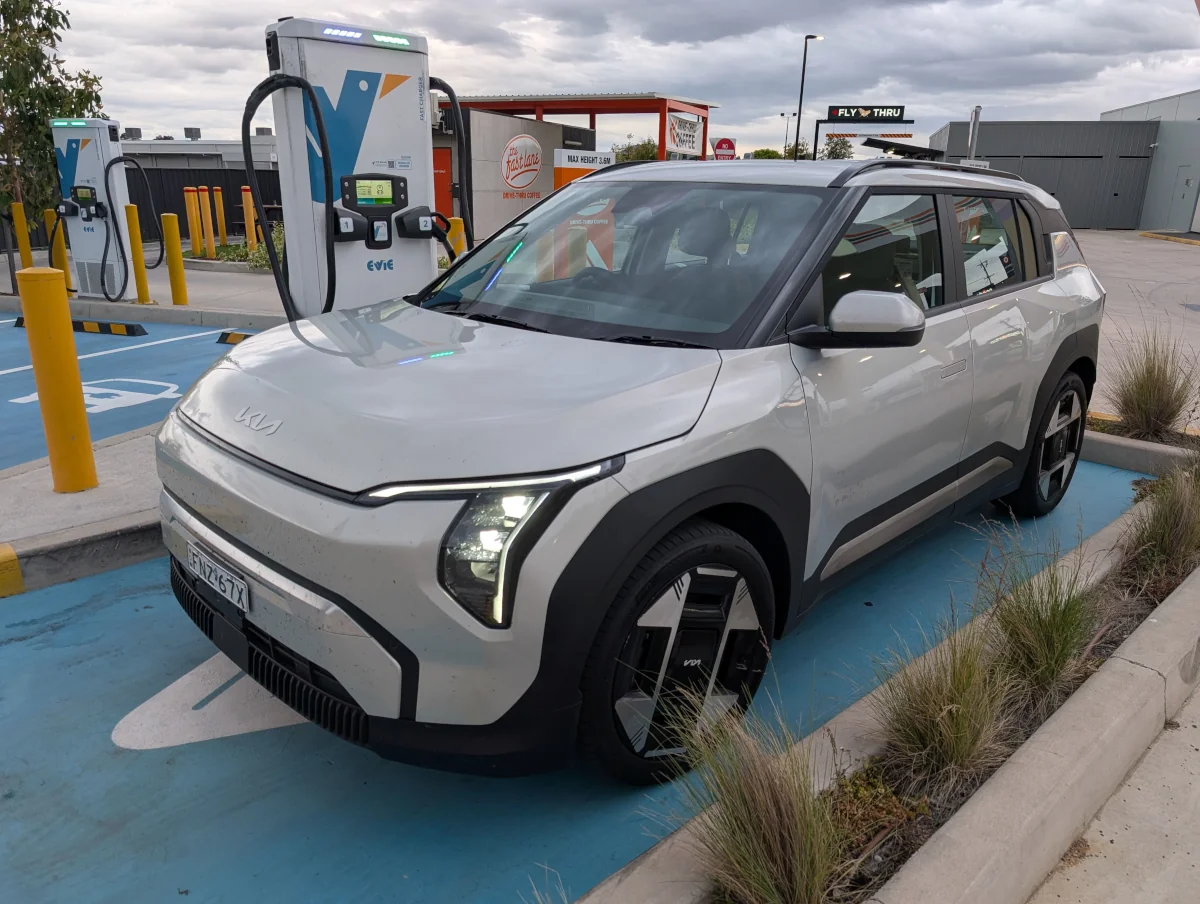
Kia EV3 is currently the South Korean brand’s smallest and most affordable model in their electric vehicle lineup. An even smaller EV2 SUV has been unveiled as well as plans for an EV1 hatchback to follow, but neither has been confirmed for Australia yet, so the EV3 will remain Kia’s entry level EV for now.
I’ve heard a lot of great things about the 2025 World Car of the Year winner, including Giles Parkinson’s EV3 review and Riz Akhtar’s take on the top-spec EV3 GT-Line variant. I thoroughly enjoyed driving the EV5, EV6 and EV9 too, so I had high expectations coming into this review.
I recently drove from Sydney to Melbourne for Everything Electric Victoria plus the AEVA National Conference and had the opportunity to put an EV3 Earth Long Range to the test for the trip.
After spending a week with the car covering more than 2,000 km, my expectations were mostly satisfied. I found several things about the EV3 were delightful, although some annoying quirks left me feeling puzzled.
EV3 lineup and competition
The EV3 lineup starts from $47,600 plus on-road costs for the Air Standard Range, offering 436 km WLTP range from its 58 kWh NMC battery pack. Next up is the Air Long Range, fitted with a larger 81 kWh NMC pack delivering 604 km range for $53,315 plus on roads.
EV3 Earth and GT-Line variants utilise the same 81 kWh battery, priced from $58,600 and $63,950 respectively. WLTP range drops to 563 km for these 2 due to their larger 19” wheels. An identical single motor front-wheel drive setup providing 150 kW / 283 Nm powers all EV3 models.
First released onto the Australian market in March 2025, the EV3 is currently sitting in 10th place with 2,181 year to date sales, roughly half the volume of its larger EV5 sibling with 4,241 sales in 4th place.
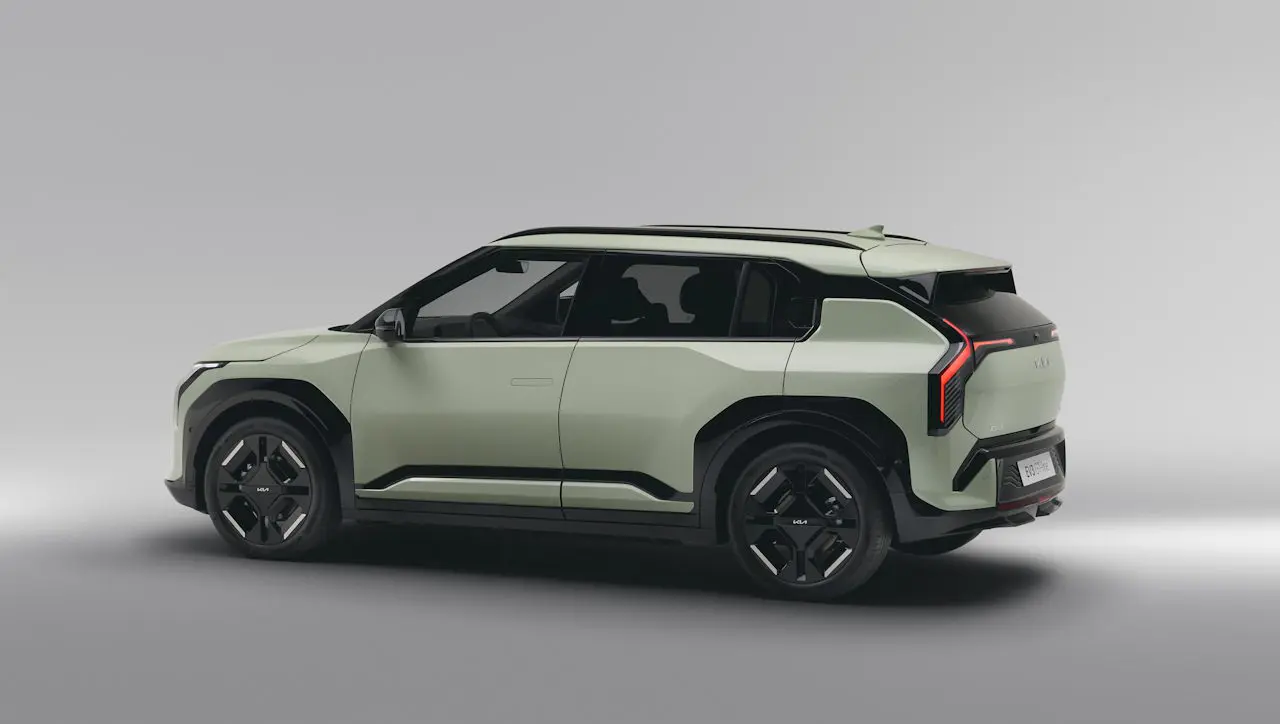 Kia EV3 GT-Line. Source: Kia
There is a long list of small SUV competitors for the EV3 starting with the Alfa Romeo Junior Elettrica, BYD Atto 3, Chery E5, Hyundai Kona Electric, Jeep Avenger, Kia Niro EV, Mercedes-Benz EQA, Renault Megane E-Tech and Volvo EX30. Some of these competitors cost significantly less money, but can’t match the EV3 on range.
BYD will also be adding their very affordable Atto 2 to this list shortly, which starts from $31,990 and is expected to sell in similar volumes to the Atto 3, therefore most likely pushing the EV3 just outside the top 10 in future.
Compact size hides practical, spacious interior
At 4.3 m long and 1.85 m wide, the EV3 certainly looks more compact from the outside compared to our most common mid-size SUVs such as the Model Y and Sealion 7. The boxy design shared by Kia’s larger SUVs as well as a stubby bonnet allow the EV3 to make the most of its compact dimensions where it counts though, on the inside.
In terms of storage space, the EV3 boot offers an impressive 460 L with the rear seats up. Kia’s Australian brochure doesn’t include a measurement with the rear seats folded, but other sources online quote 1,250 L.
These figures are significantly better than most of its direct competitors, for example the Chery E5 (300 L), Volvo EX30 (318 L) and Jeep Avenger (355 L). There are a few which come close like the Atto 3 and Renault Megane E-Tech which are both capable of storing 440 L with the seats up.
 Kia EV3 boot easily fit my luggage and a Segway scooter. Source: Tim Eden
Numbers aside, the EV3 boot was plenty big enough for everything I took to Melbourne, as well as the Segway scooter reviewed here by Ed Lynch-Bell, which hitched a ride with me back to Sydney.
The EV3 boot also has a flat floor for easy loading, with a large space underneath the adjustable and/or removable floor if you need to carry more stuff. It might even be big enough under there for a spare tyre of some sort, provided you store the charging cables in the 25 L frunk or elsewhere.
 Large underfloor area in the Kia EV3 boot. Source: Tim Eden
Front seats in the EV3 were another highlight of my trip. I found them very comfortable, even after a full day of driving to Melbourne I arrived feeling refreshed and was not stiff or sore at all. Front seat heating and ventilation are reserved for the Earth or GT-Line variants, along with a heated steering wheel for those living in cold climates.
I did not get a chance to take the family for a spin as I normally do, but the rear seats come standard with all of the usual features including air-vents, 2x USB-C ports, door pockets, seat pockets and fold down armrest with cupholders.
From a brief test the second row appears spacious enough for 2 large kids or adults to travel in comfort, with room for a 3rd person back there on shorter journeys, so I think the EV3 could easily handle families of 4.
Whether you call it practical and hard-wearing or just cheap, the EV3 could be criticised for widespread use of hard plastics, found throughout the front and back cabin, as well as most of the door and dash panels. At least there are padded areas for your arms on both the centre console and door armrest.
Customisable one pedal driving with i-Pedal 3.0
It might have taken Kia 3 attempts to get one pedal driving right, but in my opinion they have finally nailed it with i-Pedal 3.0, giving drivers the choice to fully customise and save their regenerative braking preferences between drives.
One of my biggest gripes with the Kia and Hyundai electric vehicles I tested previously was the fact you needed to use the steering wheel paddles to re-enable the full strength one pedal drive setting every time you hopped into the car or after reversing.
With i-Pedal 3.0, the EV3 remembers the previous regen setting permanently, which makes me happy because the accelerator pedal now behaves consistently rather than changing depending on whether you are driving forwards or backwards.
 Toggle switch to disable i-Pedal when reversing. Source: Tim Eden
I acknowledge some people prefer their EVs to creep all the time or just in reverse, such as fellow contributor Bryce Gaton who maintains this is safer while parking. With the new toggle switch above found within the EV settings menu, it is now possible to set up an EV3 whichever way you prefer so there is no need for anyone to compromise.
Another advantage of not creeping in reverse is that you can change gears without having to shift your foot onto the brake, instead you can just ease off the accelerator, which makes parking and 3-point turns quicker and easier. Gear changes like this are not as smooth as in a Tesla, but Tesla drivers looking to change or get a second car will appreciate it.
Great highway range, but thirstier than expected
Originally I had an Air Long Range booked with Kia, the longest range version in the EV3 lineup with up to 604 km WLTP. This is significantly higher than most of its competitors which sit around the 450 km mark, apart from the extended range Kona Electric with 505 km from a smaller 65 kWh battery.
After Kia had an issue with that particular car I was swapped into the next best thing, an Earth Long Range, still offering a very respectable 563 km range. This ended up being more than enough to cover the approximately 850 km drive to Melbourne with just 2 charging stops in Yass and Albury.
 On the way home I had the Tesla Supercharger in Yass all to myself. Source: Tim Eden
However, to make sure I arrived in Melbourne with enough charge to last the next few days of city driving, I also topped up and grabbed some dinner at Kilmore, about 65 km from my final destination.
Apart from those charging stops, I took regular rest breaks along the way including lunch at Gundagai, which felt odd because I would normally be charging while I’m stopped, but the EV3 was still on 75 percent after the first charge and coffee in Yass.
Upon arrival in Melbourne, I was a bit surprised after checking the trip meter which showed consumption of 192 Wh/km for the southbound journey. The overall return trip efficiency was slightly better at 182 Wh/km, still above what I was expecting for a small SUV though.
 My round trip efficiency in the EV3 was higher than expected at 182 Wh/km. Source: Tim Eden
The tyres were inflated to the recommended pressure of 36 PSI, so perhaps the poor highway efficiency can be explained by the boxy shape of the EV3. The additional air resistance cruising at 110 km/h must be a significant factor, as the car only consumed 148 Wh/km around town for 2 days before I departed for my trip.
Driving to Melbourne and back gave me plenty of time to experience Kia’s Smart Cruise Control and ADAS features. Both the adaptive cruise control and lane centering system worked flawlessly, and I did not feel the slight weaving on straight roads that I’ve noticed in the Kia EV9 and Hyundai Ioniq 9.
Other notable features and quirks
I thought the EV3 had a great sound system, even the standard 6-speaker system found in the Air and Earth variants was crisp and clear for listening to podcasts, with punchy bass for music tracks. The GT-Line gets an upgraded Harmon Kardon branded 8-speaker system that adds a subwoofer and should sound even better.
During several bluetooth phone calls in the car I experienced an annoying issue where the audio would stop every 1-2 minutes and go into privacy mode all by itself. This could potentially have been an issue with my phone though, as Android Auto was also having issues connecting at times.
Unlocking the car without touching the key fob was another thing that puzzled me initially with the EV3. The side mirrors automatically unfold as you approach the car with the key in your pocket, but remain locked when you try to open them.
To unlock the doors I tried touching or swiping the square recess at the front of the door handles as well as the indented line at the back of the handle, neither seemed to do anything.
Kia said I wasn’t the only person to ask them for an explanation on the EV3 door handles, which is a relief. They confirmed you just need to push the door handle inwards, and it is usually best to push on the left end or back of the driver’s door handle.
The lack of a 360-degree camera on all EV3 variants in Australia is something worth keeping in mind if this feature is important to you, and particularly odd given UK and NZ right-hand drive EV3s come with one. Having said that, I found parking the compact EV3 was easy using just the rear camera and parking sensors.
Conclusion
Despite some minor quirks described above, the EV3 is a compelling overall package, offering category leading range and a practical, easy to use interior. The cabin is roomy and comfortable for long road trips too, with tons of storage space available in the boot.
If you plan on taking frequent road trips, one of the long range EV3s will give you peace of mind and the freedom to pick and choose your charging stops. The long driving range available in the EV3 does come at a premium though, as some of its competitors offer less range for significantly less money.
Table of key specifications for Kia EV3 Earth
To compare the specifications of all EV3 variants, see the EV3 brochure on Kia’s website.
Variant
Kia EV3 Earth
Starting price
$58,600, plus on-road costs
Paint colours and options
8 exterior colours:
Clear White – included
Snow White Pearl – $550
Ivory Silver – $550
Aurora Black Pearl – $550
Shale Grey – $550
Frost Blue – $550
Matcha Green – $550
Terracotta – $550
Battery size
81 kWh gross, 78 kWh usable
Battery chemistry
Nickel Manganese Cobalt (NMC)
Range
563 km WLTP
Driven wheels
Front-wheel drive
Power / Torque
150 kW / 283 Nm
Maximum charging speed
10.5 kW AC, 135 kW DC
Charging time
11 kW AC (10 – 100 %) – 7 hours 15 minutes
50 kW DC (10 – 80 %) – 79 minutes
350 kW DC (10 – 80 %) – 31 minutes
Bidirectional charging
V2L up to 3.6 kW,
via internal socket or external adapter
Exterior dimensions
Length: 4,300 mm
Width: 1,850 mm
Height: 1,560 mm
Wheelbase: 2,680 mm
Ground clearance: 140 mm
Kerb mass
1,930 kg
Storage space
Frunk: 25 L
Boot, rear seats up: 460 L
Boot rear seats folded: 1,250 L
Service interval
12 months / 15,000 km


Tim has 20 years experience in the IT industry including 14 years as a network engineer and site reliability engineer at Google Australia. He is an EV and renewable energy enthusiast who is most passionate about helping people understand and adopt these technologies.