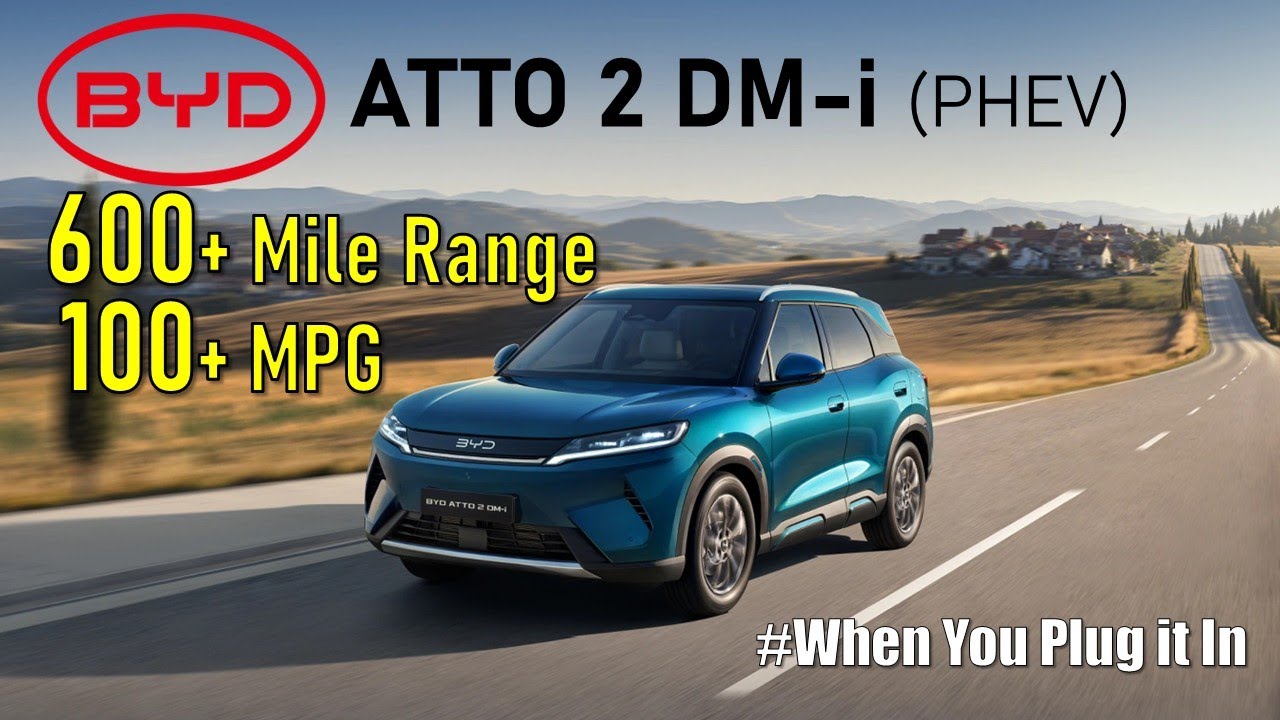
BYD Atto 2 DM-i, the 100 MPG, 600 mile PHEV (when you plug it in)
BYD continues to attack new segments of the market. This time with Europe in its sights, introducing the plug-in hybrid version of the AT2 called the One Up in China. The AT2 is a subcompact crossover that has been available as a full battery electric and now it will also be sold as a PvE wearing their dual mode intelligent or DMI branding. In this video, I’m going to compare it to the Honda HRV hybrid without a plug and mix in the horribly named E1 N1, which is Honda’s attempt to be relevant in the growing market of full battery electrics. Generally speaking, when you go to compact vehicles and smallers, you don’t see as many plug-in hybrids. Most automakers don’t have unlimited development budgets. So, in these smaller vehicles, you see more hybrid gas powertrains without a plug, like the Honda HRV hybrid. And then, if you want to go plugin, you go full battery electric. Smaller, more aerodynamic vehicles like this do very well as a battery EV. So, if customers want a more efficient powertrain, you skip the PvE and go right to a BEV. That’s what Honda is doing for Europe. BYD, however, makes no hybrids without a plug. They only make PHVs and E-Revs, vehicles with a plug to recharge, as well as a gas cap to refuel. So, for the subcompact crossover segment, BYYD said, “You know what? Why not? We have seemingly unlimited budget to make as many new models as possible and thus the AT2 aka one up gets the DMI treatment. I make lots of videos about BYD and personally I think they need to consolidate their lineup a little bit to focus more on selling higher volumes of vehicles and fewer models. But you know BYD’s grown to become the largest EV maker in the world. So you know what do I know? Quick comparison of the dimensions and you can see why I chose the Honda HRV. It’s pretty close in size to the AT 2. The Toyota Corolla Cross is also close, but it’s gotten bigger with its latest generation. First, let’s look at the battery EV models. I haven’t done a deep dive of the AT2, so I was a little surprised to see that this crossover only has a 45 kWh battery. That’s 51 nominal and 45 kwatt hours usable. Of course, it’s BYD’s Blade LFP batteries. You know, what else would you expect? And that’s not a lot. In fact, I’m surprised how small it is. It’s got a smaller battery, so less range, but more affordable in price. Power and acceleration for both bevs are good. Not fast, not stupid fast. Charging is another area where you also see compromises in speed versus cost. Smaller batteries in affordable bevs often charge at less than 100 kilowatts, but you know that needs to change over time. Simply put, the current AT2 EV really needs a bigger battery and faster charging. It gets imported to Europe from China, so it’s currently subjected to a 27% tariff. Earlier this year, BYYD announced that their Hungary plant will begin assembling some Dolphin hatchbacks. That’s a Bev model and the ATO3 crossover larger than the AT2. So, it’s possible that the AT2 could find its way into that Hungary plant or to their other plant being built in Turkey. Now, let’s talk about the star of the show, the BYD at2 DMI. They did not provide all the details, but based on other BYYD PV systems, it will be a parallel plug-in hybrid system, not an E-Rev. That means the engine drives the front wheels with assist from an electric motor, and it can drive on that electric motor alone for zero tailpipe emission miles. The engine will be a 1.5 L non-turbocharged 4cylinder running on the Atkinson cycle for increased efficiency. There will be two engine motor battery combinations that are offered in the ATO 2. The base offering is called active with 164 combined horsepower and a 7.8 kWh battery. You you do see some small sedans and smaller paves with batteries under 10 kilwatt hours, but yeah, I kind of think when it gets that small, why bother? The appropriately named boost option gives you an 18 kWh battery. Now, all right, now we’re talking. And it delivers more power. 209 horsepower. If we were to approximate EPA miles, figure maybe 48 mi EPA. You know, that’s still good, right? And combined with the gas tank, it can go over 1,000 kilometers or 634 miles on the WLTP. Europeans on average do not drive as many miles as American, but taking this PV on holiday would be an easy experience. # When you plug it in, it will offer combined fuel efficiency as low as 2 L per 100 km, which means absolutely nothing to me. So, convert that to miles per gallon, then take it a little bit down to estimate EPA numbers, and it’s over 100 miles per gallon hashtag when you plug it in. So, now let’s compare to the Honda Hybrid, a regular old nonplugin that too has a 1.5 L 4 cylinder engine running the Atkinson cycle. Because it’s a traditional hybrid, it’s going to have a smaller electric motor and a smaller hybrid battery. And the combined power output isn’t all that exciting. 129 horsepower, 0 to 62 miles an hour in 10.7 seconds. Fuel economy is a combined 5.4 L per 100 km or about 38 mp gallon roughly estimated EPA with its 40 L fuel tank. That’s a driving range of 741 km or 460 mi WLTP. So, comparing the Honda Hybrid to the BYD plug-in hybrid boost, you can see that the BYD has more power and # when you plug it in, better fuel economy and better range. We don’t know the final prices. The BYD at 2DMI Boost is likely to cost more than the Honda HRV hybrid. Since it’s a PvE, it’s going to get only a 10% tariff coming into the EU versus 27% for BEVs. Now, you may be wondering, Mike, why do you keep saying that annoying hashtag when you plug it in? You know, that’s because PBS and E-Revs are marvelous systems that offer the potential to reduce CO2 emissions and just burn less gas when used as directed. That sounds like an ad for a prescription drug, right? But that’s the key. If you don’t plug in your plug-in hybrid, then you should just buy a hybrid without a plug. We need more availability of home charging and workplace charging to eliminate the excuse for not plugging in a PvE. It doesn’t even have to be a level two charger. In the US, a level one charger putting out 1 kow, it’s going to do okay for a PV with an 18 kWh battery. Pricing was announced for Spain where it was revealed the smaller battery active version is priced at $32,990 euro while the boost version is listed at $35,90. That’s about $39,000 US. That is more than the Honda HRV hybrid, but it does get better fuel economy, produces less CO2, and it isn’t as slow. Plus, in some countries, they’re still offering incentives for plug-in vehicles. BYD appears to have found a white space for this crossover to flourish and it could even do well in the US. But you know that ain’t never going to happen. Maybe Mexico will get it. Definitely Spain. Thanks for watching. Or maybe I should say gracias.
The BYD Yuan Up DM-i, renamed Atto 2 DM-i for Europe, has been launched in the European market as a new plug-in hybrid SUV, despite being unavailable in its home market of China, where the Yuan Up is sold only as a pure Battery Electric Vehicle (BEV).This strategic decision by BYD reflects a flexible approach tailored to meet the diverse mobility needs of European consumers, who are still transitioning to electric vehicles and seeking PHEV options. The Atto 2 DM-i uses BYD’s DM-i super hybrid technology, offering an impressive combined range of up to $1,000text{ km}$ when fully fueled and charged, with a pure EV range of up to $90text{ km}$.The company also introduced the extended-range Atto 2 Comfort BEV variant, boasting a WLTP range of $430text{ km}$, further enriching its lineup. BYD is actively expanding its presence in Europe, with plans to grow its dealership network to 1,000 locations by the end of the year.
#byd #electricvehicles #phev
0:00 – BYD Atto 2 DM-i
0:50 – Why are there not many Small PHEVs?
2:22 – BYD Atto 2 EV vs. Honda e:Ny1 (BEV)
3:48 – BMY Atto 2 DM-i (PHEV) vs. Honda HR-V e:HEV (Hybrid)