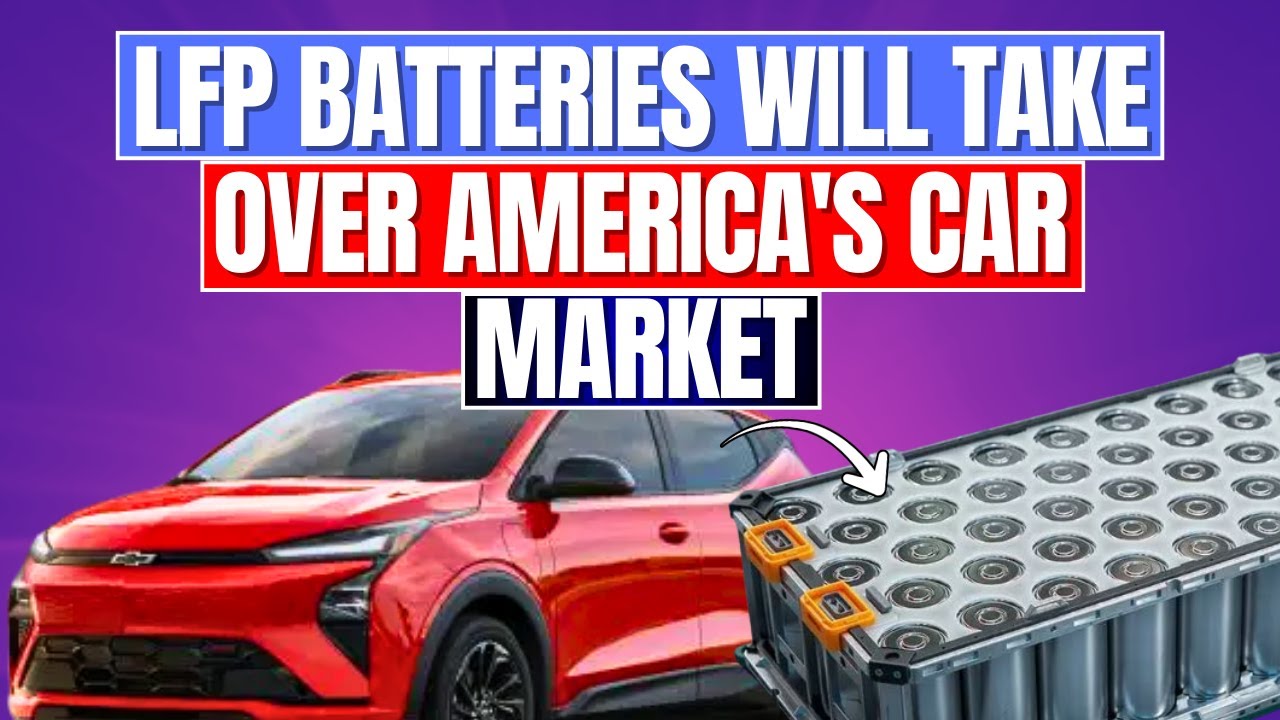
Beginning with the CHEVY Bolt, LFP Batteries will dominate the US Car Market
right now, right? China uses lithiumion phosphate batteries in almost all their cars. Not all of them, but almost. In the US, only a very tiny fraction of the EVs on the road and the EVs for sale today use lithiumion phosphate batteries. The rest of them use mostly NMC batteries. Not all of them, but mostly NMC lithium batteries. So, why is that? And how are things going to play out? Well, in this video, I’m going to explain why. But secondly, my prediction is this. I believe a very large number of EVs in the US by 2035 will be lithium phosphate. In fact, I’d say it’s going to be at least 50%. Even though today it’s only about 2%. About 80% of the EVs in China produced this year. Well, they’ve all had lithiumion phosphate batteries, not the batteries with nickel. So, most of the market in China has now moved to LFP. That number could be closer to 84%, but it’s between 80 to 84% over the last 10 months of the year. And there’s a good reason for this. Yeah, lithiumion phosphate batteries are cheap. They are cheap. And did I mention they’re cheap? Well, actually that’s the number one reason to be honest, the affordability. Now, they do last for a long time as well. They a lot of people think they last can outlast the life of NMC batteries, but that really is dependent upon the architecture. It really is dependent upon the battery management software, um the actual pack itself, how it’s structured. The cells themselves though in theory can last longer. So, there’s some advantages to lithium phosphate cells. Plus, the other advantages is they don’t use nickel or cobalt, which potentially can be conflict metals. So, LFP batteries can be more profitable, right? You can make a car, an EV that you can actually make a profit on because the batteries are usually around 40% cheaper, but they do have lower energy density. The energy density has improved in some of the newer LFP batteries, particularly uh J’s new LFP battery and some new CL LFP batteries. They’ve gone over 200 now. So, they’ve definitely improved. Some of them haven’t improved. I’ve talked about that in previous videos. But here’s the thing. In the US, you guys don’t produce much LFP. Tesla used to use lithium phosphate batteries in their cars in the US until they kind of couldn’t anymore because of this new ruling from Trump um and from Joe Biden as well. Uh the basically the government said if you use lithium phosphate batteries from China in your EVs you vehicles won’t qualify for EV incentives. And Trump said well if you use them in your EVs then you’ll have to pay tariffs for that part of the car. So anyway Tesla doesn’t use the LFP batteries anymore in the US. They’re going to make their own at their factory. Well basically they’ll make CL’s batteries under license from them. General Motors are doing the same thing as well. And there are other new factories in the US making lithiumion phosphate batteries too, including Goshon High-Tech, which is a a big Chinese conglomerate, which is owned about 1/3 by the Volkswagen Group. But anyway, Rivian’s electric van comes with a 100 kWh lithium ion phosphate battery. It’s quite a big van. It’s their delivery van that Amazon use, I believe, as well. Does only provide 161 mi of EPA range, though. Charging speed’s quite slow, too. It’s 100 kW DC. So basically, these are all the EVs you can get in the US that use lithium phosphate batteries. You’ve also got the Rivian R1S and the Rivian R1T. The refreshed versions of the R1S and the R1T, so the SUV and the pickup truck. Both of them come with a 92.5 kWh battery. So that’s the entrylevel Rivian, and they’re cheaper for that reason, but estimated range is obviously a little lower. It’s at 270 mi. That’s EPA range, by the way. So, because of those cheaper batteries being used, the R1T and the R1S start at about $71,000. Now, another car you can get in the US with the lithium phosphate battery is the Ford Mustang ME. Just like the Rivian R1S and the R1T, the base model ME gets a 73 kWh lithium phosphate battery. Those cells are manufactured by CL in China, and it provides a range of 260 mi, I believe. If you get it with the all motor, the the dual motor version, so two motors, you add an extra motor to the front, then your range will drop to 240 mi. Now, in addition to that, the Chevy Bolt is going to use lithium phosphate battery cells from General Motors, and that will provide a cheaper entry- level version of the Bolt, but I’ll get to that in just a minute. The car that I actually drove, I drove in the US when I was there was a Tesla Model 3 with lithium 1 phosphate batteries. That was the cheapest version of the Model 3. It was called the rear wheel drive and it came with a lithiumion phosphate battery pack. The pack was made by Tesla but the cells were made by CL. EPA range was $272 mi on a full charge and the starting price was $38,990. It lost its eligibility though for the $75,000 federal tax credit after anti-China provisions or rules kicked in in 2024. So then it wasn’t a good deal and Tesla had to discontinue the car and provide a an NMC battery powered version which by the way had a lot more range. The range actually jumped up in the NMC version by 100 miles. It was a huge difference. Anyhow, there’s only four EVs right now with lithium phosphate batteries. So those are the ones I just mentioned. However, a bunch more are coming. Some are coming with the Chevy vehicles like General Motors EVs will have lithium phosphate batteries. I believe a Chevy Equinox, the base model will have lithium phosphate. Plus, in fact, General Motors have said pretty much every base model across their EV range will have LFP batteries within the next couple of years. How long it’s going to take, I don’t know. But we do know the Chevy Bolt EV when it comes out in the first quarter of next year will have a 65 kW lithium phosphate battery. And it’s a structural battery pack, so that’s going to help reduce weight. It doesn’t have any battery modules. It’s called cell to pack configuration, CTP. Some BYD call it. I think if we just call it structural battery pack, it’s good cuz then it all these different manufacturers have different names and it becomes confusing. Anyway, that will make it a little lighter though. But the Chevy Bolt with that battery will have 255 miles of EPA range, which is about the same range as the previous version. But it will charge faster than the previous Chevy Bolt. Charging speed will be 150 kW DC. The Chevy Silverado EV, the base model, will also get a lithium phosphate battery, meaning they’ll have a cheaper version of the Silverado EV, which I believe is probably the best electric pickup truck available in the market in the US right now. That said, I do like the Cyber Truck as well. In addition to that, the new cheap Ford uh electric truck, sort of like um the EO7 multi-truck. Ford are going to make one. So, it’s sort of like an SUV that converts into a pickup truck. Ford are going to do one of those and it’s going to have a lithiumion phosphate battery and that’s how they they say they’re going to get the price down to 30 to $35,000 for that vehicle. Now, I should mention that those battery cells will be from China’s CL, but they’ll be made in the United States at Ford’s battery factory in Michigan. So, essentially what will happen is KDL, the world’s largest battery manufacturer, they’re going to send all their tech and all their stuff to build the batteries to the US to miss Michigan and Ford will send their employees there and then KD will teach them how to use these production lines and Ford will pay a royalty fee to KDL. Tesla going to do the same thing and so are General Motors. So this is essentially the future of the US auto industry. Probably at least 50% of the batteries in the US by 2035 will be lithium phosphate. Even though today only four models are. So today only, you know, less than 5% of the cars you can buy or that exist on the roads are powered by LFP batteries, but within 10 years it’ll be probably 50 or more%. And the biggest reason is cost. But also remember there hasn’t been very many recalls of LFP batteries. In fact, very very few. And there’s been a lot of recalls of NMC batteries or NCM batteries. Basically nickel, maganese, cobalt, lithium based batteries. Lots of recalls of those. Been a fair few fires as well. Not heaps of fires. I mean obviously a lot less in gasoline powered cars, but they are more likely to have fires for whatever reason. And that’s one advantage of LFP as well. Guys, let me know what your thoughts are. How do you see this playing out? Do you think I’m right about my prediction about around 50% market share in the US by 2035? Remember, there are a few factories, quite a few factories. There’s also the Goshan high-tech. They’re building a lithiumion phosphate battery factory. There’s a few others going up as well from other companies, too. Thanks for watching.
Beginning with the CHEVY Bolt, LFP Batteries will dominate the US Car Market
LFP batteries are rapidly taking over the U.S. EV market, starting with the Chevy Bolt’s mainstream breakthrough. Their lower cost, longer cycle life, and safer chemistry are pushing automakers to shift away from nickel-based packs. This marks the beginning of a major industry realignment toward affordable, durable electric cars.
Sign up for my newsletter here ► https://theelectricviking.com/newsletter/
🔔 Subscribe and hit the notification bell! ► https://www.youtube.com/@electricviking?sub_confirmation=1
👉Book a 1-Hour Consultation with The Electric Viking via the link at https://theelectricviking.com/consultation/
Join me on Patreon ► https://www.patreon.com/theelectricviking
Join as a member in The Electric Viking YouTube►
https://www.youtube.com/channel/UCjzi56cxvmEDwjo1Bd2Yxpg/join
Members-only videos (see videos before anyone else)►
Support by sending Super Thanks! Here’s how to buy a Super Thanks:
The best solar company in Australia just installed my new solar system.
Check them out here: https://www.resinc.com.au/electricviking
I use Starlink internet to upload all of my videos, use my referral link here: https://www.starlink.com/residential?referral=RC-392400-91086-9
👇👇 Buy something and support The Electric Viking Store 👇👇
https://shop.theelectricviking.com/
Size guide and other help for the store 👇
See what happened to Shanna (Sam’s wife):
The Electric Viking on other platforms:
Apple Podcasts ► https://podcasts.apple.com/us/podcast/the-electric-viking/id1826841318
Spotify Podcasts ► https://open.spotify.com/show/7qDxQ2PDFC3KvJq5f7Oxih
If it’s not available in your country, use this link: https://podcasters.spotify.com/pod/show/theelectricviking
Rumble ► https://rumble.com/c/TheElectricViking
Facebook page ► https://www.facebook.com/theelectricvikingfb
Facebook group ► https://www.facebook.com/groups/theevfbgroup/
X (Formerly known as Twitter) ► https://x.com/theevking
Instagram ► https://www.instagram.com/theelectricvking/
Pinterest ► https://www.pinterest.com/theelectricviking/
Telegram ► https://t.me/theelectricviking
TikTok ► https://tiktok.com/@theelectricviking
Read my blog ► https://theelectricviking.com/blog/
👇 My Bali trip 👇
👇 Video about My Skateboard 👇
👇 Subscribe to my kids channel 👇
https://tinyurl.com/subscribetojackandcal
See more videos:
Best Electric Family Car? Deepal S07 VS BYD Sea Lion 7 Review
641HP Genesis GV60 Magma: Supercar-Beating Electric Hatch Coming Soon!
Luminar’s Collapse: From $600 to Under $1 & Volvo Ditches LiDAR – WTF?
$15,000 OFF! Lucid FINALLY Makes Gravity SUV Affordable—Is the 268 HP Loss Worth It?
S&P KILLS NISSAN! “BB-” Rating Crushes Automaker With Brutal Borrowing Costs
Western Automakers Are Handing China the Global Car Market
Ford CEO Sounds Alarm: Skilled Worker Shortage ‘We Are in Trouble in Our Country’”
CATL Reveals New LFP Batteries VS NEW Naxtra Sodium Battery Energy Density (175 Wh/kg)
Anker SOLIX Reveals VPP-ready home energy solution at All Energy
#chevybolt #lfpbattery #gm #dominate #batterytech #lfp #electricvehicles #cleancars
👇Reference to the news/charts & videos used in this video:
https://insideevs.com/features/771965/evs-with-lfp-batteries-america/
This channel may use some copyrighted materials without specific authorization of the owner; but content used here falls under the “Fair Use” Copyright Disclaimer under Section 107 of the Copyright Act 1976.
Allowance is made for “fair use” for purposes such as criticism, comment, news reporting, teaching, scholarship, and research. Fair use is a use permitted by copyright statute that might otherwise be infringing. Non-profit, educational or personal use tips the balance in favor of fair use.
Contact us for any copyright issues. If you want a credit of any footage we are using, please let us know.
Website: https://theelectricviking.com/contact/
Email: contact@theelectricviking.com