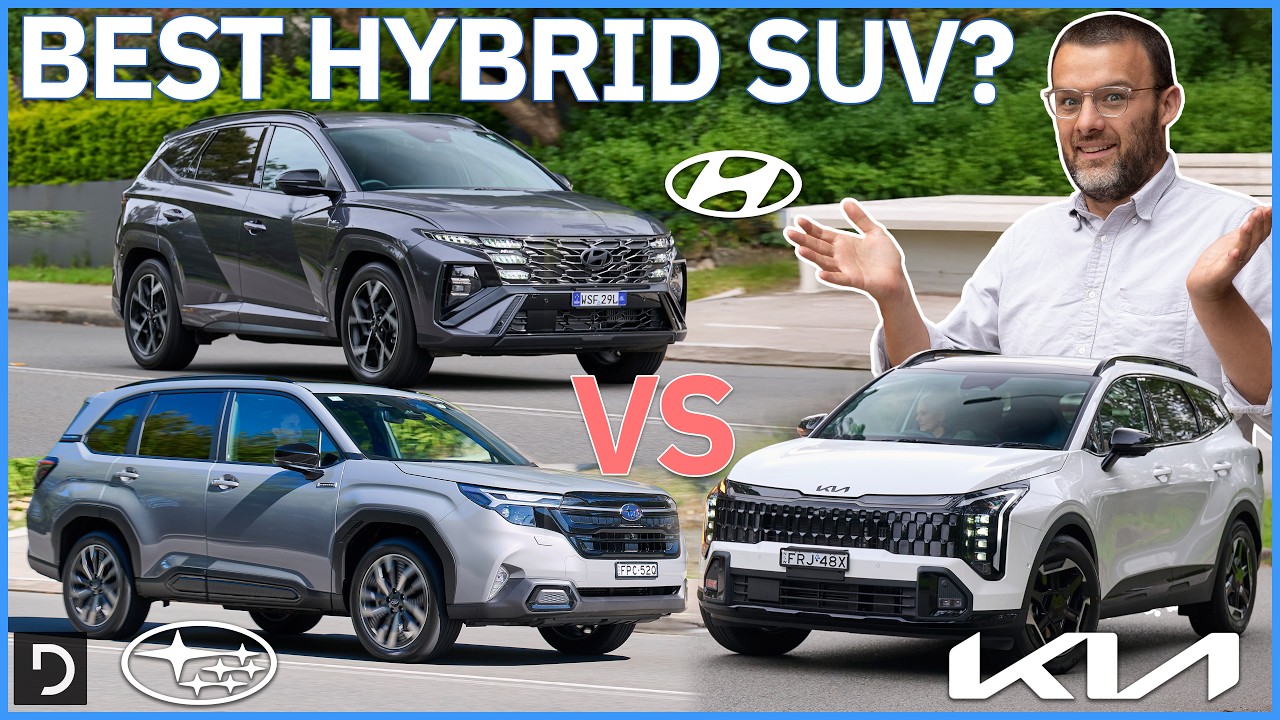
2025 Hyundai Tucson Hybrid v Kia Sportage GT-Line Hybrid v Subaru Forester Hybrid AWD Comparison
Well, we got a new entrant in the medium SUV segment, Sam, which has prompted something of a comparison test, hasn’t it? Yes, that’s right. They say if you can’t beat them, join them. And I think this has worked really well for Subaru with this Forester hybrid because it’s now got Toyota technology under the skin. Not completely Toyota, mind you, but it’s fair to say, I think, that this is now a much better medium SUV than it was before. But the question is, of course, how good is it? Yeah. Can it take on the established brigade? So we’ve got vehicles like Hyundai Tucson and Kia Sportage. Hyundai Tucson obviously reigning drive car of the year champ in that segment. They’re established. You mentioned Toyota RAV 4s there. This is a key segment for Australian new car buyers. There is so much competition in this medium SUV segment. There’s a lot of buyers as well, but think about things like RAV 4 that isn’t here, Nissan X-Trail that isn’t here as well. These are three of the best options in the segment. I’m really keen to see how this Forester stacks up though. Well, there’s a lot that buyers take into account in this segment, but what’s the most important thing? Well, it’s got to be value for money, right? How much metal do you get for that asking price and how much spec do you get included as well? So, it’s going to be really good to see which of these three is the best. That’s right. We’ll take a look at price and specification. We’ll have a look at the interiors. We’ll also take them for a drive, of course, and ultimately, we’ll find out which medium SUV is the king of the segment. Newest here is the Subaru Forester Hybrid, which has adopted Toyota’s hybrid technology and mated it up with a Subaru boxer engine and all-wheel drive system. While the cheapest Forester hybrid goes for $46,490 plus on-road costs, we’ve got the hybrid touring model, and that ups the asking price to $55,990 plus onroads. And at the time we recorded this video, Subaru had a list price of $61,692 driveaway for a New South Wales postcode. This Subaru Forester gets 19in gloss alloy wheels, LED headlights, LED fog lights, and LED daytime running lights. Although, I have to point out this Subaru Forester Hybrid does unfortunately lose its spare wheel. It’s got a puncture repair kit because it’s run out of space. Buyers can choose between two different trim levels with either all-wheel drive or front-wheel drive for the Sportage Hybrid. SX is priced from $46,450 plus on-road costs in front-wheel drive form. Kia lists this topsp spec hybrid Sportage at $65,738 drive away at the time of recording this video. This trim level Kia Sportage gets 18in alloy wheels with tire pressure monitoring, a 360° camera system, parking sensors at each end, automatic LED projector headlights, and full LED tail lights. Hyundai’s Tucson has the lowest entry cost of a hybrid SUV from these three, coming in at $42,600 plus on-road costs for the base two-wheel drive hybrid offering. It’s also the cheapest of these three here, asking for $53,100 plus onroads for the Elite with the endline package just like we have here. Although it’s not a true apples and apples comparison because there is a better equipped Hyundai Tucson available which is priced from 58,100 plus onroads that would be more in line with the other two SUVs. On-road costs at the time of recording this video was $55,772 for our test model according to Hyundai. No matter which model you choose, the Tucson does feel quite well equipped and organized for the asking price. Buyers can choose between three different trim levels, while the top two can be augmented with an endline package that makes a few nice changes inside and out. Our Elite trim with the endline pack gets 19-in alloy wheels on the outside along with automatic LED projector headlights. There’s tinted LED tail lights and a sportier overall appearance compared to models without the inline treatment. The first thing you think when you sit here inside the Tucson and close the door is the level of fit and finish, the attention to detail, and the quality. This is a really, really good cabin across the range. It feels like really good value for money regardless of which model you choose. On the inside, seats are only heated in the case of this Elite Nline. If you want ventilation, you’ll need to stump up a little extra for the premium trim level, which also adds a sunroof. But we do get twin 12.3 in screens here and a gear shifter that moves to a stalk on the steering column instead of a shifter in the middle. The driver seat has 10 directions of adjustment, while the front passenger seat is manual. And let’s start up the top here with those screens. You’ve got a lot of real estate there, which means you’ve got a lot of information displayed. The driver’s display is interactive. You can change that, customize it the way that you want it to look. And then, of course, Hyundai’s signature infotainment screen, which is really responsive, quick to do the things that you need to do while you’re driving, while you’re on the move, and a really good unit to use. The curve helps as well. And then of course next to that you’ve got a pretty clever little parcel shelf there which works well for smartphones so they don’t slide around. The wireless charging we mentioned that’s down here. It works well too and provides a safe place for your smartphone to sit without flying around. This console design is actually quite smart. So you move back up here again. You’ve got the controls that you need most frequently I guess is fair to say largely buttons. There is some touchcreen here, but clearly delineated and you don’t need to chop and change out of menus. They’re all there, easy to use. And that sort of lines up with the controls here across the steering wheel. Then you go down one step further. You’ve got your USB inputs for charging if you want rather than wireless. But you’ve also got this second under shelf area, which when we sized up these cabins, this floating shelf and then the secondary one under there is a really clever use of space. And you suspect one of the reasons that the shifter is over here on the steering column. So the ergonomics here inside the cabin are excellent. But again to restate what we said at the beginning, fit, finish, attention to detail, choice of materials in the Hyundai Tucson, fantastic. One last thing too that’s obviously hugely important for these vehicles is seat comfort. Visibility is excellent. Comfort here in the seat itself is great. It is heated, which is fantastic if you’re in the middle of winter, as we are when we’re testing. makes a big difference. And just general comfort in the way that you position yourself here, especially for long drives, is fantastic. And on that subject, if you’re going on longer road trips, you’re going to have people in the second row. Let’s take a look at that now. Now, second rows are obviously vital in these vehicles. Medium SUVs, incredibly popular in Australia, largely used as family vehicles, so they have to be comfortable back here. And the Tucson is fantastic. Now, it has to be said that all three of these are very, very close, and you’re really drilling down into fine details to try to work out which one’s better than the others, but this is very comfortable back here. There’s plenty of headroom. It doesn’t feel like the roof is closing down on you. Visibility is good. So, if you’re on a road trip and as your kids get a bit older into their teenage years, they’re going to be comfortable back here. You’ve got air vents, got a decent light if you need it. You’ve got two USB C ports down there to charge devices. And perhaps most importantly for people around that sort of 6′ 6’1 mark, knee room’s good. Room for your feet under the seat so you can move them around. The transmission tunnel is not as big as some, so it’s pretty good. Uh, and if you’ve got somebody using that middle seat, it’s not too bad. But I really think the most obvious thing that lifts the comfort back here is the fact that the roof feels like it’s a long way away. So you don’t feel like you’re doing that. You’ve got plenty of room back here. It is comfortable. If you’re in the second row for a longer road trip, you’re going to enjoy the Tucson. Take a seat in the Kia Sportage. And there’s a couple of things you notice. Firstly, very familiar to you if you’ve driven a Kia Sportage before, but something that isn’t familiar, this two-spoke steering wheel. We’ll get to that in a second. As you would expect, the Kia Sportage in top GT Line Hybrid trim delivers plenty of standard equipment. On the inside, you’ve got twin 12.3 in displays within a single curved unit on the dashboard. Seats are an artificial leather with eight directions of electric adjustment for both front seats. There’s dual zone climate control, heated and ventilated front seats, a heated steering wheel, wireless charging pad, a panoramic sunroof, and head-up display. So, that makes a quite comprehensive list of equipment for this Sportage. Right now, to the elephant in the room, the two spoke steering wheel. I’ve heard this described as interesting, innovative, different, kooky, all sorts of descriptive terms. What’s hilarious? Four of us at drive have done the assessment split right down the middle. Two of us went, I don’t really like it. Two of us went, “Yeah, I don’t mind it at all.” That’s the design of it. Functionality is great. The switch gear on it, the way that it interacts with the driver’s display there is fantastic. Things like drive mode, terrain mode, changing pages within the display, really easy to do. Let us know what you think in the comments section below with the two-spoke steering wheel. Does it work for you? Do you like it? Do you not like it? If you don’t like it, tell us why. Wraparound screen, very similar to the Hyandai Tucson. Big screens as we mentioned. Functionality is great. Touch response. Um, the way that commands work, it’s very quick. It’s very intuitive. It’s easy to use. Now, something that is really interesting and again is a subject of debate for the judges is this tier here of controls. Now, what you can do, and we’ve showed you this with Kia before, there’s a switch here that you touch and it takes it from the infotainment controls to climate controls. It is really easy to use once you’ve worked it out, but the fact remains, you have to work it out. Whereas with the way the Hyandai is set up and indeed the Subaru, you don’t really have to learn anything necessarily. You have to work this out. Then once you do, you go, “Right, okay, I get it. Nice and easy.” On the other hand, though, this single control panel here, there’s no argument to the fact that it minimizes clutter. Because what you’ve got is one basic line of controls there that does two very different things. So, with the touch of a button, as we said, you go to the infotainment and mapping controls. Then you come back to HVAC for the air con. Very neat. And like I said, really cleans up where you would need other switch gear. Moving on to some more of the practicality. Heated seats, cooled seats in this spec, wireless phone charging, two USBC ports in there as well. These cup holders here are quite innovative in that they’ve got adjustable, I guess you could call them retainers that sort of spring in and spring out. So, you can put a smaller coffee cup or a bigger bottle in there. Decent storage here. But overall, where this can’t quite match the Tucson is in functionality through here because Hyundai’s moved the shifter to there and got that doubles here stacked center console. You don’t get that in Sportage. And the other thing is some of the choice of materials. The Hyandai edges it in terms of premium fit, finish, and just the attention to detail. There’s some hard plastic here in various places that you don’t have in the Tucson. Lastly, seat comfort. Unsurprisingly, very similar to Tucson. These are great seats. They are heated and cooled, as we said, good visibility. Uh, you also get a head-up display too in this model as well, which works really well. You see it if you want to see it. You don’t notice it if you don’t want to notice it. In terms though of comfort and longhaul touring practicality, this is fantastic. And as we keep saying, difference between these vehicles is very, very small and you’re almost nitpicking. So, if you’re trying to pick this between the Sportage and the Tucson, if you’re trying to work out which one’s better, it’s really small details. And this is only marginally half a step behind Tucson. Once again, in the back seat here of the Kia Sportage, it is comfortable. There’s no doubt about that. You’ll notice the air vents. You might look at this and think there are no USB ports here, but there are. They’re actually in the seatbacks, which is quite clever. Uh useful, I guess, use of space, which might otherwise have nothing in it. So, they’re up there, one on either side. I like these takeaway bag hooks. They’re really useful if you want to grab some food on your way home and you just want to secure it there so it’s not flying around and you’re trying to worry about hanging on to it. Really clever. More cars should do that. You get a stand, I guess you could call it, for an iPad. Won’t really work up there for a phone because it’s too deep, but it works well for an iPad. And it’s pretty comfortable back here to be honest. Even though you’ve got a huge sunroof up there, which comes right back past your head in the second row and does eat into the space a little bit, there’s still plenty of room, plenty of headroom here. I’ve got good knee and foot room and the visibility is great. So once again, very little details that separate one from the other. If you’re buying the Kia Sportage though and you use it for road trips and for family stuff often and this second row gets a workout, it’s pretty good back here. Once you’ve spent time in the Kia and the Hyandai and things start to look a little bit similar, I think it’s fair to say take a seat here in the Subaru Forester. Now a hybrid and very different. All-wheel drive hybrid touring is topsp spec for the Forester, which means you get a good dose of standard kit. There’s an 11.6 6 in portrait style infotainment display, a 12.3 in digital instrument cluster, and a 360° camera system, but we don’t have a head-up display here. Seating is heated and ventilated up front with a combination of leather and ultraas suede used for the trimming. There’s also a dual zone climate control and a sunroof. Now, we mentioned it there in the spec rundown, but the big ticket item here inside the cabin is this portrait orientation screen. There are some things that are really, really good about it. And one of them is that when you think about it, that’s how you look at your mobile phone all the time. You look at it in portrait mode. So looking at the screen in portrait mode kind of makes sense as well. However, there are a couple of things that aren’t as intuitive as they might be. For example, if you put mapping on like that, you’re only getting that section in the middle of the screen because the bottom is air conditioning controls and the home button and the top is a notification of what you’re playing on the audio or you can sort of swipe through it and have different information up there. I guess the reality is that you could be better served if the smartphone screen went the whole way rather than just that section in the middle. Not the end of the world, but it’s the factor that lifts the other two. the Kia and the Hyundai just a little bit above the Forester here inside the cabin. There’s some great stuff about the Forester which I’ll get to in a second. The other point worth mentioning is the switch gear. Really easy to understand on the driver’s side over here. And then of course, you’ve got an interactive display there. Excellent screen. In fact, that screen for the driver is probably the pick of all three. However, over here you’ve got a mix of touch and physical buttons. So for example, the fan up and down is a touchscreen functionality here whereas temperature up and down is a physical button here as is front and rear demyist. You do get a volume dial too which we really like. Much more conventional through here. So you’ve got inputs and USB ports there, two cup holders here, conventional gear shifter, wireless phone charging there, and a decent center console storage where the Subaru Forester really impresses. now is the little things, what we’d call small ticket items as opposed to a big ticket item. And by that I mean the choice of materials. You’ve got a really lovely pattern through the center part of the dash here, the seats, the stitching, the leather, the suedelike material here in the doors, soft touch surfaces. It feels premium. This this feels like a really premium cabin. And again, the areas that the two South Korean vehicles just edge the Subaru a little bit are just things like tech and up-to-date tech. Realistically, that screen is the big one. Uh, but everything else about the Forest is fantastic. Comfortable seat, really good glass house, tall glass areas, so the visibility is great, really easy to see out of and position the car. This is a lovely thing to drive. It really is. And that’s evident here in the driver’s seat. But if you’re a passenger, it’s also fantastic. As we keep saying with these vehicles, though, the key is just as much in the second row. Let’s check that out. Now, once again, plenty of room back here in the Forester and making the most out of what is an otherwise fairly compact medium SUV footprint. All three of these cars do it. Forester also does it well. One little detail that I really like is in the back of the seat pockets, you’ve actually got a smartphone sized pocket just to slide your phone in. If you’re listening to some music or something, put it in there. Stays in there nice and safe. Doesn’t go flying around. You get air vents. Get USB C and USBA chargers back here as well. This seat base is probably a little flatter than the other two vehicles. They’re probably just a little bit more sculpted, but once again, lots of room. Head room’s good. Uh even though you’ve got a sunroof up there, plenty of foot room to get your feet under the seat. Knee room’s good. It’s pretty comfortable back here as well. Subaru Forester is probably one vehicle that historically in this segment has always been seen as the one for adventurers and people who go camping and kaying and mountain biking and that sort of stuff. Now, if you do that, whether that’s true or not, if you do that, you’re going to spend a fair bit of time on the road getting to where you’re going. And if you’re doing it three or four up, it’s very comfortable. It’s very practical. And this builds on all of the things that’s always made the Subaru Forester such a favorite in this segment. Here’s one handy feature in the Kia Sportage and the Hyandai Tucson, which a lot of owners might not know about. Now, there’s a button here down near the park brake which says 12vt battery reset. Now, you’re probably thinking, “This is a hybrid car. It’s not going to run out of battery power.” But don’t forget, we’ve actually got two batteries in this vehicle. There’s a traditional 12volt battery under the bonnet like you would have in any other car. And then you’ve got your big lithium battery in the back which will actually power the electric motor. Now, if that 12volt battery runs out, the car has been parked for a long time, the accessories have been pulling that power down, you can actually use this button to boost that battery back up again from the lithium battery, which is a really cool feature. And it’s one of those things I think that you might not use very often. You might not use it at all actually, but that could also save your bacon and save you from calling up a tow truck potentially. So, it’s a really cool feature, I think, and something that every other hybrid car should have. Let’s get a few facts down around hybrid powertrains because some people can still be left scratching their heads trying to make heads or tails of new and different powertrain technologies. The three hybrid powertrains that we have here are what we refer to as a closed loop hybrid, which is different to a plug-in hybrid. Closed loop hybrids have a smaller electric motor and battery which is used to supplement and help the petrol engine which does the majority of the work. They cannot be plugged in and they don’t have any kind of electric only driving range to worry about. Rather, you only have to fill up the petrol tank when it gets low just like a normal car. However, that should happen less frequently thanks to the improved efficiency of a closed loop hybrid powertrain. The smaller hybrid battery in these vehicles is topped up mostly through regenerative braking and coasting as well as directly from the petrol engine. Then it can use that captured energy to help with small bursts of acceleration. You’ll notice this mostly from a standing start. This is where the efficiency gains are made mostly, and this is the first time that Subaru has brought what we would call a proper hybrid powertrain into the Forester market. This combines Subaru’s well-known 2.5 L Boxer 4 cylinder engine, which makes 121 kW and 212 Newton m with an electric motor within the CVT transmission. That makes 90 kW and 276 newm. Peak combined outputs are 145 kW, but Subaru doesn’t give us a combined torque figure for reference. Power goes to all four wheels, in this case via a permanent all-wheel drive setup. And claimed fuel efficiency for the Subaru Forester hybrid is 6.2 L. According to the manufacturer’s claims, combining Toyota hybrid powertrain tech with existing Subaru stuff really is a smart move, I think. And it’s made this Forester now a genuine hybrid and a real competitor to the likes of a Toyota RAV 4, Kia Sportage, Nissan X-Trail, all of those other competitors that have hybrid powertrains. And the important thing, I think, for buyers is to know that the application of this hybrid tech, combining the Toyota stuff with a Subaru engine and gearbox and all-wheel drive system, works really well overall. There’s a nice combination, a blend I suppose you could say, of those power sources. It’s smooth, it’s easy, and it works. We’ve got a CVT here. That’s the Subaru CVT, which can flare up a little bit when you press the throttle down, and the revs really raise up. So, the driving experience is a little bit different compared to the torque converter automatic that you get in the Kia and the Hyundai, but it’s not too much of a big deal, I think. And I think for a lot of people, they wouldn’t really mind at all the fact that this is a CVT with that kind of characteristic about it. But one strong element of this Forester, I think, is some of the ride quality here. So, cruising around at the moment, going over some rougher surfaces, it handles bumps really nicely. in particular big potholes and things like speed bumps because we’ve got a slightly raised ride height here. We’ve got plenty of suspension travel on offer. This thing soaks up speed bumps and potholes really nicely around town. So, that’s a great benefit to have even if you’re not heading off into the bush every other weekend. And the other thing to talk about here is the all-wheel drive system in this Forester. That is the same as what you get in other Subarus. They call it symmetrical all-wheel drive, but it means we’ve got four driven wheels in this car all the time. It’s not an ondemand system like you get in the Kia and the Hyandai, for example. So, it’s not as reactive. It’s really shore-footed, and it does bring benefits in terms of off-road and loose surface driving. But, I’ve got to say, missing out on a spare wheel in this Forester really puts it back a little bit. Even having a space saver spare instead of that goo kit would be a much much better solution. The Hyundai Tucson uses a turbocharged 1.6 L 4 cylinder engine which runs through a six-speed automatic transmission and that makes 132 kW and 264 newm. The electric motor adds in 37 kW and 264 newm as well, which gives a total combined output of 172 kW and 367 newm. Lots of numbers there. While the Tucson can be had as a front-wheel drive vehicle, we’ve got the all-wheel drive variant here, which is an ondemand system. That means drive goes mostly to the front wheels, but different drive modes and a bit of wheel slip can send a bit of extra drive into the rear end. This is different to how the Subaru is set up. Most notably, claimed fuel efficiency for the Hyundai Tucson hybrid is 5.3 L per 100k, which is a little bit better than the Forester. Having a competent and efficient powertrain is such an important ingredient to have in a medium SUV these days, and that is exactly what Hyundai has here with this 1.6 L hybrid setup. Now, Hyundai and Kia for that matter, they haven’t got the same amount of experience as what you have with Toyota in terms of how long they’ve been doing hybrids. But from the driving experience, you cannot tell that at all. This is a smooth and easy to drive car. It actually feels very, very similar, almost identical to what you would have in a regular petrol-powered car. And I think a lot of people will appreciate that. It just happens to use a lot less fuel, which is the whole point of these hybrid setups. Now, we’ve got a 1.6 L turbocharged petrol engine, so it’s smaller than the Subaru’s engine, but it does have force induction. And we’ve got a six-speed automatic transmission, which is different to the CVT in the Subaru. So, you get less rev flare when you’re really punching it along here. It feels a little bit more regular, I suppose, like I said before. And being a slightly smaller engine, I think this generates a little bit less noise as well in comparison to the 2.5 L boxer 4-cylinder in the Subaru. Now, naturally, this is very similar to what you get in the Kia as well. They are sharing a lot of components and platforms, obviously, but there are some subtle details here. So, this Hyundai has a slightly firmer ride quality overall. Now, it’s not massive and it’s not huge, but I would say that in direct comparison to the Kia Sportage, this just has a little bit less suppleness, which I guess some people may prefer and some people may prefer to have a little bit more firmness there as well. So, it really depends upon personal preference there. There’s no real standout of ride quality between these three. And it’s worth really pointing that out. I think the difference in ride quality and the driving experience between these three hybrid SUVs, there is not a lot in it at all. We’ve been backto-back driving these cars on the same roads with different drivers and reaching similar conclusions, but having slightly different preferences, and that tells me that these are all very good overall. Can’t really go wrong in that regard. And there will be just a little bit of personal preference in terms of what you might like in your own driving experience. So, get behind the wheel and do some test driving yourself. The Kia Sportage Hybrid has a very similar powertrain setup to the Hyundai with a 1.6 L turbo 4-cylinder going to all four wheels via an ondemand all-wheel drive system. And like the Tucson, this Sportage can be had with a more efficient front-wheel drive setup if you prefer it. In this case, the petrol engine makes 132 kW and 265 newm, while the electric motor has 48 kW and 264 newm. Slightly different to the Hyundai, if you’re paying attention. Combined outputs are 173 kW and 367 newm for the Sportage. Naturally, there is not a lot of difference in the driving experience between the Tucson and the Sportage. They are corporate cousins using a lot of the same components and platforms under the skin, but there are some subtle differences and the Australianized suspension tune of this Kia, which is done locally, does bring a slightly different sort of vibe, I suppose, to how this Sportage handles. And to put it in a nutshell, it feels better on rougher surfaces only just it’s got a little bit more suppleness and absorption there going over things like potholes, going over speed bumps and that sort of thing. Just generally handling rough surfaces well. Now, it doesn’t tend to throw the baby out with the bath water in terms of feeling too loose and floaty either, but there is perhaps an element of personal preference there. If you want something that’s a bit more tied down, then maybe look at the Tucson. But otherwise, the hybrid powertrain in this Kia Sportage is excellent. It’s smooth and it’s easy. It’s efficient. And similar to the Hyundai, it’s got a driving experience that is very reminiscent of a regular petrol powered car. So, nothing really changes for the buyer in that regard. One thing I do like in this Kia, and the Hyundai has it as well, the Subaru does not, is the use of paddle shifters actually for adjusting your regenerative braking. though it almost turns driving into a little bit of a game to a degree. You can dial in more regen there as you’re going down hills and try and pump as much power back into that battery as you can. But this Kia Sportage, just like the other two, is impressively efficient overall. You’re looking at a vehicle that can do under 6 L per 100 in a lot of scenarios, which for a mediumsiz SUV is quite excellent. Now Sam, we’ve said a few times throughout this test that you’re talking about finite details like we’re we’re really splitting hairs here, right? So Kia Sportage still a really really good product and a hell of a lot to like about it. Absolutely. This addition of a recently updated hybrid powertrain I guess rounds out the Sportage in terms of being a really complete offering now in the medium SUV segment. I do like the ride quality of this car. you can get a sense of that Australian tuning just tickling things up a little bit. But for me, I’ve got to say, not having hybrid power available in every trim level is a little bit of a let down, I think. And I do like the Hyundai in comparison in terms of just the interior layout working better from a family point of view. So, like you said, really, really close margins here. So, even though it’s third, this is still an excellent offering. Move on to the Subaru. If there’s going to be a second place getter, I guess, as as close as these two are. That’s right. I think Subaru just edges this. It’s a really good thing to drive. I do love the interior ambience and the elegance inside the cabin. However, the portrait orientation of the screen and some of the tech just doesn’t quite feel as up to date, does it? Yeah. Yeah, that’s right. The infotainment is maybe a little bit of a let down. I mean, one thing I do like about this Subaru is that mechanically it is different to the others. So, you’ve got a different style all-wheel drive system that definitely has its advantages. Maybe it’s not as efficient as the other two in this comparison, but missing a spare wheel. This is sort of the It’s an adventurous car. It’s an almost semi-offroader, but it really goes one step forward and two steps back because these other two have space savers, and I’d much prefer a space saver than that goo kit than this Subaru has. So, I do like the all-wheel drive setup. I love the way it drives, but that’s one little thing that just holds it back a little bit for me. We say it kind of jokingly all the time. You’ve only got to use a goo kit once to realize that you never needed to use a goo kit and you didn’t want to ever use one. Uh let’s move on to the winner then of the comparison and still our reigning drive car of the year medium SUV is the Hyandai Tucson. Great package, really well executed. I think you made a point very early on that the fact you can get this as a hybrid right across the range. Big tick there. And just everything that this does, it does well. It does. the the hybrid setup works really well. It’s efficient. It’s smooth and easy to drive. But for me personally, I really do like the interior. That indicator stalk shifter. Maybe it’s not to everyone’s taste, but the fact that the shifter’s moved out of the way, you’ve got all of this room to fit all of your stuff on the inside. And the interior for me is one of the best out of these three. So, I think it works from that point of view. In the second row in the boot, it’s also very good. So, this I mean, it’s not perfect. There are little niggles here and there just like with every car, but on the whole, this is still the choice. In boxing terms, you’ve actually got to go into the ring and take the champions belt off the champ, you know, and the Tucson is the reigning champ and deserves to be so. So, if you don’t love the styling of the Tucson, you prefer the Sportage, good news is by that you get 7-year unlimited kilometer warranty and 7-year cap price servicing, still a really, really good car. Subaru’s Forester is a really, really strong proposition. Their all-wheel drive system is great. This is a very very good car to drive and the interior has a really high quality refinement to it as well. But ultimately Hyundai Tucson best allrounder and let’s face it this segment is about being an allrounder. Good value for money across the range. Doesn’t matter which model you buy. Proper efficiency and a premium cabin. As always let us know what you think in the comments section below. Don’t forget to hit like if you’ve enjoyed the video. Click on subscribe so you can stay up to date with all of our latest content. Now Sam, there’s a comprehensive written review as well. Where will they find that? It’ll all be on drive.com.au and also on YouTube.
Which family-sized SUV is best? We pit the new Subaru Forester with Toyota’s hybrid technology up against the best from Korea. We compare price, practicality, drive experience, and fuel economy to find the ultimate hybrid family hauler.
Click Here to Subscribe: http://drivesoci.al/1Cuo50FO51C
00:00 Introduction
01:28 Forester Price
02:17 Sportage Price
02:53 Tucson Price
04:06 Tucson Interior
08:08 Sportage Interior
13:36 Forester Interior
18:20 Battery Reset
19:23 Hybrid Powertrain Breakdown
20:24 Forester On-road
23:23 Tucson On-road
#hybridsuv #hybridsuv2026 #besthybridsuv
______________________________________________________________________________________________
At Drive we pride ourselves on being the future of automotive and letting you, as the driver and reader, know where it’s all headed.
Drive showcases the best of all things automotive, covering all brands and areas of the motoring industry providing Australia’s most engaging and entertaining content.
The dedicated team at Drive are here to bring you their trusted advice, share their passion for all things motoring and to help simplify the Australian motoring landscape for all types of drivers.
We’re here to help you discover the Best of What’s Next.
Drive’s YouTube channel showcases new car reviews, car comparisons, mega tests, great drives and the latest car news. We want to deliver everything you need to know about the car or cars you are interested in.
Our team of motoring experts drive and review every car in the Australian market keeping the needs of both consumers and brands at the forefront. They are driven to help consumers navigate the dynamic and ever-expanding new car market, to help buyers find their best next new car.
Visit our website: https://www.drive.com.au/
Join our facebook community: https://www.facebook.com/Drive.com.au
Check out the latest cars on our instagram: https://www.instagram.com/drivecomau/
What Is The Best Car Of 2025? Watch the winning video from our 2025 Drive Car of the Year
See One Of Our Latest Comparisons: Hybrid Ute Comparison: Ford Ranger PHEV vs BYD Shark 6 vs GWM Cannon Alpha PHEV
Watch The Best EVs Of 2025 Reviewed By Drive: Electric Car Reviews Australia | Best EVs 2025
Take A Look At A Car Review From The Drive Team: 2026 Kia Tasman Review | Is This Ute A Game Changer?
See Drive’s Latest Ute Reviews: Ute Reviews by Drive.com.au
Watch One Of Our In-Depth Off-Road Reviews: 2025 Toyota LandCruiser Prado Altitude In-depth Review | On-road & Off-road
Watch Season 8 of Drive TV:
Watch This Road Vs Track Video: Can A Road Car Outrun A Race Car? We Find Out With A Chevrolet Corvette!