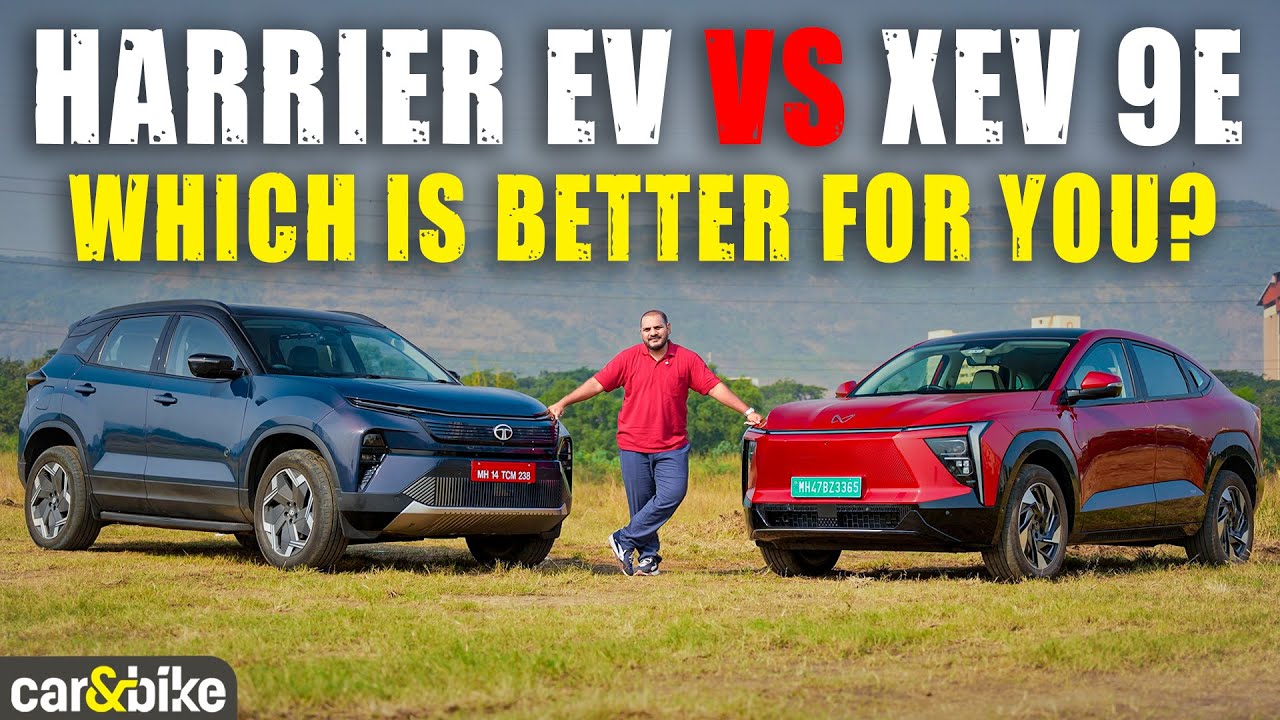
Tata Harrier EV vs Mahindra XEV 9e | Battle Of Thoroughbred India-Made Electric SUVs
Hello everyone and welcome back to Car&Bike. I’m Bilal and today I am in a bit of a confusion. On my left is the Mahindra XEV 9E, which is tech-laden, bold and looks very futuristic. On my right is the Tata Harrier EV, which is more rugged, confident and it’s made to go on any and every road. And I don’t think they are a direct rival to each other. In my opinion, they don’t compete with each other for it’s like comparing Apples to Oranges. Sure, there are some similarities. For example, both are priced in the same segment. They both offer good value proposition compared to all the imported EVs that came to our shores. And thirdly, they are properly thoroughbred Indian SUVs with potent electric powertrains. But that’s exactly where similarities ends. And in this video, I’ll tell you why both of these are very different kind of animals. But before we go ahead, you know the drill, it’s Like, Share and Subscribe the Car&Bike YouTube channel if you haven’t already and hit the bell icon as well so that you can be notified every time we bring out a new and informative video such as this one. Now let’s start with the exterior and right off the bat, there are two “Houses of Thought”. The first kind who want the EVs to stand out, they want the EVs to shout out that they are not conventional, they want the EVs to be bold and futuristic. And then there are those who want their EVs to look more traditional. They don’t mind if their cars, their electric cars, look very similar or exactly the same as their petrol or diesel powered counterparts. Now YOU tell us, by looking at them, which car belongs to which house of thought! Spend some time looking at both and you’d realize that the XEV 9e looks like a Concept Car that somehow escaped the Auto Expo show floor and it still grabs attention on the road. It’s large, it’s imposing and look at it in finer details where the individual design elements starts to pop up. Be it the slim LED DRLs both fore and aft, the coupe-like roofline and that strong funky stance, it is Bold. And on the other hand, the Harrier EV, it keeps things more Traditional. It doesn’t deviate a lot from the standard diesel Harrier and some might appreciate it for this. It continues to be a handsome hunk, muscular, stately and in that matte finish, oh so lovely. Even in terms of dimension, the XEV 9e, it is longer and has a bigger wheelbase. The Harrier EV, it is taller and wider. So overall in the design scheme of things, the XEV 9e, it’s more of a style and statement while the Harrier EV, it sticks to its traditional SUV-ish look. Both have different personalities but they are still commanding on the road. And like the exterior, even the cabin of both these electric SUVs are poles apart. Now if you sit in the cabin of both these cars back to back, you’d notice one thing that the Harrier’s cabin, it is large but doesn’t have that sense of space. Whereas the XEV 9e’s cabin, it isn’t exactly large but does feel spacious. Now let’s talk about the cabin of the XEV 9e in finer details first but before that, let me get all the negatives out of the way first. The first negative is the steering design of it and more specifically, the horn position because if I’m holding the steering wheel at three-and-nine position and if I’m trying to turn and it honks. Then secondly, if I’m trying to operate the button or trying to cut the call or operate ADAS, it honks. This entire aesthetic, it just doesn’t do well. And then there are too many German car’s inspiration. For example, this iDrive-like controller, the seats from the Three-Pointed Star, even the mid-level mark on the steering wheel taken from Porsche. Now someone who likes these things and want it in their car, they might like it. But for some, it is just plain imitation. And thirdly, it’s the visibility. Now more importantly, this rear seat, it has a headrest for all three passengers which obscures the entire rear view from the IRVM because you barely get any view out of that coupe roofline and that thick C-pillar, it doesn’t help its case. But otherwise also, if you are sitting here, the flat bonnet and the ORVM which should have been larger in my opinion, they feel like – if you’re sitting in a car and you’re trying to park it, you think everything is very close in the peripheral. But then you get down and take a look and there’s enough space for a average Mumbaiker to call it 1BHK. So that tells you that the visibility behind the steering wheel, it could have been better. But on the upside, the cabin, it feels rich, modern and has good fit and finish if not fantastic. Even the sense of space is owing to its Born-EV credentials. Compared to the Harrier EV, you get a lot of space on the inside. Sure, it doesn’t have all the Born EV credentials like the floating center console but this one, it feels properly premium. The three screens atop the dashboard are a party piece worth bragging about in every party conversation. Even the sound system is fabulous, especially if you’re watching a YouTube video on the passenger screen. But the same cannot be said for the rear bench because firstly, it’s difficult to get inside owing to the high floor height. Secondly, once inside the seat, it feels more flatter and doesn’t offer the same level of comfort which you get in the Harrier EV. You do get recliner for the backrest but the headroom would be very tight for taller passengers. Because here in the Harrier EV, you get better ingress. Sure, the area is slightly narrow but you have a step to get inside. And once inside, the seats here, they have proper contour to hug you in place and soft material in the center. Even the headrest, it has a proper support if you need to put your head on a rest. Especially for the taller passengers, you have good enough headroom as it has a flatter roofline. But more specifically, here in the Harrier EV, you’re sitting ON the seat rather than the IN-the -seat experience you get in the XEV 9e. Because here you sit quite taller, the visibility is slightly better and you get a very commanding position here behind the steering wheel. And lastly, it needs to be pointed out that there are a few ergonomic flaws here in the front seat of the Harrier EV. Because some of the parts are carried over unchanged from the standard Harrier and some of the parts are also shared from much more affordable models from the Tata’s line-up. Some might appreciate it, some might find it irksome. As for the practicality, both these large SUVs have huge boot space, so let’s talk about them. Now, hiding behind the coupe-roofline is over 663 litres of bootspace. Although the loading lip is slightly taller, you get a flat floor and if you fold down the second row via a button here inside the boot, you can actually move a house over here. And then coming to the Harrier EV, you get little over 500 litres of boot space. Now that is restricted because of the battery pack that’s placed underneath and the boot, it’s not exactly huge. You can fold down the second row and you get a large loading of cargo area. On the other hand, both these EVs have to have a frunk. The Harrier EV has a little over 35 litres for this all -wheel drive, you get slightly more in the rear-wheel drive version, but the XEV 9e is phenomenally impressive with over 150 litres of frunk. Now you can look up at the internet and you’ll find all the features on offer in both these cars. But the point is, both of them have a separate set of party tricks or gimmicks, call them what you want, to stand out. Now the Harrier EV has a camera projection for IRVM and the XEV has a groove mode. The Harrier has a summon mode and the XEV also offers auto park, where the XEV has a triple screen with infotainment for passengers. The Harrier also offers an arcade mode with gaming. The XEV has an adjustable rear seat recline. On the other hand, the Harrier has an electric boss mode for the front passenger seat and so the list goes on. Now after the exterior and interior, let’s talk about the driving dynamics, but before that, let’s talk about some numbers. Now both these electric SUVs are powered by some seriously large battery packs. The XEV 9e, you can have it in a 59kWh battery pack or what we have here, the range-dropping 79kWh battery pack. Whereas the Harrier EV is available in *65kWh battery pack and what we have here, the 75kWh. Now the Harrier EV that we have here is a range-dropping version, which is available with two motor setup, which gives it an all-wheel drive combination or what Tata likes to call it, QWD – Quad Wheel Drive. Now you can have the Harrier EV with a rear wheel drive only and with a lower battery pack, but the XEV 9e, you can only have it with a single motor setup. There’s no dual motor setup with the XEV 9e, making it only rear wheel drive. And then let’s talk about range and we did a real world range video of the Harrier EV a few months ago. You should check out that video on our channel where we tested the real world range of the Quad Wheel Drive version and it went around 460 kilometers in a full charge. Now if we got the rear wheel drive version, that figure might be playing around the 500 kilometer mark and that’s exactly what the calculated real world range of the XEV 9e that we have here in the rear wheel drive combination. Now admittedly, both these figures are much, much less than the claimed 600 plus kilometers of the claimed range by both these manufacturers. But look at the bright side, oday we have two electric cars, made in India, which are offering a realistic driving range of around 500 kilometers and things will only get better from now on. Now we have seen the differences of the exterior, the interior, the features, ergonomics, cabin space, everything. Now let’s talk about the differences between the Harrier EV and the XEV 9e when it comes to driving dynamics. And let’s start with the XEV 9e and this one, it feels quicker off its feet. It is sprightly in nature and it’s eager to go hard and fast. Compared to the Harrier EV that we have here of the two, this one is down on power as well because that is dual motor setup with all wheel drive. Here you get a single motor rear wheel drive setup. So the power is down but the acceleration times are not so different. The Harrier EV that the all wheel drive version we have here, it does it in little over six seconds. And this one, the two wheel drive version of the XEV 9e, it can accelerate from zero to 100kmph in 0.4, 0.5 seconds slower. And that is quite impressive. This is because the XEV 9e that we have here, it’s lighter and it feels lighter because this is almost 200 kilograms lighter than the Harrier EV that we have here. And it definitely shows for such a large and imposing car. This one, it definitely feels light. The controls are direct and it is more involving to drive as well. So if you’re looking for that kind of fun, this is it. But all that lightness and driving fun, it comes at a cost because this one, it feels like it is set up for European roads and not Indian. On the Indian road, it does feel stiffly sprung and it does send all the irregularities, bumps and creases inside the cabin. So if you’re planning to spend long hours behind the saddle, it will tire you out. And then when you jump into the Harrier EV right after the XEV 9e, you’ll notice that the controls over here are relatively heavy. However, on the upside, the ride quality of the Harrier, it’s very well absorbant. No matter what kind of road you throw at it, it will go through without a single budge. It feels very rugged and it’s very plaint no matter what speeds you’re doing. As for the acceleration and performance, the Harrier EV, it moves with purpose. With almost 500Nm of twisting force, there’s a certain grace to it when you smash the throttle and this one moving forward. The XEV 9e on the other hand, it feels sprightly and nimble in comparison. Now both these electric SUVs, they do give you drive modes, but here in the Harrier EV, courtesy of its all-wheel drive, you get dedicated off-road mode. So you can select through sand, snow, grass, and even rock mode and you can get through on the other side, smiling. However, in the XEV 9e, you do get a boost mode, which is really fun when you accelerate hard using that mode. So you have to choose your poison, off-road or acceleration. Lastly, both these cars have three levels of regen and neither of these three settings are good enough to be called as a one-pedal setup. And that is a slight bummer if you wanted that. Now after driving almost every single EV that landed on our shows in the last few years, it’s astonishing to see how far our India-bred ones have come after spending a few days with these two. These two might have some similarities, but the differences make them a viable buy for a very different set of buyers. But before that, you also need to know that in terms of pricing, the Harrier EV is almost a couple of lakh rupees less expensive than the XEV 9e variant-to-variant. So you should consider buying the Harrier EV if you want your EV to be rugged and have a capability of handling any and every kind of road across the country. You should consider it if you like an imposing stance, comfortable cabin and have faith in Tata’s now well-established EV ecosystem. It’s for the buyers who value familiarity, comfort and real-world usability and for someone who wants an electric SUV that feels tough and ready for India. And on the other hand, the XEV 9e should appeal to those who want a modern, very tech-focused cabin experience, who also enjoy the slightly sportier rear-wheel-drive experience behind the wheel. And for those buyers who see their cars as an extension of their digital lifestyle. So in the end, it’s not about which one wins, it’s about which one fits you better.
It’s like comparing apples to oranges, because Bilal Firfiray believes the Mahindra XEV 9e and the Tata Harrier EV don’t compete with each other. Despite their few similarities, they are very different. Have different personalities and are targeted at very different set of buyers. So in this video, he justifies why and which one is suited for you!
00:00 Introduction
01:17 Exterior Styling
03:13 Interior Styling
10:41 Driving Dynamics
13:56 Conclusion
MORE FROM C&B:
For more from the world of auto, visit our WEBSITES:
ENGLISH: www.carandbike.com
HINDI: www.hindi.carandbike.com
Subscribe to car&bike YOUTUBE Channels for your daily dose of Auto:
ENGLISH – www.youtube.com/@carandbike
HINDI – www.youtube.com/@carandbikeHindi
Follow car&bike on INSTAGRAM:
ENGLISH – www.instagram.com/carandbike
HINDI – www.instagram.com/cnbraftaar
Follow car&bike on FACEBOOK:
ENGLISH: www.facebook.com/carandbike
HINDI: www.facebook.com/carandbikeHindi
Follow car&bike on TWITTER:
www.twitter.com/carandbike