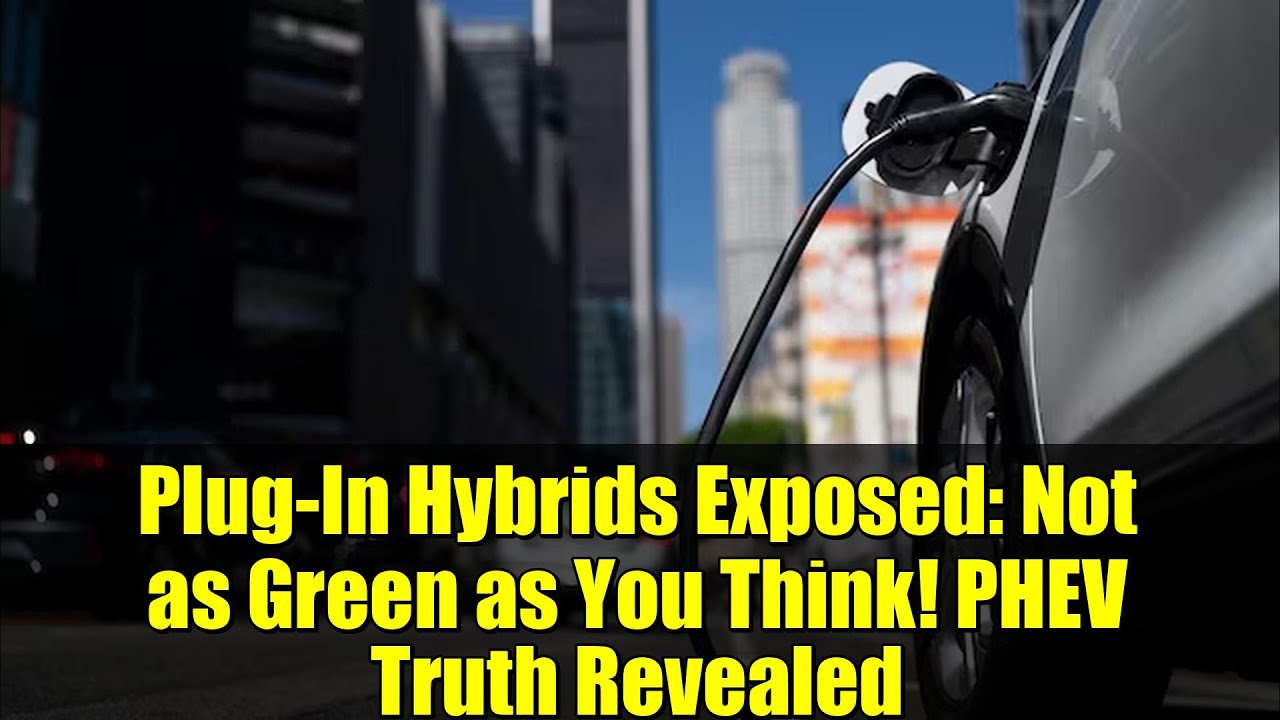
Plug-In Hybrids Exposed: Not as Green as You Think! PHEV Truth Revealed
Plug-in hybrids, often touted as a green solution for eco-conscious drivers, have a dark side that many are unaware of. These vehicles, with their dual engine system, promise the best of both worlds, but the reality is far from ideal. Studies reveal a shocking truth. People aren’t utilizing the electric mode as intended. Instead, they are relying more on the gas engine, resulting in higher emissions than expected. Critics argue that this discrepancy allows manufacturers to manipulate fuel consumption ratings, creating an illusion of eco-friendliness. As Canada debates its electric vehicle regulations, the role of plugins is under scrutiny. With real world data showing that electric mode is used only about 30% of the time, despite official assumptions of over 80%, the environmental benefits are called into question. Carbon emissions are nearly five times higher than projected and driver behavior is a significant factor. The green illusion unveiling the truth about plug-in hybrids. Plug-in hybrids or PHEVs were introduced as a compromise for environmentally conscious drivers who still wanted the convenience of long range travel. However, recent studies and real world data paint a different picture. Lab versus reality. Over the last 5 years, PHEVs have accounted for approximately 1 to 3% of new car registrations in Canada, which translates to hundreds of thousands of these vehicles on our roads. A recent criticism from a coalition of environmental NOS’s based on real world fuel consumption data from Europe reveals that electric mode is used only about 30% of the time, contrary to the official assumption of over 80%. This discrepancy has significant implications for carbon emissions which are nearly five times higher than projected. The manufacturer’s perspective. Experts argue that manufacturers had a clear incentive to produce PHEVs. As governments pushed for decarbonization, PHEVs helped meet new standards. Colin McCerricker, who leads the transport and energy storage group at Bloomberg NEF, explains that many early PHEVs were compliance cars designed to satisfy stricter environmental regulations in places like California and Europe. Additionally, adding an electric motor to existing manufacturing processes could result in cost savings. In Canada, PHEVs played a role in helping manufacturers meet the Trudeau government’s road map for all new car sales to be electric by 2035. However, this mandate is currently on hold by the Carne government. The consumer’s perspective. For consumers, PHEVs offer a transition between traditional hybrids and fully electric vehicles, addressing concerns about range anxiety and the lack of charging stations. They provide the benefits of electric driving while still allowing for long road trips. Marsha Scrim, a retired senior living in Ottawa, is an example of an ideal PATV user. Her Kanero’s 55 km electric range serves her well for city driving and she charges it at her condo. However, when she travels to her summer cottage, the lack of charging infrastructure becomes a challenge. While Canada’s electric charging infrastructure has improved, forecasts suggest that a fully electric future will require hundreds of thousands more charging stations. Scrim’s experience highlights the unexpected fuel consumption of PHEVs. The sudden switch from electric motor to engine, especially during acceleration or uphill driving, can catch drivers off guard. The future of PHEVs in Canada. Despite the challenges, Adam Thorne, director of the transportation program at the Pemina Institute, sees a future for PHEVs in Canada. He believes that educating drivers about the benefits of charging their vehicles overnight can help maximize fuel savings. Thorne’s position aligns with Pembbeinina’s recommendation to allow PHEV models to count towards 45% of a manufacturer’s fleet until 2030. This approach aims to drive down emissions while providing a realistic path forward. Despite uncertainties and the dismantling of EV supports in the US, the PHEV category shows promise. McCera expects around 8 million PHEVs to be sold globally this year compared to 14 million battery electric cars. Even without consumer rebates, PHEV sales seem to be holding steady, especially compared to fully electric cars. Conclusion: Plug-in hybrids, while not as green as initially thought, still have a role to play in the transition to electric vehicles. As Canada considers its electric vehicle regulations, finding a balance between environmental goals and practical realities will be crucial. The debate surrounding PHEVs highlights the complexities of the automotive industry’s shift towards sustainability.
Discover why plug-in hybrids (PHEVs) might not be the eco-friendly choice you thought.
Explore studies showing drivers often skip plugging in, leading to higher emissions in gas mode.
Learn about real-world vs. lab fuel consumption, European data, and issues in Canada.
Uncover manufacturer incentives, EV regulations, and expert insights on PHEVs.
Is the compromise worth it? Watch to find out!
Keywords: plug-in hybrids, PHEVs, electric vehicles, emissions, green driving, Canada EV mandate, hybrid cars, fuel efficiency, climate impact.