Can We Fix This EV1? | 1997 GM EV1 Restoration
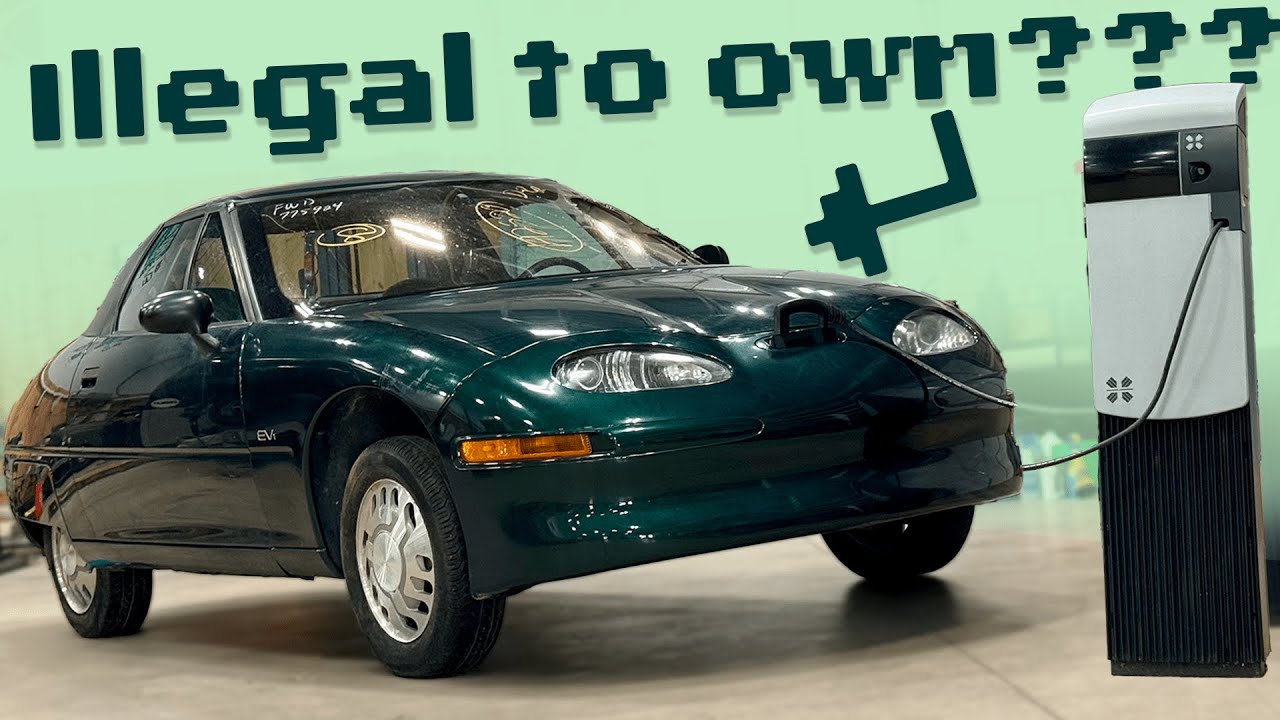
I feel like I don’t need to do an intro for this one. This has genuinely been a dream of mine since I was a kid. I’m going to do an intro anyway. Ladies, gentlemen, and of course everybody in between, welcome back to the Electra Garage. I’m your host, as always, Declan Cav, and this is an EV1. Roll the cinematic, I guess. Your front page here will appear. front page boy. Well, he’s finally here. So, well, stop. Normally when I write a script for a video like this, it takes me about two weeks, but uh I wrote the script for this video on the plane ride here a couple days ago. This is all happening so fast, so I might be a little bit rambly in this video, but uh you. It’s an EV1. Who cares? Normally, this is the part of the video where I’d go over the history of the EV1, but I know a lot of you are just here to see this car, so we’ll do the history later in the video. Clearly, this car has lived quite the life. It was made in 1997, which makes it a Gen 1 EV1. All that really means is it had a lead acid battery pack instead of a nickel metal hydride, and it was good for about 55 to 90 miles of range, depending on which version you got. Originally, this car was leased by a guy named Jonathan Sawyer, and he daily drove this car in Boulder, Colorado. Unfortunately, lead acids suck in cold weather. So about every 5 months, he’d have to send this back down to a repair center in Tempe, Arizona. Unfortunately, one of these times he sent it down for repairs. GM refused to give the car back. So Sawyer sued them. Unfortunately, the lawsuit went nowhere and Sawyer was never able to get his EV1 back. Luckily, this car escaped the crusher and was donated to Clark Atlanta University in Georgia. However, just like every other car GM donated to universities and museums, this car was decommissioned. We’ll get more into what that means later in the video. But what you need to understand is basically they took out a lot of important components of the car to make it undrivable. And on top of that, CAU had to sign a contract that said they would never attempt to make the car drive again. Basically, it was destined to spend the rest of its life as a brick. At some point, this car was just parked somewhere on the CIU campus and they forgot about it while it collected dust. It sat for so long that they forgot they owned this car. And about a year ago, they had it towed to an impound lot because they thought it was just some random abandoned vehicle. The impound lot held this car for the legally required 6 months. At which point, and this is important, they got a court order that stated they were legally allowed to sell this car. That means that this EV1 is the only EV1 ever legally sold. They were only ever leased. So that means yes, there are other EV1s that still exist, but those are either either considered legally stolen or they’re still owned by GM and just leased to universities and museums for display. I cannot overstate how big of a deal this is. This legal loophole means that yes, we will be making this car function again and on its original drivetrain. I too am involved in this project. This EV1 went to auction on Peak Auto auctions for a starting bid of $800. When I found this car, I immediately realized how important it was, and I started bidding. Of course, this was not a bidding war I could win. The maximum I could bid was $17,000. And if I paid that much, uh, my boyfriend, whom I love, and he loves me, uh, would kill me violently. So instead, I wanted to make sure this car ended up in the hands of the right person. I have a friend who I knew would be very excited about owning an EV1. So I sent them the listing and hoped for the best. And before you ask, no, I’m not the friend that he sent the auction to that ended up buying this car. I don’t have EV1 money and I’m not his friend. Oh, I know this is stupid, but as the auction gained popularity, I got so anxious I couldn’t sleep. I knew there was every possibility that this car would go to some millionaire who would lock it away in a big garage collection where it would gather dust and never see the light of day again. Or even worse, end up in the hands of some stupid YouTuber who wouldn’t know what to do with it and just break it further. Luckily, that didn’t happen. And here we are. My friend won the auction for $104,000. And honestly, this is the best outcome possible. And not just because selfishly I know it means I get to work on the car. This owner wants this car to be seen by everyone. And what that means is myself and other highly talented and passionate engineers and Robert will be fixing this car and getting it running again. Good job, Robert. Now that you’ve gotten a little bit of an overview of the car we’re working with, I want to give a brief history lesson for those of you who might not know why this car is so important. In 1990, California had a problem. The pollution emitted by the state exceeded that of the other 48 states, all combined. Seeing tailpipe emissions as one of the most egregious pollution contributors, the California Air Resources Board or ARB enacted a mandate. The mandate stated that the seven largest auto manufacturers in the US had to have 2% of their vehicles sold be zero emission vehicles. GM as well as other manufacturers had already been working on electric cars for decades. In 1966, GM had produced a concept electric car called the Electrovare, which was based on a modified second gen four-door Corvair. Unfortunately, due to high costs, short range, and the poor cycle life of the silver zinc batteries, the project never made it out of the prototype stage. Later, in 1987, GM entered into the first ever World Solar Challenge, a 1,878 mile trek across the Australian outback powered by nothing but the sun. An event that still continues to this day, GM worked with company Arovironment to design the ultraefficient Sunraer, which not only beat the second place team by a whole 2 days, but also set speed records that would not be broken until 2002. In January of 1990, GM unveiled the impact prototype, a battery electric vehicle designed with a environment and AC propulsion. The impact prototype was a major hit and GM rolled out a beta program called preview where 50 impact prototypes were tested by everyday drivers. The preview program was a hit and journalists who could get their hands on an impact raved about the drive quality and functionality of the electric car. However, GM did not see it the same. Despite overwhelmingly positive feedback, GM considered the preview program to be a failure and attempted to get Carb to drop the zero emission vehicle mandate. However, Carb did not remove the mandate and in 1996, GM begrudgingly released the first generation EV1, a refined version of the impact prototype. The EV1 was again an instant hit with consumers with analysis estimating that the demand could be up to 20,000 cars per year. However, GM did not want to make 20,000 EV1s per year and instead only made 660 generation 1 EV1s. Additionally, GM had a trick up their sleeve. GM only offered the EV1 as a lease. You could not buy one. This meant that at any time GM could recall all EV1s and kill the dream of the electric car. While the carb mandate remained in effect, in 1998, GM released the second generation EV1, now featuring a nickel metal hydride battery pack that was good for an estimated 120 mi of range. The waiting list for an EV1 grew larger and larger, and the people who could get their hands on one loved them. The EV1 proved there was a large demand for electric vehicles, and the market had plenty of room to grow. Unfortunately, due to pressures from the oil and automotive industries, in 2002, CARB discontinued the zero emission vehicle mandate. After only 1,117 EV1s had been made, the program was cancelled. To ensure that people would forget the viability of a modern electric car, GM used the trick up their sleeve to recall every single EV1 ever leased, despite previously stating that they would not. Despite large protests, GM crushed all but about 40 EV1s. The remaining EV1s were dismantled and donated to universities and museums with the strict rule that they would never be allowed to be made to drive again. The crushing of the EV1 by GM caused irreparable damage to the company that affects him even to this day. In 2006, while GM was facing bankruptcy, an executive admitted that the decision to discontinue the EV1 program was a mistake, and the decision single-handedly set them back a decade in terms of technological developments. While GM now offers one of the most comprehensive lineups of electric vehicles in the US, it’s important to remember how much further we could have been if not for the greed of the auto manufacturers and the big oil companies. With all that being said, this is undoubtedly going to be one of the hardest projects I have ever worked on. And because of that, it’s going to take a very long time to finish, years. And this is from someone who chronically underestimates absolutely every task he has to work on. So, you know, this time it’s serious. I definitely can’t say anything like that about myself. Anyway, what actually needs to be done on this car to get it driving again? Let’s start with the cosmetics of the car. The EV1 has composite body panels, and we can see around back here, somebody tried to break into the trunk at some point. This is going to need somebody with experience in fiberglass repair to fix this up, but it’s very doable. Other than that, the green paint is expectedly faded, but will be brought back to life with a good polish and maybe a little bit of clear coat cleanup. The most obvious bit of damage is up here at the front where we can see the front windscreen and front driver side quarter panel window have been smashed in with a brick. I don’t know why somebody did this, but they did. And unfortunately, both these pieces of glass are custom to the EV1, which means we will need to get these pieces of glass custom fabricated. It’s going to be hard. It’s going to be expensive, but we’ll get it done. I wanted to quickly add in the guys over at TFL Talk found these two images of the car sitting in an abandoned building with the roof collapsed in. I think it’s probably more likely that the damage on the car came from the collapsing roof and not from somebody throwing a brick through it. Either way, it just kind of adds to the mystery. Other than those two major things, there are some small paint defects on the car that will need to be cleaned up, but honestly, the car is in pretty great shape on the exterior. Coming to the interior, we can see that because of the broken windshield and because it sat outside for so long, there’s a bit of a moisture problem in here, a lot of the surfaces have mold on them and almost all of the metal has some level of corrosion on it. Luckily, over the past couple days, some of the people who have been helping fix this car have gone in and deep cleaned the carpets and the seats, and they’ve come back really well. And I think a lot of the plastics will come back really well as well. Unfortunately, some of the metal that is rusted has damaged some electronics which will need to be replaced. When we come to the mechanics of the car, things get much more complicated very quickly. Earlier, I said that GM had disabled this car. And what that means is they removed critical components like the battery pack, the BMS, the driveline control module, which essentially acts as a VCU, and a ton of other modules that are essential to the functions of this car. All of those components need to be replaced in some way, shape, or form. And a lot of these are going to be very, very difficult to track down. Let’s go briefly through all of these issues and explain early game plans on how we plan to fix them. Just like many other EVs of the time, the EV1 charges on a magnetarge system, which is this inductive charging paddle up here in the front. However, the actual charger and the cables going to the charger have been removed and cut in this car. But the solution to this is pretty easy because here’s our replacement part. While this is from an S10 electric, it should be almost exactly the same except for the mounting, but uh yeah, we just got to shove this in there and then it’ll be able to charge. It’s also very heavy. Now, if I take the cover off of the power inverter module, you can see we’ve already fixed one of the issues. As you can see in this B-roll from earlier, this module was missing. This is the driveline control module, which essentially acts as the vehicle’s VCU. Previously, they had cut the ribbon cables going to this and just gotten rid of the module completely, but luckily the Chevy S10 Electric of the same era has the same exact module. Now, we don’t know if the software is exactly the same, but we’re hoping for the best, and we’ll see how this turns out later on. Now, lastly, and kind of most importantly, but not really, is the battery pack. Here next to me is the empty frame that we took out of the car, or part of it. And over the past couple days, I’ve been replicating this in solid works. And now, I’m going to go home and I’m going to design a way to fit lithium iron phosphate cells into this thing instead of the old lead acids. If you don’t know, I am a battery engineer. That’s what I do for a living. So, this is really going to be my main contribution to the car. This new battery pack is going to allow this EV1 to go 200 miles plus on a full charge. Although honestly, we’re probably never going to drive it that far, but it’ll be able to do it and it’ll be far more stable than the lead acid ever. Now, as you can see, there’s a lot to this project and without a doubt, more problems are going to pop up as we get deeper into this project. But as of right now, our goal is to have this car driving again by November 14th, 2026. And that date might seem specific because it is. That is 30 years from when the first EV1 was delivered to a customer. And honestly, I think we’ll be able to meet that goal. I want to quickly go over some things that we’ve already taken care of on the car. The first thing we did was we started taking apart the car. We took out the seats, we took out the carpets, and we started taking out electronic modules. Basically, anything we could get a ratchet around, we took out just to get an idea of what needed to be replaced and what the condition of the car was. After the seats and carpets had been removed, Robert took it upon himself to pressure wash everything. This was desperately needed because in the trunk of the car, there were eight service manuals that had fused with mold to the carpet. So, that took a little bit of effort to get the stains out, but it worked and it looks great. After my graceful attempt of getting the distribution modules out and definitely not passing the job off to somebody else, we cracked them open to find that our circuit boards had rusted and there were some components that seem to have fused together. I don’t know. The overall idea here is we’re just going to replace these modules. Next, Billy, the owner of the car, transplanted the drive line control module from an S10 electric into the EV1. We didn’t have a chance to test this yet, but we’re really hoping that the software is exactly the same. After all of that, we got the car up onto a lift where we removed a lot of the undercarriage components, including the battery pack, and Robert tried to use a lollipop as a wedge. It did not work. Also, there was a wasp nest under here, so I crushed that. It was very satisfying. In the middle of all this, we also tried to repair an S10 Electric, but found that the battery modules were wildly out of balance. So, we gave up on that pretty quick. But I got this cool shot of Robert trying to unclog a hose. So that’s something, I guess. And on our last day in our super secret location where the car is currently being stored, we did try to connect the 12vt system and we were able to get the blinkers to work one time and then nothing on the car would work again. So that’s going to be a challenge. I think it’s because of the rust in the distribution boxes, but who knows? That’s a future problem. That’s basically all we were able to accomplish in the short amount of time we were in the super secret location, but believe me, we’re going to be making a lot of progress on this thing over the next year. Before I end this video, I want to set expectations. This is obviously a massive project that’s going to take many, many months and many, many smart people to finish. And Robert’s here, too. Now, I will almost certainly not be posting regular updates on my YouTube channel. Instead, as we restore this, I will be documenting everything I can on camera, and when we finally get it driving again, I will post a super long, superdetailed YouTube video about the restoration process. Now, I will undoubtedly not be the only one making videos on this car, so I’m sure you’ll be able to see updates on other people’s channels. I want to end this video by just thanking everybody involved in this project. First of all, a huge thanks to the new owner of this car for liking me and trusting me enough uh to work on this project in this way. A huge shout out to the guy who owns this space. It’s a freaking awesome space and I would love to show it more in another video if I’m allowed to, but he’s been such a generous host with his time in space. So, huge shout out to that person. Uh I want to thank Brian Sylvevesto from the Autotopian for doing a really deep dive into the history of this particular car and doing a really great writeup. I highly recommend checking out his article. Really, this has been a dream come true for me. I’ve wanted to work on one of these things since I learned what they were, and I can’t wait to someday drive it. These are insane circumstances led by even inser people, and I couldn’t be happier or more grateful for this opportunity. Thank you so much for watching. It means a lot to me. If you like the video, please consider leaving a like and subscribing and leaving a comment about Robert and his segue. You’re lucky you haven’t gotten hurt yet. Anyway, I’m going to end the video by just playing a lot of footage of Robert on the Segway because maybe he’ll finally learn how stupid he looks on it. Enjoy this ending montage of Roberts on a segue. See y’all next time. Love you.
I am writing this description at 2:38am the day of the upload. I want to go to bed.
This has genuinely been the coolest project I’ve gotten to work on, and I’m super excited that I get to bring you all along with me.
BlueSky:
https://bsky.app/profile/deccyweccy.bsky.social
Website:
https://www.uniquemobility.org/
🎵 Copyrighted music licensed from Lickd. https://lickd.co
SPKOTHDVL by I DONT KNOW HOW BUT THEY FOUND ME, https://t.lickd.co/l/Qj7k11v0zo8