Global performance rankings in the electric era have taken a surprising turn, with Chinese automakers now setting the benchmark for raw acceleration. The latest list of the top 20 fastest-accelerating production new energy vehicles (NEVs) shows a decisive shift in where the highest-speed engineering breakthroughs are happening.
Leading the charge is the GAC Hyptec SSR 2024 Sprint Speed Edition, a supercar from GAC’s luxury Hyptec brand, which delivers a staggering 0–60 mph time of just 1.9 seconds. Close behind is the Xiaomi SU7 Ultra, clocking 1.98 seconds, followed by the Zeekr 001 FR 2025 at 2.02 seconds.
Together, they secure a clean top-three sweep for Chinese manufacturers and highlight how quickly China has moved from EV contender to global performance leader.
Tesla, Porsche, Lamborghini, and BYD battle for top 10 spots
Rounding out the remainder of the top ten reveals just how fierce the acceleration race in the EV and supercar world has become. Right behind the Chinese front-runners is the Tesla Model S 2023 Tri-Motor AWD, hitting 0–60 mph in 2.1 seconds, followed closely by the Porsche Taycan at 2.2 seconds and the Yangwang U9 2024 Standard Edition at 2.36 seconds.
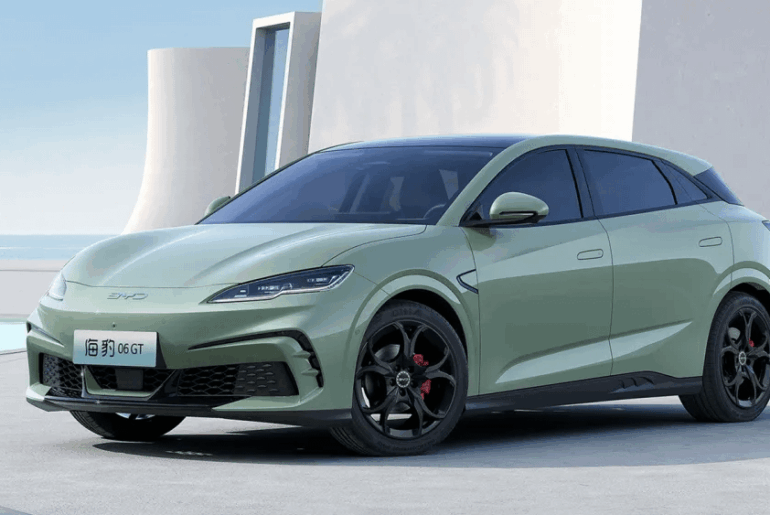
The lineup continues with the Lamborghini Revuelto posting 2.5 seconds, while Tesla returns with the Model X 2023 Tri-Motor AWD at 2.6 seconds. Closing the top ten are the BYD Han L 2025 EV Four-Wheel Drive LiDAR Flagship and the Maserati GranTurismo Folgore 2023, both at 2.7 seconds. The diversity of brands highlights a global race where quality EV engineering and traditional supercar performance now compete on the same leaderboard.
What makes the ranking even more striking is the enormous spread in pricing among the top performers. At the accessible end of the spectrum sits the four-wheel-drive BYD Han L, which comes in at under $40,000 despite its supercar-level acceleration. On the opposite extreme is the Lamborghini Revuelto, carrying a price tag that approaches #900,000. This contrast shows that blistering performance is no longer limited to ultra-exclusive hypercars – high-end acceleration has now reached vehicles across multiple market segments, from luxury to mainstream EV sedans.
New draft rule could slow EV acceleration despite record performance
While the acceleration rankings showcase China’s lead in performance EV engineering, a regulatory twist adds another layer, since recent reports indicate that China is weighing new national passenger-vehicle standards that would reshape how performance is delivered on public roads.
According to a draft proposal, once a vehicle is powered on or ignition is engaged, it should automatically default to a driving mode in which 0–60 mph acceleration is no quicker than 5 seconds. In practice, this means cars capable of blistering launch speeds would still be allowed, but drivers would need to manually switch to high-performance modes.
If implemented, the rule would aim to balance safety and efficiency with EV power, raising the question of how far governments should go in moderating performance as EVs continue to exceed traditional engineering limits.