
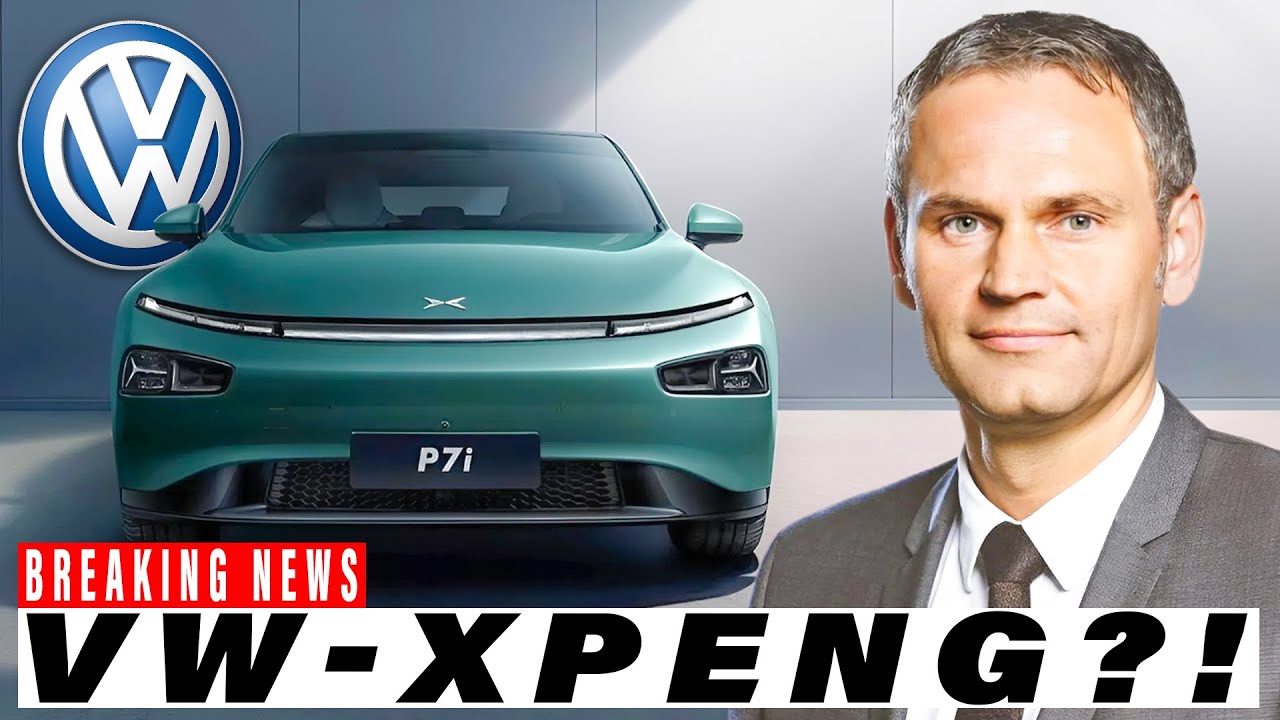
New Volkswagen-Xpeng EV Will CHANGE The Entire US Electric Car Industry! VW
foreign. So now this partnership with Xpong, $700 million is a you know a massive investment and a big and a big commitment. That’s the fourth partnership now in China. Um so why did you go this route and what does Xpong bring to you specifically that makes it such a good partner? We are very strong in China in the in the combustion engine business uh with with market share about 20% but we have to catch up in the BV segment. A Volkswagen just leaked that looks better than anything the company has ever built in its 87year history. The reason is simple. It isn’t really a Volkswagen at all. It is an Xping P7 wearing a VW badge and a slightly different face. And the photos proving it are already circulating in China. The car in the pictures is called the Yuz Hong08. No official press release exists yet. No glossy brochure, no carefully staged studio shots, just a handful of grainy factory photos sent from someone inside the industry. But those photos are enough. The roof line is identical to the Xpong P7. The glass house is identical. The rear hunches, the way the tail lights wrap into the trunk lid, the proportions, everything matches the Chinese sedan that has been humiliating Tesla Model 3 sales in its home market for 3 years. Only the front clip is new. split LED headlights, an illuminated VW logo glowing in the middle of a blank black panel, and smoother, less aggressive surfacing that still somehow looks more expensive than any current ID model. In short, Volkswagen took one of the best looking electric sedans on the planet and made it look even cleaner. The shock isn’t that it’s beautiful. The shock is who actually built it. Everyone knew Volkswagen and Xping announced a partnership. What nobody expected was for Volkswagen to hand over the keys so completely. The German giant paid roughly €700 million euros for a 4.99% stake in Xpong and in return basically said, “Here’s the money. You design and engineer our next China market electrics for us. [Music] [Music] The official line was that the two companies would jointly develop an allnew electric architecture. The reality now visible in these photos is far more brutal. Volkswagen is badge engineering an existing Xpong, tweaking the face and calling it progress. This isn’t collaboration. This is capitulation. Look at the timeline. Less than 18 months after the deal was signed, the first car is already rolling around test tracks in China. Compare that to the premium platform electric PPE disaster that was supposed to underpin the next Audi Q6 Ron and Porsche Mechan Electric. a platform delayed so many times that both brands had to launch with a half-finish version while customers waited years. Or look at the me cars Volkswagen has been selling. Decent, but bloated, heavy, and saddled with software so bad that new ID.3 owners in 2021 were driving cars that sometimes forgot how to start. Meanwhile, Xping has been shipping cars with city street autonomous driving, over-theair updates every month, and battery packs that charge from 10 to 80% in 15 minutes. Volkswagen couldn’t match that pace if it worked around the clock for a decade, so it stopped trying. It wrote a check instead. The use Hong08 will almost certainly use the same powertrains already proven in the P7. Rearwheel drive versions deliver 362 horsepower and a CLTC range of 702 km, roughly 430 to 440 realistic miles on a 75 kWh LFP pack. The long range model pushes that to 820 km CLTC. Expect 380 to 400 usable miles with a 93 kWh pack. The dual motor all-wheel drive variant makes 586 horsepower and hits 100 km/h in 3.7 seconds. It also has that ridiculous race mode that plays fake engine sounds through the speakers. Childish to some, hilarious to others, but undeniably memorable. None of this is hypothetical. These are productionready specs that XPing has been refining since 2020, while Volkswagen was still trying to get its infotainment screens to stop crashing. And the platform underneath is the same sea 2.0 architecture Xpong spent years and billions developing an 800volt electrical system cellto-body construction and front and rear integrated die castings that slash parts count and weight Volkswagen’s own MEB platform by comparison is 400 volt heavier and already obsolete. The new China main platform that this use Hong rides on was announced as a joint effort but the fine print makes it clear Xpong did the heavy lifting. Volkswagen contributed money and brand cache. Xpong contributed everything that actually matters in an electric car in 2025. This matters more than just another new model because China is no longer a sideline for Volkswagen. It used to be the company’s biggest single market, bigger than all of Europe combined. In 2018, VW delivered almost 4.3 million cars there. In 2024, that number collapsed below 2.5 million and has continued to fall. BYD alone now outs sells the entire VW group in China in pure electrics. Local brands offer better tech, faster charging, lower prices, and crucially designs that don’t look like melted jelly beans. Volkswagen’s answer was to keep pushing facelifted Golfs and Lavitus with tiny batteries while customers walked across the street to buy a seal or a P7. The use Hong08 is the moment the company finally admitted the old strategy was dead. The humiliation runs deeper when you remember Volkswagen spent €30 billion on its own electric future through its Kriad software division and produced almost nothing usable. Billions wasted on half-baked operating systems, while Xping, founded in 2014, built a full autonomous driving stack that works in dense Chinese cities today. Porsche and Audi executives openly complain in earnings calls about Kriad’s failures. The same week those complaints went public, Volkswagen quietly increased its cooperation with Chinese partners. The message is unmistakable. German premium brands can no longer write their own software, design their own platforms, or even style their own bodies fast enough to compete. So, they are renting someone else’s. Whether this saves Volkswagen remains to be seen. The company has promised more than 30 new models for China by 2030, at least 20 of them electrified, and many will ride on Chinese developed architectures. Some will come from the Xpang partnership, others from the Seike Volkswagen joint venture. And Audi is already building Q6Lrons on a stretched version of the same J1 platform that underpins the Zeer 001. The proud inventor of the people’s car is becoming the world’s most expensive rebadging operation. For customers, the picture is simpler. If you live in China, you will soon be able to walk into a Volkswagen showroom and buy what is essentially the best electric sedan on the market, backed by VW’s dealer network and residual values for less money than an equivalent Audi. If some of these cars make it to Europe or North America, and the platform is flexible enough to support right-hand drive. The same will apply globally. You will get Xpong levels of refinement, charging speed, and autonomous capability wrapped in a body that doesn’t scream, “I bought a Chinese car to your neighbors.” Whether that feels like a bargain or a betrayal depends on how much pride you still invest in roundles and four rings. The photos of the Yuzu Hong08 are the most evident proof yet that the old order is gone. The best Volkswagen electric car in 2026 will be Chinese from the floor pan up. The Germans kept the badge and the marketing budget. Everything else, the beauty, the speed, the intelligence was designed in Guanghou. And the most shocking part is that this isn’t a scandal, it’s survival.
New Volkswagen-Xpeng EV Will CHANGE The Entire US Electric Car Industry! VW. A leaked Volkswagen electric sedan just broke the internet in China — and it is the most beautiful VW in decades.
Except it isn’t a Volkswagen. It is an XPeng P7 with a new nose, illuminated VW badge, and a Chinese-market name: Yuz Hong 08.
The roofline, glasshouse, rear haunches, door handles, and proportions are 100 % XPeng P7. Only the front fascia was changed to look like a proper Volkswagen. The result? A sleek, low, coupe-sedan that makes the ID.7 look like a melted bar of soap.
This is the first fruit of Volkswagen’s €700 million deal with XPeng: VW paid for a stake and said “build our cars for us.” Expect the same 800-volt SEPA 2.0 platform, 586 hp dual-motor powertrain, 820 km CLTC range, city navigation autopilot, and monthly over-the-air updates — all things Volkswagen has failed to deliver on its own for years.
Volkswagen sales in China are collapsing. Instead of fixing its broken Cariad software and outdated MEB platform, VW chose the shortcut: rebadge the best Chinese electric sedan and sell it through its dealer network.
The Germans kept the badge. China kept the talent. This is what surrender looks like.
For Business or Copyright contact: topunderrated.channel(at)gmail(dot)com
Disclaimer: Our content is based on facts, rumors, and fiction.