NEW Porsche Cayenne Electric Preview | Porsche’s Electric Saviour?
This is the Porsche Cayenne electric and
it’s going to be absolutely crucial to the future or not future of Porsche EVs. And
if you want to know why, then keep watching. The new Cayenne Electric is Porsche’s most
important EV since the Taycan, and it’s coming at an unpredictable time for the company, which
admits that it’s seen a large drop in the demand for electric cars. In fact, the upcoming large
SUV that’s set to slot in above the Cayenne is now going to be launched as a petrol and a plug-in
hybrid, not as an EV as was originally planned. So, where does that leave the Cayenne Electric?
Because initially, we thought the introduction of this car meant that the Cayenne was going to go
to an all electric name plate. There wouldn’t be any more petrol or hybrid versions. But Porsche
has recently said that it’s committed to petrol and hybrid versions of the Cayenne going well into
the 2030s and that’ll ideally run alongside these electric models. It’s a little bit confusing,
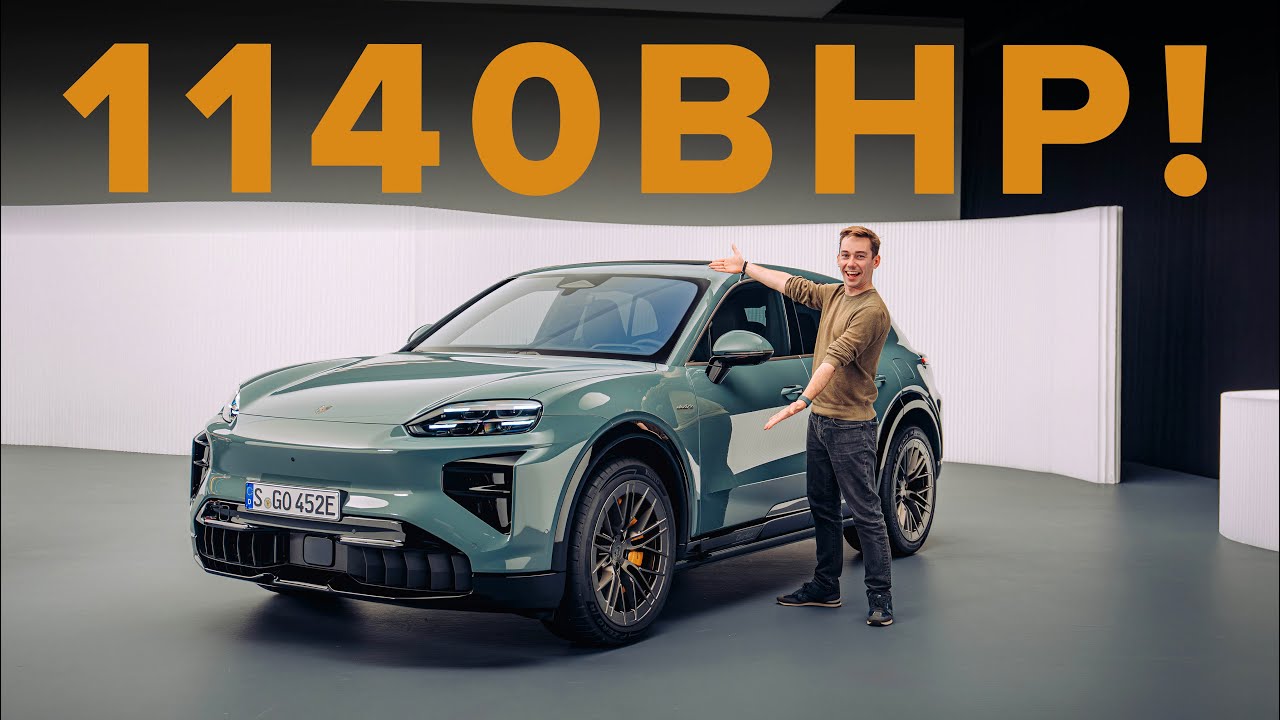
but hopefully you’re still following. Now though, we have got this in the studio. It’s the Cayenne
Electric and it’s going to go on sale in 2026 with a starting price of around £83,000, which
isn’t that much more than an entry-level petrol Cayenne. And the really interesting thing is that
the turbo version is going to cost about £131,000, which is over £10,000 less than a turbo e hybrid,
and it’s quicker. Honestly, the turbo figures are a little bit silly. 1,140bhp 1,106 lb ft torque,
0-62 mph in 2.5 seconds, and 0-124 mph in 7.4. It’s even got direct oil cooling on the rear
motor in order to keep those numbers repeatable over and over and over again. You can launch it
eight times before you start to see a drop off in the power. Or at least that’s what Porsche
claims. However, there is a caveat to those numbers because in normal driving it’s capped at
845bhp, which is still quite a lot, but it’s not 1,140. And you only get that when the car is in
its full launch control mode. And I can’t help but think that Porsche knows that at some point this
car is going to be drag raced mercilessly by a man from Birmingham and he’s going to put it on his
YouTube channel and the car will do very very well indeed. But for most people, the 845 I think will
be absolutely fine. The regular Cayenne electric, which like the turbo is also all-wheel drive,
delivers launch and standard power outputs that are far closer together. With the launch
control activated, it’s 436 brake horsepower, whereas otherwise it’s 402. Good luck if you
ever have to push this thing because the Cayenne electric turbo weighs in at over 2.6 tonnes, which
is very, very heavy. But then that’s pretty much part of the course with luxury electric SUVs.
So, I’m not going to criticise them too much for that. And actually, the Cayenne Electric
has some very clever tricks up its sleeve when it comes to stopping and turning. Porsche is very
keen to point out that the Cayenne Electric can reach up to Formula E levels of recuperation when
braking, namely 600 kW, and that in everyday life, 97% of all braking operations can be handled by
the motors. And for the remaining 3% of the time, Porsche has you covered because there’s optional
carbon ceramic brakes on the Cayenne electric turbo. And they are huge. 10 piston calipers,
440 mm disc at the front. That’s overkill, but it’s glorious. The Cayenne Electric also
gets adaptive air suspension with Porsche active suspension management as standard on both models.
Plus, the turbo features Porsche torque vectoring plus on the limited slip rear differential. Rear
axle steering is also available on both models, as is Porsche Active Ride for the first time on an
SUV. We’ve seen Porsche’s active ride technology before on the Taycan. And what it essentially
does is jettison the anti-roll bars and instead it replaces them with an active damper on all four
corners of the car. And within that active damper, there’s an electric motor. And that helps
counteract the forces of pitch and roll while the car is maneuvering. And Porsche actually
refers to that as helicopter mode because when you accelerate, for example, you think you’d be pushed
back in your seat, but actually you still are, but the car is pitched forwards. And then when
you’re braking, the car pitches itself backwards a little bit. It’s very clever tech. It works in the
Taycan, so there’s no real reason why it wouldn’t work in the Cayenne Electric. It won’t come as any
surprise, but the Cayenne Electric is even larger than the petrol Cayenne. At 4,895 mm, it’s 55 mm
longer, with much of that coming in the wheelbase, which gains a whole 130 mm, giving much more rear
legroom. Meanwhile, the boot is 781 L seats in place and 1,588 L seats folded down. Plus, you’ve
also got the 90 L frunk up front. As for the looks, the good news is the Cayenne Electric and
the Cayenne Petrol are distinguishable. They are not carbon copies. For what it’s worth, I think
the rear of the car looks better than the front, but I’m going to point out some of the design
details that you can tell the difference between the two cars. Anyway, so we’ve got these super
slim LED headlights. You can get HD LED headlights as an option. There’s the Turbonite coloring on
the badge. Everything seems to have Turbonite now because it was on the Turbo S 911 that we
reviewed recently. There’s also an example of the active arrow down here. Those can open and
close. And then come around the side. 22in alloy wheels. More Turbonite coloring. And I mean, I got
to say, how small do they look for 22in wheels? That is insane. Open the door. You can see that
it’s frameless, which is a nice touch. And also the side skirts, 3D style side skirts. Come around
the back and we’ve got the active rear spoiler below that. There’s the full width LED light bar
with the Porsche lettering in the middle. And then my favourite bit, more active arrow. It’s
these arrow blades which pop out and they’ve got the coordinates to the wind tunnel at ViceAC
engraved along the bottom. Not entirely sure why, but it’s a nice detail nonetheless. In terms
of customisation, there’s 13 different standard exterior shades that you can choose from. There’s
also nine different alloy wheel designs and 12 interior options that you can go with, too.
There’s a huge amount that you can choose, but also there’s a customisation program separate
to that. So essentially, the world is your oyster when it comes to making the Cayenne Electric
your own. Never mind the outside of the car. The interior of the new Cayenne Electric is
pretty spectacular. There’s a huge amount of screens on display, which is pretty normal for a
lot of new cars, but these screens are actually extra nice. We’ve got the main flow display in
the middle, which is a curved screen. Looks very cool. And that integrates into the optional 14.9
in passenger display and the standard 14.25 in digital dashboard display. There’s a lot of new
features to talk about with the Cayenne Electric’s interior, and one of the most interesting ones
is the Porsche moods that you can choose from. So on the main screen here, we’ve got dynamic,
journey, urban, relaxation, focus, entertainment, and if you scroll through them like I’m doing
now, the ambient lighting, the air conditioning, the sounds, even the seats will change depending
on what mood you want. So, I’m in dynamic now, but let’s press relaxation. And yeah, lighting
goes greeny blue, and everything goes a lot more zen. I’d love to see what this is like
when you’re stuck in traffic on the M25 and you’ve got screaming children in the back, but
for now, I feel pretty relaxed. Adding to the cabin tech is a head-up display with augmented
reality, meaning the display you see in front of you is the equivalent to looking at an 87in
TV that’s positioned 10 m away. I think what’s really interesting with this interior is that
Porsche already had a benchmark cabin design. It was pretty much one of the best that you could
buy, but they’ve ripped it all up to some degree and they’ve started again. I mean, the digital
dash display is pretty similar to what you see on the Taycan, but this central screen, the flow
screen, it’s a really impressive thing to look at and to use. The screen itself is super responsive.
Graphics are great. Functionality is obviously very, very high-end. And then I mean I’m looking
at the screen now with the model of the car on it and it’s the same color as this car is and the
graphics and the detail. If we go through the drive modes and we put it in off-road mode, you
can see the tread on the tires and little bits of dirt and gravel collecting in the tread. It’s
a small detail, but it makes a difference when you’re sitting here. Something else I’ve noticed
in here which is a very useful feature is this pad here. They call it the ferry pad after Ferry
Porsche obviously and it allows you to use the infotainment screen and actually rest your wrist
on it which is super handy because usually you’ve got your hand at a bit of an unnatural angle and
it’s difficult to press the screen and get the icons accurately. So that’s a really good
feature. And then speaking of this central infotainment screen, the CarPlay integration is
excellent because half of the screen CarPlay and the bottom half still shortcuts to the widgets
that you can set on the main Porsche infotainment system. So you can have your moods, you can
have your battery, temperature, trip computer, all of that. You don’t have to choose between
having the CarPlay and the rest of the widgets. So you can quickly shortcut to lots of different
items. Also, that passenger information display, optional, but probably worth it because it
is one of the clearest passenger information displays that I have seen. And you can see
that now by the YouTube video that’s playing, the CAR Magazine Porsche 911 Turbo S review in all
its 4K glory. It looks superb. I can see it now because I’m in park on the gear lever, but when I
put it in drive, I won’t be able to see it. Only the passenger will. but you can have that screen
on the center screen when the car is parked as well. Couple of other bits to mention. We’ve got
heated panels, not just heated seats in this car. That’s very 21st century. So, we’ve got heated
panels. So, there’s paneling that it’s heated there. Paneling that’s heated here as well. And
then the roof, you can change how opaque it is and it also opens up as well. Whereas in the TYON, you
can change how opaque it is, but it doesn’t open. It’s completely fixed. Got to say that the cabin
in this Cayenne Electric is very, very impressive. It feels like the real deal. The Cayenne Electric
gets a predictably humongous 113 kWh battery. In the regular car, that’s good for a claimed 399
mi, with the turbo only slightly behind on 387 mi. 800v technology allows the Cayenne electric to
charge at up to 400 kW from a suitable DC charger, meaning a 10 to 80% charge should in theory be
achievable in less than 16 minutes. What’s more, the Cayenne Electric is the first Porsche ever
to be available with optional wireless charging, whereby the car can simply be parked over a
charging pad and topped up at a rate of up to 11 kW. The system will likely cost around £5,000
and can be speced on all UK Cayenne electrics. On first impressions, the Cayenne Electric,
whether it’s the regular model or the turbo, it looks like it has everything. It’s got space,
pace, technology. It’s not even a badl looking car. But the big question is is whether the
Cayenne Electric will do for Porsche what the regular petrol Cayenne did around 20 years ago
and transform the fortunes of the company because that’s what this one needs to do for Porsche’s EV
brand because at the moment it’s very much in the balance and if this car doesn’t work as an EV
for Porsche then you’ve got to ask the question will any car work as a Porsche? EV because
this it should be about as good as it gets.
#Porsche #Cayenne #CayenneElectric
Porsche’s Cayenne Electric aims to rescue Stuttgart’s faltering EV ambitions in a similar manner to how the OG Cayenne catapulted sales figures in the early 2000s. Can it do it? CAR magazine’s James Dennison has been to see the 1140bhp luxury SUV in the metal.
SAVE 49% WHEN YOU SUBSCRIBE TO CAR MAGAZINE THIS CHRISTMAS… The ultimate gift for any petrolhead! Find out more here: https://bit.ly/4qzVZCR
Want to stay up to date with CAR’s videos? Subscribe here:
https://www.youtube.com/user/CARmagazineTV/?sub_confirmation=1
Get more content from CAR with a magazine subscription:
https://www.greatmagazines.co.uk/car-magazine?utm_source=youtube&utm_medium=social&utm_content=bau_car
Get the latest reviews and news from CAR magazine here:
http://www.carmagazine.co.uk/
Follow us at:
X: https://twitter.com/CARmagazine/
Instagram: https://www.instagram.com/carmagazine/
Facebook: https://www.facebook.com/CARmagazine/
TikTok: https://www.tiktok.com/@car.magazine.uk
Presenters:
https://www.instagram.com/james_dennison_94/
CAR is the online edition of CAR magazine, Britain’s oldest monthly motoring mag. It’s the UK’s best and fastest online motoring news service, providing a constant stream of scoops, first drives and official pictures of new cars.