Toyota’s New Battery Goes 1000 Miles and Charges in 5 Minutes!
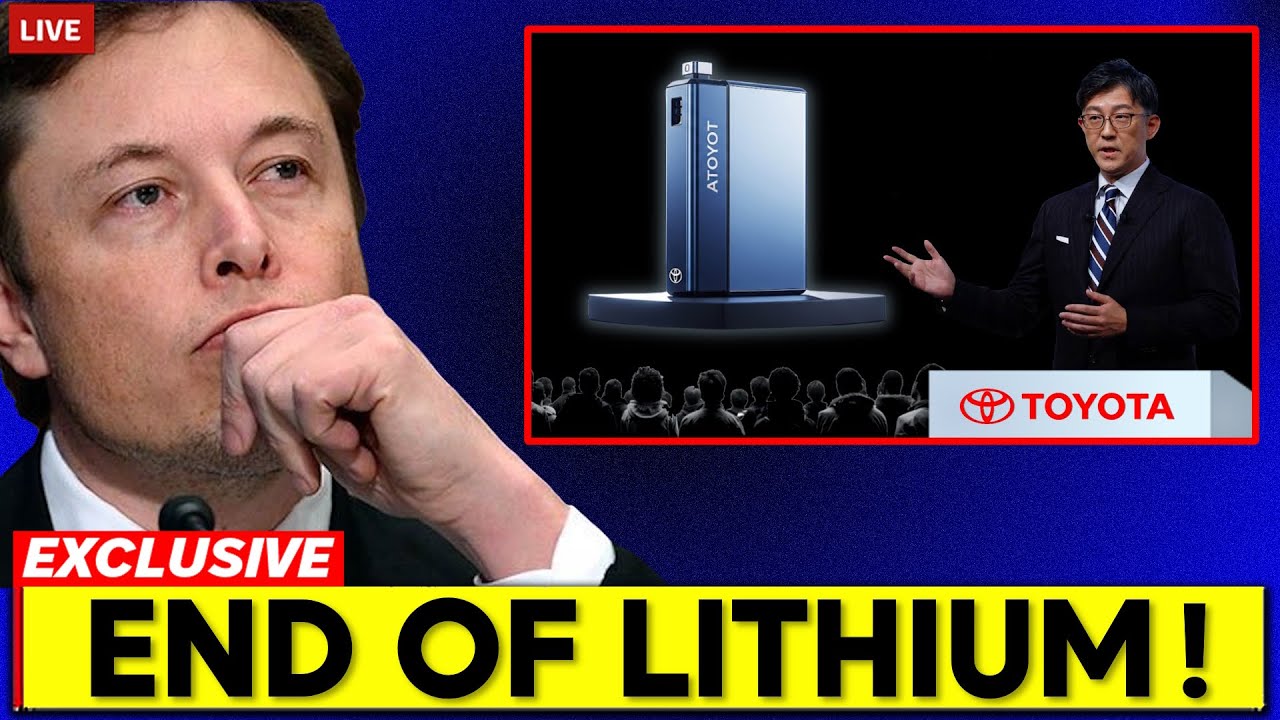
What if I told you Toyota just did what no other car maker on Earth could? They’ve unveiled a next generation aluminum ion battery. A monster that claims a,000 mi of range and a 5minute full charge. Yeah, you heard that right. 5 minutes. Let that sink in. No more waiting at chargers. No more range anxiety. No more excuses. At a surprise press event in Tokyo, Toyota dropped a bombshell that shook the entire EV world. In the crowd, CEOs from Tesla, GM, and BYD watching in stunned silence. Because this wasn’t just a step forward. It was a quantum leap. A battery that’s fireproof, lighter, non-toxic, and free from wear metals. The kind of innovation everyone said was still decades away until Japan made it real. Before we dive into how Toyota pulled this off and what it means for Tesla, for gas cars, and maybe even for oil itself, make sure you smash that like button and subscribe to Draxa. Because what you’re about to see isn’t just another EV update. It’s the opening shot in a global energy war, and you’re watching it unfold right now. They said lithium was the future, that solid state was the final frontier. But Toyota just shattered that illusion with a 5-minute press event that sent shock waves through the industry. No teasers, no leaks, just raw numbers flashing on the screen. 1,000 m, 5 minutes, zero lithium, zero cobalt. At first, everyone thought it was a stunt, some viral marketing trick. But it wasn’t. What Toyota showed was real. A functioning aluminum ion prototype verified by third-party labs. Charging speed 1,200 kow. Cycle life over 10,000 full charges with less than 5% degradation. Thermal stability tested up to 250° C without a single failure. Insiders panicked. This wasn’t an upgrade to Tesla’s 4680 cells. It was a demolition. Four times faster, lighter, nonflammable, no cobalt, no lithium mines. No geopolitical choke holds. Just the cleaner, safer, infinitely more scalable future. And here’s the genius. The material itself. aluminum, abundant, recyclable, already traded across every continent. Toyota didn’t just make a better battery. They rewrote the global supply chain. And here’s the part nobody saw coming. That 1,000mi 5-minute promise, it’s not theory. It’s field tested, lab tested, and fasttracked for mass production by late 2026. Toyota’s internal road map now lists aluminum ion for at least eight upcoming models and new patents hint it could scale beyond cars into home energy and even aviation. So what makes this chemistry so different? Well, imagine this. While lithium ions carry just one charge each, aluminum ions carry three. That’s three times the electrical payload packed into the same space. And when you pair that with a graphine-based cathode, those ions move like lightning. Fast, clean, almost frictionless. No overheating, no runaway reactions. No need for bulky cooling systems or fireproof zones. While lithium cells degrade under pressure, heat, fast charging, deep discharges, aluminum ion cells simply don’t. Toyota’s prototypes were tortured, frozen, superheated, crushed, punctured, shortcircuited, nothing blew up, nothing leaked, not even a spark. That level of stability isn’t just safer, it’s revolutionary. You can mount these packs under seats, inside doors, anywhere in the frame. Zero fear of fire. For regulators, insurers, and fleet operators, that changes everything. But here’s the twist. While the world obsessed over the numbers, insiders noticed something else. What Toyota didn’t say. Not one mention of lithium. No comparisons. No talk of backward compatibility. Just silence. A silence that spoke volumes. A cold message to every automaker still betting on lithium ion. You’re now behind. Tesla, GM, BYD, even CL all caught off guard. Their billiondoll contracts, mining deals, and gigafactories suddenly looked outdated because this new chemistry doesn’t play by the same rules. No lithium extraction from South America, no cobalt mining in Congo, no geopolitical choke holds, just pure, abundant aluminum. clean, cheap, and everywhere. And here’s the kicker. That 1,000mi 5-minute claim, it’s not a lab trick, not marketing math. Toyota’s prototype sedan ran a full 1,000 mi on a closed track, one charge, carrying the same payload as a Camry, no stripped down test mule, no hyper mileing, just a real car, real load, real speed. The implications are staggering. If Toyota can massproduce this, it won’t just compete with today’s EVs. It’ll erase them. Cost, performance, infrastructure, all rewritten. Charging stations would shrink. Highway pit stops would take 5 minutes, like gas. EV range anxiety gone. But here’s the real power, the chemistry itself. Aluminum is fireproof, non-toxic, 96% recyclable, and best of all, it doesn’t rely on scarce minerals hoarded by a select few. This is where lithium’s empire begins to crack. For two decades, lithium wasn’t just energy’s backbone. It was a monopoly controlled by a web of miners, processors, and middlemen from Chile to China. But now that grip is slipping. And if Toyota’s right, it’s about to break completely. So, if you haven’t already, hit that like button and subscribe to Draxa because what’s coming next could redefine everything you thought you knew about EVs? And who really controls the future of energy? Between 2020 and 2023, lithium didn’t just rise, it exploded. Prices surged over 400% and panic rippled through the EV world. Automakers raced to lock in billiondoll supply deals. But those deals, they’re aging like milk in the sun. Because while everyone else was fighting over lithium, Toyota quietly stepped aside and dismantled the entire system. With aluminum, they didn’t just dodge the chaos. They pulled the pin on a very fragile grenade. And that fragility runs deeper than money. Most of the world’s lithium lies beneath the salt flats of Bolivia, Argentina, and Chile. Regions haunted by protests, export bans, and armed militias. One decree, one border closure. And the global EV supply chain gone in a puff of dust. Then there’s Cobalt, the quiet accomplice. 70% of it comes from the Democratic Republic of Congo. a region scarred by child labor, corruption, and armed militias. It’s the dark secret behind the EV revolution. And Toyota, they just walked away from it because aluminum doesn’t carry that stain. It’s mined cleanly, traded globally, and recycled almost infinitely. Toyota’s pivot could slash global lithium demand by 30% within a decade. That’s not a projection. That’s a crash warning. And lithium giants know it. They’re praying this future doesn’t happen. But while lithium cracks under pressure, oil starts to panic. The fossil fuel lobby has seen battery hype before, but never with numbers like this. A 1,000mi range, a 5-minute recharge. That’s not competition. That’s a kill shot. Internal combustion can’t evolve its way out of extinction. An aluminum ion Toyota Camry could outdrive a gas-powered Lexus, not just in range, but in efficiency, weight, and cost per mile. The last fortress of the gas engine has fallen, and the ripple is spreading fast. Gas station chains in Japan and California are already planning 1 megawatt aluminum ion docks capable of charging a full vehicle faster than you can grab a coffee. No fumes, no fire hazards, just raw, silent electricity. This shift doesn’t dent oil. It guts it. Analysts predict global petroleum demand could collapse by 8 million barrels a day by 2035 if aluminum ion hits full scale. That’s more than all of Canada’s oil exports, erased not by regulation, but by innovation. And here’s the twist. That innovation, it’s no longer coming from Silicon Valley. Inside Tesla, sources whisper about Project Helix, an emergency crash program launched just hours after Toyota’s reveal. Engineers pulled from Dojo, from FSD, from every corner of the company, all racing to catch up. Because for the first time in EV history, Tesla isn’t leading the charge, it’s chasing it. So, if you’re watching this right now, hit like, drop a comment, and subscribe to Draxa because what’s happening here isn’t just a new battery. It’s the start of a global reset, and you’re watching history charge itself in real time. Meanwhile, in China, the empire is shaking. CL and BYD, two giants who built their thrones on lithium, are suddenly fighting for survival. Aluminum cuts them out completely. It erases the leverage they spent a decade building. Inside closed door meetings, executives scramble, filing emergency patents, fast-tracking prototypes, desperately trying to slow Toyota’s momentum. But the truth, the storm has already passed them. Across the Pacific, the US Department of Energy is in damage control. caught flatfooted. They’ve reopened aluminum ion research once buried in dusty archives from the early 2010s. Projects quietly abandoned when lithium became king. Now those forgotten blueprints are being pulled from vaults under full lockdown. New patents filed at record speed. Too late, maybe. Because this race is no longer about who started first. It’s about who survives the shift. And back in Japan, the reaction was electric. Local media called Toyota’s reveal the tech Pearl Harbor of the auto world, an ambush so precise, so disruptive, it shattered alliances overnight. Automakers that once mocked Toyota’s slow EV rollout now found themselves crawling back, begging for licensing talks. Even Elon Musk, never one to bite his tongue, broke his silence with just two words. Didn’t expect that. No memes, no bravado, just quiet shock. Because deep down he knew this wasn’t a launch event. It was a declaration of war. And the battle had already begun behind closed doors. By dawn, venture capital started pulling back. Billions vanished from startups like Lucid and Fisker. Their breakthroughs suddenly obsolete, their valuations evaporating. The future had pivoted and the old guard wasn’t invited. Even the giants were bleeding. Ford, GM, Volkswagen, all had sunk billions into lithium infrastructure. Gigafactories, mining contracts, joint ventures across Chile, Australia, and China, and now every boardroom echoed with the same cold question. Did we just lose the future to Toyota? The markets didn’t wait for an answer. BYD’s stock tanked 6% in a single day after Toyota’s road map leaked to Nikkeay. GM’s EV division cancelled two major unveilings, citing strategy revisions. Hyundai Kia quietly entered talks with Toyota for aluminum ion licensing rights. No press releases, no leaks, just whispers and urgency. Because in this race, no one wanted to be last to pivot. And yet for Toyota, this wasn’t about being first. It was about being final. Their 2026 lineup now boasts eight aluminum powered models from compact hatchbacks to full-sized SUVs. Each one lighter, faster, cleaner. Each one delivering a range that embarrasses everything on the market. Toyota isn’t catching up to Tesla anymore. They’re leapfrogging the entire field. So, if you’re still watching, smash that like button, subscribe to DEXA, and stay tuned because this is more than a battery story. It’s the beginning of a new industrial era. And the question isn’t who wins, it’s who survives. But that leap came with a twist. Infrastructure. Because the world’s charging network built for lithium suddenly looked ancient. Superchargers, CCS ports, destination plugs, all maxing out around 350 kW. Impressive once, but for aluminum ion, that’s like trying to funnel a tsunami through a garden hose. Toyota’s new chemistry demanded megawatt level throughput. And that meant the world’s entire charging grid faced an ultimatum. Upgrade or die. Power companies, station operators, even government agencies scrambled into motion. In Tokyo, within weeks, a 1 megawatt pilot station quietly appeared, branded under Toyota Energy. Cars charged in 5 minutes. No overheating, no cues, no waiting. Just plug in and go. And it didn’t stop there. Japanese convenience store chains already linked to the national grid announced plans to retrofit thousands of locations into aluminum fast charge hubs. In the US, a California startup called Charge It filed permits to convert solar EV hubs into aluminum compatible mega sites. Even Shell, yes, Shell, was spotted in closed-d dooror meetings with Toyota’s infrastructure team. This wasn’t just about faster charging. It was about familiarity. Aluminum ion erased the final psychological barrier between EVs and gas cars. 5minute fillups, no range anxiety, no app timers, no overnight plugs. You park, plug in, grab a snack, and drive away charged, effortless. Consumers didn’t need persuasion. They just needed access. And that’s when the conversation shifted from technology to economics. For years, the EV dream was real, but expensive. Batteries made up 30 to 40% of every car’s cost. Lithium ion cells hovered between $120 and $140 per kilowatt hour. Solid state still trapped in prototype labs costing over $200. A playground for billionaires, not the masses. Then Toyota flipped the equation because aluminum is cheap. Dirt cheap. It’s mined in over 60 countries already woven into the veins of global trade. And unlike lithium, aluminum ion manufacturing doesn’t demand dry rooms, rare chemicals, or cobalt coatings, factories could be retoled overnight, fast, clean, and affordable. Analysts now estimate Toyota’s per kowatth cost could drop below $80 once mass production kicks in. And that changes everything. an aluminum powered Toyota Corolla, 1,000 miles of range, a fiveminute recharge, and a sticker price under $25,000. That’s not just an affordable EV. That’s a category killer. A car so efficient, so disruptive, it makes every other vehicle on the lot look outdated the moment you test drive it. So, if you’re still watching, hit that like button, subscribe to DEXA, and turn on notifications. Because what Toyota just set in motion isn’t an upgrade. It’s a reset. And the future just charged itself faster than anyone imagined. Imagine this. An electric car so durable, it outlives your phone, your laptop, maybe even your mortgage. That’s Toyota’s aluminum ion dream. No liquid cooling, no fragile modules, no thermal babysitting, just a battery so stable it doesn’t flinch at time. Maintenance practically gone. Safety absolute. Longevity, 20 years, one car, two decades, zero battery swaps. And when its life finally ends, it’s not waste, it’s rebirth. Because unlike lithium’s toxic, costly recycling mess, aluminum comes back almost whole. 96% recovery, no complex chemistry, no energy drain. Toyota calls it circularity. We call it genius. The supply chain tells the same story. While others scramble for cobalt and nickel, Toyota’s calm. smelters, casting plants, foundaries already in place across every industrial nation. No new mines, no geopolitical headaches, just aluminum everywhere waiting. And suddenly, this wasn’t just an automotive revolution. It was an energy awakening. The same chemistry could power grids, ships, even aircraft. The world’s biggest industries, once divided by technology, now look to Toyota, chasing the secret that made lithium look ancient. Because this wasn’t just faster, cheaper power. It was cleaner, ethical, human. No child labor, no poisoned groundwater, no flaming salt flats, just a humble metal mined in daylight, not in shadows. Lithium had always carried a hidden cost. Water drained from deserts, cobalt pulled from unregulated pits, lives lost in the pursuit of green. But aluminum, it’s the redemption arc. Clean energy needed. No toxins, no fires, no thermal runaway, even punctured. Toyota’s battery stays cold to the touch, inert, stable, silent. No hazmat units, no recalls, no headlines about EVs and flames, just reliability. Pure and simple. And with over 96% of materials recovered in every cycle, the battery doesn’t just endure, it regenerates. The future of energy isn’t just faster, it’s finally guilt-free. If this kind of revolution fascinates you, hit that like button and make sure you’re subscribed to Draxa because the next part will take you inside Toyota’s secret labs where this miracle metal was born. And then came the shock wave, the knock-on effect no one saw coming. EV production emissions down by over 40%. Overnight, the old argument, EVs are just coal powered cars, crumbled to dust. In life cycle studies, aluminum ion didn’t just beat lithium, it crushed it. Even hydrogen fuel cells and hybrid systems couldn’t keep up. Governments chasing carbon neutrality suddenly realized Toyota hadn’t built just another car. They’d built a shortcut to zero. But here’s the twist. It was never just about cars. Buried deep in quiet patent filings and subtle press leaks, Toyota’s next ambition came into focus. The grid. Solar and wind always had one fatal flaw. Storage. Lithium could store energy, yes, but at a cost. It was pricey, unstable, and degraded fast under constant cycling. Aluminum ion, it thrives under pressure. It doesn’t mind deep drains, long dormcancy, or constant load. It just works. Inside Toyota’s labs, engineers unveiled something remarkable. A modular power brick the size of a shoe box. Stackable, silent, fireproof, recyclable. One could keep your house running during an outage. A few hundred power an entire neighborhood. Rural farms, off-grid communities, even small islands, all powered by pure aluminum energy. But that horizon stretched even further. Military tests began. Unmanned drones, field generators, portable command units, then aviation. Quiet partnerships between Toyota aerospace and commercial jet manufacturers. Lightweight, nonflammable, cabin safe. Finally, a chemistry that could fly without fear. And then the consumer tech leaks hit. Phones charging in under 60 seconds. Laptops running for a week straight. Smartwatches that never overheat, even in desert sun. This wasn’t just an automotive evolution anymore. This was a power revolution. Who controls it? Who stores it? Who delivers it? Because Toyota had quietly transformed from an automaker into a global energy platform. And the ripples became tidal waves. Patent offices from Washington to Tokyo saw record filings stamped Toyota Motor Corporation. Universities fought for aluminum ion research grants. Startups pivoted overnight. Governments rewrote their energy road maps. It wasn’t a ripple anymore. It was a rift. Inside boardrooms in Detroit, Munich, and Shanghai, one question burned through the silence. Is it too late to catch up? Because Toyota wasn’t slowing down. They’d already plotted their next conquests, cargo ships, industrial fleets, robotics, and power grids. Their vehicles would charge your house. Their batteries would stabilize cities. And their chemistry, that silent, unburnable slab of aluminum, had become the most valuable object in the modern auto industry. Elon Musk’s engineers still chasing. China’s battery giants scrambling and the lithium lobby, the once untouchable kings of the EV age, were watching their empire fracture in real time. The new energy war had begun, not over lithium, not over oil, but over aluminum ion, the metal that rewrote the rules of power. Because the old world ran on combustion, the next one, it’ll run on aluminum. and Toyota just lit the fuse. If this vision of the future fascinates you, hit like, subscribe to Draxa, and join the revolution because the next episode dives into Toyota’s global strategy and how it could change the energy map forever.
⚡ Is this the end of Tesla? Toyota’s 1,000-mile solid-state EV battery charges in 10 minutes — and it could change the entire industry.
🚗 The $15B breakthrough that might leave Elon Musk scrambling for answers.
Toyota just shocked the EV world with a battery breakthrough so massive it could put Tesla on defense. After 16 years and $15 billion of research, Toyota is ready to unleash solid-state batteries that promise:
✅ Over 1,000 miles (1,600 km) range
✅ A 10-minute fast charge
✅ Longer lifespan than any EV battery today
✅ Safer, lighter, and more sustainable than lithium-ion
While Elon Musk continues to push Tesla’s 4680 cells, Toyota’s solid-state technology might be the real revolution. Could this be the moment Tesla loses its crown as the EV leader?
In this video, we’ll break down:
The science behind Toyota’s solid-state batteries
How they compare against Tesla’s 4680 and BYD’s Blade Battery
The timeline for Toyota’s 2027–2028 mass production
Why this breakthrough could end range anxiety forever
And what it means for Tesla, BYD, and the future of EVs globally
The EV race is heating up — and Toyota may have just played the winning card.
👉 Don’t forget to like, share, and subscribe for more breaking EV news, Tesla updates, and automotive tech revolutions. https://youtu.be/jm87evlSktA?si=yKIjsZyDizVBwn4O
#ToyotaEV #TeslaVsToyota #SolidStateBattery #EVRevolution #FutureOfCars #ElectricVehicles
Chapters
00:00 – The EV Shockwave: Toyota vs Tesla
01:12 – Toyota’s $15B Battery Breakthrough
03:00 – What Makes Solid-State Different?
05:05 – 1,000 Miles Range & 10-Minute Charging
07:20 – The End of Range Anxiety
09:10 – Tesla’s 4680 vs Toyota’s Solid-State
11:00 – BYD, CATL & The Global EV Battle
12:40 – When Will Toyota Launch Solid-State?
14:00 – Could This Really END Tesla’s Reign?
15:15 – Final Thoughts & What’s Next
📜 Copyright & Content Disclaimer
This video may feature copyrighted materials, such as images, footage, or audio clips. We do not claim any ownership over these third-party assets. All rights are respectfully attributed to their original creators.
Content is used under the principles of Fair Use as outlined in Section 107 of the U.S. Copyright Act — which permits use for commentary, education, analysis, news reporting, and research purposes.
🔍 Disclaimer:
This video may include a blend of factual information, informed opinion, and creative storytelling. It is intended solely for educational, informational, and entertainment purposes. Viewer discretion is advised when interpreting speculative content.