Honda Just Dropped a Bombshell Our New E-Fuel Engine Will Destroy the Electric Motorcycle Industry!
Honda just threw a wrench into the
electric revolution — and nobody saw it coming. No batteries, no cords, no
waiting — just a new kind of combustion that runs clean. They call it an e-fuel
engine, and if the early reports are true, it could make every electric motorcycle
out there look outdated overnight. But here’s the thing — this isn’t hype. Honda’s
been testing synthetic fuel tech for years, and now it’s finally roaring to life inside the
Fireblade. We’re talking carbon-neutral combustion that still growls like a real engine. Stay with
me till the end, because if Honda pulls this off, it won’t just change the industry — it’ll change
what kind of motorcycles we get to ride next… What’s happening?…
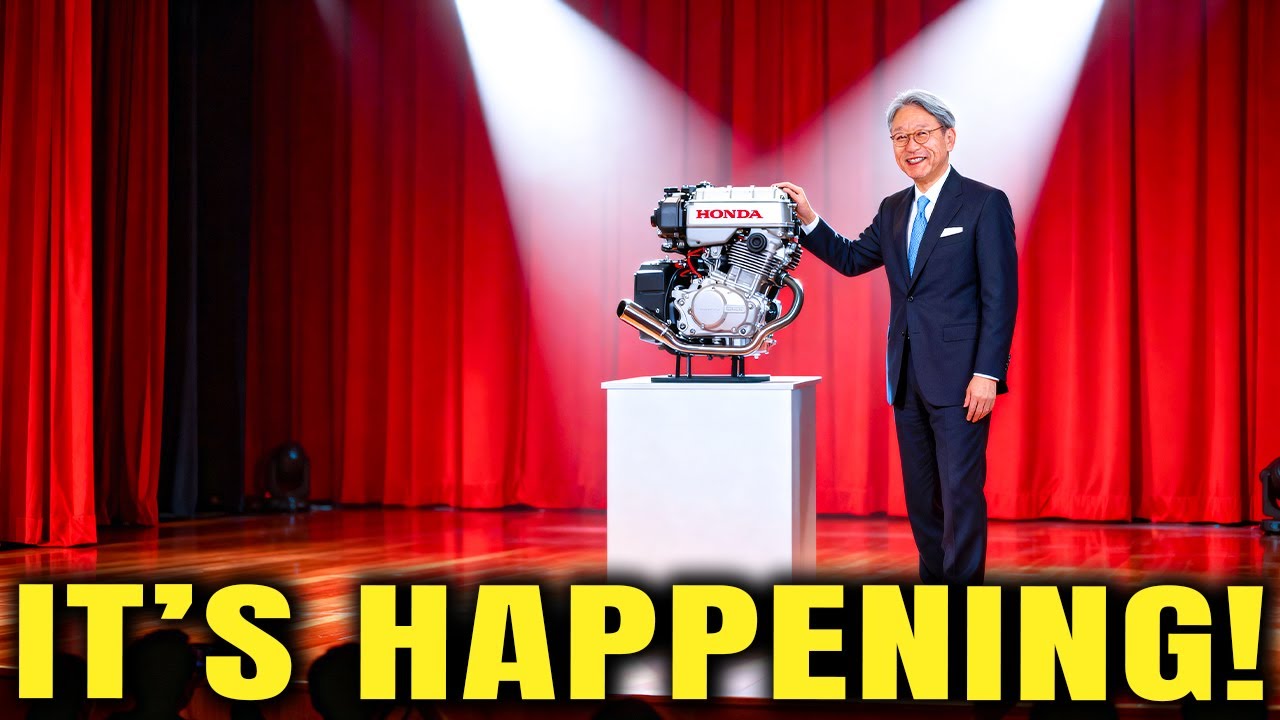
In one Tokyo press event, Honda dropped a revelation that detonated across
the motorcycle world: a fully functional e-fuel engine that doesn’t need charging, doesn’t burn
fossil fuel, and doesn’t compromise performance. It wasn’t a concept. It wasn’t a whisper of what’s
next. It was here, real, running, and mounted inside a machine every rider already knows by
name — the CBR one thousand RR-R Fireblade SP. As reporters scrambled for sound bites, Honda
engineers simply smiled. They knew they hadn’t just improved an engine; they had rewritten
the future of mobility. The Fireblade’s new powerplant doesn’t hum like an electric
motor — it roars. It breathes, it reacts, and it runs on a renewable synthetic fuel made
from captured carbon and clean energy. The crowd stood stunned as test footage rolled — no cords,
no batteries, just speed, sound, and zero guilt. By the time the press conference ended, phones
were lighting up across the industry. Electric startups went silent on social media. Investors
pulled emergency meetings. And one whispered headline started spreading faster than any
marketing campaign ever could: “Honda just made every electric motorcycle obsolete.”
But behind that stage and spotlight, the real story was the machine that carried
the secret — a legend reborn for a new age… The Fireblade Reborn…
If Honda wanted to send a message, they couldn’t have chosen a better messenger than the Fireblade
SP. This wasn’t some eco-experiment wrapped in plastic; this was Honda’s flagship, the symbol of
precision and speed. For over three decades, the Fireblade carried the soul of Japanese engineering
— a perfect balance of fury and finesse. Now, it’s the proving ground for an engine
meant to outlive the electric era entirely. When the curtain lifted, the familiar
silhouette of the Fireblade stood under bright white lights — lean, sharp, and
unmistakably alive. But inside that chassis, the heartbeat had changed. Honda engineers had
fused the past and the future: high compression, redesigned injectors, and a combustion process
fine-tuned for e-fuel’s clean burn. The result? Power on par with the best superbikes
in history — without a single drop of gasoline or a minute of charging time.
The first test riders came back shaking their heads, not in disbelief but in awe. “It
sounds like freedom again,” one of them said. “But cleaner.” Every gearshift sang
like an anthem, every throttle pull felt like defiance. The Fireblade wasn’t just
reborn; it was rebelling — a mechanical middle finger to the silent, battery-powered
future everyone said was inevitable. And while the crowd cheered the spectacle,
deep inside Honda’s research labs, the quiet revolution that made it possible
had already been years in motion. If you’re into the truth behind real engineering
breakthroughs like this, hit that like button and make sure you’re subscribed. Share your thoughts
below — what do you think this means for the future of riding and the bikes we love?…
The Electric Mirage… For years, electric motorcycles
were painted as flawless heroes — zero emissions, low maintenance, the
end of the fossil age. But riders on the ground saw a different story. The real costs showed up
not in glossy ads but in monthly bills and mined landscapes. Batteries didn’t grow on trees; they
came from lithium, nickel, and cobalt torn from the earth in industrial scars that stretched
for miles. When those batteries wore out, recycling them proved expensive and patchy. What
looked clean on the highway often left a darker footprint before the first mile was ridden.
Charging time was another truth few wanted to admit. Even with fast chargers, riders waited
half an hour or more to fill what a gas tank did in five minutes. For long tours, that delay
wasn’t progress — it was a deal-breaker. And while electric bikes promised low running costs, the
infrastructure strained under demand. Power grids groaned during heat waves, and in many towns,
public chargers sat broken or blocked. Add in the rising cost of electricity, and the math didn’t
feel as futuristic as the brochures claimed. Riders began to ask the same question
Honda engineers were quietly exploring: if going electric meant trading one dependency
for another, was it really the solution? That skepticism grew, especially among those
who valued reliability over trends. So when Honda revealed a carbon-neutral engine that used
existing fueling systems and renewable sources, the disbelief quickly turned into
cautious curiosity. Maybe, just maybe, the future wasn’t electric after all.
Curiosity soon gave way to fascination, because behind closed doors in Japan, Honda’s engineers
had been perfecting something even more audacious. If you want the same gear and accessories
I ride with, they’re linked right below… Inside Honda’s Hidden Workshop…
Deep in the industrial heart of Suzuka, Japan — the same soil where Soichiro Honda first
forged his dream — a small team had been working away from the spotlight. They called it “Project
Phoenix.” It wasn’t about replacing engines but resurrecting them. The workshop was off-limits to
outsiders, guarded by nondisclosure agreements and layered security. But according to insiders
who later spoke to the Japanese press, the sound from inside was unmistakable — a
combustion roar, pure and alive, echoing down sterile test corridors. It was the heartbeat of
something that wasn’t supposed to exist anymore. The process began years earlier. Honda engineers
studied carbon capture systems, synthetic fuel chemistry, and micro-turbine refinements long
before most manufacturers cared. They weren’t chasing applause; they were chasing perfection.
Prototype engines were tested in compact forms, then scaled to handle the precision tuning
demanded by the Fireblade SP. In early trials, the team achieved near-zero emissions output
without losing torque response — a feat previously thought impossible for performance bikes. The data
looked unreal, but every number checked out. When the Fireblade prototype roared alive
at Suzuka, its sound blended nostalgia and science—water vapor, not smoke, rising behind
it. Nearly carbon-neutral yet fully alive, it marked a turning point. While others buried
combustion, Honda revived it. The e-fuel Fireblade proved motorcycles can be sustainable, powerful,
and still sound like freedom. And that realization set the stage for what came next — the deeper dive
into how this engine actually works and why it has the whole industry looking over its shoulder…
Inside the E-Fuel Core… At its heart, the e-fuel engine is built on a
simple but radical idea — to keep combustion alive without burning the planet. Honda’s chemists
start by pulling carbon dioxide straight out of the air. Using renewable electricity from wind and
solar sources, they separate hydrogen from water molecules, then combine it with that captured
carbon. The result is a synthetic fuel almost identical to gasoline in performance but
nearly neutral in emissions. When it burns inside the cylinder, it releases only the carbon
it borrowed, not new carbon dug from the ground. It’s a closed loop — capture, convert, combust,
repeat — all without the fossil footprint. Honda’s engineers compare it
to breathing: air in, air out, balance maintained. The process doesn’t rely
on mining rare metals or building vast battery networks. It’s made from the same elements that
built life itself — air, water, and electricity. That simplicity is what makes it powerful. Instead
of reinventing the infrastructure of the world, it uses what already exists. The same
fuel stations, tanks, and pumps could serve a new generation of cleaner combustion.
For riders, nothing changes—you still fill the tank, feel the throttle, hear life ignite. Yet
beneath that ritual lies precision chemistry defying electric promises. No cords, no waiting,
no silence—just motion that gives back what it takes. Innovation without losing identity.
And nowhere does that balance of old and new come together more perfectly than inside
Honda’s reimagined Fireblade engine… Re-Engineering the Fireblade…
When Honda’s engineers decided to fit the e-fuel system into the CBR one thousand
RR-R Fireblade SP, they faced a mechanical puzzle. E-fuel burns cleaner but slightly cooler and
slower than gasoline, so the entire combustion system had to be recalibrated. They raised
compression ratios, adjusted valve timing, and fine-tuned injection mapping to extract
every ounce of efficiency without losing the pulse that defines the Fireblade’s character.
The result wasn’t a timid experiment — it was an engine that breathed sharper, spun faster,
and delivered torque with surgical precision. Inside the frame, lighter composite alloys
replaced older metals to offset the added fuel delivery hardware. The cooling system was
redesigned to keep the narrower temperature window steady under extreme loads. New coatings
on cylinder walls reduced friction to near-zero levels. And the exhaust design preserved
that signature Honda rasp — the mechanical growl that tells you the machine is alive, not
whispering. Every adjustment served one purpose: to keep the Fireblade’s spirit intact while
making it cleaner than any superbike before it. Test riders felt it instantly—no lag, no fade,
just raw throttle and pure response. The Fireblade didn’t whisper; it roared back to life.
This wasn’t a prototype or compromise. Honda hadn’t built an experiment. They’d
engineered a comeback with teeth. It’s not theory anymore — it’s track-ready metal,
and the next question every rider asked was simple: what does it cost to live with?…
The Business Equation… In the real world, innovation means nothing if
it drains wallets faster than tanks. Honda’s e-fuel engine was designed with economics in mind.
Synthetic fuel production remains expensive today, but unlike early battery technology, its cost
drops as scale grows. Current estimates put it just above premium gasoline, and refueling
takes the same three to five minutes as always. For daily riders, that means no hours tethered
to a wall, no infrastructure overhaul at home, and no waiting in line at charging stations.
Over a five-year span, maintenance costs favor the e-fuel Fireblade by a wide margin. No battery
degradation, no power-cell replacement, and fewer software-dependent diagnostics mean mechanics —
not computer technicians — can keep it running. That reduces both cost and downtime. Riders get
what they’ve always valued most: independence. When a machine can be repaired with tools instead
of firmware, ownership feels honest again. Electric bikes lose value fast, but the e-fuel
Fireblade holds steady—modern, compliant, yet timelessly mechanical. Dealers already whisper
it’s a future classic, the last sportbike that refused silence. This isn’t just freedom from
the grid; it’s freedom of choice restored. And while Honda balanced the math, the rest
of the industry was watching nervously from across the pit wall…
Competitors on Edge… When word of Honda’s e-fuel
breakthrough hit the trade circuits, shockwaves rippled through boardrooms.
At Yamaha headquarters, internal memos leaked within days — engineers were reportedly
reassigned from battery research to “alternative combustion programs.” Harley-Davidson’s
investors called emergency meetings, demanding updates on synthetic fuel compatibility
for their touring line. Even smaller electric startups, once riding the hype wave, began
quietly shifting marketing budgets away from “full electric” toward “hybrid adaptation.”
The landscape shifted almost overnight. Industry insiders said the mood at global shows
was part disbelief, part envy. Many executives had written off internal combustion years ago,
pouring billions into battery contracts and government incentives. Now, the prospect of a
carbon-neutral engine threatened to undo that entire narrative. Suppliers started hedging
bets. Steel and component manufacturers began contacting Honda’s R&D division to explore
licensing. Market analysts projected that if just ten percent of future production went e-fuel,
it could erase a decade of battery dominance. Pressure mounted as electric giants scrambled
to stay relevant. One European CEO called Honda’s move “a betrayal of progress.” But
riders saw truth, not treason—the soul of a motorcycle lives in connection, not kilowatts.
Power was shifting, and everyone felt it. But the real shake-up started far from corporate
boardrooms — out where bikes are tuned by hand, engines speak in echoes, and riders decide
what the future truly sounds like… The Soul of Riding Returns…
When the e-fuel Fireblade finally hit the testing circuits, something remarkable happened —
riders stopped talking about chemistry and started talking about feeling. The first twist of the
throttle brought back a sensation many thought they’d lost forever. The vibration through the
bars, the rising note of the exhaust, the way the machine responded with heartbeat precision — it
felt alive. For years, engineers had tried to make motorcycles cleaner, quieter, and more efficient,
but in doing so they had stripped away something vital. Honda had managed to bring it back without
breaking the new rules of a greener world. Test riders described it as a paradox: a
bike that sounded fierce yet ran clean, that kicked like the old Fireblade yet burned its
fuel almost guilt-free. The connection between hand and engine was immediate again. There was
feedback, resistance, and rhythm — the language real riders speak. Electric motorcycles could
outrun it in silence, but they couldn’t match its soul. That sound, that breath between
gears, was the heartbeat of freedom. For those who grew up wrenching on carburetors and
syncing throttles by ear, it was validation. The mechanical era wasn’t dead. It had just evolved.
This new Fireblade didn’t just win hearts; it restored faith in the craft of riding itself.
And when faith returned, so did the places that had always kept the spirit alive —
the small garages that never stopped believing in engines…
The Garage Stays Open… The ripple effect of Honda’s e-fuel engine reached
beyond factories and showrooms. In small-town garages, the kind that smell like oil and dusted
aluminum, a quiet celebration began. For years, mechanics watched electric vehicles creep
into the market and wondered what that meant for their future. You can’t tune a circuit board
or feel a torque wrench bite into a sensor port. But now, the news from Honda meant the
trade was safe — maybe even reborn. E-fuel engines use familiar systems: pistons,
valves, spark, compression. The parts may be refined, but the fundamentals remain the same.
Independent shops could still rebuild, adjust, and personalize machines without proprietary
software locking them out. That meant riders could keep their relationships with local
mechanics — the people who turned wrenches long before laptops entered the bay. The community
of grease, grit, and know-how stayed intact. “We can work on these,” a veteran mechanic
said—and that changed everything. The phrase spread through forums like wildfire. It wasn’t
just about engines; it was hope. Honda’s e-fuel design didn’t replace independence—it reignited
it, keeping every garage light burning bright. But something even bigger was happening out
on the road — a cultural shift where riders from rival brands started to realize
they were all chasing the same thing. If you want more deep dives into the
machines reshaping the motorcycle world, make sure you’re subscribed. Every week
we uncover the stories other channels skip — real riders, real engines, and the
truth that keeps this culture alive… The New Brotherhood…
Motorcycle culture has always thrived on rivalry — Harley against Honda, cruisers versus
sportbikes, old guard versus newcomers. Yet when the e-fuel Fireblade made headlines, that rivalry
started to fade into something unexpected: respect. Riders across camps recognized what
Honda had done. They didn’t see a corporate stunt; they saw a defense of everything motorcycles
stood for. Even those who swore by V-Twins admitted it took guts to keep combustion alive
when everyone else surrendered to the plug. Online, you could see the shift. Harley loyalists
called it “a real move, not marketing.” Sportbike fans cheered the return of power that didn’t hide
behind silence. Forums once filled with arguments about emissions turned into debates about how
soon other brands might follow. The Fireblade became a unifier — not by branding, but by belief.
It reminded everyone that riding wasn’t just about speed or brand pride. It was about connection,
craft, and rebellion against conformity. From Texas to Tokyo, crowds gathered to hear
combustion’s song again—the rhythm that carried generations. The e-fuel revolution
didn’t erase identity; it revived it, proving it’s not the logo that matters, but the
heartbeat still alive inside every machine. That unity wasn’t just cultural — it had
economic and political echoes stretching across oceans and industries…
Supply Lines and Sovereignty… The deeper consequence of Honda’s breakthrough
reached into the global balance of trade. Electric vehicles depend heavily on lithium,
cobalt, and rare-earth minerals — materials controlled by a handful of nations. For
years, that meant one geopolitical truth: whoever controlled the mines controlled the
market. Honda’s e-fuel program threatened to flip that power dynamic on its head.
By producing synthetic fuel from captured carbon and renewable energy, nations
could create their own supply chains. No more shipping batteries across oceans or
waiting for mining contracts to clear. The fuel could be produced locally, even regionally,
using solar or wind farms. For countries that once worried about energy dependence, e-fuel offered
something close to self-sufficiency. In Japan, government officials quietly hailed the Fireblade
announcement as a national milestone — proof that innovation could protect both the
environment and industrial sovereignty. For riders, it wasn’t politics—it was pride.
Their fuel could come from home, not compromise. E-fuel meant motorcycles stayed in the future
without apology. It wasn’t just technology; it was freedom reborn, proof that Honda had
sparked something unstoppable and deeply human. And while nations began to re-evaluate their
strategies, inside Honda’s boardrooms another revelation took shape — this wasn’t
a lucky strike. It was the product of a plan decades in the making…
The Strategy Behind the Curtain… Long before headlines screamed about electric
revolutions, Honda was already laying the groundwork for something different. While
competitors raced to announce battery platforms, Honda engineers quietly filed patents and funded
laboratories focused on clean combustion. It wasn’t hesitation; it was patience. The company’s
internal roadmap stretched back over two decades, rooted in a simple belief: you don’t abandon what
works — you evolve it. That philosophy defined Honda since the days of Soichiro himself, who
built his empire on resilience, not reaction. The first steps appeared invisible to the
public. Research grants for carbon capture projects. Partnerships with renewable
energy firms in Japan and Europe. Small, controlled experiments on fuel reforming. Each one
seemed disconnected, but together they formed the backbone of the e-fuel breakthrough that would
later shake the industry. When other companies dumped billions into battery gigafactories, Honda
invested in chemistry and efficiency. It was the long game — a bet that the world would eventually
see that sustainability doesn’t require silence. Honda’s R&D team called it “Project Continuum”
— proving combustion could evolve without losing soul. Years of silent prototypes, each cleaner
and smarter, built toward this moment. When the e-fuel Fireblade roared alive, it wasn’t
luck — it was twenty years of precision. And now that future is forcing the
world’s regulators to face a question they’d tried to bury — can combustion
coexist with clean energy?… Policy Shockwaves…
The shock didn’t stop at dealerships or racetracks. It hit government offices and
climate committees across the globe. For years, the European Union had been preparing strict
bans on internal combustion engines, planning to end their sale entirely by two thousand
thirty-five. But once Honda demonstrated a functional, near-zero-emission e-fuel system,
the discussion changed overnight. Lawmakers began to realize that banning engines wasn’t
the same as banning pollution — and that the two ideas didn’t have to be tied together.
In early reports from Brussels and Tokyo, policymakers hinted that e-fuel might qualify
for carbon-neutral exemptions under updated green mobility acts. Germany, which had
already championed similar fuels for its automotive giants, threw public support behind
the idea. Japan followed quickly, positioning itself as the global leader in synthetic
fuel development. Even in the United States, where regulations are often divided by state
lines, the Environmental Protection Agency began quietly reviewing data provided by Honda’s
research arm. Engineers who once felt ignored suddenly found their inboxes full of inquiries
from energy and transportation agencies. For the engineers, it was vindication.
Once dismissed as obsolete, their craft now rewrote the rules. Governments
replaced bans with performance targets, letting clean combustion compete with electric
power. The tide hadn’t just shifted—it had turned. E-fuel wasn’t a loophole; it was a bridge.
But while the policymakers debated emissions on paper, a more tangible revival was already
unfolding where it mattered most — inside the factories…
The Factory Revival… For years, manufacturing workers feared
extinction. The rise of automated electric production lines replaced skilled labor with
robots and algorithms. Assembly plants that once echoed with the sound of tools now hummed
with conveyor belts. But the introduction of Honda’s e-fuel program began reversing that
trend. The new engines required craftsmanship, machining, and precision tuning — skills
that couldn’t simply be automated. Across Japan, new hiring notices appeared. Honda
reopened training centers that had been dormant since the mid-two-thousands, teaching young
mechanics the discipline of engine assembly. In the United Kingdom and the United States,
suppliers who once built crankcases, pistons, and exhaust systems found themselves back in
demand. It wasn’t nostalgia — it was necessity. E-fuel combustion demanded tighter
tolerances and higher-quality metals. Machines still built the parts, but it took
human expertise to make them sing in harmony. Inside the Suzuka plant, workers described
the mood as electric in the old-fashioned sense. Pride replaced anxiety. For decades,
manufacturing had been treated as an obsolete art — a relic of the industrial past. But now,
as production of e-fuel components ramped up, that pride returned. “We’re building engines
again,” one supervisor told a local reporter. “Real engines, not batteries in boxes.” The
sentiment spread across continents. This was more than a technological shift. It was a cultural
one. The dignity of creation — the feeling of making something that breathes — was back.
That same spirit carried beyond the factory gates, reaching the very people these machines were
built for — the riders who still believe freedom should sound like motion…
Your Ride, Your Future… When Honda unveiled the e-fuel Fireblade to the
public, the message was simple but profound: the choice belongs to you. For years, riders
were told the engine era was ending, that the next generation would never know the sound of a
redline or the smell of fuel at dawn. But now, that prophecy had cracked. The e-fuel
revolution proved that progress doesn’t demand surrender — it demands innovation. Riders
no longer had to pick between nostalgia and responsibility. They could have both.
For owners, the implications went beyond performance. It meant that the bikes sitting
in their garages didn’t have to become museum pieces. The same fueling network could evolve
to support synthetic blends, giving older models a second life under new regulations.
It also meant that future riders would still learn the rhythm of gears and throttles, not
just software updates. The freedom to modify, maintain, and truly know one’s machine
could survive the digital takeover. As the sun set on the track, Honda’s CEO
summed it up perfectly: “They said the engine was history — turns out, history just fired
back.” The e-fuel Fireblade proved the soul of combustion still burns bright. The future
of riding won’t be silent—it’ll be cleaner, mechanical, and undeniably human.
So here’s the bottom line — if Honda’s e-fuel Fireblade is the real deal, it means the
ride we love doesn’t have to fade into silence. The sound, the feel, the soul — it can all survive
in a cleaner world. But that’s only if riders like us still care enough to keep it alive. What
do you think — would you ride an e-fuel bike, or is it just another headline? Drop your thoughts
in the comments, hit that like button if you still believe engines deserve a future, and subscribe
— we’ve got more real talk coming your way.
🏆 Our FREE ”Ride More. Spend Less” EBOOK Is Finally Here. Get Yours Now 👉 https://www.garageheadsebook.com/home
Honda Just Dropped a Bombshell Our New E-Fuel Engine Will Destroy the Electric Motorcycle Industry!
Honda just threw a wrench into the electric revolution — and nobody saw it coming. No batteries, no cords, no waiting — just a new kind of combustion that runs clean. They call it an e-fuel engine, and if the early reports are true, it could make every electric motorcycle out there look outdated overnight. But here’s the thing — this isn’t hype. Honda’s been testing synthetic fuel tech for years, and now it’s finally roaring to life inside the Fireblade. We’re talking carbon-neutral combustion that still growls like a real engine. Stay with me till the end, because if Honda pulls this off, it won’t just change the industry — it’ll change what kind of motorcycles we get to ride next…
🔴Can We Hit 100K Subs Before 2025 Ends?🫡 Subscribe Here And Don’t Miss Anything👉https://www.youtube.com/@MotorcycleheadsML
⬇️ Our Top Must-Have Tools & Products for Every Rider
🔧 Maintenance & Cleaning
Top products to keep your motorcycle in perfect shape:
– Waterproof motorcycle cover (Protects bike from rain) → https://amzn.to/43s2DS6
– White chain spray (Smooths chain performance) → https://amzn.to/43ujrIb
– Bike cleaner spray (Removes grime and mud) → https://amzn.to/43g93T9
– Chain cleaning + lube kit (Cleans and oils chain) → https://amzn.to/4jR4Vjr
– WD-40 contact spray (Cleans electrical components) → https://amzn.to/43fI7CU
– Durable MoS2 grease (Lubricates metal parts) → https://amzn.to/3SoIaHP
– Fuel system cleaner (Improves engine fuel flow) → https://amzn.to/4madreZ
– Microfiber wash mitt (Scratch-free surface cleaning) → https://amzn.to/3YIF0lA
– Waterless bike wash (Clean without water) → https://amzn.to/4kiwLFe
– Full cleaning & drying kit (Complete bike cleaning set) → https://amzn.to/43sAI4q
– 8-in-1 cleaning kit (Multi-brush detailing tools) → https://amzn.to/42Y1zp5
– Maintenance-free motorcycle battery → https://amzn.to/4k5lFDC
🛠️ Tools
Essential gear for your garage:
– Motorcycle stand set (Lifts bike for work) → https://amzn.to/4mfnQ9l
– Electric bike pump (Quick tire inflation) → https://amzn.to/43b4sl6
– Pro garage tool kit (Complete workshop tools) → https://amzn.to/3ZfL2KA
– OBD2 scanner (Reads fault codes fast) → https://amzn.to/4kceWHO
– 2-ton garage jack (Lift cars/motorcycles safely) → https://amzn.to/4jXhLge
– 3-ton low-profile jack (Heavy-duty low jack) → https://amzn.to/3GRWcz3
🧰 Accessories & Gear
Ride smarter, safer, and more comfortably:
– Ultralight hydration pack (Water on long rides) → https://amzn.to/4j7MwxL
– Alarm disc lock (Anti-theft brake lock) → https://amzn.to/43ujG63
– Motorcycle tank pad (Protects tank from scratches) → https://amzn.to/3ES2u17
– Vibration damper for phone (Protects electronics from shaking) → https://amzn.to/45cOb1F
– Motorcycle gloves (Essential riding protection) → https://amzn.to/3YKIQdZ
– Balaclava for riders (Cold-weather face shield) → https://amzn.to/3F8onJq
– Cruiser saddlebags (Extra bike storage) → https://amzn.to/3GVBOgA
– Waterproof crash bar bag (Storage on crash bars) → https://amzn.to/43gUtLh
– Kevlar riding jeans (Protective motorcycle pants) → https://amzn.to/4dqXfSH
– Ventilated motorcycle boots (Cool, protective footwear) → https://amzn.to/437B6Wd
– Wall mount helmet holder (Organize gear at home) → https://amzn.to/44CcsxT
– Universal phone holder (Holds phone while riding) → https://amzn.to/4k5lI2g
– Trail hydration backpack (Hydration for off-road rides) → https://amzn.to/4dgSnPO
– Helmet lock with cable (Anti-theft gear lock) → https://amzn.to/42Y2Oof
– Wall-mounted helmet rack (Display or store helmet) → https://amzn.to/43w6qha
💊 Health for Riders 50+
Support your health on and off the bike:
– Daily multivitamin (Essential daily nutrient boost) → https://amzn.to/4jZ1LdC
– Vitamin D3 + K2 (Supports bones and immunity) → https://amzn.to/3FdmgE8
– Calcium, magnesium & zinc (Bone and muscle health) → https://amzn.to/3S1bSlZ
– Vitamin B12 (Supports energy and nerves) → https://amzn.to/44wEYky
– Omega 3 fish oil (Heart and brain support) → https://amzn.to/3ZiqwJj
– Magnesium combo (Muscle recovery and relaxation) → https://amzn.to/3F5YkTm
– Advanced probiotics (Gut health and digestion) → https://amzn.to/43vEQkg
– CoQ10 supplement (Supports energy and heart) → https://amzn.to/43u7ceE
– Marine collagen (Improves skin and joints) → https://amzn.to/43sDI0G
– Milk thistle capsules (Liver detox and protection) → https://amzn.to/4jX8uVw
🔴Can We Hit 100K Subs Before 2025 Ends?
Subscribe Here And Don’t Miss 👉https://www.youtube.com/@MotorcycleheadsML
🤝 For collaborations please contact: snftmedia@gmail.com
📩For Copyright matters please contact: snftmedia@gmail.com