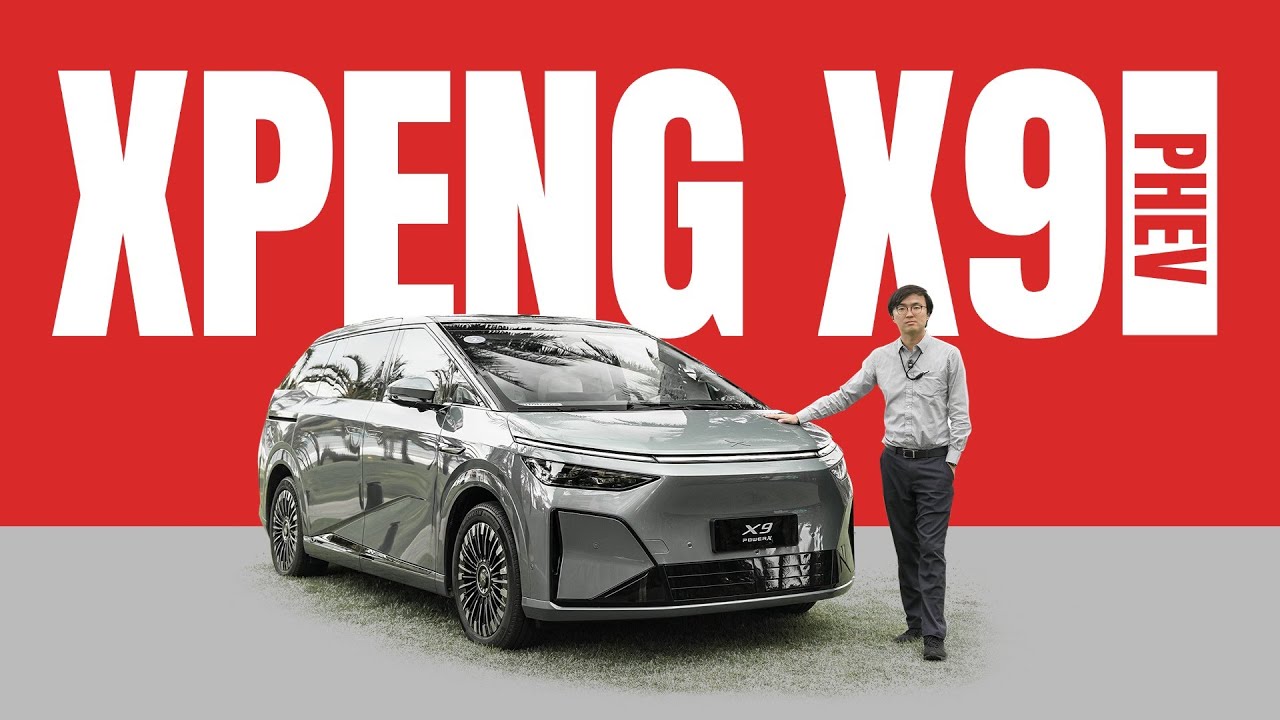
EV Converted into Petrol – XPeng X9 Range Extender Review
Hello and welcome to the telescope. Every week we bring you a fresh insight from the biggest car market in the world. Today’s car is the Xpon X9, but the range extender version that has a pure electric range of 452 km salecro I drive every day, but it’s a range extender. And experienced telescope viewers might have noticed the Xpunk X9 when I first introduced this car to you about 2 years ago. This was a battery electric vehicle, pure electric car. We’ve definitely seen petrol powered cars converted to a battery electric car. But how do you retrofit a battery electric car back into a range extender? Packaging wise must be a nightmare. In this nice cutaway, we can see exactly how XOM package everything. This is the petrol engine transverse mounted. And on the right side is the generator motor. This is the electric motor that turns the kinetic energy from the engine into electricity. And here you can see the major compromise that Xpon has made on this X9 being a BEV first retrofitted as a range extender is that this car does not have a front axle drive motor. is that this car doesn’t have four-wheel drive. It’s rear wheel drive only. And also being a range extender, there’s no mechanical link between the petrol engine and the car. The petrol engine output the electricity and send to the back motor simply through wires. I don’t think it’s a huge shame for this car to miss out on the four-wheel drive or the front axle power, but we have seen some wrench extenders recently can reuse this generator motor to double as the front axle drive motor to actually drive the front axle. If Xpen can do that in future iterations of X9 and this X9 can get a meaningful performance boost because you will see later on in the dynamic section. The performance is okay but just about okay. But the real magic is towards the rear axle on the side. You can see because the battery got smaller. This has 30 kWh less battery compared to the BV version. So they have the space to package a 60 L fuel tank. And this car doesn’t pick fuel. You can give it just about any fuel. You don’t need to give it the super delicate high octane rating fuel. It takes 92 octane rating fuels in China. But here at the rear axle is the real magic because if you remember the BV version of the X9 has a very small rear motor. The BV version of the X9 is predominantly frontwheel drive. The rear motor is only 135 kW. So, when I first heard that this car is rear wheel drive only, I thought that can’t be the case because you cannot drive a 2.7 ton car with a 135 kW motor. But no, this is Exon’s own 210 kW motor that somehow they’ve made this smaller than its 135 rear motor on the BV version. How they did that, I don’t know. And because this new motor is even smaller than the BV version’s rear motor, all of the functions amazingly on the rear axle gets fully retained. I’m talking about rear wheel steering, dual chamber air suspension, and also X9’s party trick. This third row seats, which sort of fully folds back into the floor, also gets fully retained. Also, now being a plug-in hybrid, by having an engine, this set of exhaust, they package all of this in a near identical interior package. The only bit of difference you see is that there’s a small bulge here on this section. We’ll put a comparison of the range extender version and the BEV version. That’s the only difference. I mean, bravo to Xpon’s packaging team by keeping the interior to this amount of minimum changes. The rest of the interior is a nicer version of the Xpon X9 we first showed you about 2 years ago. The most noticeable change is this now contrasting two-tone leather, which does add a lot of the luxury ambience to this car. and this very big um speaker cover, a new steering wheel which in terms of operating the assisted driving and changing the drive mode is now consistent with rest of the XON’s lineups three-spoke steering wheel. This is still a two-spoke steering wheel, but at least you have a consistent way of engaging with assisted driving and drive mode. And it I could be wrong, but I think this steering wheel horizontally is just a tiny bit smaller. It’s a tiny bit narrower, which is a welcome change. You know, the previous steering wheel, it’s fine, but you feel like you are handling a huge car all the time. I know this car is huge, but the previous steering wheel is sort of reminding you that almost every second. On the move with the range extender version of the X9, it’s now rear wheel drive. It’s got about 282 horsepower and this is roughly the same weight as the battery electric version which gives this car a very similar powertoweight ratio as my Volkswagen ID3 which makes this to work 100 km an hour is also roughly around 8 seconds. But I would say this car’s performance is more geared towards the low speed section. Below about 80 kph I’ll say this car is faster than my ID3. uh from 80 to 120 that kind of reaceleration phase I would say the performance is just about to be average that kind of C plus B minus region. I didn’t bring you the review of the 2024 model year um X1 X9 because it’s a minor facelift, but in that model year update and also carried over to this version as well is the vastly improved high-speed MVH. The 2024 model year and also this is now on the better side of being average. um it is good but if you compare it to let’s say the Leoto Mega um the Leoto i8 the latest um Neo ES8 and also the ZonX this is still there’s still some distance between this and those cars but also there’s a significant distance on price between this and all of the other cars I’ve just mentioned because we are expecting this range extender version to be priced I would is somewhere around 320 to 330,000 reming B. That’s about 30 to 40,000 reming B reduction compared to the BV version because this car uses less battery and this car uses an offthe-shelf range extender solution kind of consistent with many of the Huawei range extender models. So that uh range extender and exhaust solution is we know the open market price. It’s not that expensive. The highlight of this car is its massive battery, especially for a plug-in hybrid or or a range extender. This car has a BEV range, battery electric range of 452 km CLTC. That’s 2 km more than the Volkswagen ID3 Pro IR on a daily basis. This car to me most of the time, no most, not most of the time, all the time will be a battery electric car because my BEV, my daily BEV is has a shorter range than this and I have a home charger. So, the way I approach this is this is a BEV with a smaller battery, but will never run out of electricity. And this car running an off-the-shelf range extender solution. I can also point out this car is the MVH of the range extender checks out. You cannot really notice the range extender is on or not. Also, partly because it’s slightly rainy today with a lot of crosswind. Um, wind noise is particularly strong, but I can’t really pick up um the switching on and switching off of the range extender. Experienced EV owners and telescope viewers might think this range extender version of the X1X9 is an overkill and is quite unnecessary. the most probable use case that most owners of this car will probably never use the petrol engine because the battery electric range is that long and I agree with that. However, I review cars for a living and I also have a home charger. I know many ways when and how I can squeeze more performance out of the EV powertrain, but you cannot require everyone else to do the same. Especially if you have an extended family, you know, when you go out to a family day, happy but always to some degree chaotic, the last thing you want is to say to everyone, “Sorry, we need to make an extra stop to charge the car.” This range extender by having the petrol engine gives you that peace of mind. And I want to congratulate Exponent for successfully transforming this battery electric MPV into a range extender MPV. They tried really hard on engineering to keep everything that’s good about a battery electric version. There are other models on the Chinese car market today. They have plug-in hybrid and battery electric versions that they are so substantially different that underneath the bodywork, the same looking bodywork. They’re really two completely different cars. This is not one of them in a good way because in terms of stiffness, MVH and overall space efficiency, battery electric cars is always going to have an edge over plug-in hybrid cars. This kept 99.9% of the BV’s attributes. And that 001% of the difference is only noticeable to someone like me who review cars for a living. normal users of the range extend version of the X9, you will never notice that one last compromise XA made for the range extend version. I know some people might be disappointed that this car by having the petrol engine is somehow a dirtier car. Well, I would say don’t jump to conclusion that fast. First of all, I’m expecting minimum CO2 output from the tailpipe of this car because it has a battery electrical range longer than most mainstream electric vehicles. And secondly, this range extender version uses 30 kilowatt hour less battery than the smaller base battery version of the BV version of this car. And that’s a substantial reduction in carbon footprint in the manufacturing phase. So don’t just shout at the screen that this car is a plug-in hybrid, so it’s a dirty car. The total life cycle carbon footprint might not be that different after all. And that’s definitely an interesting exercise, isn’t it? Because owners of this range extended version of the X1 X9 when they switch to other battery electric cars in the future, they will know they don’t need all the battery, all the range in the world because they lived on quite a modest battery for such a huge car for a very long time and it seemed to be okay. So, their carbon footprint for their next car might just be smaller. That is all from the telescope today. If you enjoyed this video, keep watching, keep subscribing. More videos coming along very
XPeng shows you how to squeeze an engine back into an EV, and keep everything good about it.
Telescope channel introduction: https://youtu.be/oMb9ssowYR4
Contact: telescopesh@outlook.com
Chapters:
00:00 Intro
00:47 Packaging
04:06 Interior
05:04 Performance
05:54 NVH
06:41 Price
08:22 Why PHEV?
10:16 Verdict