BYD CEO Drops a Bombshell: New motor Engine Will Shakes The Entire EV Industry!
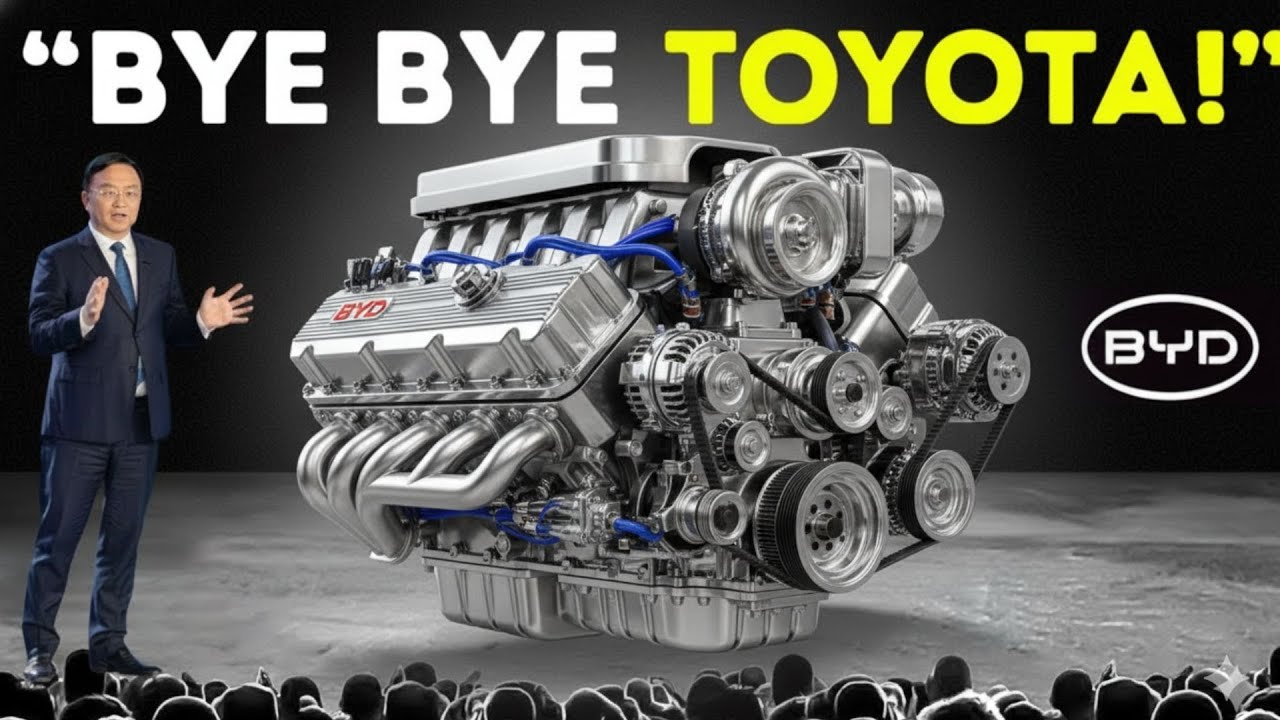
While Tesla was laying off 14,000 employees and cutting prices just to stay in the game, BYYD’s CEO quietly dropped a bombshell in Shian, which could destroy the EV industry as we know it. Picture this, a hybrid engine that gives you over 2,100 km on a single tank and charge with the highest thermal efficiency of any mass-roduced vehicle, 46.06%. This isn’t just a new engine, it’s a shot across the bow. Wong Chon Fu isn’t just competing anymore. He’s rewriting the rules. And if he’s right, Tesla may have just blinked at the worst possible moment. But how exactly does this new engine threaten to destroy an industry that’s supposed to be the future? Let’s break it down. The answer lies in what BYD calls their fifth generation DM technology. But calling it an upgrade doesn’t do it justice. This isn’t version 5. It’s a reset button, a complete reimagining of what a car engine is supposed to be. And it’s exactly why the BYD CEO just revealed a new engine that could destroy the EV industry. On May 28th, 2024 in the city of Xian, Wong Chuan Fu walked onto a stage that looked like every other auto launch event. Two sleek new sedans rolled out. One called the NLDMI, the other the Seal 6DMI. But this wasn’t just about new paint jobs or infotainment screens. Under the hood, something unheard of had happened. What Wong revealed was a hybrid powertrain with a thermal efficiency of 46.06%. If that sounds like just another stat, let’s put it in perspective. Most combustion engines waste around 70% of their fuel as heat. And even Toyota’s hybrids, the current gold standard, peak around 41%. So when BYD smashed that ceiling by over 5 percentage points, it didn’t just set a new record, it rewrote what engineers thought was even possible in a production car. But here’s what makes it truly dangerous to the EV industry. This isn’t a return to old school hybrids. BYD’s fifth gen DM is an electric ccentric platform, which means the gasoline engine isn’t even the main character. It’s the supporting act. Most of the driving, especially in the city, is handled by the electric motor. The gas engine only comes on when it can operate in what they call its high efficiency zone. So, it’s never burning fuel at stop lightss, crawling through traffic, or doing short trips where engines are typically the most wasteful. This isn’t just clever design. It’s a surgical reinvention. To pull this off, BYD had to run over 240 combustion experiments just to get the fuel mixture right. They tested more than 100 different cooling methods. They pushed the compression ratio up from 15.5 to 16. Now, that might sound like a tiny number bump, but in engine design, that’s a tectonic shift. It meant redesigning the combustion chamber from scratch, rebalancing thermal loads, and rethinking how materials hold up under extreme stress. And the result, it doesn’t just work in theory, it crushes in the real world. In June, during a live stream demo, BYD’s head of branding and PR, Lee Yun Feay, drove one of the new DMI cars under regular conditions. The car clocked in at 2.54 L per 100 km. That’s not marketing spin. That’s better than BYD’s own advertised number of 2.9. For context, a Tesla Model 3 eats up 16 to 20 kwatt hours per 100 km. And unlike a Tesla, this thing doesn’t care whether you’ve got a charger nearby or not. With a full fuel tank and battery charge, the car can travel a combined range of 2,100 km. That’s not a typo. That’s not wishful thinking. That’s nearly three times what most gasoline cars can do and about five times the real world range of most EVs on the road right now. And all of it without hunting for a fast charger in the middle of nowhere. Now think about what this actually means for drivers. Range anxiety, the number one fear holding people back from going electric, just disappears, gone. You get smooth, silent electric driving for daily errands. the kind of instant torque EV lovers crave. But for long road trips, no planning routes around superchargers, no cues at busy charging stations, no guilt when the battery drops below 20% in the middle of nowhere. This is where BYD’s engine stops being just clever tech and becomes a weapon. It solves everything EVs haven’t figured out yet. It gives you range, power, reliability, and convenience without asking for lifestyle compromises. No EV brand, not even Tesla, has managed to hit all those targets in one go. Which is why this isn’t just a challenge to the EV industry. It’s a knockout punch in the making. And Wong Chuan Fu knows it. This was never about building one great hybrid. It was about breaking the illusion that fully electric was the only future worth chasing. He’s not just trying to beat Tesla at its own game. He’s building a new one altogether. And honestly, ask yourself this. Think about your last long road trip. Would you rather pull over every 300 kilometers for a half hour charge or just keep driving for 2,100 without ever needing a plug? Because for most people, the answer isn’t about brand loyalty. It’s about freedom. And that’s exactly what BYD just offered the world. But as wild as this engine is, it’s not even BYD’s boldest move because hidden behind it is a battery technology that just survived tests no other manufacturer even dared to attempt. And what it endured changes everything. While Tesla struggled with battery fires and safety recalls, BYYD built something so absurdly safe that they now stab it with steel nails on stage live just to prove it won’t explode. Because this isn’t just another battery. This is BYD’s blade battery, and it might just be the most underestimated weapon in their entire arsenal. At first glance, it’s easy to miss how radical this design actually is. While most EV makers stack cylindrical cells like soda cans or fold pouch cells like Origami BYD decided to flip the table entirely. Their cells are long, flat, and razor thin, arranged edgetoedge like Samurai Blades inside the pack. Not a gimmick, but a full-blown structural redesign. One that sacrifices nothing and gains everything. Now, here’s where things get wild. Most EV batteries, especially the ones using nickel, manganese, cobalt chemistry, have a problem. If the pack gets punctured, damaged, or overheats, it can hit 500° C and just erupt into flames. Tesla has endured multiple high-profile media frenzied fire incidents. Similarly, legacy automakers like Nissan, GM, and Hyundai have all had their own turns in the unenviable fire spotlight with thermal runaway events searing themselves into public consciousness and becoming a significant psychological barrier to EV adoption. But BYD’s blade battery represents a fundamental departure from this volatile reality in a dramatic public demonstration of its inherent stability when engineers deliberately jam a steel nail directly through the heart of a fully charged cell in front of a live audience. A test designed to induce the worst case scenario of an internal short circuit. The battery’s reaction is astonishingly muted as it barely even warms up. We’re talking about a temperature increase to a mere 30 to 60° C. A range that is the thermal equivalent of a warm cup of coffee. There are no violent flames, no toxic smoke plumes, and no explosive disassembly. So, yes, the blade battery doesn’t just marginally pass the infamous nail penetration test. It conquers what is widely considered the single most brutal and unforgiving safety standard in the entire battery world. But the significance of this achievement transcends the laboratory. This isn’t merely about a battery surviving an abstract torture test. It’s about strategically flipping the entire script on deep-seated consumer fear and anxiety. Because every viral video of a Tesla or another EV engulfed in flames powerfully reinforces a subconscious public narrative that electric vehicles are potential ticking time bombs, a perception that has stubbornly hampered widespread acceptance. BYD didn’t just incrementally address this safety concern. They have effectively deleted it from the consumer conversation, transforming a glaring weakness of electric mobility into an unassalable strength and a powerful marketing pillar. However, groundbreaking safety is just the visible surface of the blade batteries revolution. Lying underneath, this innovative power source is systematically rewriting the very economics of electric mobility. First and foremost is its achievement in energy density. BYD’s engineers have managed to squeeze a remarkable 50% more energy into the same physical space compared to previous generation lithium iron phosphate cells. Crucially and perhaps most impactfully, they accomplish this density leap entirely without cobalt, a strategic master stroke that is huge for the industry. This breakthrough eliminates the industry’s precarious dependencies on expensive and geopolitically tense rare earth supply chains, sidesteps the ethical and environmental quagmires of sketchy mining practices, and liberates manufacturers from the volatile commodity price roulette that has long plagued battery production. The ultimate result is a transformative trifecta of batteries that are simultaneously cheaper to produce, profoundly safer to use, and significantly denser in energy capacity, thereby delivering a decisive blow to the long-standing trade-offs between cost, safety, and performance that have defined the EV battery landscape for ears.
What if I told you that a single motor has the power to shake the foundation of the entire EV and hybrid industry? 🚗⚡ Yes, we’re talking about BYD’s new motor technology that has already left the world’s biggest auto brands restless. This isn’t just about power—it’s about intelligence, efficiency, and future-proof performance that could redefine how we drive forever.
In this video, we’ll uncover the hidden technology inside BYD’s motor that experts are calling a potential game-changer. Could this be the biggest threat to Tesla and other global giants? Or is it just another marketing trick? Watch till the end to discover the truth behind this revolutionary innovation.
#BYD #Tesla #ElectricVehicles #EVRevolution #HybridCars #FutureOfCars #EVTechnology #ElectricMotor #GameChanger #BYDMotor #AutoIndustry #NextGenEV #CleanEnergy #CarTechnology #Innovation #EVFuture #TechRevolution #SustainableCars #EVVsTesla #BYDTechnology
Copyright & Content Disclaimer:
This video may contain copyrighted material, including images, video clips, and other media. We do not claim ownership of any copyrighted content used, and all rights remain with the original creators.We use such materials in accordance with Section 107 of the U.S. Copyright Act, which provides for “fair use” for purposes such as criticism, comment, news reporting, teaching, scholarship, or research.All content is used in good faith under fair use guidelines and is intended to educate, inform, and inspire discussion.
⚠️ Disclaimer: The content of this video may include a mix of facts, speculation, and creative interpretation. It is intended for entertainment, educational, and informational purposes only.