
Toyota North Carolina officially began production on their electric vehicle battery plant in Liberty, Randolph County, with a grand opening event. Local, state and federal officials joined Toyota leadership at the 1,850-acre megasite (the equivalent of 120 football fields) for an official tour and welcome party. The battery facility marks the first of its kind operation in the United States for the company.The Toyota plant brings a $14 billion investment to North Carolina, with an additional $10 billion promised in the next five years in the United States. As of 2025, Toyota has invested $60 billion in the energy and transportation sector in the United States. “Americans love cars because a car means freedom,” said US Transportation Secretary Sean Duffy, who spoke before a crowd of thousands at the event Wednesday. “When companies invest in America, that means great American jobs. And I think the example here is the families sustaining great American jobs that Toyota has made for this community comes from that $14 billion investment.”The new facility hosts 2,000 employees and is set to hire 3,000 more employees in the next phases of development. The current capacity of the megasite can create 150,000 batteries per production line that could power 600,000 vehicles. Last year, Toyota said it sold 1 million vehicles with electric battery capabilities. “There’s going to be a good chance that your new Toyota hybrid, plug-in hybrid, or electric vehicle will be powered by a battery that comes off the line in this facility,” said North Carolina Gov. Josh Stein. Former governor Roy Cooper announced the plans for the megasite back in 2021, and leaders at the opening event gave a nod to the late former Greensboro Mayor Jim Melvin for his commitment to economic development in the Triad. The site not only employs North Carolinians, but also lowers the cost of electric vehicles produced for Toyota in the U.S.”We want to be both the employer of choice for the people of North Carolina, and all of our sites across North America, but also we stay close to our customers and we want to make sure for families that they have affordability to be able to have mobility,” said Kevin Voelkel, the senior vice president of manufacturing operations for Toyota North America. The raw materials used for batteries are imported to the U.S., but production costs and use of American labor in North Carolina streamlines the entire supply chain process.”Here in North Carolina, there are more than 400 Japanese companies operating,” said Shigeo Yamada, the Japanese Ambassador to the U.S. “Japan is proud to be the leading investor and leading employer in this state.””It’s about belief in the American Dream, belief in the American workers, belief in the power of technology and teamwork to move us all forward,” said Toyota North America president Ted Ogawa.Ogawa and Toyota North Carolina president Don Stewart announced that Guilford County Schools and Asheboro City Schools would receive a $2.7 million donation for STEM education through Shift_Ed and their Driving Possibilities education initiative.How it works: battery productionMuch of the battery building process is kept under wraps because of the patents on the manufacturing process. Although cameras were not allowed inside the manufacturing site, journalists got a tour of the production site that has already begun.Cells are made of anodes and cathodes. They go through a vacuum-sealed process in a tight room that locks the cells into an aluminum body to mitigate contamination. They are processed in a temperature and humidity-controlled environment and laser sealed as well. Voltages are checked, and helium checks are done to weed out the ‘bad’ cells. Cells are roughly the size of a cell phone once they are sealed.Electrolytes are run through the dry cells to ensure that the battery can hold a charge, and a second leak test is done. Then, dozens of cells are stacked together in a process called palliating. The pallets are then put inside a heater to be tested for quality and to withstand different conditions.The waiting cells go through a charge and discharge process that lasts anywhere between five to 15 days, otherwise known as the “cell phone theory.” That means cells get charged, wait for the energy to leave the cell, and then attempt to charge it again. AI is not currently being used on the production floor or in the manufacturing process. The cells get put into a formation called a module, which is the base of the final product battery seen in hybrid vehicles, hybrid electric vehicles, and battery electric vehicles that Toyota produces in Alabama and Kentucky. The module is approximately 80% complete when it leaves the Randolph County facility and is finalized on the production floor when being put into vehicles like the Rav-4, Highlander, Corolla, and Camry.
LIBERTY, N.C. —
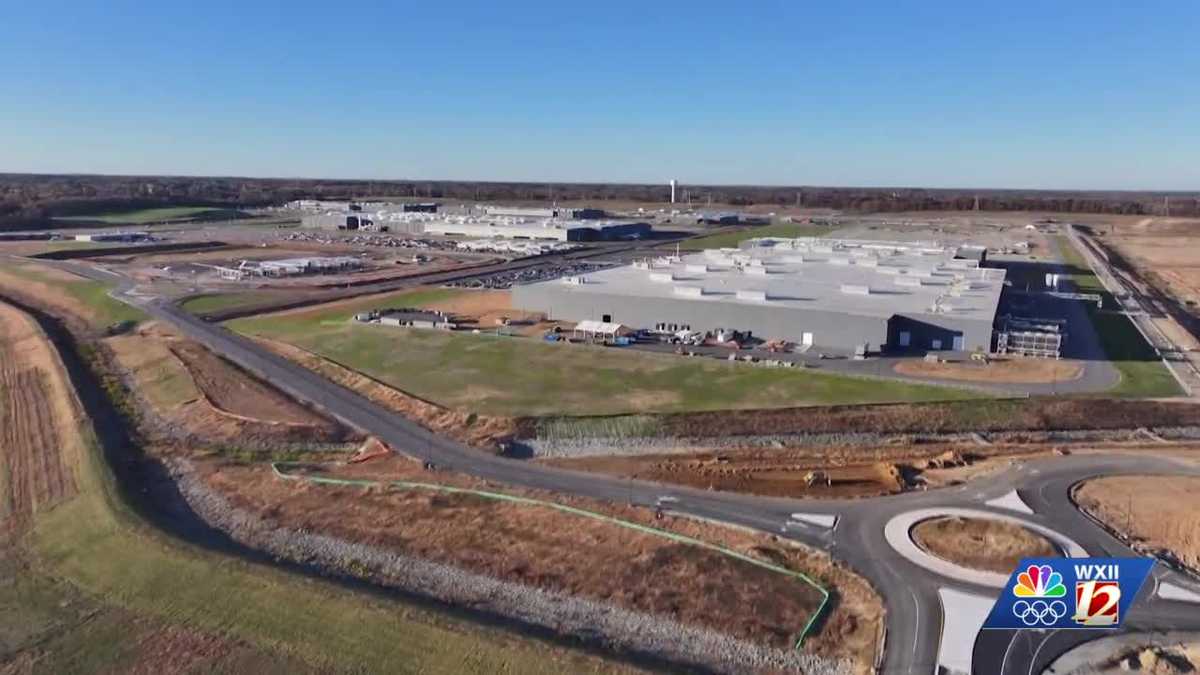
Toyota North Carolina officially began production on their electric vehicle battery plant in Liberty, Randolph County, with a grand opening event. Local, state and federal officials joined Toyota leadership at the 1,850-acre megasite (the equivalent of 120 football fields) for an official tour and welcome party. The battery facility marks the first of its kind operation in the United States for the company.
The Toyota plant brings a $14 billion investment to North Carolina, with an additional $10 billion promised in the next five years in the United States. As of 2025, Toyota has invested $60 billion in the energy and transportation sector in the United States.
“Americans love cars because a car means freedom,” said US Transportation Secretary Sean Duffy, who spoke before a crowd of thousands at the event Wednesday. “When companies invest in America, that means great American jobs. And I think the example here is the families sustaining great American jobs that Toyota has made for this community comes from that $14 billion investment.”
The new facility hosts 2,000 employees and is set to hire 3,000 more employees in the next phases of development. The current capacity of the megasite can create 150,000 batteries per production line that could power 600,000 vehicles. Last year, Toyota said it sold 1 million vehicles with electric battery capabilities.
“There’s going to be a good chance that your new Toyota hybrid, plug-in hybrid, or electric vehicle will be powered by a battery that comes off the line in this facility,” said North Carolina Gov. Josh Stein.
Former governor Roy Cooper announced the plans for the megasite back in 2021, and leaders at the opening event gave a nod to the late former Greensboro Mayor Jim Melvin for his commitment to economic development in the Triad. The site not only employs North Carolinians, but also lowers the cost of electric vehicles produced for Toyota in the U.S.
“We want to be both the employer of choice for the people of North Carolina, and all of our sites across North America, but also we stay close to our customers and we want to make sure for families that they have affordability to be able to have mobility,” said Kevin Voelkel, the senior vice president of manufacturing operations for Toyota North America.
The raw materials used for batteries are imported to the U.S., but production costs and use of American labor in North Carolina streamlines the entire supply chain process.
“Here in North Carolina, there are more than 400 Japanese companies operating,” said Shigeo Yamada, the Japanese Ambassador to the U.S. “Japan is proud to be the leading investor and leading employer in this state.”
“It’s about belief in the American Dream, belief in the American workers, belief in the power of technology and teamwork to move us all forward,” said Toyota North America president Ted Ogawa.
Ogawa and Toyota North Carolina president Don Stewart announced that Guilford County Schools and Asheboro City Schools would receive a $2.7 million donation for STEM education through Shift_Ed and their Driving Possibilities education initiative.
How it works: battery production
Much of the battery building process is kept under wraps because of the patents on the manufacturing process. Although cameras were not allowed inside the manufacturing site, journalists got a tour of the production site that has already begun.
Cells are made of anodes and cathodes. They go through a vacuum-sealed process in a tight room that locks the cells into an aluminum body to mitigate contamination. They are processed in a temperature and humidity-controlled environment and laser sealed as well. Voltages are checked, and helium checks are done to weed out the ‘bad’ cells. Cells are roughly the size of a cell phone once they are sealed.
Electrolytes are run through the dry cells to ensure that the battery can hold a charge, and a second leak test is done. Then, dozens of cells are stacked together in a process called palliating. The pallets are then put inside a heater to be tested for quality and to withstand different conditions.
The waiting cells go through a charge and discharge process that lasts anywhere between five to 15 days, otherwise known as the “cell phone theory.” That means cells get charged, wait for the energy to leave the cell, and then attempt to charge it again. AI is not currently being used on the production floor or in the manufacturing process.
The cells get put into a formation called a module, which is the base of the final product battery seen in hybrid vehicles, hybrid electric vehicles, and battery electric vehicles that Toyota produces in Alabama and Kentucky. The module is approximately 80% complete when it leaves the Randolph County facility and is finalized on the production floor when being put into vehicles like the Rav-4, Highlander, Corolla, and Camry.