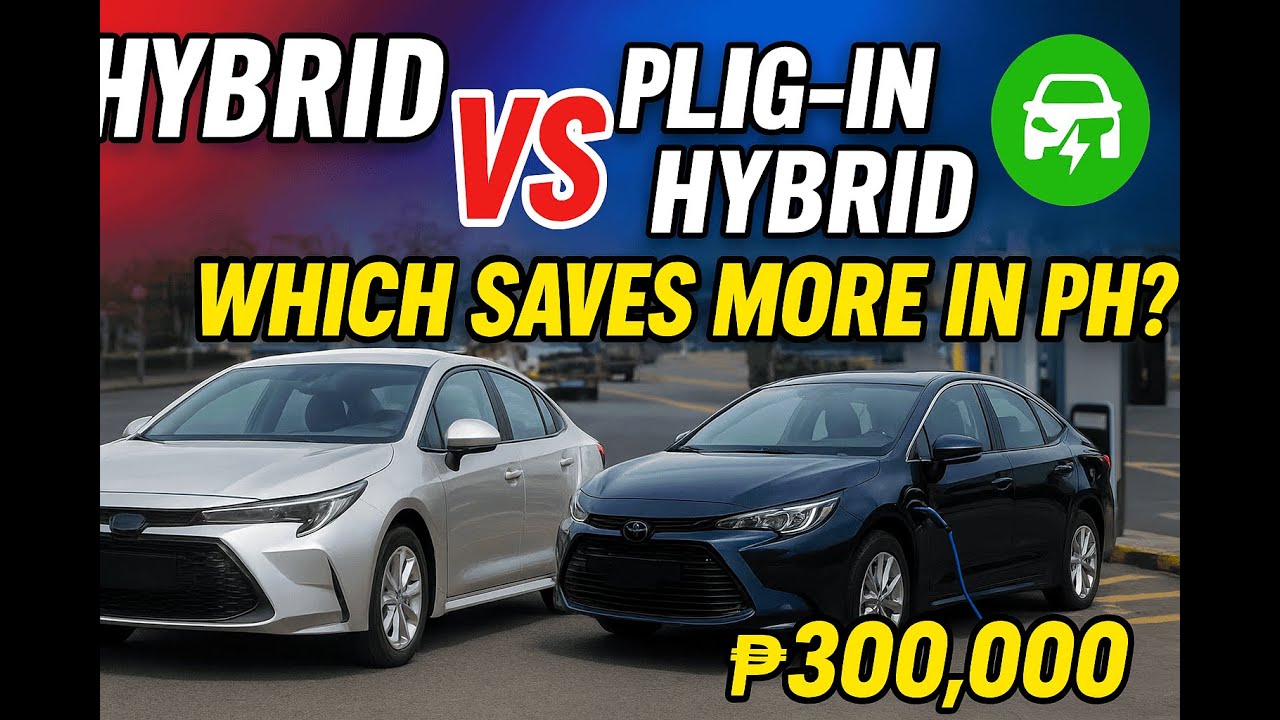
“HYBRID vs PLUG-IN HYBRID in the Philippines: Which One REALLY Saves You More?”
What’s up, auto fans? Thank you for coming back to our channel where we make car ownership simple. Hybrid or plug-in hybrid? Which one actually saves you more here in the Philippines? Before you spend that extra Philippine peso, 300,000, let’s break down which powertrain gives you real savings, comfort, and convenience on our roads. But before we start, if you’re new here, please hit that subscribe button and ring the bell icon. That way, you’ll get updates on all our future content, from buying tips to getting your car road trip ready. All right, let’s break these two down. First, we have the regular hybrid or HEV. Think of it as a standard car with a gasoline engine, but it also has an electric motor and a small battery. The key thing here is you never have to plug it in. The battery charges itself through a clever process called regenerative braking, which captures energy every time you slow down. Then you have the plug-in hybrid or PHEV. It’s got the same setup, a gasoline engine and an electric motorbud. It comes with a much larger battery and as the name suggests, you can plug it into an outlet to charge it up just like your smartphone. This bigger battery allows you to drive on pure electric power for a certain distance. Once the battery runs out, the gasoline engine kicks in automatically, so you’re never stranded. So, a simple way to remember it is all plug-in hybrids are hybrids, but not all hybrids are plug-in hybrids. Now, let’s bring this discussion home to the Philippines. Because choosing between these two isn’t just about the technology. It’s about our driving habits, our infrastructure, the costs, and the local incentives. Let’s talk fuel savings versus the cost of ownership. Hybrids definitely offer better fuel economy than pure gasoline cars. In our notorious traffic, that electric motor constantly kicks in, reducing the engine’s workload and saving you fuel. However, hybrids have a higher upfront cost. That extra 300,000 pesos or so could take you around 8 years to recover just from fuel savings alone. Next, charging infrastructure and your daily routine. This is where PHEVs get a bit tricky. To truly maximize a PHEV, you need to plug it in. If you live in a condo in Metro Manila or park on the street without easy access to a home or workplace charger, you might not be able to use its electrocon feature optimally. And if you’re not using the electric motor, you’re just carrying around the extra weight of a big battery, which can actually make your fuel economy worse when running on gasoline. What about government incentives? Here in the Philippines, there are some perks. Electrified vehicles, including hybrids and PHEVs, are generally exempt from excise tax and often have lower registration costs. Some are even exempt from the number coding scheme, which is a huge plus for city dwellers. And finally, our unique road conditions. Think about it. The stopandgo chaos of EDSA, the long stretches of provincial highways, the tolls, and even hopping on a ferry to another island. All these scenarios affect how effective a hybrid or PHEV can be. If most of your driving is on the highway at a constant speed, the electric assist from a regular hybrid becomes less advantageous. So, when we compare hybrid versus plug-in hybrid here in the Philippines, we have to layer all these local factors into the equation. Let’s run through some real life scenarios to make this clearer. Scenario A, you buy a regular hybrid. You drive it mostly in the city, stuck in that classic Manila traffic. The electric motor helps out during all that stopping and starting, so you use way less gasoline. You didn’t have to worry about installing a charger or finding a plug. The upfront cost was a bit higher than the gasoline only version, but you’re saving on fuel. There’s less wear and tear on your brakes thanks to regenerative braking, and you might get some tax benefits. It’s a simple, no fuss way to be more fuel efficient. Now, scenario B, you go for the plug-in hybrid. You paid a significantly higher price up front because of that big battery, but you have a garage at home where you can charge it every night. Your daily commute to work is short, maybe 20 to 30 km. This is the sweet spot. You can drive to work and back almost entirely on electric power, barely using any gasoline. Your fuel savings are huge. But if you often drive long distances, say from Manila to Bickl, or if you can’t charge it regularly, that advantage shrinks fast. That expensive battery just becomes dead weight. Here’s a quick ballpark tip to help you decide. If you drive mostly in the city, have reliable access to charging, and your daily commutes are short, a plug-in hybrid could be absolutely worth it. But if your driving is a mix of city and long highway trips, or if you don’t have a dedicated charging spot, a regular hybrid will likely give you better overall value for your money. So, you’re leaning towards one or the other. What are some practical buying and maintenance tips for us here in the Philippines? First, if you’re eyeing a PHEV, honestly assess your charging setup. Do you have a garage with a power outlet? Can you install a dedicated wall charger? How much will that cost? And be realistic. How often will you actually plug it in? If you’re relying on street parking, the plug-in advantage disappears. Second, check the service and parts availability. These cars are more complex. Make sure the dealership has technicians trained to handle hybrid systems, and check the warranty, especially for the battery, which is the most expensive component. Third, look at the actual electric range of a PHEV. Ask the dealer how many kilometers it can go on a full charge. In the Philippine context, that range might be just enough for your daily drive, but if you’re planning a trip from Manila to Bagio and then up to Isaac Co, you’ll be on the gasoline engine for most of that journey anyway. Fourth, calculate the total cost of ownership or TCO. Don’t just look at the sticker price. Factor in the upfront cost difference, your estimated fuel savings per year, the cost of electricity for charging, maintenance, and even potential resale value. As we mentioned, some owners calculate the payback period for a hybrid to be around 8 years just on fuel savings. And let’s not forget the travel side of things. If you frequently drive from Manila to Tagait or Batangas, a regular hybrid is great. All that traffic and braking on the way down helps recharge the battery, saving you fuel. If you have a PHEV and charge it overnight, your drive out of the city could be almost entirely electric. Then once you hit the SLEX or NLEX, the gasoline engine seamlessly takes over. That’s amazing flexibility. But if you’re doing a big north Luzon loop from Manila to Baguio to La Union, you’ll find very few public chargers along the way for your You’ll be running on gasoline most of the time, reducing the benefit. Also, consider the extra weight when climbing steep mountain passes or carrying a full load of family and luggage. And a pro tip, regardless of which you choose, always prep your car for a road trip. Check your tire pressure, your battery state, and all your fluids. Plan your route, including tolls and potential charging stops. Your high-tech car is only as good as how well you prepare it for the journey. So, what’s the final verdict? If you want the absolute maximum fuel savings, you have reliable charging at home or work, and you mostly do short urban trips, you’ll get more value from a plug-in hybrid. But if you drive a mix of city and long distances, or you don’t have easy access to charging, then a regular hybrid is probably the sweet spot for cost effectiveness here in the Philippines. Remember, the real winner isn’t decided by the label on the car. It’s decided by your personal usage pattern, your access to charging, and how much more you’re willing to pay upfront. If you found this breakdown helpful, please hit that like button and share this video with your friends who are car shopping and comment below which one are you leaning towards and why. I’ll read through your comments and maybe we can do a Q&A in a future video. Don’t forget to subscribe for more Philippines specific car buying tips, maintenance hacks, and travel ready prep. Drive safe, enjoy the ride, and I’ll see you in the next
HYBRID vs PLUG-IN HYBRID (PHEV) in the Philippines 🇵🇭 — Which one really gives you the most savings?
In this video, we’ll break down the difference between a regular Hybrid (HEV) and a Plug-In Hybrid (PHEV) — and find out which powertrain makes more sense for Filipino drivers.
We’ll look at:
🚗 Real fuel savings in Philippine driving conditions
⚡ Charging availability and condo/home setup challenges
💰 Cost of ownership and pay-back period
🛣️ Road-trip and daily commute scenarios (Metro Manila, Tagaytay, Baguio, Batangas)
🏦 Incentives, taxes, and ownership perks for hybrid car owners
If you’re planning to buy a hybrid vehicle soon — Toyota Corolla Cross, Mitsubishi Outlander PHEV, Nissan Kicks e-Power, or any upcoming models — this video will help you decide which is more practical for your lifestyle.
💡 Pro Tip: We also share maintenance and travel prep tips for hybrid owners to help you get the best out of your investment.
Don’t forget to LIKE 👍, SUBSCRIBE 🔔, and COMMENT below which one you think fits better in the Philippine setting — the regular hybrid or the plug-in hybrid!
#HybridVsPHEV #HybridCarsPhilippines #PlugInHybridPH #HybridSavings #FuelEfficiencyPH #CarBuyingTipsPH #HybridTechnology #ToyotaHybridPH #MitsubishiOutlanderPHEV #NissanKicksEPower #CarVlogPH #DrivingInThePhilippines #CarMaintenancePH #RoadTripReady #AutoTipsPH #PinoyCarLife #HybridVsGas #PHEVExplained #SustainableDrivingPH #ElectricVehiclesPH