Zeekr 7X RWD vs AWD: Range Test & The Surprising Truth About AWD Efficiency
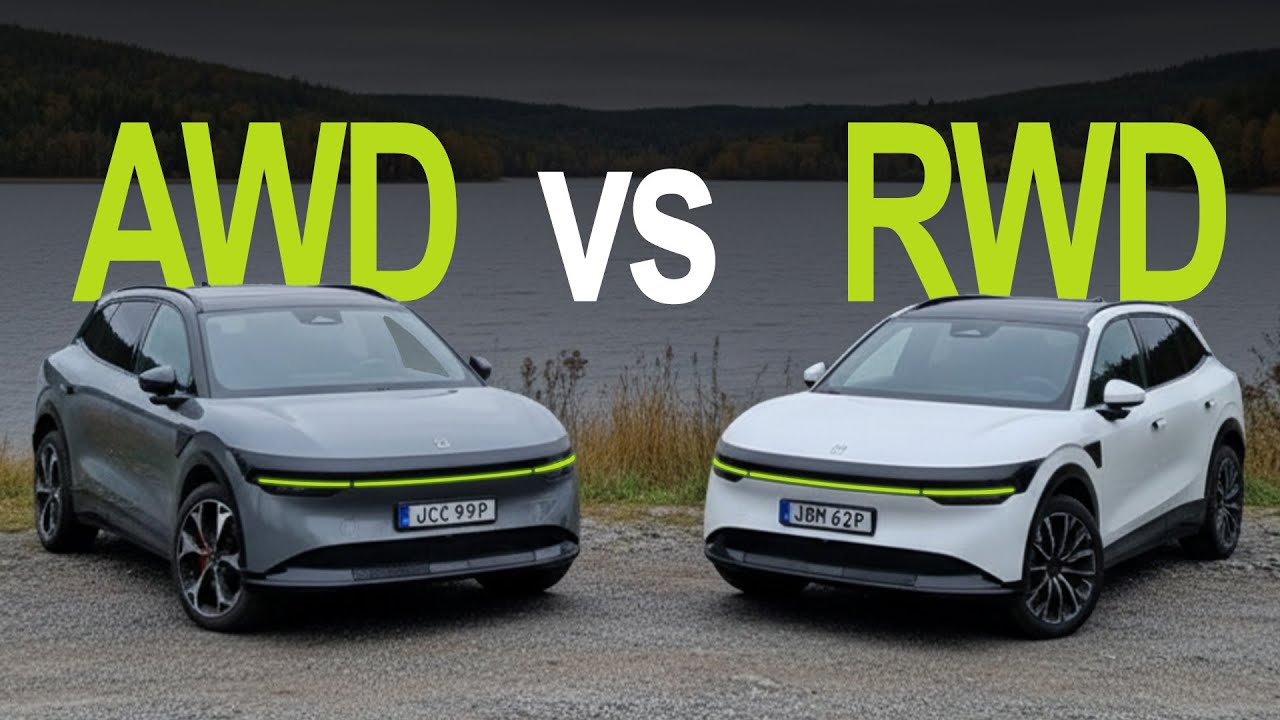
It’s time for the battle of these 7Xs. Here to my left in pearl white, a rear wheel drive version. To my right in tech gray privilege all-wheel drive performance version. And this video is about comparing the actual range on highway and a mix cycle, but also the cabin noise, so the comfort level inside the car. But before we do that, let us walk through the actual differences when it comes to the specifications. Welcome to It’s Only Electric. Let’s start. [Music] It’s only electric. [Music] So, driving on the rear wheels only with a permanent magnet motor at the rear, putting out 310 kW, 421 horsepower or 440 Newton meters of torque, 0 to 100 in 6 seconds flat, top speed 210 km perph. This one though puts out 475 kW since it has two permanent magnet motors. One that’s possible to decouple here at the front. 710 newton meters of torque or 646 horsepower. That’s a lot. 0 to 100 in 3.8 seconds with the same top speed as this one at 210 km/h. When it comes to the weight, this one actually weighs 100 kg more. So 2.5 tons compared to 2.4. Another difference is the wheel setup. The rear wheel drive version does have the extra equipped 20-in rims. Micheline Pilot Sport tires 26545 all around, whilst the privilege version comes with 21in rims, Continental Eco Contact 7, 26540s all around. Will this make the cabin noise better on that one? And how much will it actually affect the range? That’s what we’re going to test today. And another difference is the frunks. This one has 20 L of extra frunk space because you don’t have the motor at the front. So, both cars are equipped with the same big NMC battery pack with a gross capacity of 100 kW hours and a net capacity of 94. So, the same pack. When it comes to range, that’s when it gets interesting because this one has a claimed WP range of 541 km whilst this one has 610. So the penalty of getting all-wheel drive is 70 km on paper, but how much will you actually lose in real life? Let’s test that. So starting the range test in the privilege version and the first stretch the mixed cycle. So the mixed cycle is a 80 km long cycle. Always drive the same stretch of roads. It’s a mixed speed setup between 50 all the way up to 110 km/h. So average speed is 93 km/h. And I stick to a set of certain rules. First off, stay to the speed limits. The second thing, set the AC to 20° auto and eco is active. Second thing is the dry mode. And I always set the cars to eco if eco is available as a dry mode. In the Zeker 7X, there is no dry mode called eco, but I set the acceleration mode to comfort, and that’s the best I can do. One thing that’s interesting with the privilege version is that it comes with the air suspension, which means that it actually lowers the car on certain speeds. So it just jumped back from very low to low. So when you drive over 100 km/h, it actually drops to very low to preserve energy and lower the air resistance. And I check in I have been driving for 20 km almost 19 to be more exact. Um as you see here in trip 2 and the average consumption until now is 23.2 2 kW hours per 100 km. And uh I mean that’s high for the moment. It’s 8° outside. Dry roads. Did rain a couple of hours ago, but the road seems to be fairly dry anyway. So pretty good conditions, but still 8° C, so it could be cold. Maybe not mild winter, but almost. But running on summer tires. So hitting the halfway 40 km past average consumption until now 20.6 kilwatt hours per 100 km. So 20.6 it’s going slightly downwards but on these roads it’s a bit more damped. So I would say semi- damped dry to semi-damped conditions. But I’m going to drive the other car back to back. When it comes to the suspension, as I mentioned, this one is running the air suspension as it’s the privilege version whilst the rear wheel diversion is running on the traditional steel coil setup. No active dampers. I like that setup too and I think it behaves good. I will elaborate a bit more on that topic when I do the same stretch with the rear wheel diversion. This will be a interesting result. Will the bigger wheels, slightly heavier car, and the extra motor with all that output add to the consumption on this cycle and on the highway test? We’ll see about that. But I don’t know about you guys, but I’m excited cuz uh I think the result may be a bit surprising. And for you that’s new to the channel, this is usually what we do. We have tested over 60 cars on this specific cycle. We do it the same way every time to get comparable result. We also do the 120 highway test, cabin noise, acceleration test, etc. All that data for all our tests are gathered into one giant spreadsheet and that’s available for members in the members section. So, as a member, you will get priority on your questions. So, priority replies, you will get access to videos before everyone else. And you will also, of course, get access to this spreadsheet with all our test data. So, now in the rear wheel drive version, I have been driving for 22.8 8 kilometers average consumption until now 20.5 kilow per 100 km I don’t exactly remember but it feels like it is slightly lower than I had on the privilege version at this stage but we’ll see about that other things to mention the suspension despite being a traditional coil suspension with normal dampers. I feel that this is a good setup. This behaves better in certain conditions than the air suspension. The air suspension is a bit harsh during harsh road conditions and uh in low speeds. This one handles low speeds better. But if you go over big bumps for instance, then the air suspension is better. whilst this one is a bit too stressed in higher speeds. So on highways you will have a better comfort with the air suspension. And on top of that, of course, also the possibility to adjust the height of the car with the air suspension. That’s also a good perk if you if you need that. And on highways, you will get hopefully a bit lower air resistance when in the lower or very low mode. Other than that, try to feel the the cabin noise difference. It’s really hard. But just my perceived experience is that it feels very similar. It doesn’t feel less noisy. So, the cabin noise seems to be very equal. The privilege version has bigger rims, 21 instead of 20, but the footprint of the tires are still the same. So, 265. So, the width of the tires all around are the same. So, the contact you get with the asphelt with the road is the same. So the same amount of rubber touching the row. So that means that the wheel difference or the difference in the wheel size doesn’t matter that much when it comes to cabin noise. What probably can matter of course is the type of tire you’re using. Both tires does have acoustam in it. So there is kind of a soundproofing or sound insulation within the tires to avoid replication of noise. Regarding the door handles on the privilege version, I’m running the automatic doors. So there is no extractable door handles. This one though does have the regular doors with extractable door handles. And I must say that I’m not sure if I missed it or which one I would go for again cuz there is a lot of nice features with automatic doors especially when you after you have jumped into the car. It’s very easy to use can be a bit frustrating sometimes but on the other hand the manual doors does not feel as premium. So, when it gets used to the automatic doors, I think the automatic doors is something I want to keep. I’ve said it before. I think I wouldn’t pay extra for the automatic doors. U cuz I got it for free in uh for free. It was included in in a package that was included in kind of a introduction uh campaign on on the Zer 7 X here in Sweden. But I wouldn’t pay extra for them. I still stick with that conclusion. Back when I did my first real range test with the privilege version, that was during summertime. I think it was like 25° CC or something like that. So, perfect conditions. Then I scored a consumption of 16.6. That’s really good. That’s better than now, I can say. Uh and of course that’s due to the different weather conditions. Still semi- damp roads and uh cold outside 7 8° Celsius. So uh big difference. But that also tells us how much the weather plays here. I mean when it comes to range weather conditions is so important. One of the most important facts actually when you drive electric. Final check-in closing into 50 km/h. Now it’s the highspeed stretch left. So highway driving average consumption currently 20.4 or 20.3 km per 100 km. So feels like it’s very close to the results of the privilege version. But let’s see about the final result. After this, I’m also going to dissect and show you the numbers for the 120 test. So, it’s time to walk through things here. Now, let us start with the highway test, the results of that one. And just for information, what we do is that we drive the car on a highway in 100 km/ hour straight, keep that speed according to the GPS. And according to the GPS, you need to keep a speed of 119 km according to the car. That equals to 120. That’s normally not the case. Normally, you need to drive a bit quicker, but not with the Zeer 7X. And that goes for both cars, the rear wheel drive and the privileged version. So, uh the end result maybe not that super surprising uh is that in a constant speed all-wheel drive and the extra 100 kg of curb weight does not matter that much or I would say almost nothing or nothing cuz the end result given the road conditions dry roads 4° C so almost winter conditions in this is mild winter. I would say the rear wheel drive version ended up with a consumption of 25.6 kilwatt hours per 100 km. That equals to a full range of almost 370 km. And the all-wheel drive version ended up almost identical with 25.8 8 kilowatt hours per 100 km. That equals to a total range of 365 kilometers. So in reality on highway you will get the same range. This is of course in a constant speed. And what happens then is when driving in comfort, the car decouples the front motor for the privilege version, meaning that it’s resistant free and it’s rolling on the front uh front tires. Only the rear motor is engaged. And that means that the only difference is actually the weight. And when keeping a constant speed, the weight doesn’t matter that much. The weight will only matter when decelerating and accelerating a lot because then you will feel the difference and you will need more energy to pick up the pace. So very equal. And if we look at the mixed speed uh with an average speed of 93 km per hour, I was expecting kind of a bigger difference, but after driving the car for one week now, uh I have a hard time telling if there is any actual efficiency gains by going for the rail drive because the numbers I get is very close or exactly the same as for the privilege version as I use as my daily driver. Uh so that actually also is the case for this range test. So when looking at the numbers the regular diversion managed a average consumption of 19.8 8 kilw hours per 100 km. Road conditions dry to semide damped 8° Celsius. The exact same road conditions as for the privilege version as I took the cars back to back. So 19.8 that equals to range of 482 kilometers. So 482 km for the full battery pack. And if you look at the numbers for the privilege version that actually ended up at 19.5. So slightly lower but I would say within the margin of error. So I would say the same, but that translates into a range of 490 km and that’s actually 91% of the stated WLTP range and the rear wheel drive version 79% of its claimed range. So this is what happens. I mean in these conditions there is truly no efficiency gain going for the rear wheel diversion. When you go electric this is the case and for some cars you really see that for instance Tesla there is not that much of a loss of range if you look at the paper the WTP range when comparing a rear wheel drive car compared to a allhe drive car. also goes for cars like the Mercedes, the new Mercedes CLA, very close in WTP range for all wheel drive versus rear wheel drive. And that’s what we are seeing when it comes to EVs. We can really in a efficient way decouple the front motor or put in induction motors at the front. But I’m curious if there are any rear wheel drive version owners watching this video. Can you confirm my findings here? Do you like see the same thing? uh the numbers, write that in the comments below. Let us have a discussion. So, let’s move on to the noise test. Cabin noise. I always measure the cabin noise at the same exact same stretch of roads, dry roads, and I always place the microphone head height at the passenger seat to be able to create consistent and comparable results. And I measure noise in 50, 70, 90, and 110 kilometers per hour. And I mean, this car does have smaller rims, 20 instead of 21. But keep in mind that the tire width is the same. So 265s all around. That means that the tire noise, the amount of rubber that’s touching the the asphalt is the same, but the brand of the tires is different. Since this one is running the Michelin Pilot Sport tires and the privilege version comes with Continental Eco Contact 7 tires. I still could expect difference but both are having the acoustifoam so they are insulated and trying to like stop replication of vibrations and sounds coming from the tires. So this is also the case. I mean this is the final result of the measurement and as you see almost identical and this is also within the margin of error. So, I would say you will not expect any like comfort gain when it comes to cabin noise picking between these two. Maybe if you go for the 19in wheels instead. I’m not sure if the width are the same on those tires, but you have more rubber. So, maybe you will get a bit more of a silent ride. But with that said, this is a silent car. I mean, it’s not among the top silent cars. It’s not Xpank G9 silent. It is not Mercedes G-Class silent or EQS silent. It is not. But it’s still a comfortable ride and it’s silent. It’s a It’s a nice cabin. And the good thing is that there is very little to no wind noise. Even in higher speeds, I think the wind noise is really silent or non-existing. So now when all the numbers are on the table, which version would I go for? I mean earlier I picked the privileged version. Obviously it’s my car, but I would say I would still pick the privilege version cuz the price difference is around €6,000 depending on the market you are on. And for that you get the contrast colored roof. So the black roof instead of the body colored roof. You will get bigger rims. You get bigger brakes, you get all-wheel drive, a lot more power, uh the air suspension. So, you get a lot of things for that price difference. And I think it’s really worth the money cuz I think the sus the air suspension is slightly better. It’s more comfortable on highways than the traditional springs. And I think the rims, even if the 20-in rims looks really good, I prefer the 21s. And on top of that, as we just saw, you don’t lose any range. Actually, in real life, you will have approximately the same range and efficiency. I mean, the WLTP numbers are saying that the difference between the two cars is 70 km, but in real life, there is almost no difference at all. And that for me was the biggest downside, losing range when going for a sportier version of the car. But you don’t do that in real life. You will end up having the same range, the same efficiency, and the same amazing charge curve. So, you can charge it from 10 to 80%. You can see that here. Uh I put the link up here in the video. Uh when I did a range test and charging test, it’s it’s amazing. I mean 14 minutes from 10 to 80% for both cars. It’s the same battery pack in the same charge curve. So you will really fill up the battery pack quick. So it’s perfect for for for long road trips. And I mean the efficiency is really not perfect, but when I did test the privilege version during summer in warmer conditions, it scored really well and it actually beat its own claimed WTP range. I think it ended up at 16.6 kW hours per 100 km. And that’s really amazing for such a big and heavy car. So just to repeat myself, I would still go for the privileged version. So, which one would you pick? Rear wheel drive versus all-wheel drive? Share your thoughts in the comments section below. Let us have a discussion. And as usual, like, subscribe, and engage. And most importantly, stay electric. Thank you for watching. Speak too soon.
We test the Zeekr 7X RWD against the AWD Privilege to determine the true difference in efficiency and range. Does adding a second motor drastically cut the distance you can drive? Watch our full road test and analysis to see if RWD is the clear winner for range.
#zeekr
#zeekr7x
#zeekr7xrwd
👇 Don’t forget to subscribe
https://youtube.com/@ItsOnlyElectric?sub_confirmation=1
👇 Join this channel to get access to perks:
https://www.youtube.com/channel/UCL07Y779E_2H-S7pvD98eAA/join