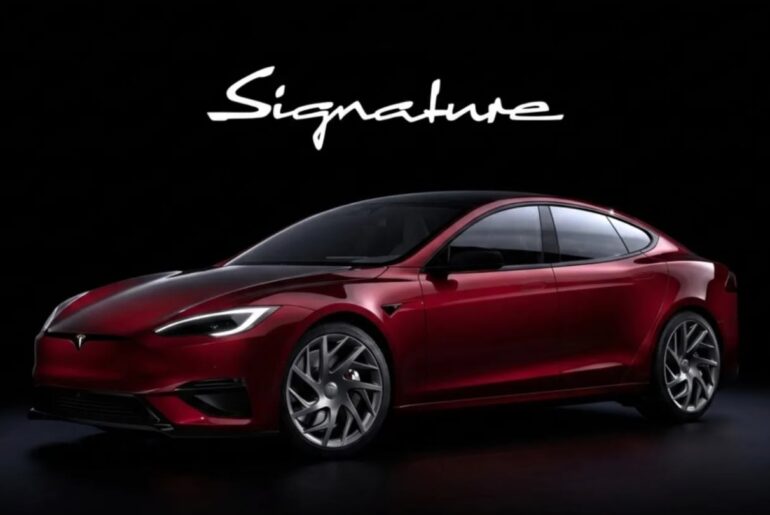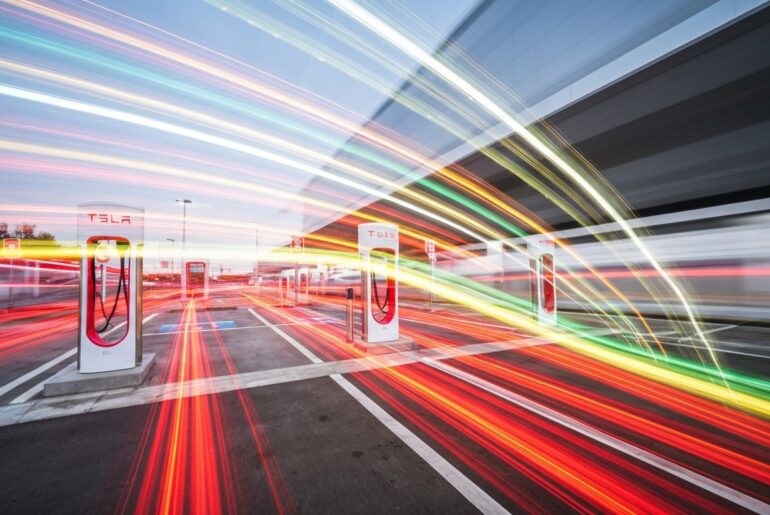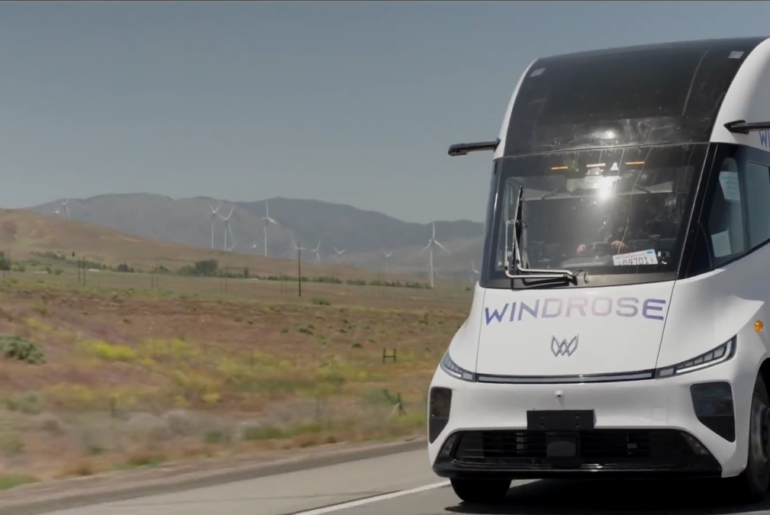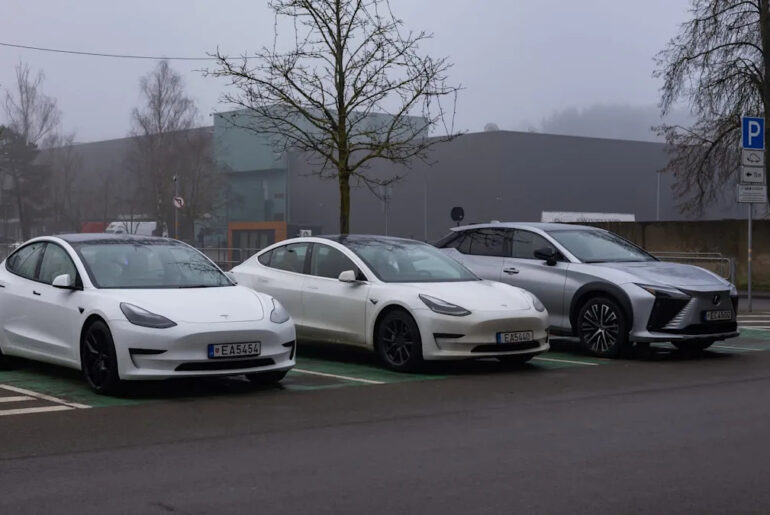
2025 Annual Shareholder Meeting | Tesla
Heat. Hey, heat. Hey, heat. Hey, heat. Hey. Heat. Heat. Heat. Heat. Heat. Heat. Heat. Hey, Heat. Can I have your attention please? We are just about ready to start our program. Please find your seats. Thank you. Nat down. Heat up Woohoo! Woo! Welcome back to Texas, the home of Tesla. My name is Brandon Hart. I’m the general counsel and corporate secretary and welcome to your 2025 annual shareholder meeting. Similar to last year, this meeting will have two parts. We’ll go through the 14 ballot items and the second part, Elon Musk. Today, we will discuss business outlook and may make other forward-looking statements. Such statements or predictions are based on current expectations. actual events or results may differ materially due to a number of risks and uncertainties that are disclosed in our SEC filings. Such forward-looking statements represent our views as of today and should not be relied on thereafter. We make no obligation to update them after today. Would like to welcome members of the Tesla team here, members of Price Waterhouse Coopers, and members of our board. Before we get started, why don’t we hear from Robin, our board chair. Well, good afternoon everyone. It’s wonderful um to welcome you all to the 2025 annual shareholder meeting. I apologize for the my voice. I’ve been speaking to investors for the last couple of weeks non-stop, I think. So, we here at Tesla could not continue to do the impossible without you, our shareholders. Our ongoing engagement with you all makes what we do possible. And I’m thrilled at how many of you made your voices heard this year as we aspire to create more value than any other company in history. Yes. Without your support, we could not have reached the heights that we’ve already demonstrated over our relatively short yet storied history. As we further expand our ambition in our quest to build a world of sustainable abundance, we are excited to continue this partnership. Tesla is at an inflection point. I think I’ve said that 3,000 times over the last few weeks. And this last year has been a critical one in our history. I want to take some time to review the acknowledgements and achievements by the Tesla team of which I and my fellow directors are incredibly proud of. We continue to redefine the automotive industry across production, customer experience, and ownership. Model Y was once again the bestselling vehicle worldwide of any vehicle in 2024, and with the new Model Y released earlier this year, it’s now better than ever. Our energy business continues to reach new heights and we deployed 31 gigawatt hours in 2024, more than double what we achieved in 2023. Fabulous. I love the energy business. And we are actively investing in both of these businesses as we aim to maximize their installed base of production globally. The installed base serves as the platform for our future value. And that creation over time Tesla will achieve through services such as robo taxi and virtual power plants powered by our realworld AI. In 2024, through the use of our products, Tesla consumers avoided releasing nearly 32 million metric tons of greenhouse gas emissions. And this is a 70% increase year-over-year. Our ability to avoid emissions will only accelerate from here as we displace larger volumes of fossil fuel-based alternatives and increase the utilization of our products through AI. But emission avoidance is is not only the thing that we focus on here at Tesla. Improving safety has been paramount to our mission since day one. Our vehicles consistently achieve the highest safety standards uh when tested across the world and that safety is increasingly enhanced with autopilot technology. In 2024, our global fleet of vehicles experienced one crash after driving more than 6.8 million miles. That’s amazing. 6.8 million miles. And to put that in context, that is 10 times better or safer than the average driver in the US. 10 times better. And in 2024, uh, and is nearly double the safety performance of our autopilot technology in 2018. With many enhancements we expect to make from here, we believe our autonomy technology will improve this performance by orders of magnitude. Sustainability extends beyond the impact of product use. The Tesla team continues to focus meticulously uh evaluating each step on the product journey from raw material extraction to a intermediate processing, manufacturing, delivery, product use and the end of life. looking all the way through to making sure that we uh reduce our resource impact and the resource use and bringing uh that to life across the entire sorry the entire sustainable and closed loop economy. For more details on what we do each and every day, I encourage you all to read the impact report. It is an amazing document and it continues to improve over time in terms of what the team is doing and we are also laser focused on ensuring the resulting prosperity of our efforts can be shared by all. This applies to our employees, our customers and even those who have yet to enjoy one of our products or engage with our company in any meaningful way. Tesla spends countless hours ensuring that we procure the most uh responsibly sourced and produced inputs. we maximize the safety of our operations and that all Tesla employees can benefit from the appreciation of our equity through our incentive programs and that we continue to bring down the cost of our fabulous products across the range, increasing that accessibility for all. At the end of the day, we here at Tesla are working tirelessly to make the world a better place for all through innovation and grit. To our amazing employees, thank you for all of your hard work in achieving our mission. You are the beating heart of Tesla and we cannot continue to deliver without you. to the management team who never get a shout out. Thank you for your huge efforts. To our shareholders, all of you in the room and on the webcast globally, once again, thank you for your support. Please know that we are listening to you and are here to represent your interests. You are the owners of the company and your voices, your perspectives and your input are critical to what we do here at Tesla each and every day. My fellow directors and I serve as uh serve you as your fiduciaries and oversee Tesla’s mission, purpose and strategy. And these responsibilities are in in our minds every day. I would also like to thank sorry to take this opportunity to thank my fellow directors for their diligence, their dedication and their tireless efforts. Changing the world for the better uh is always accompanied by um uh uh difficulties and what I can say is that you can’t do it by checking the boxes and and just reviewing PowerPoint presentations. Thank you for rolling up your sleeves, each and every one of our directors, the hard work that you do, lending your unique talents and delivering to our shareholders. Our Thank you. Thank you. Our our accomplishments have been hard-earned and these last several years have not been without their challenges. We still have much to accomplish and I believe that we have the right team, the right technologies, the right physical infrastructure to create a world that we’ve only just begun to imagine. The future is bright. Thank you. Now I’m going to hand it back to Brandon. Thank you very much. Thank you. Thank you, Robin. I will now call the meeting to order. It is 3:25 p.m. and I declare that the polls are now open. We have already received over the past few weeks voting proxies from our shareholders. However, if you wish to vote your shares now, you may do so on the online portal or with the ballot boxes you received at the front. Tesla has appointed Tony Cario, a me member of the Cario group to serve as our inspector of elections. In addition, Broadridge Financial Solutions has has certified that starting on September 17, 2025, the proxy materials or notice of internet availability of the materials were sent out or mailed to shareholders of record as of September 15, 2025. We have a majority of the outstanding shares represented at the meeting. So, I declare that a quorum is present. We now will proceed with the meeting. The items of the agenda are as follows. There are six Tesla proposals. The election of our three class three directors, Ira, Joe, and Kathleen to serve a term of three years until their successors are duly qualified. Number two, to approve seon pay on a non-binding advisory basis. Three, to ratify the appointment of Price Waterhouse Coopers LLP as our independent registered public accounting firm for fiscal year 2025. Four, to adopt amendments to our organizational documents to eliminate certain super majority voting requirements. Five, to amend and restate the 2019 equity incentive plan. And number six, the 2025 CEO performance plan to Elon Musk. The The Tesla board has recommended that all our shareholders vote for each of the director nominees and for the Tesla proposals except for the one on supermajority voting where no recommendation has been made. We also have eight shareholder proposals that are described in our proxy statement. I’d like to remind the shareholders that Tesla’s board has prepared a statement of opposition on each of them except for the one regarding XAI. Those statements are in our proxy. Now, let’s go through the shareholder proposals. The first one is an advisory vote regarding board authorization of investment in XAI. Our board has not made a recommendation on this. The shareholder proposal is proposed by Mr. Steven Hawk, who I believe is here to present the proposal. Mr. Hawk. Thank you so much. Good afternoon, ladies and gentlemen, fellow shareholders, Elon and esteemed board members. Thank you for this historic opportunity. I am Steven Hawk, shareholder since 2012. Is truly my honor to present shareholder proposal number seven. It is uh the proposal is simple. I urge the board to exercise its discretion and authorize a strategic investment in XAI in some meaningful way sooner rather than later. This isn’t just capital. It’s about formalizing Tesla’s role as a leader in autonomous intelligence. Turning AI into our new book, not just a new chapter. Tesla has always been an AI company, revolutionizing transportation, energy, and robotics through FSD and Optimus. But as we approach the singularity during this tsunami of AI outsourcing our brain to external providers, risks, misaligned goals, data vulnerabilities and loss innovation. XAI founded by Elon is different. It is m maximally truth seeeking, curiositydriven and aligned with humanity’s best interests. Like Tesla’s mission for sustainable abundance, XAI was seated with Tesla talent enabling birectional flow for highest caliber staff attraction and retention. Integrating Grock models within our vast real world data would further supercharge FSD for safer vehicles, empower optimists to navigate complex worlds and to optimize energy grids. Think vertical integration of Tesla as a neural link of AI platforms. Controlling the coming Optimus Army with prudent stewardship. Financially, it’s a no-brainer. XEI’s explosive growth could yield massive returns, strengthening our balance sheet amid EV pressures with Elon stewardship the best for shephering AI safely. Conflicts are minimal. Board oversight ensures fairness. Xi needs Tesla more than vice versa. But together we foster human happiness, consciousness, and meaning beyond work, shifting purpose from labor to truth seeeking in a world of abundance. Shareholders, we can’t be spectators. Tesla must actively participate. Let’s not outsource our destiny, but rather own it and maintain power, control, and safety. I call on the board to formalize this investment relationship and on you to support it. Thank you to Elon and special thanks to Tesla, Bloomer, Mama, Alexander Merch, Thank you, Mr. Hawk. The second shareholder proposal is an advisory vote regarding adopting targets and reporting on certain sustainability metrics with our senior executive compensation plans. Our board has recommended that our shareholders vote against this proposal as explained in our proxy. The shareholder proposals proposed by Tulipshare Capital LLC whose representative Mr. A Rouge has prepared a pre-recorded message. Hello shareholders. I am Antoan Aruj CEO of the impact fund Chulipshare speaking in support of proposal 8. Our proposal asked Tesla’s board to take a simple but meaningful step link a portion of the executive compensation to measurable sustainability performance. This last success has always been built on bold, measurable goals, production target, market cap milestone and innovation. But as we enter a new era of scrutiny around climate, labor and governance issues, it’s time that part of those milestones also reflect how sustainable that success is achieved. Proposal 8 is not asking to replace all the financial goals. We’re asking to strengthen them. Imagine if one or two trenches of the future compensation were tied to tangible outcome such as reduction in carbon intensity per vehicle, verified improvement in worker safety or supply chain transparency. These are metrics that protect long-term shareholder value, reduce legal and reputational risk, and ensure Tesla’s leadership is rewarded not only for scale, but for sustainable impact. Tesla’s mission is to accelerate the world’s transition. Linking compensation to sustainability metrics ensure that this mission lives at the very core of the leadership decision-making. This is how Tesla can continue to lead not just in innovation but also in responsibility. We urge shareholder to vote for this proposal and support a compensation framework that drives both performance and purpose. Thank you. Thank you, Mr. ARouge. As a reminder, the board’s response is set forth in the proxy. Our third shareholder proposal is an advisory vote regarding an audit of certain labor practices. The board has recommended against that as set forth in our proxy. The shareholder proposal is proposed by the National Center for Public Policy Research whose representative Stefan Padfield has prepared a pre-recorded message. My name is Stfan Padfield and I am the executive director of the Free Enterprise Project. The free enterprise project is part of the National Center for Public Policy Research, which is the proponent of proposal 9, requesting that Tesla conduct and report on a child labor audit. Let me begin by emphasizing that we are strong supporters of free enterprise innovation and shareholder value. We recognize Tesla’s extraordinary contributions to the electric vehicle market. Our proposal is not anti-Tesla. It is pro- transparency and pro-shareholder. Proposal 9 asks for something very simple and reasonable, a verified accounting of whether and to what extent child labor is implicated in Tesla’s supply chain. Tesla’s opposition statement relies on policies, but policies are not the same as proof. A quote unquote zero tolerance policy is commendable, but without independent verification, it is only a promise, not evidence. The US Department of Labor continues to list cobalt mining in the Democratic Republic of Congo among the sectors with the worst forms of child labor. A 2023 white paper on the financial and material impacts of child labor authored by Hace identifies Tesla as a case study in the ongoing risks that cobalt and other mineral sourcing pose to automakers. And while Tesla’s own 2024 impact report notes that the company invested more human and legal resources than ever before to combat forced and child labor, it provides no metrics showing whether those investments are working. Shareholders deserve data, not just asurances. We are asking Tesla to back its admirable words with verifiable results through a third-party audit or a transparent report. This is not just a moral question. It’s a governance and riskmanagement issue. Reputational, legal, and operational risks can directly affect shareholder value. So too can the risk that enthusiasm for electric vehicles undermines proper accounting of the often hidden cost that child labor may be embedded deep in EV supply chains. If Tesla is truly the industry leader it claims to be, it should also lead in transparency. We all know that proxy vote counts can be distorted by a plethora of conflicts of interest. Accordingly, we urge Tesla’s board to see this proposal not as an attack, but as an opportunity to properly account for the costs and benefits of Tesla’s mission, regardless of the final vote. If you have not done so already, please vote for proposal 9. Thank you. Thank you, Mr. Padfield. As a reminder, the board’s response is set forth in the proxy. Our fourth shareholder proposal is a vote to amend the bylaws to repeal a derivative suit ownership threshold. Our board has recommended against as set forth in the proxy. The shareholder proposals proposed by the comproller of the state of New York as the lead filer whose representative Thomas D. Napolei has recorded a pre has proposed a pre pre-recorded message. This is Thomas Denapoli, New York State Controller. As trustee of the New York State Common Retirement Fund, owner of more than 3.3 million shares, we urge shareholders of Tesla to vote for proposal 10 to amend the bylaws to repeal the 3% derivative suit ownership threshold. We filed a proposal along with New York City Controller Brad Lander to restore one of the most fundamental investor rights, the right of shareholders to hold directors and officers legally accountable when they breach their fiduciary duties. When Tesla asked investors last year to approve its move from Delaware to Texas, the board assured us that shareholder protections were similar in both states. Yet within months, Tesla’s board engaged in a bait and switch scheme and immediately turned its back on its investors by amending its bylaws to reduce shareholder rights as soon as Texas offered an opportunity to do so. The new bylaw allowed Tesla to block nearly every investor from bringing a derivative suit unless they hold 3% of the company’s stock, currently about $30 billion in Tesla shares. That threshold leaves only Elon Musk and a handful of giant Wall Street funds with any legal standing to act on their own. It effectively makes the board immune from accountability. Tesla claims this rule is meant to discourage frivolous lawsuits, but courts already have tools to dismiss meritless cases. This bylaw doesn’t stop abuse, it stops proper oversight, and it tells shareholders that the board no longer wants to be answerable to them. Our proposal simply seeks to repeal that bylaw and restore accountability. It ensures that if directors violate their duties, all investors still have a path to protect the company’s long-term value. Unfortunately, this attack on shareholder rights is part of a larger pattern at Tesla. We see a board that lacks true independence. The board has allowed our CEO to divide his attention among multiple outside ventures and then offered a pay proposal that could hand him a trillion dollar windfall and even more unchecked power. These are not isolated issues. They all stem from the same problem. A board that refuses to act as an independent check on management. Tesla has changed the world through innovation. But no company, no matter how visionary, can thrive without accountability. Strong governance protects investors and strengthens companies over time. I urge all shareholders to send a clear message that accountability, independence, and respect for shareholders are essential to Tesla’s future success. Thank you for your time and consideration. Yeah. Thank you, Mr. Dapoli. Our the board’s response is set forth in the proxy. The fifth shareholder proposal is a vote to amend article 10 of the bylaws. The board has recommended that our shareholders vote against it as set forth in our proxy. This shareholder proposal is proposed by the treasurer of the state of Illinois and trustee of the Bright Directions College and Savings Trust as the lead filer whose representative Michael Far has prepared a pre-recorded message. Fellow Tesla shareholders and members of the board, my name is Michael Ferris. I serve as treasurer for the state of Illinois and as trustee of the Illinois College Savings Programs. I’m here to present proposal 11, which asks Tesla to adopt a simple investor protection. If the board chooses to impose more restrictive requirements for submitting shareholder proposals as newly permitted under Texas law, those changes must be ratified by a super majority of shareholders. At its core, this proposal is about protecting shareholder rights. If the board decides to limit our ability to submit proposals, this amendment ensures the shareholders have the final say. It helps to ensure that Tesla remains aligned with the will of its investors. Plain and simple. Now, why is this important? Tesla is navigating a period of volatility, leadership transitions, intense competition, and heightened scrutiny from regulators and customers. In times like these, strong governance and active shareholder input can be critical. They serve as competitive advantages that position Tesla to lead, not just react. This proposal seeks to implement a reasonable safeguard would reinforce accountability and build trust. The board itself has emphasized the importance of investor feedback. In the proxy statement, Chair Robin Denholm and director Kathleen Wilson Thompson wrote, “We are in Texas because it provides a more predictable governance framework that allows us to hear from you, the people who know Tesla best.” If the board actively seeks to hear from shareholders, it’s hard to reconcile that position with their opposition to this proposal. To reiterate what’s at stake, Texas law now allows shareholder submission thresholds higher than SEC standards, requiring shareholders or groups to hold 3% of voting shares or $1 million in stock to submit a proposal. Compare that to current SEC rules which allow a shareholder to have holdings as low as 2,000 to $25,000 depending on how long the shareholder has held the stock. If the board chooses to adopt the Texas thresholds, they risk silencing investors who could drive meaningful governance improvements as well as narrowing the pipeline of ideas. Note that this proposal does not limit the board’s direction to evaluate governance options. It simply ensures that if the board adopts the Texas shareholder submission thresholds, a supermajority of shareholders must ratify that decision. That’s fair. It’s reasonable and fully aligned with the board’s stated commitment to its investors. Again, I encourage my fellow investors to vote for proposal 11 as a clear step towards protecting our rights as shareholders. Thank you. Thank you, Mr. Far. As a reminder, the board’s responses set forth in the proxy. The sixth shareholder proposal is an advisory vote to elect each director annually. Our board has recommended against as set forth the reasons in the proxy. This shareholder proposal is proposed by James McRichie who has prepared a pre-recorded message. Thank you shareholders. We’ve presented this proposal before, 2021 and 2024. It won a majority both times, even with board opposition. But Tesla requires a super majority of shares outstanding. So those majorities weren’t enough. Today, we ask again, join the 90% of S&P 500 companies that elect all directors annually. Declassification means accountability every year, not every three years. Most institutional investors support this reform. It’s the retail votes we need here today. A Delaware court recently found three major governance failures at Tesla. The board wasn’t independent. The disclosures to shareholders on its pay plan were misleading. And the board failed to negotiate properly on our behalf. Declassifying the board is part of the cure. It ensures shareholders can hold directors accountable each year or nominate qualified replacements when needed. Matt Muscardi of FreeFlat Media calls this one of the most important votes of the year because it could shift Tesla’s board from a friends and family plan to independent professionals with the skills necessary for Tesla’s next chapter. We’re also endorsed by Nell Mow, co-founder of Value Edge Advisors and ISS, one of the most respected proxy advisors. John Chaved’s related proposal number 13 calls for simple majority voting. We’ll need that reform, too, for this proposal to succeed. Tesla’s Musk premium, once a source of strength, is fading along with his global reputation. Remember, Tesla is his only publicly traded company. It’s the liquid piggy bank that fuels his other ventures. Yes, Elon Musk is brilliant, but no company should depend on a single personality. Either he stays long enough to keep using your capital elsewhere or he moves on when the tapped runs dry. Either way, shareholders must prepare for Tesla’s future. a democratic professional company led by a capable independent board. Let’s build Tesla to attract customers, employees, and investors who all contribute to its innovations. Vote for proposal number four, declassify the board. Vote four, proposal number 13, eliminate supermajority requirements. Together, let’s restore accountability, independence, and trust at Tesla. Vote now before the polls close. Your vote can make a real difference in Tesla’s future and your future as well. Thank you. Thank you, Mr. Mc Richie. As a reminder, the board’s response was contained in the proxy. Our seventh shareholder proposal is an advisory vote regarding a proposal that 54% at last year’s meeting. Our board has recommended against for the reasons set forth in the proxy. This shareholder proposal is proposed by John Chaveetin who is on the line to present this proposal. Mr. Chaveetin. Hello. This is John Chaveetan. Proposal 13. This proposal is about Tesla being governed by a democratic majority vote standard. This proposal 13 is proud to be on the same topic as the Tesla proposal six. Ser requests that Tesla take the steps necessary so that each voting requirement in the Tesla charter and bylaws that calls for a greater than simple majority vote be replaced by a democratic requirement for a majority of the votes cast for and against such proposals or a simple majority vote standard. is important to vote for both proposal 13 and proposal six which are on the very same topic. In fact, it’s more important to vote for proposal six because proposal six is a binding proposal and this proposal 13 is an advisory proposal. It is important to vote for proposal 13 because proposal 13 is a backup proposal in case the Tesla proposal six does not get enough votes. This proposal 13 has one advantage over proposal six in that it requires less votes to be approved by shareholders than the Tesla proposal six since this proposal 13 is an advisory proposal. But it’s still important to vote for both proposals. Adoption of proposal six will pave the way for annual election of each Tesla director sooner than this proposal 13. annual election of each Tesla director will tend to keep Tesla directors away from their current status as being lap dog enablers for Mr. Musk and Mr. Mus outrageous executive pay and Mr. Mus outrageous distractions from Tesla. Please vote yes for Tesla being governed by a Democratic majority vote standard proposal 13 and vote for the Tesla proposal six on the same topic. Thank you, Mr. Chaveetin. As a reminder, the board’s responses set forth in the proxy. Our eighth and final shareholder proposal is an advisory vote to seek shareholder approval before adopting certain bylaw amendments pursuant to Texas law. The board has opposed it for the reasons set forth in the proxy. This shareholder proposal is proposed by Eric and Emily Johnson and Bruce Bryce Mathan as co-filers whose representative Bruce Abear from Newground Social Investment has prepared a pre-recorded message. Good afternoon. I’m Bruce Herbert of Newground Social Investment in Seattle and I stand to move proposal number 14, a simple request that Tesla hold a vote before adopting any bylaw that would restrict the ability to file a shareholder proposal. Here’s why this matters. Texas recently passed a law that allows companies to set skyhigh barriers to shareholder participation instead of the SEC’s current one-year ownership threshold of $25,000. These Texas rules would require owning $1 million of stock or 3% of the company. In Tesla’s case, roughly $30 billion before one could file a proposal. And Tesla could enact this without a shareholder vote. simply by issuing a notice. This is not shareholder democracy. It’s silencing shareholders like nearly every one of us in this room. Whether you are an individual, retiree, or institution, the backers of such thresholds presume you must be ultra rich in order to have a good idea, which on its face is a baseless and undemocratic proposition. The shareholder proposal process serves both Tesla and the capital markets. This is because stockholders frequently spot emerging risks long before they hit the headlines. Whether in the form of labor relations, climate impacts, or failures in governance, shareholders provide an efficient early warning system that helps companies to stay ahead of the curve. We are a lowcost, high value cornerstone that keeps companies and capital markets healthy. In closing, corporate democracy is not a nuisance. It’s an important safeguard. It’s how shareholders ensure accountability and informed long-term value creation. The idea here is quite simple. Before limiting shareholder rights, put it to a shareholder vote. Therefore, to keep Tesla engaged, accountable, and forward-looking, please vote for proposal number 14. Thank you. Thank you. Thank you, Mr. Abear. As a reminder, the board’s response set forth in the proxy. Please note now is your final opportunity submitting votes for them to be counted. I declare that the polls are now closed. Based on the proxies that we have received and the votes submitted at the meeting, I’d like to announce these results on a preliminary basis. With respect to the shareholder proposals items 8 through 14, our shareholders have supported the recommendations on the Tesla board on all of them other than proposal 12. With respect to proposal 7 regarding XAI, while we have received more votes in favor than we did in against, there were a significant number of abstensions. Since this is an advisory vote, the board will examine the next steps in light of this level of shareholder support. Now, moving on to the Tesla proposals. First, on the proposal to adopt amendments to our organizational documents to eliminate certain supermajority voting requirements, our shareholders have not approved. Second, on the seon pay advisory vote, our shareholders have approved. Third, on the ratification of the appointment of Price Waterhouse Coopers as our Tesla’s independent registered public accounting firm for the 2025 fiscal year, shareholders have approved. Fourth, on the election of our three class three directors, Ira, Joe, and Kathleen, our shareholders have reelected them. Fifth, on the amended and restated 2019 equity incentive plan, our shareholders have approved Sixth and finally on the 2025 CEO performance award to our founder and CEO Elon Musk with over 75% voting in favor. Approved. We love you. I I declare this meeting is now closed. Elon Musk welcome. So, uh, what were what were what we’re going to And those bots are just dancing. There are no wires. Those are actual robots. Thanks, guys. Uh first of all, I’d like to just give a heartfelt thanks to uh everyone who supported the the shareholder of votes. Uh I super appreciate it. Thank you everyone. Um I’d like to take thank the Tesla board for their immense support. We have a fantastic board, fantastic group of shareholders. Thank you all. and uh and and what we’re about to embark upon is not merely a new chapter of the future of Tesla, but a whole new book and I’m going to talk about that. So, this this really is uh this really is going to be quite the story. Um and uh Optimus is a fundamental part of that. The the sheer scale of Optimus I mean I’m I’m going to say a bunch of things that probably I shouldn’t say, you know, but um but but that’s what keeps it interesting. I mean, have you have you watched any other annual shareholder meeting? I mean, honestly, I was like I mean, if you need to go to sleep, sure. I mean, that other shareholder meetings are like snoozefest. I mean, but ours ours are bangers. I mean, look at this. This is sick. And we got like the the cyberpunk nightclub here with real robots just standing there and uh milling around and dancing and um you know around our engineering headquarters in Palo Alto. Uh the robots just walking around the office 24/7 with no one minding them. they just and then they go charge themselves and um yeah so the the the scale of of of Optimus I like I said that’s really going to be something else um I think it’s going to be the biggest product of all time by far yeah so like bigger than cell phones bigger than anything um I guess a way to think about about it is that uh every human on Earth is going to want to have their own personal R2-D2 C3PO. So, who wouldn’t? But actually, Optimus will be even better than them, you know, like you know, R2-D2, it’s kind of would beep at you and it’s kind of hard to figure out what he’s got talking about. Um, you know, you see C3PO to translate, but uh Optimus is going to be I like everyone’s going to want one. uh I think with in terms of uh industry providing products and services I think it’s probably I don’t know three to five robots in industry for every you know one that’s a personal robot. I I I think there could be tens of billions of of Optimus robots out there. Um, now obviously it’s very important we pay close attention to safety here. Uh, because uh we we do we do want the the the Star Wars uh movie, not the Jim Cameron movie. Um, I love Jim Cameron’s movies, but you know uh you know what I mean. So um yeah and yeah so so we’re gonna launch on uh the the fastest production ramp of of any product of any large complex manufactured product uh ever. Um, and starting with building a million unit production line uh in in Fremont. Um, and uh that’s that’s that’s line one. Um, and then a 10 million unit uh per year production line here on the I don’t know where we’re going to put the 100 million unit production line. on Mars. Maybe on Mars, I don’t know. Um but uh but I think it’s it’s going to literally get to 100 million a year. Uh maybe even a billion a year. Um and um you know, people often talk about like eliminating poverty, giving everyone amazing medical care. Well, there’s actually only one way to do that, and that’s with the Optimus robot. with with humanoid robots you can actually give everyone amazing medical care. Uh so uh in terms of optimist will be more precise optimist will ultimately be better than the best human surgeon with a level of precision that that isn’t possible that that is beyond human. So I think that’s that’s a pretty wild concept to say okay if you you know there’s always people always talked about eliminating poverty but actually optimist will actually eliminate poverty. Optimus will actually give people incredible medical care. So, um I mean and and so you start getting like sort of some pretty wild sci-fi sort of scenarios uh where uh and some of these things I say will obviously be taken out of context and used in snippets and you know sent around but whatever. I was still going to say them, you know, like I think we may we might we may be able to give people a more uh if somebody’s committed crime, a more humane form of uh containment of future crime, which is if if you if you say like you now get you now get a free optimist and it’s just going to follow you around and stop you from doing crime. But other than that, you get to do anything. Just it’s just going to stop you from comm committing crime. That’s that’s really it. um you know you don’t have to put people in like prisons and stuff. I think u it’s pretty wild to think of the the various of all the possibilities but I think it’s it’s it’s clear it’s clearly the future. Um and um you know my book recommendation for the maybe the best mostly utopian sci-fi future are the inbanks books the culture books. So if you’re curious like what what do I think the future’s probably like? I think it’s probably a bit like that. um or you know um ASMO to some degree but but but I think it’s and Heinland um but uh in banks if if you’re like saying what what what does Elon think the future probably will be like for AI and robots it’s kind of banksian um so um now now and and and things do get kind of wild from an economic standpoint Um because at a certain point uh with AI and robotics you can actually increase the global economy by a factor of 10 or maybe a 100. Um there there’s not like an obvious limit. Uh so um like Optimus is kind of like an infinite money glitch. uh you know uh and I’m maybe there won’t even be money in the future um or or money but if it might be measured in terms of wattage like how much uh you know power can you bring to bear from an electrical standpoint. Um so uh I guess what I’m saying is hang on to your Tesla stock. So, uh, yeah, man, it’s pretty wild. Um, thank you. You’re welcome. Um, let’s see. I think we got some slides to go through. Um we say adlib a lot of the stuff but so the the you know when we started Tesla the the goal was to accelerate the advent of sustainable energy and that is uh that’s what we’ve done and Tesla has really led the way in with with electric vehicles with battery packs uh with a lot of solar and uh many other companies have have then followed our lead and done that and electric cars which used to be uh non-existent are now prevalent. Um and uh and the Model Y for example is the number one selling car of any kind on earth. Um but obviously now with with AI and robotics uh we need to update our mission. Um and our mission um I think it’s a good it’s it’s the it’s a great mission which is to achieve sustainable abundance which is it’s like because I often ask people like what is the future that you want? What’s the best future you can imagine? Um you know because we want to try to make that future like make the best future you can imagine. and and I guess probably the best future is if people uh you know can have whatever they want from a goods and services standpoint or medical standpoint. Um and but at the same time we we don’t destroy nature and we we keep the rain forests and the the beautiful national parks and and all the all that stuff. And so that’s that’s what I mean by sustainable abundance uh is that people, you know, can have whatever they want um have all the needs met. Uh, but we still keep all of the natural beauty that we want. I mean, if somebody can think of a better future, I’m all ears. Uh, but I think that’s that’s probably the best the best way to go. Um, so yeah. Um, see, so yeah. Um, as you know, every Tesla is designed to be autonomous. So, the it’s sometimes difficult to explain to people if they’ve not, in fact, I’m sure you’ve all encountered this where you try to tell people that the Tesla can drive itself and they they think you’re crazy or something. Um, I mean, especially like apart from the Cybert truck, our our cars look pretty normal. Um, I mean, they’re good-looking cars, but they don’t look super they look normal. Um, but I guess uh it’s kind of like having a cat or like and and uh the cat’s just sitting. Let’s say you’ve got a cat and it’s like just sitting there on the couch and you try to tell people that the cat uh can actually um it’s actually puss and boots and and it and it can actually put on boots and a hat and and swashbuckle and sing and dance. And people are like, “No way, man. That’s a cat.” until the cat does all those things. You’re like, damn, what the um so, uh we’ve got, you know, millions of Tesla cars out there that are the kind of like puss and boots. They’re they’re intelligent, but people don’t know that they’re intelligent. They look like normal cars, but actually they’re super smart and can drive themselves. So as um I think that’s probably the single biggest thing we need to do is to educate uh potential customers that you you can either have a car you can either have a cat that’s like normal cat or you can have frozen boots and puss and boots is very cool. Um, so, uh, that’s so we these days when people come to our stores, um, or even people that have the car haven’t turned it on, we find and sometimes people have paid for FSD and they haven’t turned it on, we’re like, what? You should at least try it once. Um, and so, so now we like we the sales team, the service team will actually sit with customers and say, look, let let us show you how it works and how easy it is. And then once they’ve tried it for even just a few days, uh they they can’t live without it. Um and and and now with version 14, we’re actually getting to the point where we almost feel comfortable allowing people to text and drive, which is kind of the killer app because that that’s really what people want to do and do do. Uh um and uh actually right now the you know the version’s you know the car is a little uh strict about keeping eyes on the road. Um and uh but I’m confident that in the next month or two uh we should we we’re going to look closely at the safety statistics but we will allow uh you to um text and drive essentially. Yeah. So yeah. That’s that’s uh it’s it’s certainly better in the current situation which often people will actually turn off FSD to text then turn it back on which is less safe. So um so yeah that’s probably the single biggest thing is is just get people aware of of FSD. Um and then obviously we need to get it approved in in Europe. So we certainly appreciate the support of our customers in Europe uh pushing the regulators to approve FSD because you can’t even get a super even just normal supervised FSD is not allowed in Europe currently um which doesn’t make any sense and I’ve had these like crazy conversations with regulators that seem like a France novel where where I’m like well look we have you know billions of kilometers of data that shows that FSD increases safety. Um, and they’re like, “Well, we have to have all these committee meetings.” I’m like, “Yeah, but people’s lives are at stake here.” So, definitely a pressure from our uh customers in Europe to to push the regulators to approve would be appreciated. Um, and then we have partial approval in China and we hopeful hopefully we’ll have full approval in China uh around February or March or so. That’s what that’s what they’ve told us. Uh yeah, but uh yeah, the the fact that every Tesla car is capable of full self-driving, every car we build and have built for the last several years is capable of uh full self-driving is is pretty wild and most people don’t don’t know that. So, um, and then we’ve got the the first car that is specifically built for, uh, unsupervised full self-driving to to be a robo taxi. It’s called a cyber cab. It doesn’t even have pedals or steering wheel. Um, yeah. So, no, no, there’s no side view mirrors. There’s no Yeah. So it’s it’s and and it’s it’s very much optimized to min for for the lowest cost per mile in in an autonomous mode. Um and that production is happening right here in this factory and we’ll be starting production in April next year. So the the way that um Cyber Cab is designed is it’s it’s it’s designed uh obviously for a purely autonomous world but also the manufacturing system is uh unlike any other car. uh it the manufacturing system of the cyber cav it’s it’s sort of it’s closer to a high volume consumer electronics device than it is a a car manufacturing line. So the net result is that I think we should be able to achieve I think ultimately less than a 10-second cycle time basically unit every 10 seconds uh maybe ultimately take a few years to get there but it’s theoretically possible to get to a 5-second u production time and um so so what that would mean is you could on a on a line that would normally produce say 500,000 cars a year at uh a one minute cycle time uh like Model Y the this this would be maybe as much as you know two or three million maybe ultimately you know it’s theoretically possible to achieve a 5 million unit production line uh if you if you can get to the 5-second cycle So it’s a lot of cars. So the these will be everywhere in the future. So and wanted we wanted to look futuristic. So it like it changes the look of the roads. Um now the yeah um the ingredients when you look at at at what Optimus is what’s required to make Optimus and the various ingredients uh what do you need to do to make to do high volume uh humanoid robot production uh I think it’s worth considering that really the cars we make are already robots but there four-wheel robots. So Tesla is already the biggest robot manufacturer in the world because every car we make is a robot. Um and when you break it down to the fundamental elements, you’ve got you’ve got batteries, power electronics, u motors, um gearboxes, you’ve got uh you know connectivity, uh you’ve got a vision based AI. Hi Optimus. Um and um you know all the various pieces that you need for a humanoid robot. You need the AI chip. You need the AI software. You need to be able to manage a large fleet. And um and so really Optimus is a robot with arms and legs as opposed to as opposed to a robot with wheels. So, you know, Tesla’s ideally suited, I think, to to make to succeed in this arena. Um, you you you will see certainly many uh companies showing demonstration robots. There’s really three things that are super difficult about robots. One is the engineering of the forearm and hand because the human hand is an incredible incredible thing actually. It’s super dextrous. So uh engineering the hand really well the uh real world AI and then volume manufacturing those are generally the things that are missing one or more of those things are missing from other companies. Um so Tesla is the only one that has all three of those. U yeah. So yeah. So this is the Optimus kind of uh initial it’s kind of the prototype production line. The the high volume production line will be very automated obviously but this is this is really the production line that we use to make the prototypes. So you can get a sort of rough sense for what it takes to build the robot. Um going to pull the finger. Um and then as I’ve said before, I think once we reach about a million units per year uh of sustained production or in excess of that, I think probably the cost of production uh is around $20,000 in current year current year dollars. So this will be certainly very affordable. Um and uh yeah, like I said, I think Optimus will ultimately increase the size of the economy probably by a factor of 10 or more. Um you know, next year we saw production with Optimus version 3. Uh this what you’re seeing here is Optimus version 2.5. Optimus 3 is is an incredibly good good design. The Tesla engineering team is amazing. Um, when you see Optimus 3. Yeah. Uh, you it will seem as though that there’s someone like like a person in a robot outfit. Um, which is how we started with Optimus. Um, it really is going to be something special. Um, and then Optimus uh, Optimus 4, you know, that that hopefully starts production in 27 and then Optimus 5 in 28. So, it’s kind of like an annual release cycle with significant improvements uh, with each one and and gigantic increases in the scale of production. So yeah, sust sustainable abundance via AI and robotics. That’s the future we’re headed for. And as you as I think most people here know, the safety statistics show that uh miles driven on FSD are much safer than miles driven with without it. So uh what this will translate to ultimately is saving the lives of millions of people uh and preventing hundreds of millions of accidents. So a massive increase in the in um you know lives saved and and tragedies avoided. Uh, it’s going to be amazing. And how many people here have tried 14.1? Okay. All right. Cool. Um, yeah, you can see the even with the point releases, it’s getting quite a bit better. Uh, it should be pretty smooth at this point. Um, but really 14.2 2 is there are major changes 14.2 and then 14.3. Um and uh I think I think by 14.3 is when we’ll really be at the point where you can just uh pretty much fall asleep and wake up at your destination. So, um, and then I’ve been putting a lot of time into the new Tesla chip design, uh, because in order to have a functional robot, you have to have a great AI chip. Um, and it needs to be an inexpensive chip and it needs to be very power efficient. So we we we believe the uh AI5 chip will be probably about a third of the power of uh say something like a Blackwell um an Nvidia Blackwell which is a great a great chip um for roughly comparable performance um and and much less than 10% of the cost. So, this is a chip that is that is very much optimized for the Tesla AI software stack. So, it’s uh it’s not meant to be a general purpose chip. It’s meant to be an amazing chip for the Tesla AI software. Um, and uh I mean a couple things that I think make like how is Tesla able to achieve such an improvement? And I think it is because uh- because we are specialized. We’re not trying to, you know, Nvidia has to serve the superset of all past and future customers. So all of their requirements, all of the software that they’ve written has to work, which is a very difficult problem. Um whereas uh we just need to make it work for our software. Um and and so we we’re able to simplify the chip dramatically. Um and then we we also uh I think I think we’re unique in this but like we we have an integer based uh system. Um and integer operations are fundamentally more efficient than floatingoint operations. So we can do floatingoint but we but the vast majority of of our inference is done in integer. um which is if you’re familiar with sort of logic gates like the simplicity of of integer and uh it’s integer is much more power efficient much more silicon efficient um but you have to you actually have to train for uh integer uh inference which everyone else is training for floating point um those that’s kind of like a niche technical detail but it’s actually very important so Um yeah, this this is this is going to be a great chip. Um so this this chip will be um made in basically in four places. Uh TSMC Taiwan, Samsung Korea, TSMC Arizona, and TSMC Texas. and and we already know uh what improvements to make for AI6. So I I I’m hopeful that we can within less than a year of AI 5 starting production, we can actually transition in the same fab to AI 6 and uh double all of the performance metrics. So I’m super hardcore on chips right now, as you may be able to tell. Um, I got chips on the brain. I dream about chips literally. Um, I can I can I can draw the the the the the you know the the at least the broad brushstroke physical design of the AI5 chip by off by heart at this point. Um, it’s it’s it’s a good chip. It’s a good chip, sir. Um, so this this is this is really key. Um, now one of the things I’m trying to figure out is how do we make enough chips? Um, so uh, you know, I have a lot of respect for our the the Tesla partners TSMC and Samsung. Um yeah, you know, maybe we’ll we’ll we’ll do something with Intel. Uh we haven’t signed any deal, but it’s probably worth having discussions with Intel. Uh but um even when we extrapolate the best case scenario for chip production from our suppliers, uh it’s still not enough. So I think we may have to do a Tesla Terraab. So, it’s like giga but way bigger. Um, I I can’t see any other way to get to the volume of chips that that we’re looking for. Um, so I think we’re probably going to have to build a gigantic chip app. It’s got to be done. So anyway, uh some of the stuff I’ve already talked about. Um yep, we’ve we’ve uh done a tremendous amount for sustainable energy. Um and that uh that’s only going to grow over time. um the world is moving towards a a solar battery economy. Um which is ultimately the that’s that’s where that’s where it was going to go anyway, but what Tesla’s done is accelerate um accelerate that outcome. Um sometimes people don’t understand quite how much energy comes from the sun. So the sun is 99.8% 8% of all mass in the solar system. Jupiter being.1% and then.1% is miscellaneous. Uh Earth being in the miscellaneous category. Um so the the total amount of energy like so sometimes people what say like well we’ll we’ll build fusion reactors on Earth. It’s like well actually the giant fusion reactor in the sky is basically impossible to beat. um to such a degree that even if you uh could burn Jupiter in a thermonuclear reactor, the amount of energy produced by the sun would still round up to 100%. That’s how much energy the sun produces. So solar power is necessarily the future. Um and I think uh there’s going to be a lot of solar powered AI satellites and um I think Tesla’s going to play a role in that. Um, we’ve obviously refreshed the product line, so S3XY. Uh, if uh if people haven’t tried the Model S, 3X or Y or the Cybert truck, I recommend at least getting a test drive or a test ride as the case may be, try out the the full self-driving. Um, and I think you’ll be blown away. To those who do not, if you might be listening and don’t have a Tesla, you should try one. Um, so, and of course, we’ve got the, uh, Cybert truck, which is the toughest truck of all time. Uh, it’s literally bulletproof, uh, faster than a Porsche 911 and can out tow a a Ford F350. So, it’s a it’s a great car, great truck. Um and then starting next year we uh we manufactured the Tesla Semi. So this this is already we already have a lot of um prototype Tesla semis in operation. Uh Pepsco and other companies have been using the Tesla Semi for quite some time. Um but we will start volume production uh at our um Northern Nevada factory uh uh in 2026. So we got we got two big products or three three massive products starting production next year. We got Optimus, we got Tesla Semi, and we got the Cyber Cap and then battery packs. So the uh if if you look at total uh US power generation capability, it’s roughly a terowatt. Um but the average power usage is less than half a a terowatt and that’s because the there big differences in power usage uh between uh day and night. So the the the daily and seasonal variations in power consumption mean that uh the United States and and really every country is only using about half is only producing about half as much electrical energy as it could because without batteries there’s no effective way to buffer the energy. Um so what batteries actually enable is uh even if you don’t build any incremental power plants, you could double the energy output of the United States just with batteries. Now this is a super big deal. Um and in fact I think that’s really where most of the incremental energy production in the United States is going to come from is literally batteries. So a bigger deal than it may seem. And then we’ve got we keep improving the battery design. So the the mega block which makes it really easy to deploy battery uh utility scale batteries. Um so we’ve we’ve just simplified and and brought more of the components to be internal to the batteries. So you can just show up and drop off a battery and it works. Um and then hopefully with uh well not hopefully over time we will actually add uh more and more of the power electronics so that uh mega pack will actually be able to output up to 35 kilovolts directly. Um so you you won’t need a substation is what I’m saying. You can just literally drop it off kind of like the way that a power wall you just connect it to the house. The utility wires go in one side and the other side goes to the house mains and that’s it. Um, so we want to get Mega Pack to the point where you just literally take the utility wires and you plug them in and it just works. So then we’ve got uh the we’ve also built the world’s largest Supercharger network. So we do a lot of things here at Tesla. Um that’s the biggest uh supercharger network uh in the world by far. Um and uh ultimately you’ll be able to go anywhere on Earth using a Tesla supercharger and it’s pretty close to anywhere on Earth, but it’s uh you know it’s going to be ultimately just anywhere. It’ll just work anywhere. So um the Supercharger team has done done great work expanding that and improving the efficiency of the Supercharger network. Um, and uh in in North America they did such a good job that the uh uh the other car companies basically said, “Well, they’ll just use the Tesla Supercharger network.” Like like, “Okay, sounds good to us.” Um, you know, it’s always important to have a a slant on safety in the factory. So, we continue to improve uh safety for our factory workers. we’re we care a lot about their well-being. Um, and uh, you know, like one way you can just tell like if a company is a good company or not, if you if you just walk through the factory or walk through the office and catch the vibe and the vibe in the Tesla factory is is is good. People are happy. You know, that’s how you know it’s a good company. Um we we’ve also put a lot of investment into uh raw materials. So um the uh we we’ve built in in South Texas and Cor Corpus Christi uh the biggest lithium refinery um outside of China, I believe. Uh so it’s it’s going to it’s starting off at with 50 uh gawatt hours of of of lithium. uh and we’ll expand from there. So this is a very very important to have uh um you know in a worst case scenario that we have the ingredients necessary to make a battery. Very important. Um and uh and then we’ve got here on this site the the cathode uh factory which is just the sort of giant building uh about a half mile that way. Um and um and we’re just making sure that we from a supply chain standpoint are uh resilient against any potential geopolitical challenges. And then also at this factory we also make the 4680 cell uh which is getting better and better. Um and that 4680 cell uh will be used uh in the cyber cab cyber it is being used in the cyber truck and will be used in in the cyber cab and also in Optimus. So that that’s going well. U but we continue obviously to get sales from many suppliers. It’s kind of like the the chip bad thing. We we’ll take as many chips as our suppliers can provide us, but then beyond that, if they can’t provide us with any incremental sales or chips, we we kind of have to make them ourselves or we get stuck. That’s the uh Tesla semifactory. So, it’s going to be pretty cool to see these going down the road in scale. Yeah. So that’s that’s the that’s the basic uh plan sustainable abundance role. All right. So yeah, I guess we can go into Q&A now. Maybe at the uh next annual shareholder meeting, we’ll have Optimus take some of the questions. That’d be cool. So let’s see. Alexander, well, thank you for your help, by the way. Yeah, please go ahead. Is that a mic? Is it No, let me hold it. It’s okay. Well, what a year has been, right? I mean, just a year ago, President Trump got elected on the same day. These 12 months have been a heck of 12 months. Thank you to the board because I think they had to weather quite some storms. Yes. Institutional investors and obviously thank you to you and we stand with you. I think we we showed it and we will show it. So we would like to express a wish, please. This is a nice venue. We love coming to the factory and I think it’s actually great we’re doing this at the factory but there are thousands of retail investors who are crying because they cannot they come to me. I love playing the mama but I now give it to you. Please okay organize a bigger venue. We’re bigger than Berkshire and we will do better than Bergkshire. Okay. Sure. We can pay to make it happen. Yeah. Uh actually Tesla will be way way way bigger than B brochure long term. It’s going to be kind of nutty. Um so um all right, we’ll do the next one. Maybe we’ll do it in the Yeah, like the Yeah, maybe the the the downtown arena or the the the soccer stadium or something like that and get your security check. We want to make sure that you’re safe. What if I just and weave? But you know, we want a party and if you can bring the other Elon companies there as well, investors would really appreciate it. All right, sounds good. Thank you very much for listening to this. All right, Elon, as a father, I just want to first thank you for the everything you’re doing in the world, especially freedom of speech. Thank you. And one question, will you or Tesla ever consider FSD tied to a owner’s account rather than a vehicle to encourage more frequent upgrades provided the transfer is to only a brand new Tesla vehicle while fostering brand loyalty? If the vehicle is sold or trader without upgrade to another Tesla FS, the ownership would end. Well, we we have done that a few times. Um, I guess, uh, I guess we could extend it again. Um, all right. We’ll extend it. We’ll extend it for at least another quarter. Um, and then and then play it by year after that. All right. Uh, howdy Elon. Congrats on not having to show up to work for free anymore. Yeah. Yeah. Uh we now have over a $40 billion war chest. We’re cash flow positive and yes remain that. Uh we know how you feel about fiat already. Is it time to take a look at Bitcoin? What’s your belief on that? Also, you’ve hinted towards that there’s a wheelchair accessible model in the works. Were you referring to the Rabovian? And if so, can we please speed up production to help the least fortunate? Sure. Um, yeah, the obviously we need um a vehicle that’s big enough to to fit a wheelchair if it’s wheelchair accessible. Um, so I think um that that’s that’s that’s that is uh the Robovven or Robus or whatever we call it. Um I mean the it’s it’s not like we we’re slowing down because we we want to slow down. It’s it’s like, you know, we’re spinning like a zillion plates here. Um so, um but I do I do think it would be very cool because I think aesthetically as well, it’s just it just would change the look of the roads and make it feel like the future. So, um so it won’t be long before we make that. Uh but it’s but since we do have Optimus, you know, the we’ve got Cyber, Optimus, and Semi all next year, it’ll we’ll probably have to be maybe the year that you know a couple years from now or something like that. Um but we certainly will make uh a wheelchair accessible vehicle. Hi Satoshi. Um I was I was privileged enough to uh attend the investor day and uh you also talked about the factory being a product. I saw the dry cathode method and and so forth and I wanted to know the progress in that and also would optimist be working on that in the future uh production line in the future. Yeah. Um I I guess the dry cathode man that’s turned out to be a lot harder than we thought. Um so uh I mean it it does look like it’s going to be successful and it will have some cost advantage relative to wet cathode. Um, but if I had to wind the clock back, I would probably have gone with wet cathode instead of dry cathode. Um, because it it just turned out to be a lot harder to make it uh, you know, high volume capable of high volume production with with super high reliability. Um, so yeah, um, but we will be we will be scaling up uh, battery cell production at Tesla um, and looking for cell production from our suppliers as well. um because we’re we’re going to be ramping up production very dramatically at Tesla. So um now now that we we we believe we have u full self-driving that we have autonomy solved uh you know or or at least or within a few months of having it uh unsupervised autonomy solved at at a reliability level significantly better than human. Um it’s not that that means it’s time to ramp up production. Um because the value proposition is now much greater than a regular car. The killer app really is uh for people can you text and drive or can you sleep and drive? You know, can you um can the car take you to your destination or do you need to pay attention and be uh and have to drive it? Um, and before we allow the car to be to be driven without paying attention, we need to make sure it’s very safe. But but like I said, we’re we’re on the cusp of that. Um um I know I’ve said that a few times, but um but we really are at this point and and you can feel it for yourselves with with the the 14.1 release. Um, so the you know the what we’re we’re going to try to we’re going to push to expand vehicle production as fast as we possibly can. Um so aspirationally would aim to increase vehicle production by about 50% by the end of next year. Um, so yeah. Um, so that’s it’s it’s very hard to increase production, but that’s that’s roughly, you know, I don’t know, maybe we get to like I’m just guessing at at an exit rate to by the end of next year of around 2.6 6 2.7 million vehicles annualized production and then aim to get to maybe 4 million by the annualized rate by the end of 27. Um and then maybe 5 million by the end of 28. That th those are rough those are our aspirational goals. Um so these are this this is a gigantic increase in in output. uh which means that the entire supply chain has to move in in uh in unison with that uh with that increase in in volume. Um and uh the nature of the nature of producing a large complex product is that it moves as fast as the least lucky dumbest element in the entire system and there’s 10,000 plus items. Uh but um but this like I said this really is a new it’s not just a new chapter for Tesla it’s a new book and and that new book is massively increasing vehicle production um and uh ramping up Optimus production faster than any thing’s ever been ramped up before in history. So awesome Elon. Thank you. Uh thank you from all of us. Um you know the retail shareholders really really care and so I I echo the sentiment of you know a larger venue where more can more can come. Um you know as a testament to that I was here I was fortunate enough to be here last year and since then touring the factory talking to you know people that work here I’m just a retail shareholder but increased my holdings 12 times. Right. So, I you know, I I know it’s really engaging and gives people a confidence and and so thank you for having us and I I do echo that. I hope it grows. Um last year, I’m the one that asked you about your well-being and safety. Oh, yeah. Full life. And you know, it was a broad, you know, general question and it was before, you know, some of the uncertainty that’s unfolded since then. And uh yeah, so I I hope it had a positive, you know, impact and um you know, we all care. Um and so my question this year, you’ve talked recently about the most mindblowing product demo of all time and a shot at it being the most memorable product on ever. Roadster. Yeah. Yeah. and I have patiently been waiting on my Founders Series Roadster reservation. So, on behalf of the Founders series guys that have stuck in there, can we be unvited to this unveil? Oh, yeah. Sure. Absolutely. Definitely. Okay. Yes. So, all founders series can be invited. Yes. Yes. I mean, it’s the least we could do, frankly, for people that have are long our longsuffering uh roasted reservation holders. Um the I I I I I feel confident in saying it will be the most exciting uh product unveil and I hope that whether it goes well or doesn’t go well. Since I’m up here, can I get the first one? Well, I I guess the it’s it’s according to who whoever um put down their deposit in in that sequence. So, that’s the but you’ll get you’ll get a very early one. Um and um I mean the the new roster is very much sort of like a it’s not even the icing on the cake, it’s the cherry on the icing on the cake. So, I mean it’s really kind of like um you know it’s it’s it’s like it’s not essential for sustainable abundance. Let me put it that way. Um, but I do think there should be uh, you know, very cool technology in the world that is um, that has, you know, that’s way beyond anything that’s ever existed. And I think I’d like those like even if I could never have access to those things, I’d like to know that they exist and and see the future happening. So I think I think it will be inspiring to a lot of people. Um, and and just it’s it’s extreme. It’s like the coolest car, if it even is a car, uh, that has ever that will probably ever exist. Yeah. So, hi Elon, congrats on the uh, proposal plan. That was amazing. Uh, the compensation question back to chips. So, chips, chips, chips. Chips. Chips will be the limiting factor to the to the future. So on that it’s chips and electricity are the two limiting factors. Yeah. And we got the energy and power and energy packs ready to roll. So I think on the chips I think you said TSMC Samsung perhaps Intel 14A and several different sites. I heard a couple US factory sources which is I mean we’re like everyone you know it’s like Yeah. Yeah. And and so I guess the is there an open door in the future of investing directly into some of those boundaries? And second question how big is a terraactory? Can you put that in scale in the semiconductor terraactory? Yeah. Well, the the I mean thing is that we actually have agreed to buy all the chips that are made from the fab, you know. Uh so it’s basically a money printing machine for TSMC and Samsung. It’s like literally the faster you make the chips, the faster we send them money, but it’s still not going at the fast enough. Uh so that’s why I think as far as I can see the only option is to go build some like uh very big chip fab. Um and then you got to solve memory and packaging too. So uh but otherwise you just you just tap out at whatever the the chip production rate is. Um and um so I guess terror would be you you’d want to say it’s it’s got to be at least a 100,000 wafer starts per month size fab and maybe that would be one of 10 in a complex. So ultimately be a million wafer stars per month. Yeah, exactly. You can tell when you when it gets the giggle factor that’s probably a good sign that that we’re on to something special. But I wouldn’t be surprised if longterm it’s like a million wafers a month. Yeah. Hi Lon. Uh I’m a long-term uh investor. So I’ve been uh holding the shares for 12 years. I worked at the autopilot team development uh for 10 years and uh brought my dad here from Brazil. Uh we actually won the Tesla vision contest with a Cybert truck B video. So I hope you got to see that at some point. Uh so thanks for the free Model Y and uh my question is about obviously market expansion but not only South America, Brazil but also into Mars like with the upcoming rendevous of Mars and Earth. Uh what’s going to be in the payload? You know what are we going to send there? Well uh Optimus is going to play a big role. Optimus and I think Tesla vehicles will play a big role on the moon and Mars. So for a moon base and a Mars B a Mars city um Tesla vehicles and and Optimus robots um are natural natural fit for building um and operating a moon base in a Mars city. So sorryII cy Cybertruck also. Yeah. Yeah. Cybertruck. Um you will need to drive around in a pressurized vehicle if there’s a you know a person inside. Um, but yeah, it it’ll be it’ll be something cool. Uh, next level moon buggy or and Mars buggy. So, all right. Hi, Mr. Musk. Uh, Gorov, uh, been a fan of yours since 2006. I think I saw a piece in Popular Science magazine. It was really cool and I think I was 15 at the time. Um, shareholder since 10 years now. It’s been really, really rewarding. It’s changed my life. Uh so thank you very much to you and Tesla. Uh my question is regarding uh Tesla’s mission for a sustain sustainable future as it pertains to autonomy. Um I personally fully expect a deflationary period um after um well unlocked by autonomy basically uh both in moving humans and goods and whatnot. um excluding Optimus even. Um yeah, what efforts um are is is Tesla going to focus on to reduce the dollar per mile? Rough math um I think like 30 cents a mile would be really nice. Um 50 cents is pretty good too. I mean looking at inflation later on. And then um I guess a second part of that, how low does it have to be for people to just stop buying cars like where it doesn’t make economic sense to do that? Um I expect that to affect economies of scale and then further increase the pricing of vehicles there on out. So like how like what is that node at which inflection happens? Well, in terms of cost per mile, I mean we do see a path with a lot of work to get below 20 cents a mile in current year dollars. Um and um and and I I somewhat agree that there’s things will probably be deflationary um as productivity increases because you can think of money supply as being the ratio of goods and services to um the like what’s what’s the growth in goods and services to versus the growth in the money supply. That ratio is basically inflation. Um and um and so if the output of goods and services grows faster than the money supply, then you necessarily have deflation or vice versa. U they try to make it sound complicated, but it’s not. Um so um I’m not sure that that even government over overspending can actually I think government overspending will will not be will be lower than the increase in productivity of goods and services uh which would imply deflation as you expect. Sorry. What about economies of scale and the impact it has to how you respond as an automotive company when people stop potentially buying cars? Economies, sorry. Economies of scale in like auto manufacturing for instance. It only makes sense if lots of people buy your vehicles. Oh. Uh the total number of vehicles will decrease. um you know the the sort of vehicle fleet out there is about two billion cars but two two billion if you add up all cars and trucks that are not at a scrapyard I think it’s around two billion um but the that that number would decrease uh with autonomous vehicles so the total fleet size would drop um I actually think uh miles driven will increase because it is now much less painful to travel somewhere um so if if somebody’s thinking about traveling across a busy city then they’ll take into account, well, how much pain do I have to deal with if I have to go through two hours of traffic, I probably won’t uh won’t do it. But if you’re just say sitting in a cyber cab watching a movie or doing some work, then it’s just like sitting in a little lounge and and I I so I think you’ll see um probably a significant increase in total miles driven u but at the same time a decrease in the total uh active fleet of vehicles. Um, I’d just like to reiterate how grateful we all are to have you uh on board ready to lead us to another 7 trillion in market cap at least. At least obviously. Thank you. Um my question is how much of a concern is it that when cyber cab starts production in Q2 next year that regulation won’t be there yet to where you can deploy cyber cabs being produced or are you guys confident that uh every cyber cab you guys make you’ll be able to deploy? Yeah, I think I think the rate at which we we receive regulatory approval will roughly match the rate of cyber cabab production. Um it’ll be maybe a little tight, but um that’s it’s it’s about right. Um and I’d like to thank thank Whimo for paving the the path here. It’s very helpful. Um so uh yeah, but it I I think we’ll be able to deploy all the all the cyber caps that we produce. Um, and the other thing is like once it becomes like extremely normal in cities, it’s just going to become like the the regulators will have just fewer and fewer reasons to say no. Um, and then you’ve got this, you know, you’ve got the AC the accident statistics at scale and you can show that autonomous miles save lives then and you’ve got unequivocal, you know, billions of miles to prove it, then I think it’s it’s hard for regulators to say no. Yeah, true. All right. First of all, Elon, thank you so much for everything you do for the Tesla uh shareholders. Thank you. Do you see a path for uh optimists to have consciousness uh downloaded to it? You mean human consciousness or Yes. Yeah. Yeah, I mean it’s not like uh immediate um but if you say it down the road uh would you be able to say with a neural link have a snapshot of or at least an approximate snapshot of somebody’s mind and then upload that approximate snapshot to uh an optimist body. I think I think that at some point that technology becomes possible. Um and it it it probably less than 20 years. Yeah. But of course you won’t quite be the same, you know, be a little different. Um because you’ll be in a robot body and uh the the the mental snapshot will not be precise. It’ll be probably pretty close but not not exactly the same. On the other hand, you know, are you the same person that you were five years ago? Nope. I mean, a lot of things have changed. Uh so, uh yeah, but I guess at some point if you want to be uploaded to a robot body, my guess is that becomes possible. Hi, Elon. Um spacebased data center is a great idea and I agree with that. um was curious on your views on space-based solar power. The idea of beaming down microwave energy down to earth so that you can just point it to where it needs to go without transmission, without distribution lines and it’s more energy dense. So, you know, less land use just curious on your views. Well, space solar power and and until the advent of something like Starship um where the cost per ton to orbit um you know drops by orders of magnitude um the cost of getting payload to orbit is so high that there was no possibility of space solar power uh solving anything really. Um, now with with Starship, um, like I see a path to Starship cost per ton to orbit being lower than airflight. Uh, like if you were to fly, you know, do a longdistance uh, airflight with cargo, like say took a 747 from here to, you know, Sydney, Australia or something like that. I think um I think ultimately Starship will be able to do that trip for less cost per ton than an aircraft. So then you so now that now you’ve got that that opens up a a wide range of possibilities. Um like the the most obvious one I think is is actually uh solar powered AI satellites. sort of to move the AI uh to to or to to orbit um and and essentially deep space over time. Uh because the the you can actually access over a billion times more energy uh from the sun in deep space than you can on earth. uh the the the scaling if you if to to scale to cautev any to make any progress on a cautious 2 scale uh which is using some non trivial amount of energy from the sun uh you kind of have to do space solar power. Um now you you could only beam a tiny amount of that back to earth or you would melt earth. Um so earth actually receives a very very tiny amount of of the sun’s energy. We’re I mean earth is a tiny dust moat. Um we see like earth to scale with the sun we look like a little crumb. Um so the the to scale civilization like I said to be at all relevant on a kadeshv two scale um like to even use a millionth of a percent of of the the sun’s energy you you really have to be uh have use solar power in in deep space. Um and and you could beam some of that back to earth too. Um, but you can only beam a tiny bit of it back or you’d melt oath and this will be our last question. We’ll do Okay, we’ll do a few more. We’ll do a few more. Sorry. Uh, sorry. All right, Elon, look around you. This is a very, very small sample of Tesla soldiers. Maybe actually I should say Elon Musk soldiers. Well, thank you for your support. So, thank you everyone. So, So, I just like to say thank you from the bottom of my heart uh for your support. Thank you and thank you everyone out there. So, I I know for sure a lot of them sold the farm to buy Tesla and they stuck with Tesla through thick and thin good days and bad days. Yes. So my question to you is how do you feel about repeating this success but in a safer way where you get qualified Tesla retail investor only to invest in Space X avoiding all these market manipulator those crooks and the short sellers. Yeah it’s it it is a tough problem that you highlight. I mean the basically the unfortunately over time the parasitic load of being a public company has just grown over time. Um and um and so you get all these like you know spurious lawsuits obviously and um they just make make it very difficult to operate effectively as a as a public company. Um, so, uh, but I I I do want to try to figure out some way, uh, for Tesla shareholders to participate in in SpaceX. That would be very cool. Um, I I haven’t been giving a lot of thought to how to give people access to SpaceX stock because I I do I do want supporters to have SpaceX stock, but there’s there’s a sort 2500 shareholder threshold for you know before you become a de facto public company. Um but uh I don’t know maybe maybe at some point Tesla may at some point SpaceX should become a public company um despite all the the downsides of being public. All right. Okay. First of all, thank you very much Elon. just a amazing job you’re doing not only for Tesla shareholders but the humanity in general. So we got a couple of questions many of us are asking like we want to know many of us think you are one of the most consequential business people on earth ever and we want to understand how do you think like uh for example like a couple one how did you know in the master plan part two this is like 2018 or something like that you calculated at that point it takes six billion miles of FSD miles driven before maybe the world the regulatory would approve it and then the second is like when you were deciding if Tesla’s going to have, you know, the hardware chips, AI chips. Did you know at that time that at some point when you get to AI5, it’s going to be used not only for cars but for bots and for AI data centers like this? Was that luck a little bit or was it like you kind of knew that that was going to happen? Well, I generally I mean in terms of the estimates like the you know for the self-driving stuff I I generally try to get things to within an order of magnitude. Uh so if so I I it seemed to me like probably um and and this was technically in in kilometers but it it it would be more closer to 10 billion kilometers which is roughly 6 billion miles uh than it would be to 1 billion. Um, but I think I thought it would not take a 100red billion kilometers. So, it was really just you’re trying to when when you’re trying to guess something where there’s a lot of uncertainty, you just try to get it um get the estimate to the nearest order of magnitude. Um, you closest factor of 10 and and that’s that’s why I said, you know, probably around 10 billion kilometers or six billion miles. Um and then uh yeah um the the the chip the reason Tesla created a chip team um and it’s important to know like the vast majority of like Tesla is like a dozen startups in one. Um and you know the the only we’ve only really done one major acquisition which is Solar City and then at some very small ones. So all of this is almost all of this is organic. So uh I built the chip team from from scratch and the you know the AI AI team from scratch. Um the it was just because it became a limiting factor. So um for hardware 2 uh we used Nvidia but Nvidia was at at that time uh focused on making uh really AI server hardware which obviously was a smart bet. They’re the most val currently the most valuable company in the world. Um and and you know Jensen Wangi’s team have done an incredible job at Nvidia. My hats off to them. Um you know I’m a huge admirer of of Jensen and and Nvidia. They’ve they’ve done done amazing work but but they were they didn’t want to do a co a lowcost power efficient uh car computer at the time AI car computer. So I was like, well, okay, I guess we we need to start a chip team to solve that. Um, so then that’s when I hired Jim Keller and we we built the chip team. Um, and did AI3 uh then AI4 um and then we to be honest we made a few we made some mistakes there with with with AI5, but now AI5 is back on track. Um, and uh and and we’ll have a very rapid cadence to AI6 and and so forth. And this will really this is really necessary uh for you know for the for the card to like like with with AI4 I think we can get to you know two or 300% better than human safety maybe 400% better uh but with AI5 I think we can do a thousand% better um or or maybe even better than that uh so than than human safety. So, um, at a certain point actually it might be too much intelligence for a car. Um, because like I was thinking like what if you get stuck in a car and you have too much intelligence. But then the one of the things we could do is when the car is idle is use the car as a massive distributed uh uh AI in inference fleet. So um you know with the consent customers we’re like do you want your car to earn money for you while it’s sitting in your garage at night? you know, um I don’t know, we’ll pay, you know, $100 a month or $200 a month or whatever the right number is, uh if you allow te Tesla to do, uh AI inference workloads, uh when you’re not using your car. Um so, and that will also help the AI in the car not get bored. Um, so because like I sort of imagine like what if I got stuck in a car, you know, and then well and the highlight of your day was driving. It’s like, you know, but they don’t always want to drive. So then what do you do the rest of the time? Um, so, so, so I think Tesla could actually end up having the the largest, uh, the Tesla might have end up having the most amount of AI inference compute uh, in the world. Um, like if if you think like maybe if we had a 100 million car fleet and at some point we may have more than 100 million car fleet. Um, and they’ll have AI6, AI7, you know, and uh, if you’re able to run a kilowatt of inference on a 100 million car fleet, now you’ve got a 100 gawatts of distributed inference with built-in cooling um, and and power electronics and and distributed power. U, so, you know, probably the market’s valuing that at 0.0 right now is my guess. But but but it seems like an obvious thing to do. um if you if you’ve got distributed uh inference AI and you’ve got the power and the cooling which is very difficult to do the power and the cooling um and 100 gigawatts is a lot I mean the average said the average power consumption in the US I think is around uh 460 gawatt for the that’s the entire electrical consumption of the US so the if you did 100 gawatts that would be a pretty big Um but yeah, it’s basically something as a limiting factor and then we take actions to address the limiting factor. A quick followup. Thank you for that very much. Uh a request for you. So you guys just unveiled the cyber bear. Looks fantastic. It’s beautiful. We’d want you guys or you know maybe do a cyber bull here in Giga Texas. Uh my name’s Herbert. I’ve got a Brighter with Herbert channel on YouTube. This is the Cyber Bulls. We are representing the Tesla Bulls and we stand with you, Elon. But wouldn’t it be cool to have a cyber bull right here in Texas? Like a cy a cyber longhorn. Cyber Longhorn. All right. We’ll we’ll we’ll do a cyber longhorn for the factory. All right. Good afternoon. I’m um very excited to ask this question. I’ve dreamed of giving away a Tesla for a very, very long time. And I finally wore EVJ down enough that they’re willing to foot the bill for it. But it turns out to give away a Tesla, I have to have your permission to say, “We’re giving away a Tesla.” So, it’s simple. Just give it away. You don’t have to do anything. Tesla doesn’t. We’re going to go through the normal channels. We’ll buy it from a store. All that stuff. You can give away Tesla. It’s totally cool. Yeah. Um, yeah, but certainly you don’t need my permission to give away a car. Um, I’ll we’ll take like maybe a couple more questions and and then call it a night. So, all right. Hi, Elon. My name is Jonathan. Um, you mentioned that the Roadster will have more tech than all the James Bond vehicles combined. Do you think there’s any possibility that any of that tech will make it into the current vehicle lineup? Um, no. And to follow up on that, do you have any estimate of uh production or delivery timelines for the Roadster? Um I I guess uh well so we’re aiming for uh the so the the product unveiled uh will be of of of the Roadster 2, which will be very different from what was shown previously. Uh that that demo event will be April 1st of next year. I have some deniability cuz like I could say I was just kidding. U but uh we are actually tenatively aiming for April 1st uh uh for this what I think will be the most exciting whether it works or not uh demo ever of any product. And then um I guess production is probably about a you know 12 to 18 months after that. I think production is probably a year a year or so after that. Oh well I can’t give away the secrets. Uh but you won’t be disappointed. All right take one last question I guess. Hey. All right. Three last questions. Okay. Hi Elon. I’m really excited about this uh future of sustainable abundance that we’re talking about. Uh I mean you’re going to be saving a lot of lives with FSD, but the number of lives that would be saved and improved with this future vision you have is really inspiring and very exciting. Um so even today you’ve mentioned though that in a post scarcity world the role of money could diminish or become obsolete given that much of today’s power including yours is tied to wealth. Do you think achieving this abundance would require powerful people to relinquish their power and how might we address resistance from those who hold power to make this vision a reality? Well, I mean, I think actually long term, uh, the AI is going to be in charge to be totally frank, not humans. Um, if if if artificial intelligence vastly exceeds the sum of human intelligence, it is difficult to imagine that that any humans will actually be in charge. So, we just need to make sure the AI is friendly. Yeah. Thank you. Is that is that the question? Go ahead. Sure. Yes. Okay. Sorry, Elan. Okay. Okay. Yeah. So, uh I’m Cybercat on X and uh uh I’m doing YouTube and content creator. There’s one thing I always heard about uh uh Tesla owners or people who want to buy Tesla complain about that is about a super expensive insurance, right? And uh uh this the thing is uh Tesla I know uh Tesla also do insurance. However, it’s not cover cover every place like like based on Boston. I don’t have too much options. It’s super expensive. And the other point is the FSD is very safe right now. I’ve been using FSE for about four years, right? It’s getting to a point it’s like almost unsupervised. However, the insurance still does not take this into consideration. They don’t ask you whether you have FSD or not. and they don’t know how much you travel with uh FSD and that is not a part of the uh risk prediction kind of thing right so I feel like u uh what is what’s your thought about insurance going forward especially when we getting close to the autonomy uh what is path like uh uh either using your own or with the external partnership for example there’s a company called lemonade we we need to not have the questions be super long. Um the the uh I mean Tesla insurance uh is trying to expand as as quickly as possible, but the regulatory structure for insurance is extremely complex and and uh works on a state-by-state basis. Um so it’s it’s really somewhat of a racket. Um uh and uh the the rules for insurance are different for with every state. Uh it’s it’s a very very complicated thing. Um so uh you know the I mean yeah so there’s but I I’m aware that insurance often is too expensive and doesn’t take the right things into account. Um but so all I can say to that is yeah we’ll keep expanding Tesla insurance of when the car is operating as a cyber cap Tesla will simply selfinsure. So that kind of solves that. Um but uh insurance is is a yeah a real pain in the neck for sure. Um but okay I do need to end this at some point. Um I’ll take yeah one question and one question there. All right. Thanks Elon for taking my question. I appreciate it. My question has to do with compute and what the buildout or what how much is necessary to train optimists and actually get them to a very household meaningful um robot that can do things and if the partnership with XA with XAI would um help accelerate that. Uh yeah this there is a lot of training compute needed for Optimus um and um because the the the the AI chip in the robot is relatively weak because it’s it’s really limited on limited on power uh you can make up for that with a lot of training uh to have a lot of training result in in a um a very efficient uh AI that can run on a a low power chip in in the robot. So it it is we we we will actually have to spend a lot of money on on training like uh you know ultimately it’ll be like tens of billions of dollars on on training compute. So it’s a big number. Would a partnership with XAI help accelerate that? Uh yeah I think potentially. Yeah I think that that that could uh uh yeah think there’s potential for accelerating that. So yeah, did the XI investment thing get approved? Uh yes. No. Yes. Okay. Okay. Okay. Okay. Whatever. Um um you know whenever like it’s it’s like uh you know Tesla and some other company that I have an interest in then it’s like always quite complicated to uh you know do things um has to go through a lot of hoops to happen. Uh but uh you know I do think there’s a lot of potential for collaboration with XAI in the future um and with SpaceX. So all right. Okay. This is the last one. Yeah. Sorry. Thank you so much. Captain Alon X. I support you. Thanks so much for everything you do. Um very simple question. I’m from Israel. I don’t represent a lot of people, but uh people do ask me and I’m going to ask you any chance to have the app in other languages like Hebrew for example. Some people struggle with you know even the the app is the app itself. Yeah. Just the app the app is not in Hebrew. No. Oh, and a lot of people don’t speak English. So it’s Oh, okay. Shoot. I I thought I thought we had it in in all languages. Okay. Well Well, definitely the app needs to be in all languages. All right. So, all right. Heat. Heat.