
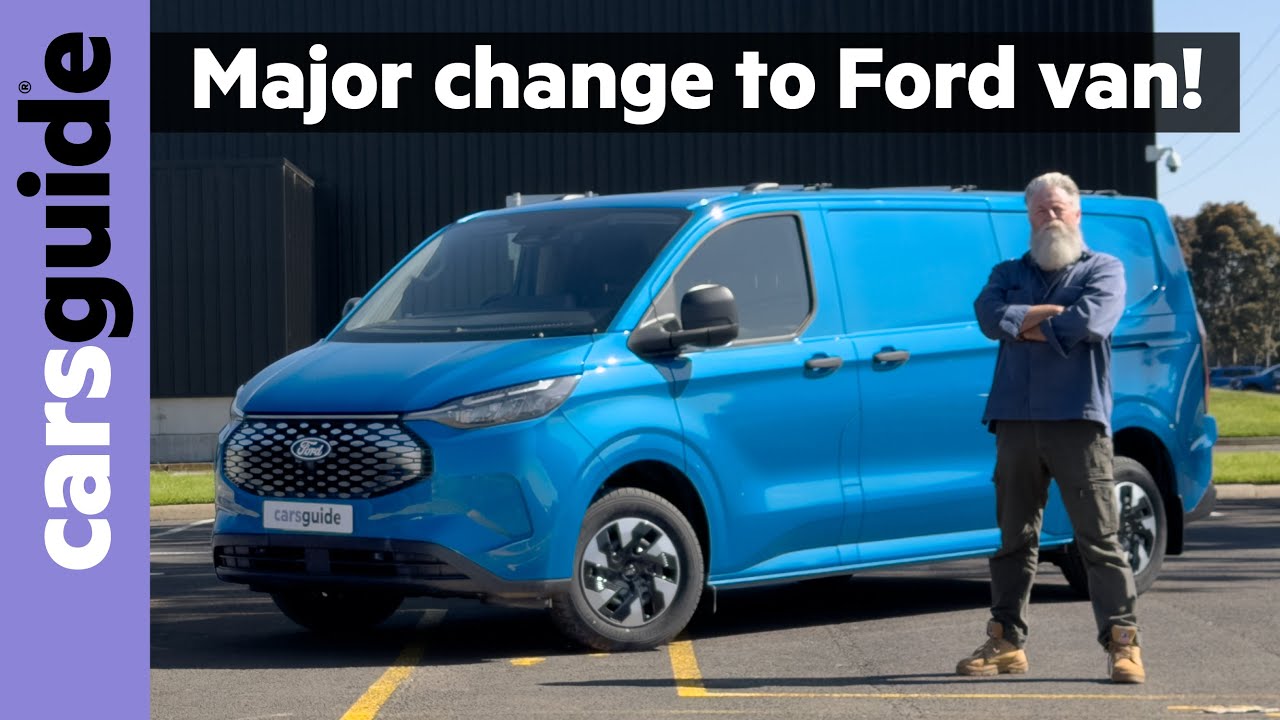
Ford Transit Custom 2026 review Australia: EV & plug-in hybrid join diesel in new Toyota HiAce rival
While some of the world’s car makers are reversing away from the concept of electrification at 100 mph, Ford is clearly not one of those because these are the most recent additions to the Australian Ford Transit custom lineup and they’re both electrified. This one is a pure battery electric vehicle. This one is a plug-in electric hybrid. Now, you could argue that commercial vehicles like this have got a lot more to gain and a lot less to lose from electrification. But while some of the car makers in the world say, “Well, do you really need an electric parcel van?” Ford’s actually saying, “Yeah, you do. You need two of them.” So, what’s the reality? [Music] This gets pretty complicated. So, for the full explanation of what’s what, check out the full written review at carsguide.com.au. So, here goes. Ford has produced not one but two electrified Transit Customs. There’s the pure electric version as well as a plug-in hybrid model. They’re both available in entry-level trend and ritia sport trim with the trend using the long wheelbase and the sport the short wheelbase for a shorter cargo area. The trend plug-in starts at 67,590 and the sport is 69,990. The fully electric trend is 77,590 and the EV Sport is $7990. If you’re buying the trend, you’ll get 16-in steel wheels, single zone climate control, a 13-in central info screen, full wireless connectivity, keyless entry and start, and wireless phone charging. Stump up for the sport, and the van gets 17in alloys, dual zone climate control, a 10-way powered driver’s seat, a body kit, stripes, and nicer cloth trim. [Music] Part of the Transit Customs appeal has always been its cool looks for a van. Anyway, the switch to electrification hasn’t changed that, although the Sport with its stripes and rear spoiler does look less like a trades work van. Inside, the design and layout is all about making the Transitus cabin a safe, comfortable workplace for somebody on the job for a full shift. So, there’s lots of charge points, storage nooks, and plain smart thinking. Okay, this is where the rubber hits the road in any delivery van. The cargo space in this car is clever. It’s lined on the floor with a very tough plastic rubbery covering. It’s got plenty of tie down points. There’s a hatch here that allows really long loads to go in through into the cabin under the passenger seat. Very clever. Solid bulkhead. The walls have got protection and there’s tons of tie down points. And the back doors are barn door style and they open right out wide against the car so you can load it with a forklift. Genius. The cabin of the Transit Custom is proof that Ford understands that it’s not just transport for a lot of people who use vehicles like this. It’s their office for eight hours. So, the seating position is a little bit sit up and beg, but that’s actually a good thing over time. The seats themselves are comfy. And because the seats mounted high and you sit up nice and high to get in and out of the thing, you just open the door and step out. You don’t have to climb up out of the car, which someone doing deliveries is going to dozens of times a day. There are plenty of clever little nooks and crannies around the cabin. Lots of cup holders. This folds down to form a riding desk. There are five USB charge ports and even things like this. The airbag in this vehicle now the front airbag drops out of the roof lining rather than out of the dashboard. And that’s allowed Ford to install a second glove box. So, they’ve really thought about stuff. There’s room in the door pockets for for big drink bottles. Everything you you need to carry out a day’s work is kind of here. It wouldn’t be a bad place to work from, I don’t think. While both these Transit Customs are electrified, they both use pretty different philosophies to arrive at a similar point on the road. This car is the battery electric version. It runs a single electric motor between the rear wheels, a 64 kWh battery pack, and it makes 160 kW. The plug-in hybrid uses a 2.5 L petrol engine combined with an electric motor. It’s frontwheel drive and it’s good for 64ks of electric only range, says the brocher. It won’t actually be that far. So, they’re quite different vehicles and they do drive a little differently. But, as for showing you under the bonnet, well, in particular, this one, there’s nothing to see. Typically, for a plug-in hybrid, the Transit PHEV did fantastically well on the official government fuel consumption test, which means you won’t match it in real life. But our real world test in urban running netted us 4.2 2 L per 100 km, which is still borderline fantastic. With the 63 L fuel tank, the Transit PHEV is capable of more than 1,000 km between visits to the servo, and that’s in urban traffic. Think about that. The only downside is that the small hybrid battery restricts pure electric range to around 50 km or less. Other brands do this better, but at least you can charge it at home in about seven hours. The EV version with it 64 kW battery meanwhile has an official range of 301 and 307 km for the short and long wheelbase respectively. Its recharging time on an 11 kW AC socket is under 7 hours. But it can also use a commercial fast charger to go from 15 to 80% charged in 32 minutes on 125 kW. [Music] So, right now I’m in the plug-in hybrid version of the Transit Custom. And the big mechanical difference is that this is frontwheel drive with the petrol engine. The EV model is rear wheel drive with just an electric motor. Funnily enough, the performance of either is actually quite similar, and that’s because they both have similar power and similar torque outputs. The reality is that they both go pretty hard. When this thing’s got a full battery charge, it actually gets away pretty smartly. So well in fact that it will actually make the front wheels chirp and a little bit and that’s just down to the fact that it’s frontwheel drive and the weight transfer to the back means that the the front becomes unloaded. It’s probably worse with a full load in the cargo area. If all you know about driving vans is the one that you rented 25 years ago to move into your first apartment, then you got a lot to learn because they’re way better than they used to be. They ride really well now. Uh they’re not quite carlike because they still do have to carry a one ton payload, but the steering is much better. And could you drive this to interstate at freeway speeds? Yeah, absolutely you could. It’s safe, it’s stable, and it’s actually really comfortable. Okay, so for the purposes of comparison, I’ve now switched to the battery electric version of the custom transit. And I got to tell you, it’s 160 kW, but they are all delivered in one hit. Typical of an electric car. Okay. So, it’s got really great stomp away from the line, which is going to make it interesting if you’re in an inner city delivery scenario because you’re going to be able to fill gaps in the traffic pretty effectively. This car has also got a really good turning circle, too. And again, that’s that’s part of the fact that Ford understands delivery vans. I mean, they’ve been making them for 60 years. They invented the original Transit. Let’s not forget. So, there’s there’s a few runs on the board, and it shines through in this car. The thing I don’t like about this vehicle is it’s got the optional solid cargo barrier, which means instead of a rear view mirror, you get a camera and a screen. The depth of field in the screen is not as bad as some of the competition, but it’s still not as good as a mirror. And if you use reading glasses, you might find that this mirror is really not very good at all. I’m not a fan. I would rather have uh a a decent mirror and and a window in the in the uh bulkhead, but that maybe that’s just me. The bottom line with this car though is it doesn’t ride quite as well as the plug-in electric version. And that’s purely because this is a heavier car. They wanted to maintain the one ton payload. By definition, then it’s got stiffer springs and you can feel it. It’s it’s probably pretty subtle to a lot of people, but I find in an urban environment where there’s lots of potholes and and and speed humps. Lord, speed humps. Let me talk to you those about those one day. This car does ride a little more harshly. It’s still acceptable, but the other thing is that the EV layout means you have to charge it every 250, 300 km. That’s not going to suit many private owners. But it won’t hurt for fleets that run parcel delivery vans because they’ll do 150, 200ks a day in an urban area, go back to the depot, be charged up, ready to go next day. I can see why you would choose the EV, but for me, my choice is pretty simple. Being a work van does not allow a modern vehicle to be less safe than any other these days. So, there’s the full suite of driver aids, including autonomous emergency braking, blind spot monitoring, and lane keeping assistance. There’s also tire pressure monitoring and a solid barrier between the cabin and cargo bay. There are also six airbags in the cabin, the front ones of which drop out of the roof lining rather than the dashboard. The Transit Custom hasn’t been crash tested in Australia, but instead has been assessed according to ANCAP’s medallion system that looks at the active safety features fitted, and on that basis, it scored a very high 96%. With EV and hybrid battery life, a hot topic, Ford has covered those elements of its Transit Custom EV and PHEV with an 8-year, 150,000 km warranty. The rest of the vehicle is covered by the usual 5-year unlimited kilometer warranty that Ford applies to all its vehicles. Running costs will depend hugely on where and when you recharge the battery, but servicing costs can be kept at very keen prices through Ford’s service plan deal. Service intervals are every 12 months or 30,000 km. Ah, and the plug-in version of the Transit uses a petrol engine, not a diesel engine. So, there’s no requirement for AdBlue. Look, I never intended for this to become a comparison between the PHEV and the electric vehicle version of the Transit Custom, but inevitably it has been because I think the PHEV just has less compromises. There’s no range anxiety. You put petrol in it, it keeps going and it does ride a little better. It’s also a bit cheaper. That said, going back to the original premise of this, which was just to look at the Transit Custom as an overall vehicle option, it really does stack up. The cabin is very, very clever. The storage spaces, the way the airbags drop down out of the roof, the the whole way the thing is put together with charge points and bottle holders and drop down desks, it just smells of a car that has been designed by people who understand that someone working 8 hours a day inside a car needs a decent workspace, and this delivers it. The cargo area is great, too. the the rubber floor mat in the back, the the protection on the walls, the barn doors that open out wide to let a forklift load it. It’s all very well considered and absolutely supports the fact that Ford knows what it’s doing when it’s building a van. The Transit is not the bestselling van in Australia, but on the basis of this car, that could change.
The 2026 Ford Transit Custom is one of Australia’s most popular mid-size vans, and this year’s update aims to make it smarter, quieter and more versatile. In this full review, CarsGuide’s David Morley takes a detailed look at the new range to see how it stacks up for business buyers and families alike.
We cover the line-up of short- and long-wheelbase models, including diesel but focusing on the new plug-in hybrid and fully electric variants. Inside, the 2026 Transit Custom features its recently redesigned cabin with improved ergonomics, updated tech and new driver-assist features. There’s also a closer look at payload, towing and cabin practicality.
On the road, David tests how the latest Transit Custom PHEV and BEV perform around town and on the highway, and compares them with rivals such as the Toyota HiAce, Hyundai Staria Load and Volkswagen Transporter. He also examines pricing and value across the 2026 range.
#Ford #TransitCustom #Review
—
Timecodes:
00:00 Intro
00:37 Pricing and features
01:44 Design
02:10 Practicality
03:40 Under the bonnet
04:18 Efficiency
05:24 Driving
08:33 Safety
09:12 Ownership
09:52 Verdict
—
Read David’s full review: https://bit.ly/49Dmr8C
Check out our Ford Transit Custom hub: https://bit.ly/4nKsP1o
Find more People Movers: https://bit.ly/3VCT92r
Visit our EV Guide: https://bit.ly/3DjhPTX
—
CarsGuide – Go beyond the test drive
Visit our website for News, Reviews, Advice and more: https://www.carsguide.com.au
Subscribe to our YouTube channel: https://www.youtube.com/carsguide
Like our Facebook page: https://www.facebook.com/carsguide.australia
Follow our TikTok profile: https://www.tiktok.com/@carsguide.com.au
Follow our Instagram profile: https://www.instagram.com/carsguideaus
Follow our X profile: https://www.x.com/CarsGuide
Follow our Threads profile: https://www.threads.net/@carsguideaus
Follow our LinkedIn page: https://www.linkedin.com/company/carsguide-com-au