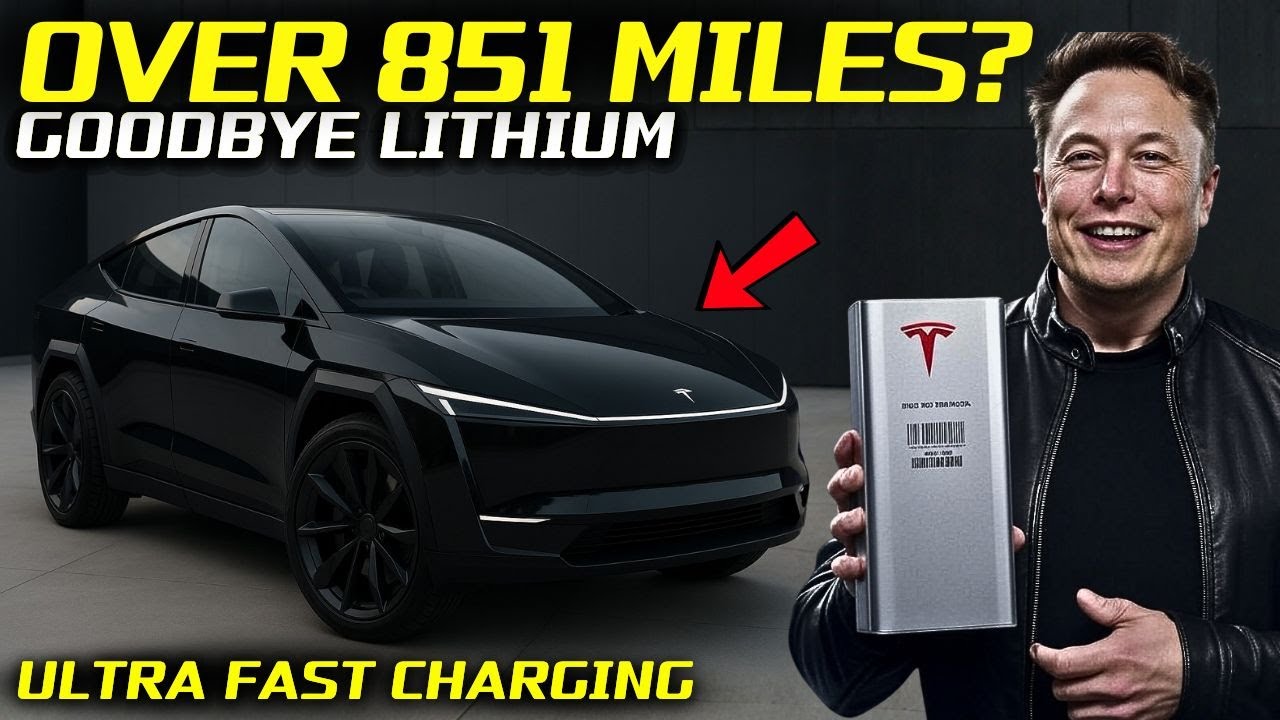
New Tesla Model 2 ALUMINUM-ION: $9,990 EV, 5-Min Charge, 250-Mile Range, 1.55M-Mile Life
2026 has barely begun and Elon Musk is already turning everything upside down again. While the internet was having fun with Cybertruck memes and bizarre Tesla bot dancing videos, a real revolution was brewing behind the scenes, but almost no one was paying attention. And as always, Musk didn’t make a fuss. No bombastic conference, no cinematic teaser, not even a provocative tweet, just a loose phrase here, a leak there, and that’s it. It became clear that Tesla is about to abandon lithium and put something even bolder in its place. Aluminum ion. It seems like a small thing at first glance, but it’s the kind of change that doesn’t just change the car, it changes the world. That’s right. Goodbye. Lithium, cobalt, and nickel. All those expensive, scarce metals laden with environmental and humanitarian controversies are becoming a thing of the past. Instead, the old and reliable aluminum takes center stage. A common, cheap, recyclable material found in abundance in the Earth’s crust. And the most curious thing is that the first model to debut this new battery isn’t a luxury car. No Roadster, Model S, or anything like that. The star of the show is the Model 2, Tesla’s popular electric car, which is slated to cause a real earthquake in the global automotive market. It’s no exaggeration. The Model 2 was already being treated as Tesla’s key piece to dominate the entry-level market. But with the arrival of aluminum ion technology, it ceased to be just an affordable promise. It became an existential threat to the rest of the industry. After all, how can you compete with a car that costs half the price, charges in minutes, doesn’t catch fire, lasts for decades, and is still beautiful? It may sound like the ramblings of an enthusiastic fan, but the technical data is as solid as a gigcast wall. And now, in 2026, all of this has ceased to be laboratory theory. It’s become a product. The secret lies in the chemistry, literally. While lithium batteries rely on materials like cobalt, which comes from controversial mines in unstable locations, aluminum is everywhere, from soda cans to train tracks. This opens up space for a much cheaper, more sustainable, and ethical supply chain. Not to mention that by eliminating these critical elements, Tesla can control the entire process from extraction to disposal at reduced cost and with zero dependence on geopolitical rivals. It’s the kind of strategic move that seems trivial until you realize the magnitude of its impact. And the craziest thing of all is that Elon Musk didn’t hide it. He’d been dropping hints for years. discrete acquisitions of advanced materials, startups, hiring engineers specializing in metal ions, and even public patents on the use of nonvolatile ionic electrolytes. But since the press’s focus was always on the robot’s dances or the Cybert truck’s windshields, this move went under the radar. It was a silent master stroke. Now that the documents have leaked and the first images of the production line have surfaced, there’s no turning back. The timing, of course, is perfect. The market is saturated with unfulfilled promises and electric cars that are too expensive for those who really need them. And while everyone was fighting over chips and rare metals, Tesla was preparing a bombshell that no one saw coming. The Model 2 with an aluminum ion battery is not just another launch. It’s the kind of product that forces competitors to rethink their entire engineering from scratch or become irrelevant. And that’s happening now in 2026, right before our eyes. It’s as if Tesla were saying, “You want affordability? Here it is. You want safety, fast charging, durability, and sustainability? It’s all here, too. And all this without depending on Asia, without mining rare earth elements, and without making the consumer pay the price of a luxury car for a compact model. It sounds like science fiction, but it’s not. The production lines are already set up, field tests have begun, and the world is about to see a new battery standard, one that will most likely bury the lithium era for good. The choice of the Model 2 wasn’t just strategic, it was symbolic. Instead of putting the new technology in a luxury vehicle to impress investors or feed the egos of early adopters, Tesla decided to start where it really matters, the wallets of the majority. This completely changes the game because now the average person who previously saw electric cars as a distant dream can for the first time consider not only buying one but owning a more durable, more efficient and cheaper car than a combustion engine one. And with a battery that charges faster than filling a gas tank, the old argument of it takes too long simply disappears. This charging speed, by the way, is not a technical detail. It’s a paradigm shift. You know that feeling of planning your day around charging time? Forget about it. The first demonstrations with aluminum ion cells showed that it’s possible to reach levels of 1,000 kilot in short peaks. Something that makes the current 250 km of superchargers seem slow. This means that instead of waiting 30 or 40 minutes for 80% charge, a Model 2 owner will be able to grab a quick coffee and get back on the road with a full battery in less than 5 minutes. And it’s not just the speed. These batteries also perform well in extreme conditions. from 50° C in the Canadian winter to 85° C in the scorching heat of the Arizona desert. They maintain stable performance without risk of overheating or significant capacity loss. This is because unlike lithium, which still suffers from volatility and thermal instability, aluminum ion batteries use ionic liquid electrolytes that are thermally stable and chemically inert. This means that even under pressure, impact or shortcircuit, they do not explode, catch fire, or become unstable. This type of safety changes what we expect from an electric car. It stops being that feeling of driving a giant laptop and becomes something more solid, more reliable. In tests conducted by universities like Stanford, the aluminum ion cells were punctured, crushed, and even set on fire and continued to function. No smoke, no fire. None of that fear that some still carry from the first EV models. That in itself would be enough to attract attention. But Tesla went further, of course, because this type of battery is not only safer, it’s also lighter, much lighter. It’s estimated that on average, an aluminum ion battery weighs about 30% less than a lithium battery with similar capacity. And this has direct implications for the Model 2’s performance. Less weight means faster acceleration, lower energy consumption, and greater range, even with a smaller battery. It’s as if the car breathes better, drives more smoothly, and even has more interior space since the cells are thinner and more flexible. For those who travel a lot or depend on their car daily, this means fewer stops, less worry, and more freedom. The driving experience changes. That anxiety about autonomy that haunts so many EV drivers disappears. And all this without needing a supercomput or an impossible infrastructure. What once seemed like a futuristic luxury is now about to become the new normal. And best of all, at a price that truly fits in your budget. That’s why this technology is being called by some Tesla engineers themselves the last piece of the puzzle. Because it’s not enough for the car to be electric. It needs to be convenient, affordable, safe, and efficient. Aluminum ion technology delivers all of that at once. And it does so without requiring drastic changes to the charging network, without creating new mining bottlenecks, and without depending on environmental policies to justify itself. This technical impact is just the beginning. Because when you look at durability, aluminum ion makes lithium seem fragile. Most current batteries last between 1,000 and 3,000 charge cycles before starting to lose performance. That seems like a lot until you put it into perspective. If you drive every day, in just a few years, you’ll already be experiencing a loss of range. Now, imagine a battery that doesn’t start aging after 3,000 cycles, but only after 12,000. We’re talking about more than 2.5 million km. That’s the kind of durability that makes the car last longer than the owner’s own lifespan. And most impressively, this durability doesn’t come with a loss of performance. Aluminum ion batteries maintain their capacity virtually intact over the years, even under heavy use. This changes the entire logic of the used car market. Today, when someone buys a used electric car, the first question is always, how’s the battery? With this new generation, that question disappears. The battery will last so long that the resale value goes up, the total cost of ownership plummets, and maintenance becomes almost non-existent. This extended lifespan also creates new possibilities for other sectors. Electric airplanes, long-d distanceance trucks, tractors, everything that was previously limited by battery wear now has room to grow. And although the focus here is on the Model 2, we can’t ignore what this technology represents for the industry as a whole. If Tesla’s cheapest car already starts with this level of durability, imagine what they will be able to do in larger models in the coming years. It may seem like an exaggeration, but we are facing a change that goes far beyond cars. And there’s more. The volutric density has also increased significantly. Early versions of aluminum ion cells were criticized for delivering little energy per liter, but that was before the use of structures like 3D graphine. With this innovation, engineers have managed to achieve levels above $1,350 WHL, while the most advanced lithium batteries barely exceed 900. This means more energy occupying less space. And space in a compact car like the Model 2 is worth its weight in gold. Less volume occupied by the battery opens up space for everything, greater structural safety, a larger deformationation area in case of impact, more interior space, and even less total weight. Tesla’s engineering has always focused on maximum integration. A battery that is part of the structure, dual function panels, giga casting to reduce parts. With the new aluminum ion cells, this philosophy goes even further because now it’s possible to mount batteries under the floor, inside the doors, behind the seats, all with thin and flexible cells. This flexibility also facilitates assembly. The cells can be stacked in an optimized way without the shape limitations that the old cylindrical ones had. This results in more compact modules, more thermally efficient and easier to cool. And when you combine this with the model 2 structure, which was designed for mass production with an assembly time of just 5 seconds per step, the result is absurd manufacturing efficiency. It’s a leap in productivity that few will be able to match. Another point that stands out is the weight. With the higher density and lightness of aluminum ion, it is estimated that the model 2 could have a reduction of 150 to 200 kg in the total battery pack. It may seem like a small amount, but in a compact car, this changes everything. It improves acceleration, reduces fuel consumption, extends range, and even influences cornering behavior. It’s as if every gram saved is converted into performance and the driver feels this in practice. But aluminum ion technology isn’t just impressive in terms of durability. It also leaves its mark on how electric cars handle the real world and the heat of it, literally. While lithium still imposes usage limits and requires heavy cooling systems, the new electrolyte used by Tesla is capable of operating in extreme temperatures without suffering performance loss. This means that in the middle of a Canadian winter or the scorching heat of Texas, the Model 2 continues to deliver the same performance without stalling, without dashboard warnings, and without relying on thermal makeshift solutions. This has profound implications for those who live in more remote regions or in areas with more extreme climates. In places where electric cars still face resistance precisely because of the thermal instability of the batteries, aluminum ion technology arrives as a direct solution. A car that doesn’t need to be pampered to work, that doesn’t require a controlled environment to operate efficiently. It’s the kind of technology that truly engages with everyday life with hot asphalt, potholed roads, and garages without special outlets. And when it comes to safety, there’s no comparison. Stress tests have shown that these batteries are almost indestructible in a practical sense. They can be punctured, crushed, or even shortcircuited and remain stable without releasing heat, catching fire, or causing explosions. It seems simple, but this solves one of the major criticisms still associated with electric cars. The fear of combustion in collisions. With the Model 2, this fear dissolves. The battery becomes almost an armored safe, invisible, but vital. Moreover, this extra safety allows Tesla to be even bolder in its structural design. Since the risk of explosion practically disappears, engineers can integrate the batteries into areas previously considered risky under the seats, on the sides, in smaller compartments. And all this with an important detail. The cells are thin, extremely thin. They are only four mimi perimeter thick. This provides a design freedom that has never existed in the automotive world. The car ceases to be shaped by the battery and begins to shape the battery according to its needs. And this soft pack format, a kind of flexible battery, is the secret. Instead of hard, heavy cylinders like the famous 4680, Tesla’s aluminum ion uses flexible cells sealed by lightweight and thin polymers. This reduces weight, increases thermal efficiency, and simplifies production. The result, a lighter car with optimized weight distribution and an even lower center of gravity. All this without compromising interior space or structural integrity. The car becomes a true technological origami. But perhaps the boldest leap is in charging time. Tesla is aiming for something that a few years ago would have been considered madness. charging the Model 2 in less than 5 minutes. With a smaller pack of 40 to 50 kilobio and peak charging speeds exceeding 350 kilo val, this is already within reach. And if you think this requires a special supercharger station, not necessarily. The company is adapting its own superchargers to handle this demand. The idea is simple. stop at a station and leave with a full battery in the time it takes to have a coffee. And there’s a detail that’s leaving many people speechless. The new recycling process. While lithium batteries still depend on expensive, toxic, and often inefficient methods involving acids, high temperature furnaces, and high energy consumption. Tesla decided to follow a different path with aluminum ion batteries. A cleaner, cheaper, and absurdly smarter path. The name of the game, dry recycling done with pressure, vibration, and magnetic fields. No chemical reagents, no smoke, no hazardous waste. This process not only reduces environmental impact, but also cuts costs by up to 40%. Yes, you read that right, 40%. In an industry where every penny counts when scaling production, this type of savings completely changes the landscape. After all, a cheap electric car only remains cheap if the entire cycle from manufacturing to recycling is efficient. And the most curious thing is that this method doesn’t require new infrastructure. It can be implemented in the gigafactories that Tesla already operates. It’s just a matter of adapting the lines. And guess what? This is already happening in parallel with the assembly of the Model 2. Another direct impact of this new chemistry is on production independence. By eliminating lithium from the equation, Tesla automatically gets rid of one of the industry’s biggest bottlenecks, dependence on the Chinese supply chain. It’s no secret that China dominates the mining, refining, and distribution of lithium worldwide. This means that any political, economic, or even climatic fluctuation there can affect prices globally. With aluminum, this risk practically disappears. The metal is cheap, stable, and produced in more than 40 countries.
While the whole world was distracted by Cybertruck memes and Tesla Bot dance clips, Elon Musk was quietly preparing the biggest power move in automotive history. In 2026, Tesla officially unveiled the Model 2 with a battery technology that could bury lithium for good: aluminum-ion. With full recharges in under 5 minutes, up to 400 km of range, durability surpassing 2.5 million kilometers, and a final price under $10,000 with incentives, this new electric car puts Tesla on an entirely new level. And we’re not talking about a concept or some futuristic promise — it’s already being mass-produced, with a build rate of one unit every 5 seconds, using recyclable materials, 98% automated production, and a supply chain completely independent from China.
In this video, you’ll understand how Tesla, led by Elon Musk, is breaking every barrier that once held back the mass adoption of electric vehicles. We’ll show how aluminum-ion batteries change everything: thermal safety, lightweight construction, cost per kilowatt-hour, and even vehicle design. Tesla isn’t just making EVs cheaper — it’s reinventing the entire logic of electric mobility with scalable, ethical, and shockingly efficient solutions. And with the new Model 2 arriving in full force, the age of the truly affordable electric car has finally begun — and there’s no turning back.
___________
Here on the EV Briefing channel, you’ll get the latest updates on Elon Musk, Tesla, new Tesla Model 2, Model 2, Tesla Model Y, Model Y 2025, Tesla Model S, Model S, Model X, and Model 3. Our focus is to bring you everything about each Tesla EV, whether it’s an affordable Tesla, a potential Tesla cheap car, or a new Tesla car on the horizon. We cover daily Tesla news, EV news, Tesla update, and tech advancements coming straight from the Gigafactory.
If you’re into electric car, future EV, Tesla 2025, improvements in Tesla battery, increased Tesla range, and everything involving Tesla innovation, you’re in the right place. We also track every Tesla reveal, Tesla launch, and of course, all major Elon Musk news and developments shaping the world of electric vehicles.
_____________
#tesla #elonmusk #teslamodel2 #teslamodely #modely #gigafactory #electricvehicles