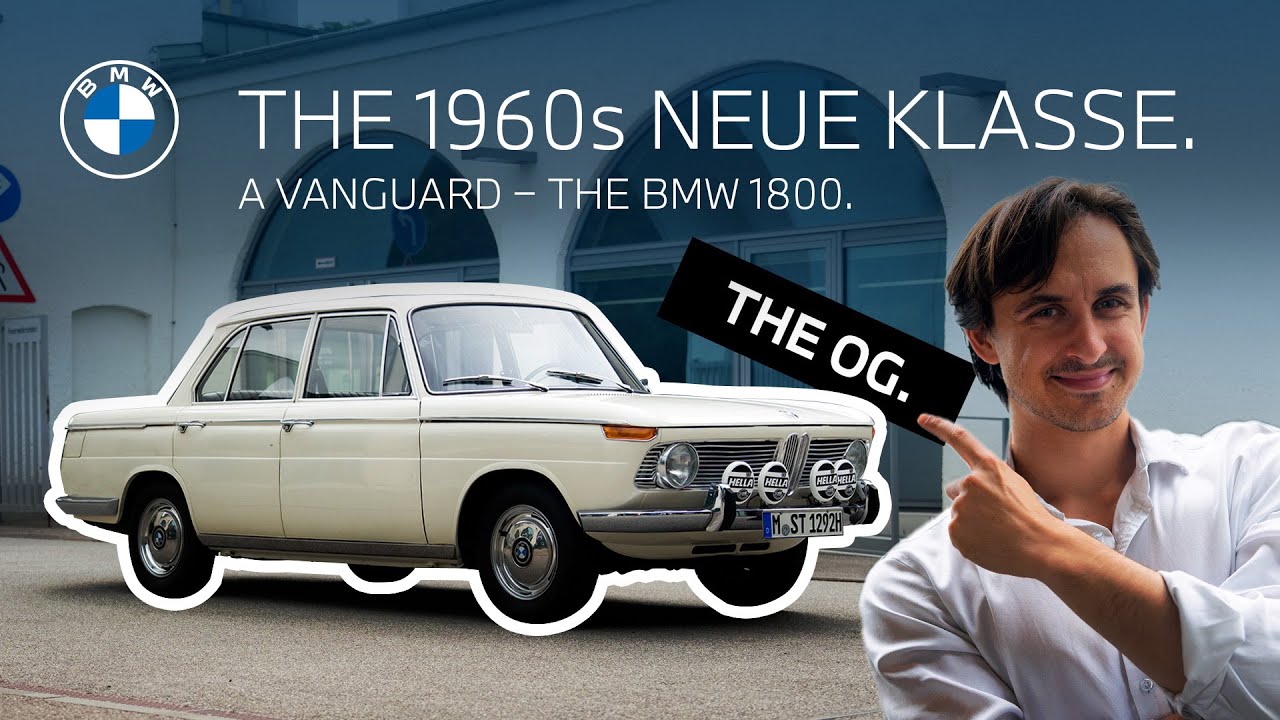
A Vanguard – The BMW 1800 | Neue Klasse Origins.
If you’ve been paying attention to BMW over the last few years, you’re probably well aware that they’re coming up with a new class of vehicles to show off their future that focuses on sustainability, digitalization, and electrification. And they’re going to call this new class, well, just that, but in German, Nea Classer. My name is Mike. You’re watching the BMW YouTube channel. And join me as over the next course of videos, we’re going to deep dive into a range of BMW classics to figure out what is it in their DNA that makes them what they are today and what we can expect from the Neya Classer of tomorrow. [Music] The term Neya Classer isn’t actually a brand new term. It harks back to the past. The past which is filled with provenence and history. Back in the 1960s, BMW was best known for two things. Big luxurious cars with big displacement engines and small things like the Isetta or a motorbike. However, in order for the BMW lineup to grow, it needed a new product. It needed to offer something new to its customers. Fortunately, the market was pretty clear about what it wanted. By the end of the 1950s, society was becoming increasingly affluent again. People wanted to cross distances at speed, efficiently, and in comfort. BMW needed to make a car for them. It needed something new. It needed a change. It needed a new class of car. And so, BMW set to work. But this wasn’t just a case of creating a brand new car. This was a shift in ideology, a shift in production methods. For the first time in 25 years, BMW commissioned its engineers to create a brand new car on a brand new chassis with a brand new engine and a brand new design. This was quite a radical thing to BMW at the time. So much so they wanted something to reflect this new change of thinking, this new change of creating cars. They wanted a new name to show to their customers that new change is on the horizon. And then it became clear they would call this the Neya Classer. the world would finally see what this Noya Classic was all about at the 1961 Frankfurt Motor Show, where BMW showed essentially the car you’re looking at here. But it was labeled the 1500, referencing the 1.5 L engine in the early cars, which produced a mighty 80 brake horsepower. It wasn’t until the year later when this thing came out, the 1800s, and you guessed it, that references the 1.8 L engine, now making 90 brake horsepower. But the thing is that engine and these design looks helped to propel the car to a very mighty 100 mph. Back in 1963, this thing was an absolute autobon stormer and an elegant one too. It was Wilhelm Hoffmeister who designed the Nea Classer. Yes, that Hoffmeister. And I’m not sure if he was aware at the time, but he would be penning the blueprint for BMW generations ahead. We have a traditional freebox design with an engine in the front, a cabin in the middle, and a rear section for your luggage. To me, this is a traditional car. It’s what I used to draw as a kid when somebody told me to draw a car. And the 1800 executes the shape perfectly. It’s beautiful. It is sleek. It is wide and it is low. Time has been super kind to the design of this car. Of course, in period, this would have been all super advanced and technological, but today its design cues have still stood the test of time. Take a note at the kidney grills. This is probably one of the most iconic features of car design ever. And is a BMW a BMW without a pair of kidneys on its front end? I don’t think so. Did you know that the kidney is now over 19 years old? First appearing in 1933 on the BMW 303 and the 1800 ensured it would continue the legacy of this design trait heading into the Neua Classer. And then you get Wilhelm’s most personal and famous design cube. So much so that’s literally named after him. Dear viewers, you are looking at the very first Hoffmeister Kink ever on a BMW. We are looking at history here. Jump inside and you’re greeted with a scene of familiarity. Cars have progressed a lot in the 60 years since the 1800 was a brand new car, but the way we drive them isn’t all that different. You still have free pedals on the floor, a gear stick to your right, and a big steering wheel to point you wherever you want to go. And that’s the thing the BMW 1800 was really good at. It drove really nicely. The chassis was sporty. So much so that BMW intended to use it in motorsport purposes. What the Noya Classer was really good at though was driving feel. This thing was incredibly fun to drive which gave birth to one of the greatest marketing slogans I’ve ever come across. Faun or to us English speakers sheer driving pleasure. It was a promise. A promise from BMW to its customers started here with the Neua Classer that continued for generations to come. My question to you now is, what’s your favorite example of sheer driving pleasure? Is it this 1800 or perhaps another car? Maybe one you own yourself. Let us know in the comments below. Thank you so much for watching. Take care and I’ll see you in the next episode. If you’ve enjoyed my BMW classic deep dive, perhaps you’ll enjoy the other videos I’ve made here during my time at the BMW Classic facility. You can find those on this hand side of your screen. And as always, don’t forget to like, comment, and subscribe.
The BMW 1800 was the dawn of a new era in the 1960s – a car that carved the path for generations and defined the very essence of what BMW would become. It opened new horizons and wrote the blueprint for a legacy that continues to shape the roads today.
🎯 Key moments:
01:17 A new thinking for a new class.
02:11 The diversity of the new class.
02:53 A new design for a new era.
04:11 The interior of the BMW 1800.
04:48 Your turn!
🔔 Subscribe for more BMW content!
📱 Follow us on social media @BMW
#BMW #NeueKlasse #BMWClassics