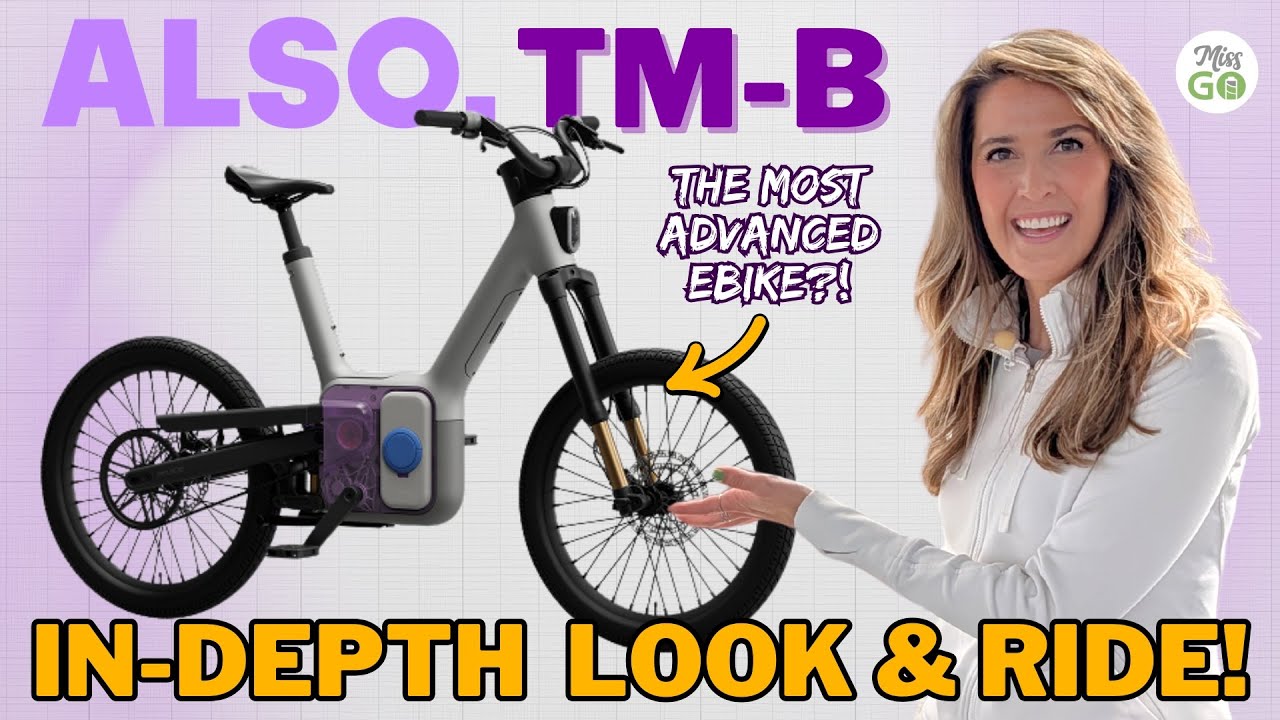
ALSO TM-B In-Depth ($4,500 NextGen Rivian eBike)
Hey everyone, Miscoco Electric here. I’m in the San Francisco area because there’s a very special event going on. And if you don’t recognize the logo behind me that says also, if you haven’t heard of the brand, it’s actually more of a micromobility company. That’s a spin-off from Rivian. We’re going to see everything that they’re going to unveil. And not only that, but we’re going to be able to ride it. So, let’s get into it. [Music] At the unveiling event, also first surprised the audience with their TMB all electric class 3 ebike. Shortly after, they shared another surprise by driving out two different quad vehicles they’re calling the TMQ that they developed in partnership with Amazon. We were able to snag an interview with biking industry veteran and president of also Chris U to ask him more about the business side of things. I’ll link that video in the description if you want to tune in. After co-founders R.J. Scaring and Chris U introduced the first products in the also lineup, I seized the opportunity to learn even more from Saul Lyken, who is the director of that product line. Can we talk a little bit more about the specifications and go into a little bit more detail about what you’re offering here? I think the most important thing to go over, the first thing is our Dream Ride propulsion system. Dream Ride sits right here uh on the TMB. That’s what we’re looking at. And Dream Ride is our in-house pedal bywire propulsion system. Uh and what that means is that there is zero mechanical connection between the pedals and the movement of the rear wheel. And you can kind of see that if you look right, pedals are down here. Usually this piece would be concentric with a front chain ring. All right? But on this bike, it’s not. The equivalent to a front chain ring or a front pulley is up here. And there’s no mechanical connection between these two pieces. It’s all an electrical connection that is softwaredefined. So can you talk about the challenges that you faced in developing this system to being so refined and precise that it feels like an extremely natural riding experience from my experience at least. Oh well, I’m glad you found it natural. Uh you hit the nail on the head as to what the challenge is, right? Because almost everyone on the planet has ridden a bicycle. If we’re even a quarter of a percentage off, it’s really noticeable. So, you mentioned taking a few pedal strokes before it before it goes on some of the other products out there. For for us, we said even taking a quarter of a pedal stroke before that power transfers to the rear wheel, that’s unacceptable. We have to make it feel just like the experience that we all know and love of riding a traditional bike. What’s in here that helps you achieve that? Several things, but first one I’ll talk about is uh what is connected to the pedals. So, what’s connected to the pedals here is a generator. That generator is incredibly capable of absorbing and understanding the energy you’re putting into it. It can then send that signal through software up to what we call the traction motor or the output motor. And that is what’s behind this pulley up here. What’s the peak wattage? The TMB is a class 3 ebike and meets all the regulations of a low-speed electric bicycle. But the power that people really care about, I think, when they’re using an ebike is torque. And the TMB has some class leading wheel torque. Uh, it is capable of up to 180 Newton meters of torque at the rear wheel. And that’s really important because it allows folks who have the GMBB performance when they’re in sport mode to accelerate at up to.3 GS, which is the equivalent of, let’s say you’re driving a car to work and you’re running a little bit late and you’re, you know, trying to jump off the the line when the light turns green. Uh, it’s basically equivalent to that level of acceleration. And that’s really important because it’s really important that folks on electric bicycles are riding with traffic, not in traffic, and not slowing people down. Yes. And that’s actually why I like how responsive this is with the throttle. There are a lot of brands that kind of make it a really gradual response, and I think that’s good for some audiences, but I like it when it’s like I’m putting the pedal down and it or the throttle down and it is going. So, I really appreciate that. Now, that’s also really important with the torque when you live in an environment like where we’re at right now in San Francisco where there’s tons of steep steep hills. The TMB with minimal rider effort can climb up to a 30% grade whereas most ebikes on the market with that same minimal amount of rider effort uh would top out at about a 15% grade. Uh and then similarly when I come down the hill like in the morning uh it can add resistance to my pedals so that you know often if you’re coming down a hill and you want to be moving your feet you’re like going like this real fast. Well the TMB can adjust it so it’ll add resistance for me so it feels like I’m riding on flat land. It’s not just how fast you’re moving the pedals. It’s also how hard you’re pressing on the pedals. And it can even Dream Ride can even detect the incline or decline that you’re on and can adjust based on that to provide the smoothest pedaling experience out there. I was so surprised with how much of that resistance I could feel while riding it, which I think also contributes to making it a very a natural feel. So, one of the wonderful things about Dream Ride being software defined is if you compare it to a traditional bicycle, you can imagine switching drivetrains at the press of a button. So, if you want to give yourself a workout, you can go into manual mode. You can shift the gears up uh like you would on a traditional bicycle to make it harder to pedal. And then, yes, Dream Ride will provide that resistance that that that you’re feeling. We can even load a workout onto this bike uh and and follow that workout. So, you can imagine maybe you live in Chicago and you’re riding on Pancake Flat Lakeshore Drive around Lake Michigan and you load a fitness workout onto the TMBB that says that you’re in the Alps and you’re on that flat road feeling like you’re climbing a mountain in the Alps and then feeling like you’re descending a mountain in the Alps. And on the flip side, you could be in the Alps and and load a a workout or maybe it’s less of a workout onto the bike that makes it feel like you’re riding on Lakeshore Drive in Chicago. That’s very cool. That is uh awesome. And I was I was saying earlier, you know, this is a culmination of so many things that I’ve tried in the ebike industry, but they’re all very disperate and they’re on different bikes. This kind of brings everything that you would want together in a full experience. So, as far as the rotors here for your disc brakes, they look very unique. Can you talk about why it looks like that? Because I heard that’s like a speed sensor system. I’m going to come back to the speed sensor in just a second, but I just want to say first and foremost, Dream Ride features regenerative braking. Uh, so when you pull the brakes, the first part of the what they call the lever stroke, so how far you pull the brakes slows you down while recharging the battery. That that regen system though also gives us a lot of options for other features including rear wheel slip control and that is where that front ring comes into place. The outermost part of that disc brake is the disc braking surface where the the pads grab the caliper. That inner ring is called a tone wheel and there’s a sensor down there that detects how fast that wheel is spinning which tells the bike how fast the front wheel is moving. Thanks to Dream Ride, we always know how fast the rear wheel is moving. And so what we can do using the data from the front wheel, matching it with Dream Ride’s data, is we can tell when there’s a differential between the front wheel and the rear wheel and Dream Ride can adjust the speed of the rear wheel to match the speed of the front wheel, thereby maintaining your traction with the ground. And so that’s what we call rear wheel slip control. Very cool. The TMB includes hydraulic disc brakes with a 203 mm rotor in the front and a 180 mm rotor in the rear, both measuring 2.3 mm thick. It will eventually be offered in standard and performance variants. At first, a limited launch edition will be the sole option. It features some unique colorways on plastic accents on the Dream Ride enclosure and battery. All three of these models will sit upon a full suspension with 120 mm of travel front and rear. Launch and performance editions will feature air shocks all around, and the standard model will feature a coil suspension up front. The tires are 24 in in diameter and 2.6 in wide with this tread for solid road efficiency by default. The company will offer an all-terrain package with knobier tires, appropriate pedals, and trail ride modes. fenders will be among the available accessories. There are two handlebar options, including a standard comfort cruiser version with a 120 mm rise and a sport option that’s more straight across with an 80 mm rise. The battery pack will contain the same automotive grade Samsung 50G NMC 2170 cells Rivian uses for their R1 EVs. The UL2271 certified battery pack comes in two sizes running at 48 volts with the standard battery offering about 11.2 amp hours or a 538watth capacity. It can recharge on or off the bike from empty to full in about 2 hours and 20 minutes. Also estimates up to 60 mi of range with the standard battery. The large battery capacity is 16.8 amp hours or 808 W hours. It can recharge from empty to full in about 3 hours and 45 minutes. Also estimates up to 100 mi of range with the larger battery. All TMBBS come with the charger. The company says both range estimates include a 25% power contribution from the use of regenerative braking. As long as there is some energy in the battery, even at 0%, a pedal forever or limp mode will enable the rider to pedal and continue slowly traveling for unlimited miles. And how much does this weigh? Well, you know, weight usually comes into play most often when you need to carry the bike up a few stairs or yeah, onto onto a car rack. These bikes have uh a system uh called a removable top frame. Press of a button. Press of a button and it comes off. Then I can hit another button to take the battery out, unlock the battery, pull it out, and between these two things, I’ve taken almost 25 pounds off the bike. All right. And so I take these off. I put these in the trunk. And then you can lift the bike up and put it onto your car rack, right? Very simple, nice and lightweight. You have to be able to drive through a rainstorm if it’s on the back of your car, right? So, we have designed it to withstand that. We’ve also designed it when it is all, you know, buttoned up, I like to call it, with with the top frame on and the battery installed for the rigors of a mountain bike trail, right? And we all know that sometimes when you’re mountain biking, you have to ford a stream or something like that. So, we actually have a waiting depth requirement which basically covers much of the dream ride. So you can go through a stream or something and not worry about the uh the dream rod system. Can you talk about the choices and what you see the swapping out of the seat post enabling for the future? This one here we call our Solo. This is for those riders who kind of just want the most simple expression of a bicycle. Maybe they want to go for a trail ride. Maybe they want to commute with a backpack on. That’s what this is for. This comes in two sizes. Uh we’re looking at the large size. There’s also a smaller size. And between those two, we can cover riders all the way from 4 foot 11 to 6’8, which is very impressive because in the ebike world, that’s a huge range. Yeah. No, usually someone in 68, like an NBA player, and they need a custom bike, but not here. Right. Uh the next one we have is a utility top frame. That rack is rated up to just shy of 80 pounds. Uh so it can carry, you know, your week’s worth of groceries. I’ve even done a Costco run on it. Um or it can carry a kid up to about 10 years old can ride on the back for school drop off or something. So, and I think I saw that that’s Mik HD compatible or is that just the front rack? Oh, no. They both are. So, the the rear rack is Mick HD compatible. So, you can so you can take the kids in the kids seats. And the front rack is Mick compatible. Uh, and then last but not least, we have a third top frame called the bench top frame. This is for someone who maybe doesn’t identify as a cyclist, maybe is not so excited about pedaling. Uh, right around like a moped. Yeah. And so, it’s a nice long top frame still built for one person that’s maybe throttle forward. And by the way, I love that you’ve gone with the dual kickstand. I think it’s perfect for this bike, especially considering if you have that utility rack and you are going to put kids on it. It is just a much better experience if you’re loading cargo or anything like that before you take off. We had that use case in mind exactly when we made this kickstand. And so we actually did some tests where we were trying like dialing in the fit of the kickstand and we put the kids seat on the on the back rack and had kids come running out to the garage and jumping on the bike and making sure it wasn’t gonna tip over with them. That is awesome. I’d love to hear that. Now, this frame is absolutely stunning. If anyone watches my ebiker reviews, you know that I’m very picky about cable management and how the frame design is. There’s no welds. It’s just very, very refined. This is a cast aluminum alloy frame. And it’s that casting process that allows us to create such a beautiful frame without any of those weld lines in it. It is very beautiful. I love to see it. Can you talk a little bit about the the bell that’s like is it going through a speaker or something? It kind of sounds like it is more amplified. So, right now for today, because we’re riding like in a local demo loop, we have it set up on bell only. Once the bike is out riding on the regular streets, uh this same paddle when you do a light flick of it, it’ll it’ll be the bell you experience today. A nice pleasant, you know, ding- ding on the bike path. Yep. Um, but when you need to get the attention of someone inside a car, when you really slam on this thing, it’s gonna make a nice car horn uh sound and that level of noise. Thank you. Thank you. And the way it’s going to do that is through a speaker built into the down tube here. I was going to ask a speaker right here. And so we set out a requirement that said our car our horn needs to match the decibel level of a car’s horn. I love that. And that was quite the engineering feat to fit all that sound into this little speaker, but the team did it. One more thing about the speaker though. Um, right now it’s playing the bell. It will be playing the horn. Uh, it also can play different sound cues from the bike. So, when you walk up to the bike with your phone as a key, it’ll greet you nicely. When you walk away, it’ll say goodbye nicely. When you turn the turn signal on, I’m going to do it here. You can see there’s a tell on the display highlighting that right side because the right side turn signal is on. It’s kind of loud in here so you can’t hear it, but the bike is making a sound to let you know the turn signal is on. And then we have some a really cool feature that I don’t think we’ve really talked about yet, which is another feature of Dream Ride. We can actually provide haptic feedback through the pedals. Felt that and I was like I was telling him right off when I got up I was like it’s brilliant when they shift. It’s gives you that feedback right to the pedals and it feels very precise. It’s very cool. That’s right. So this feature is in testing right now. But we have a plan to actually vibrate your pedals kind of rapidly after let’s call it like 30 seconds or something in case you’ve forgotten to turn your turn signal off. It’ll vibrate rapidly on that side of the pedal to let you know, hey, turn that turn signal off. I love to see that there are integrated lights and they have turn signals not only on the rear but also on the front light. Um, but can you talk a little bit more about this front headlamp in specific and what the lumen reading is because safety obviously is really important even if you’re riding at night. So, yeah, on the front light, um, you can see it might be inspired by our our cousin brand Rivian. Uh, and, uh, there’s a couple lights going on in here, right? So, you have the RGB ring light that is serves as sort of like a daytime running light. Uh we it also can have some features like when you plug it in to charge, that light will tell you how much your bike is charged. So, if you’re staring at it from across the room or across the garage, just one quick glance, you’ll know what percentage the bike is at. Uh the main projectors, there’s two of them. There’s a high high beam and a low beam. Uh the high beam goes uh up to about 1500 lumens. Uh and the low beam is capped at around 250 lumens. I do want to speak briefly about the rear light. Uh the rear light offers about 200 lumens of of light on the back. And it features biomotion lighting. And so we actually set up some LEDs on all three of our top frames to fire downwards towards your lower leg, like your calf and your ankle. And that’s highlighting your pedaling motion as you move down the road. And that’s a motion that’s unique to human beings. And so that sends the signal to your brain, oh that’s a human being, and I have to be extra careful. It’s not just a red light. So can we talk a little bit more about the interface here and what its capabilities are? What is it capable of? Absolutely. So, this is our portal display and uh right now we are in ride mode. So, you’re looking at the default screen when you’re in ride. That big zero in the middle, that’s a speedometer. So, if we were moving, you know, that would be showing you your speed. Um on the right hand side, you have a energy bar. So, when you’re putting energy into the bike through the pedals, you’ll see it light up orange up on the top. And when you pull your brake levers for some regen braking again, if we were moving, uh you would see it light up green on the bottom showing that there’s energy going back into the system. Like my Rivian on the left side, uh the top icon there is what ride mode you’re in. Uh and the bottom number there is what assist level you’re in. So I’m going to show you on the right hand toggle here. If I toggle it up, it shows you I’m going up into an assist level. See, I went up to four and now it’s showing four on the display. Similarly, if I want to change my ride mode, I tap that. And you see up at the top we have auto and manual. In auto, it’s your kind of set it and forget it transmission style. If I clicked over to manual, that would give me the option to manually shift the gears. And uh and then you can go into manual and select a trail mode. Trail mode uh speed limits you to 20 miles an hour. So you’re kind of trail legal for for most of the trails out there. It also uh disables any throttle capabilities from the throttle and turns this into an assist boost, which means you have to be pedaling the bike, but let’s say you’re pedaling along and you’re in assist three, but you come to a a steep and short incline. You don’t want to change your assist level altogether because you can see the top of the hill and you know when you get up to the top, you want to be in three again. Well, you can be pedaling along. You can hold this down and while you hold it down, it’ll boost your assist up to 10. It’ll you’ll get up the hill, you let go, and it’ll return you back to three. And then you can actually customize this screen. So you can change what stats you’re seeing on here. Okay. And that’s all done through the app, I’m assuming, or Yes. Okay. So, moving on to the next screen. This is our navigation screen. So, right now, my phone’s not connected to this bike, which means uh that it’s going to show you a compass. But when my phone is in the loop, uh I can actually put in a destination and it will show me turnbyturn directions. uh on this screen. Is it going through the also app or is it through like a Google Maps or an Apple Maps? It’s going through the also app. It’s our own proprietary stack of navigation. That’s really important. I’m so glad you asked that question. Thank you. That’s really important because Google Maps has great cycling directions, but it doesn’t really know how fast you’re going, especially when you’re on an ebike. It kind of assumes you’re on a traditional what I call analog bike and that you might not be the strongest rider out there. So, when I use Google Maps, I always end up showing up way early wherever I’m going to uh and twiddling my thumbs while I wait to get there. Well, with our stack, we know not just that you’re on an ebike, but we actually know like your ride history and your performance history and what your average speeds are. So, we can quote your ETAs based on all of that. And all of that data, is it recorded in the app so that you can look back and say, “Okay, I rode x amount of miles on this day and I did, you know, this month I did a total of this many miles and all that kind of stuff.” Yes, exactly. It is recorded in the app. Cool. So, if you’re building your own like navigation system for this bike, are you able to prioritize or give information based on like mountain biking trails and other types of trails that maybe something like Google Maps wouldn’t necessarily show you because it’s just picking up like bike lanes and things like that. The short answer is yes, we can. Uh we are f focused first and foremost on the on-road directions, but we will be building out the uh off-road network as well. The system also leverages the app for proximity unlocking as the rider approaches. When riders walk away, the bike can be set to automatically lock the top frame, rear wheel, and battery. Owners can receive push notification alerts if someone tampers with the bike while it’s locked. The TMB also has GPS location tracking enabled by LTE data. The Connect Plus connected services are available with a subscription, which is currently priced at $120 annually or $12 per month. Okay, now the last screen I want to show you. Again, uh no phone is in the loop. You can see right there it says no phone connected, but this is our media screen. So again, where my phone connected to the bike, uh and I had my Alpha Wave helmet on. Uh I could use this pad on the left here to change my volume. Again, it’s telling me no phone connected. Usually the phone was in the loop, just like when I changed the assist level and that screen came up showing me the assist. Usually when I hit this, it would show me what volume I’m at. And then similarly I can use this button here to adjust play, pause, next track, that kind of thing. Saying that the phone is going to be utilized for those things. It makes me think of well if my battery is low on my phone, is there a way to keep it charged up while I’m riding? So is there on this bike the ability to quickly and cleanly connect to be able to charge off the bike’s battery? We have a birectional USBC port on the down tube of the bike. This will allow you, if you’re lucky enough to live in a place where you don’t have to pull the battery out to charge it, like like you have a garage or something, you could plug right in with our charger and charge the bike. Also, while you’re on the go, you can u use this to output power to your phone. Heck, it can even go to your MacBook or something like that cuz that’s 240 watts of output power. The birectional nature of it is really cool to be able to export the battery even and take it out to like a picnic or the beach or whatever. And in this case, I’d run a cable from here to maybe up to the handlebars, but is there like accessory packages that you guys are going to be able to offer that will enable people to customize and really make it suit them the way they want to ride it? Absolutely. Uh, so we have a series of accessories that mount on these ports on either side of the stem here. Oh, now that um and they’ll mount in you could put like a beverage holder here so your cup of coffee is right there as you’re commuting to work. Um, and we also have a phone holster over here. So, if you keep your phone nice and secure, right? All the things you might want to do on the phone while you ride. Well, the portal is going to take care of that for you. But maybe you’re stopped at a red light, you have to send a quick text, hey, I’m on my way home. Something like that. The phone will be at your fingertips right here. And of course, it’s very close to our USBC port, so it’s very easy to charge while you’re on the go. Now, as you mentioned that, is it visible that shows you that you receive a text message? Yes. And you can you see the text of the text message or does it just tell you that there is a notification? Yes. So right now in order to keep people safe and like focused on riding down the street, we want to let them know that there’s a uh that there’s a text there so that they can use their voice assistant to listen to the text if they want. Uh but we’re not putting the text itself on the screen cuz we don’t want people to be distracted. The TMB will also come with a 2-year warranty and the brand will be announcing more details on service in early 2026, but they have said that they will be working with the mobile bike service company Velopix as a part of their offerings. Thank you so much, Saul, for spending so much time with us and answering so many of our questions. We really appreciate it and best of luck with this. My pleasure. Thank you so much. All right, so we have seen the presentation and but now it’s time to ride the TMV. So, I’m all geared up. Let’s go [Music] put my turn signal on. The shifting is all right. Right. So, as you guys know, I usually start off my ebike reviews without any assistance at all. But since this is kind of a a different use case, and we’re at this media event, I am being started off in the third pedal assistance mode. And it is responsive and the fact that it feels like just like any other normal torque sensor. And that’s important to note considering that there is no connection between the pedals and the drivetrain because this is a pedal bywire system. And so far, just going over that little um crack, it’s very comfortable with this full suspension. So, if I push a little bit harder, I do get a little bit more power. But let’s move up into the higher assist modes. This has 10 different assist modes when you’re pedaling. And so the responsiveness will absolutely change. And I am feeling actually that this is very surprising to me without having a traditional derailer and shifter that I still feel some resistance. So this is an extremely natural feel of riding a bike. Um, but if I do want more assistance, I can bump it up and pedal up to 28 mph cuz technically this is a class 3 bike. Very good hydraulic brakes. [Music] This is in the automatic mode, though. I’m going to actually test out this throttle now, which will top out at about 20 miles hour. So, let’s see from a standstill how it performs with the throttle. Holy moly, that’s responsive. In a lot of cases, there are several ebikes that they give you quite a gradual response with the throttle, but this is so so quick. And that also might be because I’m in the 10th pedal assist mode. Let’s actually move down into that third mode again and just see It’s still very responsive. So, it doesn’t seem as if the throttle is attached to the pedal assist modes. So, it’s just very, very, very responsive. I like that. Um, actually, you know what I’m going to do is I’m going to come down around here and talk to someone in order to switch me out into the manual mode so we can see how that feels. All right. Now, I have switched out into the manual mode. So, as far as the controls go, on the right side here, next to the throttle is the adjustment that you can use to switch out into the mode. So, if I want to bump it up, it’s actually really cool what I’m feeling right now because there’s a lot of resistance. So, it does actually feel like a traditional chain bike in that regard. So, when you switch out, it’s almost like a little vibration in my feet that I feel when I’m going into a different mode. I will say I do feel as if I would like the handlebars to be a little bit up higher. You can twist these handlebars up here so that there is some flexibility. But I love how clean this design is. I do not like these grips. I um asked someone if they were the production version. There’s a lot of people working here, so he said he thinks they are, but I’ll get an answer on that. Now, if you want to make any adjustments through the screen, it is a touch screen. You can also move through menus by twisting the screen. And then there are some controls on the left side that you can adjust for volume and um your media connection. So, you can see as I swipe down, it’s saying I don’t have any connection because I don’t have a phone connected to this. But basically, you can move through that with the knob and with this selection screen. And it also allows me to move through the different menus to tell me more information, how many watts I’m outputting. But I like that they’re providing a lot of information. This also has navigation. So that is a game changer for the ebike world. There are other brands that offer navigation. It simply hasn’t been glitch-free system. So it’s good to see that they have that integrated here. And there’s a nice loud chime of the bell. So, well, I think I’ve spent enough time with this. Some other people got to ride it around, but this is a uh nice first introduction to the also TMB. So far, so good. All right, so we’re wrapping up the day here at the also event. We had the ability to ride the TMB, talked to a lot of the great leadership here, and not only that, we saw a very cool quad vehicle in partnership with Amazon. So hopefully in the future we’ll be able to get a little bit more time with the product. But until next time, drive, fly, ride, go electric. [Music] [Music]
What is ALSO and what is Transcendent Mobility?
@ride_also is a micromobility brand which spun out of @Rivian Automotive. Their first products were shown in October of 2025 and set to launch in 2026. Join Miss GoElectric as she spends time with a product director to learn the finer details of the product and rides a pre-production model on track.
We hope ALSO will make a review unit available when the product is finished so we can offer a complete review, but this video should be helpful for those considering a $4,500 deposit on the Launch Edition.
Here is a separate video in which Miss GoElectric interviews ALSO president and co-founder Chris Yu:
Here is our general coverage of the ALSO brand introduction as seen on our weekly electric mobility news program “The Current” which is published every Sunday to our mainstream channel @MissGoElectric
Of course, you can visit the ALSO web site at www.ridealso.com
Our look at the company and our take on how its products could evolve and change the industry
The Power Chronicles : ALSO and Their Pursuit of Transcendent Mobility
(coming soon)
Thanks for watching!
——————————————————————————
Visit my website for Deals on eBikes and Miss GoElectric Merchandise:
http://deals.missgoelectric.com
Tweets by MissGoElectric
Daily electrification updates
http://www.Instagram.com/missgoelectric
Fun photos behind the scenes and at public appearances
https://www.facebook.com/MissGoElectric
Event invitations and community
——————————————————————————
CHAPTERS:
00:00 Introduction
01:03 Dream Ride Propulsion System
06:33 Traction Control
07:25 General Specifications
09:21 What Happens at Zero Percent Battery
10:33 Top Frame Swap System
12:20 Frame Construction
13:30 Smart Features
14:35 Lighting Systems
15:50 Portal Display Capabilities
20:24 Accessories and Power Export
22:50 On Track Impressions