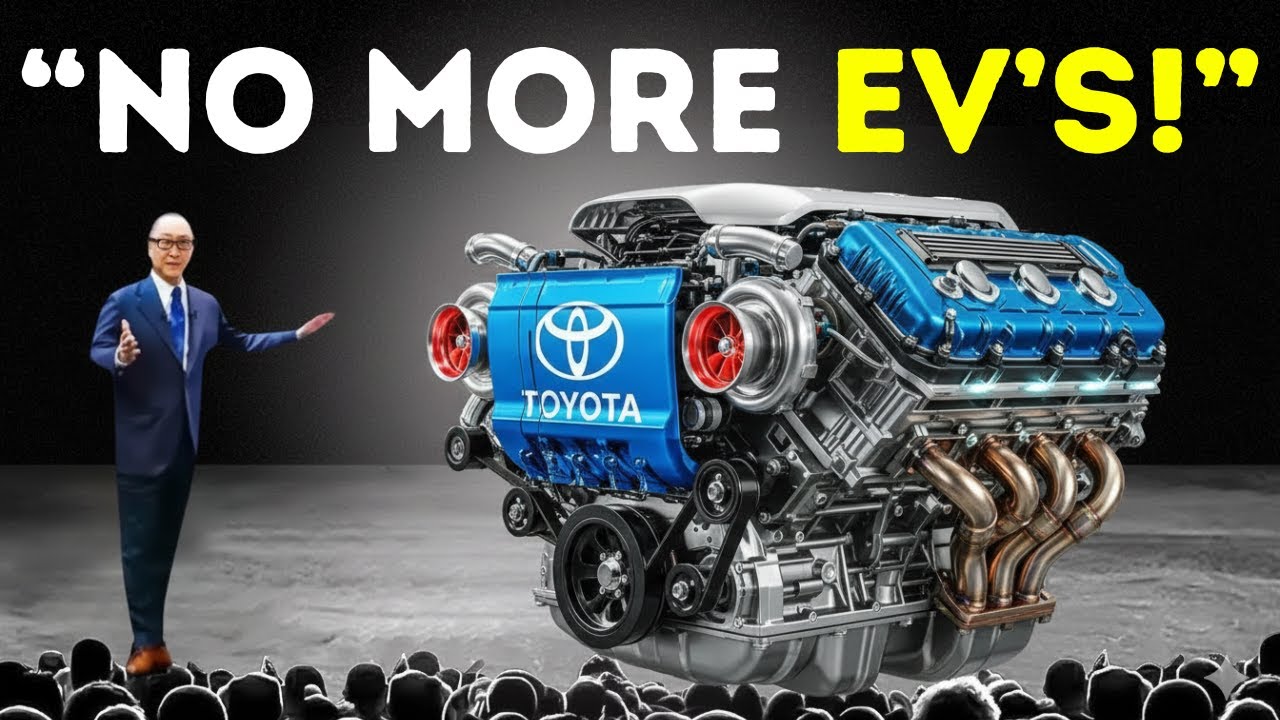
Toyota CEO Declares: This Engine Will END the EV Hype!
Although several engines have been around for a while, it’s becoming increasingly clear that there are more efficient ways to provide the power needed to move our cars from point A to point B. Toyota believes hydrogen power is the future and that its new engines could make electric vehicles obsolete. It’s time to take a closer look at the development of Toyota’s engines and explore the key factors that make Toyota a leader in the automotive industry. How does Toyota plan to achieve this? And can its hydrogen-powered internal combustion engines truly replace electric vehicles? Let’s find out. Toyota is pursuing a multifaceted strategy to achieve carbon neutrality, and the Japanese automaker may just find success with it. Toyota has been a pioneer in hybrid and plug-in hybrid technology since it introduced the groundbreaking Prius in 1997. Those vehicles paved the way for today’s electric vehicle boom. Despite that legacy, the company has been reluctant to fully embrace the allect electric trend. Toyota’s resistance to the 100% EV transition has sparked controversy and serious debate. Several governments, including those in California, Australia, Canada, and across the European Union have already approved bans on new gas-powered cars by 2035. Automakers everywhere, are under immense pressure to switch from gasoline to electric as part of the global push to cut carbon emissions. Yet Toyota has publicly resisted declining to sign the COP 26 agreement that called for electric vehicles only by 2040. The company has deliberately slowed its transition, arguing that the rush toward full electrification overlooks several critical realities. Former CEO Akio Toyota faced heavy criticism for his unpopular stance. In contrast, brands like Jaguar announced plans to go fully electric by 2025, while Cadillac and Volvo committed to all electric lineups after 2030. As competitors such as Honda, Ford, Mercedes, Volkswagen, and General Motors prepare to phase out gasoline powered cars. Toyota appears uninterested in joining the race, a surprising move from a company long known for being an early adopter of new technologies. However, Toyota’s reasoning is compelling. The company argues that a complete shift to EVs isn’t yet feasible. AO Toyota believes electric vehicles are overhyped and that an over supply of them could create new problems. He points out that high prices and limited charging infrastructure make widespread EV adoption unrealistic. Currently, EVs make up only about 1% of the global auto fleet. But as their numbers grow, challenges will become impossible to ignore. One major concern is the power demand. If EV adoption surges by 2030, the United States alone would need to expand electricity output by 40%, requiring over $100 billion in grid investments. Even in parts of Europe and Asia with more advanced energy systems, demand could easily exceed capacity if every driver switched to electric. Toyota has emphasized the need to focus on hydrogen-powered technology instead. He believes Toyota’s new hydrogen engines could disrupt, even destroy the current EV market. Beyond range limitations, he’s also raised concerns about the environmental costs of battery production and disposal, as well as the lack of charging infrastructure. And he has a point. There isn’t enough clean electricity to support mass EV use. Most of the world’s electricity still comes from fossil fuels. So switching to EVs doesn’t eliminate emissions. It simply shifts them upstream. Toyota’s famous statement captures his philosophy perfectly. Carbon is the enemy, not the internal combustion engine. Globally, EV adoption isn’t uniform. Europe and China are moving faster than most. But the US is lagging, and many regions, particularly in Africa, have almost no EV infrastructure. This uneven progress shows that the world isn’t ready for a one-sizefitsall electric future. Toyota worries that an allect electric shift would leave millions of its customers behind. In 2021, Toyota sold more than 10.5 million vehicles across 200 countries, giving it the world’s largest market reach. Many of those markets, especially in developing nations, lack the infrastructure to support EVs and won’t have it by 2035. Electric vehicles are also expensive. Today, government subsidies make them somewhat affordable, but those incentives may not last. Once subsidies end, many consumers simply won’t be willing to pay the premium for EVs. Toyota believes a balanced approach using multiple power sources is more realistic. That’s why the company continues to invest in hybrid and hydrogen technologies. Producing lithium batteries is resource inensive and global supplies of lithium and batteryrade nickel are limited. Hydrogen engines could relieve pressure on these materials and slow the looming supply crunch. Another factor is sound and emotion. Electric vehicles, while fast, can feel lifeless to car enthusiasts. Of course, hydrogen has challenges. It’s highly flammable and tricky to store safely, and burning it can produce nitrogen oxide. Still, Toyota’s approach to carbon neutrality is far more diverse than its competitors. While most automakers are betting everything on batteries, Toyota is exploring multiple technologies to reach zero emissions. That foresight looks increasingly wise. Energy shortages caused by the war in Ukraine have forced European nations to cut consumption. Switzerland even advised EV owners to drive only for essential trips and that could become law. Hydrogen vehicles offer a promising alternative. Fuel cell technology provides longer range and faster refueling than battery EVs. However, for hydrogen cars to go mainstream, costs must drop. Hydrogen production must become cleaner and refueling networks must expand. Hydrogen fuel cell technology isn’t new. NASA used it in the 1,960 seconds to power spacecraft. It works by splitting hydrogen atoms into protons and electrons. The electrons generate electricity, while the protons combine with oxygen to form water, the only emission. Hydrogen cars store compressed hydrogen in reinforced tanks, feeding it through a fuel cell stack that powers electric motors, releasing only water vapor. In the end, the choice belongs to consumers. Both battery electric and hydrogen-powered vehicles have vital roles to play in a sustainable transportation future. It’s unlikely that one will completely replace the other. Instead, they’ll coexist, each serving different needs, lifestyles, and regions around the world. To understand how groundbreaking this is, let’s take a step back. The concept of using hydrogen for energy began as early as 1,800 when William Nicholson and Sir Anthony Carlilele experimented with electrolysis. Over time, this idea evolved into a serious industry, one that is now seeing a revival thanks to Toyota. Imagine an engine that only emits water, runs on the most abundant element in the universe, offers high energy density, and performs better than most cars on the market. For decades, this was thought to be impossible until NASA engineers selected hydrogen as the fuel of choice for their most powerful rockets. Hydrogen went from being a scientific curiosity to a symbol of futuristic energy. But there was a problem. While hydrogen was promising, the infrastructure to support it was practically non-existent. Gasoline was cheap and easy to distribute, while hydrogen required new complex systems. The 1,970s oil crisis, however, forced the world to consider alternatives. Engineers started developing hydrogen-powered prototypes based on NASA’s concepts. Compared to gasoline, hydrogen was cleaner, more efficient, and less tied to political conflicts. Still, decades of research yielded little progress. By the mid 1,990s, companies like BMW and Mazda had experimented with hydrogen engines, but without lasting success.
#FutureCars #AutomotiveNews #ElectricVehicles
When the whole world is investing billions of dollars in Electric Vehicles (EVs), Toyota has shocked the auto industry with the reveal of its Hydrogen Combustion Engine.
The biggest weakness of EVs is the long charging time and limited battery range. But Toyota’s new engine can eliminate both of these problems. Instead of smoke, it produces only water and steam – giving you petrol-like power with zero pollution!
#Toyota #HydrogenEngine #ElectricVehicles #EVvsHydrogen #FutureCars #GreenTechnology #HydrogenPower #TeslaVsToyota #EVRevolution #HydrogenFuture #ZeroEmission #NextGenCars #CleanEnergy #ToyotaHydrogen #AutomotiveNews #HydrogenTechnology #GameChanger #FutureOfCars #HydrogenVsEV #TechRevolution