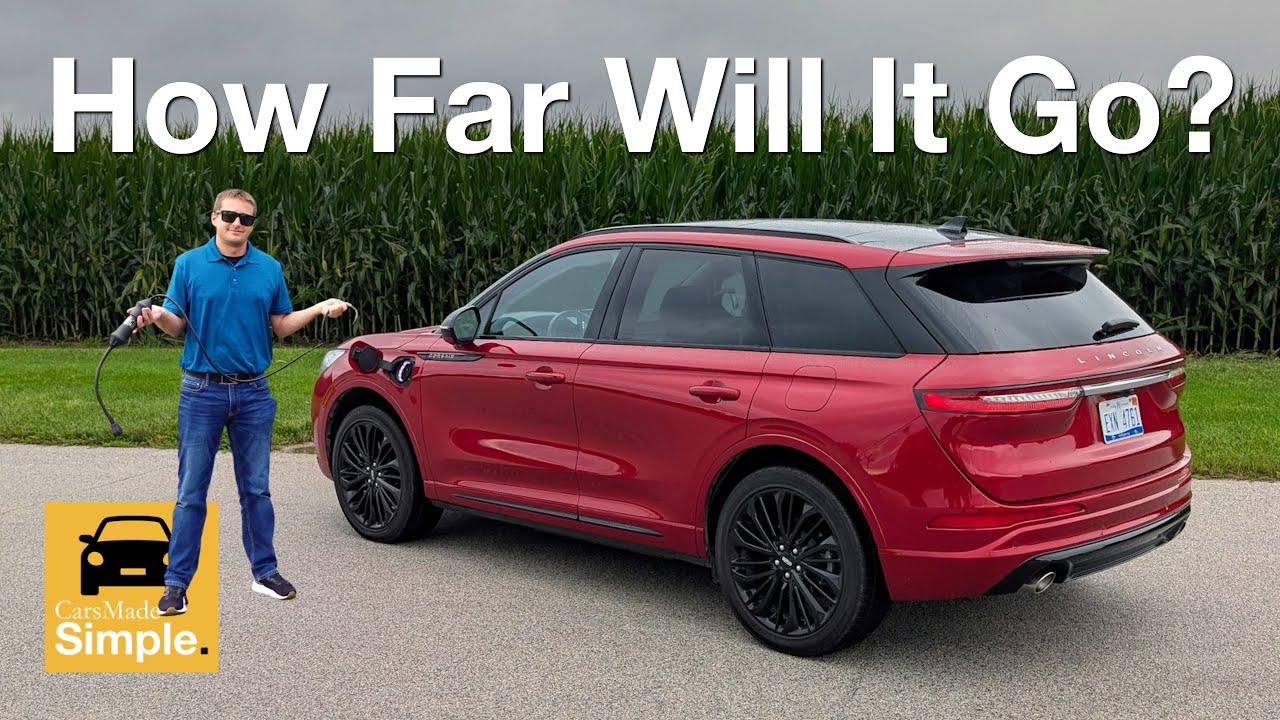
2025 Lincoln Corsair Plug In Hybrid Range Test | Beating Expectations
Hey everyone, welcome back to another range test video here on the channel. Today you join me in the 2025 Lincoln Corsair Grand Touring plug-in hybrid, which is honestly a vehicle I did not know existed. Now, I’ve gone ahead and What is this thing doing? I don’t want the engine on. I’m in pure EV mode. It should not be kicking on the engine. Okay, looks like we got that sorted. But anyways, this is my very first Lincoln product that I’ve tested and reviewed here on the channel. And uh it’s very been a very interesting experience thus far. Like I said, I really didn’t know much about the Corsair, let alone the fact it did offer a plug-in hybrid powertrain. And uh given I put about 120 miles on this vehicle thus far, I have ran it and depleted it from a full charge already. I’m not sure we’re going to achieve uh some of the best range figures on all electricity that I’ve achieved here on the channel from some of the competitors to this vehicle and just other plug-in hybrids currently offered on the market. So, under the hood of this vehicle, you’re going to find a 2.5 L naturally aspirated 4-cylinder engine Atkinson cycle paired to a CVT transmission in the front wheels. And you’ll find two different electric motors, one in the front, one in the back for uh an all-wheel drive system. So, it is an electronically controlled fulltime all-wheel drive, and there’s no mechanical linkage from the front wheels to the back wheels, which is the setup that a lot of plug-in hybrids actually use. Uh, very similar to this one. Now, total system output is 266 horsepower, which is 16 horsepower more than that of the 2 L turbo four-cylinder that will be the other powertrain offered in this vehicle. So, it technically is the more powerful of the two, but 0 to 60 times are going to be roughly equivalent in the low 6-second range. And I don’t think you’re really going to notice any major performance benefits unless you are uh, you know, keeping this vehicle at a full charge, trying to drive around on all electricity all the time. And that is really the benefit of plug-in hybrids, given they are going to be slightly heavier given the high voltage battery system. They have some other componentry uh that, you know, just add weight to a vehicle like this. So, the key benefit to getting really maximizing the fuel economy is going to be keeping it fully charged up as much as possible and operating on all electricity as much as you can. Now, this vehicle is powered by a 14.4 kWh battery pack. I’m not 100% sure if that is usable or gross capacity, uh, but that is a little bit on the smaller side of things for, uh, even some of the competitors in this segment, such as the Lexus NX plug-in hybrid. uh but really isn’t too far different from some of those other vehicles. It might just be a touch smaller. Again, if that is either gross or uh you know net usable. Now, if you are new to the channel or haven’t seen any of my other range test videos here on the channel, then my loop is consists of a 30 mile roundtrip loop. So, I start at the house, I will head to a halfway point, turn around, make the return trip back, and it consists of about a third of it or 33% is 70 mph interstate driving. Another third of it is roughly anywhere from 45 miles to 55 mph, which is on the road we’re at now, currently at a stoplight. And then the rest of it is going to be slower speeds from anywhere from 15 m hour all the way up to about 30 35 m an hour. So I think it is a relatively good mix of driving and realworld use case for a vehicle like this. And uh you know, I just try to be realistic in my testing and not try to maximize it necessarily given a large chunk is out on the interstate at 70 plus miles an hour, but I do want to uh be fair and I run all the plug-in hybrids that I get to test here on the channel on the exact same loop. Now, current weather conditions are a little bit on the hotter side. It’s currently 91° outside, so I do have the AC set at 70. I got the ventilated seat turned on and I’m trying not to like blast the AC full blast just to give this vehicle a fair shot. But the reason I’m actually running it here in the evening time is because there’s like no wind outside. It is nearly calm. So there should not be any negative impacts in terms of wind uh or anything like that, which you know, some other vehicles I’ve probably tested do have a little bit of that factor rolling into it. Uh but today we are battling the heat. So, I will keep you guys updated on uh kind of my first impressions and uh what I’m seeing with this vehicle. It is rated at 27 mi of range according to the EPA on the window sticker. However, both times I fully charged this battery up, it’s only topped out at 23 mi to the uh estimator here on the digital dashboard. So, it will be interesting to see uh how close we can get to that 27 mile mark according to uh Lincoln, you know, and the EPA. Okay, so here we are getting on to the interstate portion of this test. Now, I do have to say this one with the adaptive suspension, it actually handles reasonably well. Uh, it’s a pretty compliant, soft, plush ride, but I think it holds its own in terms of handling and, uh, chassis dynamics with these Continental Allseason tires. Now, the one thing I don’t like about it is the power under the, you know, strictly electric motors. These are not very powerful and I am putting my foot, you know, 75% on the accelerator right now and it takes some time to get up to speed past, you know, 40 45 m an hour. So, this is not one of the most effortless accelerating plug-in hybrids strictly on the electric power. And it’s borderline where I would call it acceptable. It’s certainly down a lot from some of the competitors and its effortless nature, but it did it. We’re up to uh nearly 70 mph now. But one of the nice things and one of the best things about this vehicle is the Lincoln Blue Cruise functionality, which can be activated here. Touch of a button, we’ll go ahead and set it at 70 m an hour. Activates the adaptive cruise control. And then once all other criteria are met, giving you are driving on an applicable roadway, it will transition automatically into hands-free driving, assuming you have that enabled on the settings, which you can see right there. blue cruise enabled. So now we are traveling hands-free. Uh which is just a nice feature. It it honestly is one of the better driver assist uh you know systems that’s currently available even from uh some other competitors to this vehicle. So, I think I have to give it to Ford and uh the Blue Cruise system because even though this one is not the latest, most up-to-date version of it, it does have manual lane changes, which means if you want to change lanes to left here, we just press the turn signal, it will automatically check to make sure that lane is clear, merge over to the lane that you’re moving into, and automatically recenter you in the lane, and keep on driving. So, there’s a lot of other more expensive products on the market to this one that you’d expect equivalent driver assist systems. However, they are far behind Blue Cruise and some of the other, you know, hands-free systems such as GM Super Cruise. We are here traveling 7.2 mi into the trip and we are down to 17 miles indicated on the gesso meter, which means we’re pacing about 24 total miles of range. We got are slowing down here, so we need to move into the left lane. And you can tell it’s using pretty much all the electric motor power available to it to uh speed up to pass cars, assuming you have like a 10 mph delta. But it does it it’s reasonably well. And um overall, I think the average person, assuming you aren’t racing this thing, uh and are maybe a spirited driver, would find the acceleration acceptable. But to me, uh compared to a lot of the other plug-in hybrids I’ve tested, this is one of the least powerful. uh got off the interstate. Everything is still pacing. 24 to 25 miles on the uh total range of this vehicle. And given the roughly 27 miles of electric range, this is going to be one of the first vehicles, maybe the first or second that I’ve ever tested on this range test that will not complete a 100% full loop because it ultimately just can’t do the full 30 mi that uh my range test consists of, which is okay. Uh, you know, obviously certain people will need a little bit more range than others depending on how you drive the vehicle, what your commute is, and uh, you know, whether or not you have charging at your workplace. It all comes into play. So, 27 mi of all electric range isn’t necessarily a bad thing. Uh, but just know it is going to be, you know, noticeably less than some other vehicles I have tested. Okay, so we have just made it to the halfway turnaround point and you can see we’ve traveled 14.6 6 milesi according to the vehicle and we still have 12 miles of all electric range left which means we’re pacing just under 27 miles which is very impressive considering that uh I guess meter was saying you know 23 miles when when I unplugged at 100% state of charge. So we are doing quite well and we are pacing a real world test of you know nearly 27 miles which is exactly what I hope to see in all the vehicles that I test. So, we’re going to go ahead and uh start back on the way back. Got to say, over some of this really broken rough pavement. Uh the Corsair does a pretty good job uh you know, isolating the occupants inside the vehicle and uh dampening those harsh bumps cuz some of those with any sort of lowprofile tires without any adaptive suspension or depending on how the suspension is tuned would be absolutely brutal on occupants. And who knows, might even start damaging the uh, you know, wheel and tire or other components depending on how deep those potholes really are. And of course, something I’ve already mentioned earlier on this video when we first merge onto the Interstate is uh, you know, plug-in hybrids. Something to look out for if you really plan to use this vehicle on all electricity all the times is the merging power that you have available using the electric motors. Even this sweeping on-ramp, you can tell that the Corsair is a little bit down on power from some other vehicles I’ve tested. Now, there’s one that comes to mind, such as like the CX70 and the CX90, because the electric motor powers the transmission. So, the vehicle is shifting through the gears, which gives it a totally different um feeling than this one that’s obviously running just, you know, straight to the wheels. No gear set or anything that the electric motors are powering. But that is just something to keep in mind. This one again just not the most powerful out there. But again, I’ve already mentioned it. It’s just depending on your use case. This one is definitely pushing the limits of acceptable uh when you either need frequent merging applications on on-ramps, uh you know, high-speed maneuvers, anything like that is, you know, it’s a little bit lacking. I’m not going to lie. I’ve gone ahead and pulled up the power flow meter on the main infotainment system so you guys know exactly when it switches over uh from all electric into its hybrid operation. Cuz obviously this vehicle once the battery is depleted will still be slightly more fuel efficient and operate as a traditional hybrid using the buffer that they have programmed into the high voltage battery pack. You know, to give you that hybrid feel and all of that sort of additional power benefits, too. So, we’re actually passing 25 miles as we speak right now. So, we are going to be really darn close, if not accomplish 27 miles on a full loop, which is fantastic. Okay, we’re down to 1 mile of electric range. 0 miles of estimated range now. Still shows we’re in pure EV and electric drive only, but we might be running up on the buffer here very shortly. Just passed 27 miles. So, we did beat the uh EPA rating at this point. Still driving on the buffer, it seems like. We’ll need to get over into the left lane for my turnoff here. There we go. EV mode not available. 27.7 miles on all electricity. I got to give it to the Corsair. It It actually did it. It actually ga got its EPA estimated range despite the trip information being very pessimis pessimistic. I’m plugging at 100% state of charge and even on in, you know, 91 degree temperatures with the AC running. Granted, very little to no wind outside, it did it. So, I will catch up you guys here uh in a couple seconds. We’re going to run over some of the uh you know efficiency information and all that miles per kilowatt hour and uh see how it stacks up versus some of the other vehicles I’ve tested including the Lexus NX on this exact same route and uh go over some of the final thoughts and conclusions here in the Lincoln Corsair. So there we have it. As you can see, I was a little bit wrong or pessimistic about the Lincoln Corsair and its abilities, but it was able to achieve the 27.7 mi traveled using the 14.4 4 kWh high voltage battery pack. Now, if we take a look at efficiency using that 14.4 kWh number, again, I’m not sure if that’s usable or overall gross capacity. This comes out to roughly 1.92 m per kilowatt hour, which is right in line with a lot of the other plug-in hybrids that I have tested here on the channel, such as that of the Lexus RX and NX plug-in hybrids, which achieved very similar um efficiency numbers right around 1.87 87 1.9 or just over 1.9 miles per kilowatt hour. And some of the most efficient uh plug-in hybrids I’ve tested, of course, are well over uh 2.2 2.3 m per kilowatt hour. So, uh not quite at that level, but still uh you know, at least met my expectations, the window sticker rating of the vehicle, and as a whole, it it performed on the test uh in these given conditions. Now, like I said, going back to the Lexus NX, which is one of the direct competitors to this vehicle, you know, that was unable to it achieve its rated economy on the window sticker of 37 miles on a single charge. I observed right around 34 miles. So, yes, even though the Lexus vehicles and such have a larger capacity battery pack, the efficiency is relatively similar. But at the end of the day, just because it has that extra capacity in terms of battery equals more range and ultimately, I think equals more usability, especially when you look at the given price points of the Lincoln Corsair that I tested and the NX I’ve had in the past, which are both in the mid to upper $60,000 price point. And for the $69,000 that this Lincoln costs, I would hands down take the NX fully loaded with everything that that vehicle has to offer. Heck, I think it comes out like $1 to $2,000 cheaper or less expensive. Uh, so at the end of the day, I think it boils down to that. I think the uh Lincoln has some issues when it comes to overall power output using its electric drivetrain solely. Um, it’s not the most peppy. It’s not the most powerful out there. It gets the job done. It’s adequate, but at the end of the day, uh, a lot of the other ones I’ve tested drive much more effortlessly and, uh, just have better power and or overall efficiency. So, uh, ultimately you guys will have to let me know what you guys think of these results and, uh, the Lane Corsair plug-in hybrid down in the comment section below. Is this something you’re actually interested in purchasing in? Uh, is this a vehicle that, you know, you’ve cross shopped either in the gas and or plug-in hybrid powertrains or uh, are you guys just curious about what this vehicle is able to do? Because ultimately, I think that’s kind of what my perspective on this vehicle is. But anyways, I want to give a huge thanks to Lincoln for sending out the Corsair Grand Touring 3 plug-in hybrid for me to test and review. If you guys enjoyed this video or find it helpful, make sure you hit that like button, subscribe if you haven’t already, check out my dedicated likes and dislikes, and my full driving impressions of the Linky Corsair in separate videos posted here on the channel. As always, I appreciate the support and hope to see you guys in the next one. [Music]
In this video we test the electric only range on the 2025 Lincoln Corsair Plug In Hybrid. The Corsair PHEV consists of a 2.5l NA 4 cylinder and CVT transmission paired with two electric motors for a combined output of 266hp. The rear electric motors makes the Corsair PHEV AWD as standard unlike the Ford Escape PHEV which is offered in FWD only. The battery capacity is 14.4 kWh which allows for the Corsair to drive at least 27 miles according to the EPA. During my test, I was able to beat the EPA figures… barely. Given the smaller battery, the Corsair still has ok efficiency for a PHEV which makes the range usable although not as great as the others in the segment. Let me know your thoughts on the Corsair results below!
Support the Channel!
– Amazon Affiliate: https://www.amazon.com/shop/carsmadesimple
– Channel Membership: https://www.youtube.com/carsmadesimple/join
#lincoln #lincolncorsair #phev