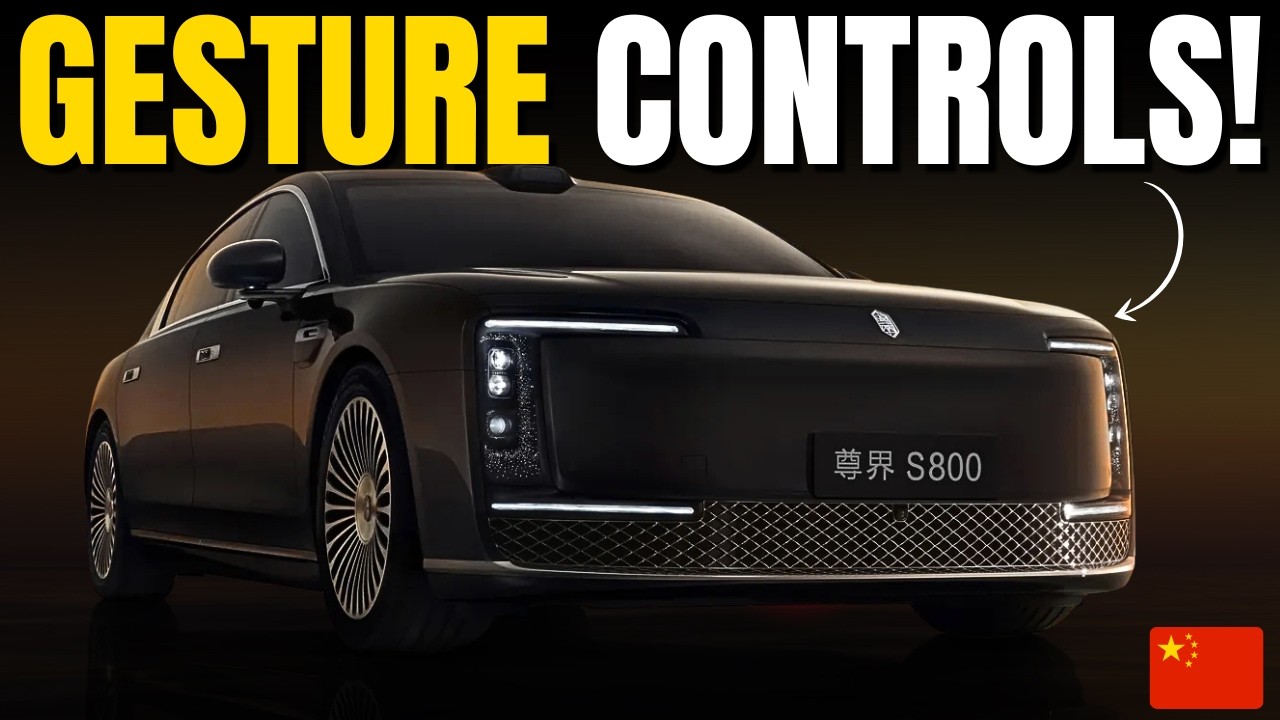
Huawei Maextro S800 – The Most Luxurious Chinese Sedan Ever!
Buckle up, because what you’re about to see might just change the way you look at luxury cars forever. This is the Huawei Maestro S800, a full-size Chinese luxury sedan that looks like it costs $150,000, but doesn’t. And trust me, the price isn’t even the most shocking part because in this video, we’re not doing a lazy 5minute surface review. No, no, no. We’re going deep. We’re breaking down every single inch of this car. From the laser headlights that can write your name on the road to the seats that literally massage your spine like a five-star spa in motion. Every switch, every texture, every hidden luxury, nothing’s being skipped. And when we get to the interior, oh, you’re going to lose it because what Huawei did inside this car makes Mercedes and Tesla look like student projects. So, make sure you stick around till the end because we’re about to unpack the Maestro S800 piece by piece. And trust me, by the time we reveal the price, you’ll be questioning everything you thought you knew about premium. Let’s dive in. Starting with that exterior, because this thing, it looks like it just rolled out of a sci-fi movie. Let’s talk about what really makes people turn their heads when this thing rolls down the street. The exterior. Because the Huawei Maestro S800 isn’t just a car. It’s a moving piece of tech art. The kind that makes your neighbor’s Tesla suddenly look like an overgrown iPad on wheels. First glance, it looks expensive. Like seriously expensive. You could park this next to a Mercedes EQS or a BMW 7 series and most people wouldn’t know which one cost six figures. That’s how confident, how polished, and how damn mature this design language is. Huawei calls this their new intelligent aesthetics. I call it how to humble BMW in 2025. The front end sharp, clean, and almost sinister. You’ve got a closed off grill that’s laser sculpted into this digital diamond texture. It looks like a high-end speaker mesh because Huawei literally designed it to channel air flow and radar sensors for its autonomous sensors. So yeah, even the grill is smarter than half the cars in your local dealership. And those headlights, man, these are Huawei’s digital pixel laser matrix lights inspired by their smartphone display tech. Each one has over a million micro mirrors that can project customizable patterns on the road. You could literally spell your name on the pavement if you wanted to. Try doing that with your Lexus. The daytime running lights form this continuous blade across the front. It gives off pure cyberpunk vibes. And when you unlock it, the lights do a little startup animation dance like the car is waking up from hypersleep. No joke, people stop and stare just for that. Slide to the side profile, and that’s where you realize this car means business. Long stretched proportions, fastback silhouette, flush door handles that pop out with a little click when you approach with your Huawei phone. The Maestro doesn’t shout, it whispers wealth. And here’s a fun detail most people miss. The roof line isn’t a single piece of glass. It’s actually a dual pane panoramic smart roof that automatically tints in zones depending on the sun’s angle. So you can have bright sunlight for the front seats and shade in the back at the same time. That’s the kind of feature you expect in a Maybach, not a Chinese sedan that costs less than your average Rivian down payment. Let’s talk about the body. The Maestro S800 uses Huawei’s new zero line gap manufacturing process. Panels are so tightly fitted that the gap between them is only 0.8 mm. For context, that’s tighter than Rolls-Royce tolerances. Every curve feels intentional. No wasted lines, no random vents just for show. And the color options, man, Huawei went full fashion week on this. You’ve got stellar silver, crimson moon, midnight ink, and my favorite, quantum blue, which shifts color depending on how the light hits it. It literally glows like a galaxy under street lights. Park that next to a Model S, and suddenly Elon’s car looks uh kind of old school. Move to the rear, and this is where Huawei flexes. full width LED bar, 3D glass texture, and a subtle active spoiler that raises automatically when you hit 90 kmh. But it’s not just for show. It’s connected to Huawei’s aerodynamic AI system that adjusts air channels underneath the car in real time to reduce drag. Yeah, it’s got adaptive aerodynamics from a company that used to make phones. Down below, you’ve got a perfectly flat underbody. No pipes, no mess, no noise. This thing cuts through the air like a stealth jet. CD value, just.1 98. That’s less drag than a freaking Mercedes EQS. And here’s the thing, when you see it on the road, you can’t even tell it’s Chinese. It’s that globally premium. Huawei didn’t just copy Europe, they outdesed Europe. This car looks like what Mercedes would have made if they weren’t so busy adding useless touchpads. And let’s not ignore the wheels because Huawei nailed the stance. 21-in turbine style alloys wrapped in Michelin Pilot EV tires. Behind them, massive Brembo calibers painted in harmony red, the same red used in the Huawei logo. And no, that’s not just for looks. This thing has legit performance underneath, but we’ll get to that later. Every element of the S800 exterior screams precision. Even the side mirrors, they’re digital cameras with night vision and rain repelling nano coating. When you park, they fold inward and display your surroundings on the infotainment screen like a drone view. You could practically parallel park this thing blindfolded. And here’s a subtle flex most people miss. There’s barely any chrome. Huawei ditched the bling. Instead, everything’s matte metallic or piano black. It feels grownup, like the kind of car that doesn’t need to prove it’s expensive because it already knows it is. But here’s the part that really hit me. You know when you see a luxury car that’s all design and no soul? This isn’t that. The Maestro S800 feels alive. The way the lights breathe, the panels curve, the reflection dances, it’s got character. It’s got that main character energy. You can literally imagine this thing pulling up in a sci-fi movie next to a spaceship and it would fit right in. And I get it. Some of you are thinking, “Okay, it looks good, but it’s still Huawei. How premium can it really feel?” Buddy, you have no idea. Because the real shock, the part that made me rethink everything I thought I knew about luxury sedans, comes the moment you open that door. So, buckle up because what’s waiting inside the Maestro S800 makes Mercedes and Tesla look like student projects. Let’s dive in. Because the outside of the Maestro S800, sure, it’s stunning, but the inside, the inside is where Huawei basically said, you know what? Let’s embarrass Mercedes for fun. You open the door and the first thing that hits you isn’t even the smell. It’s the silence. It’s like stepping into an Apple store that learned about comfort. The doors though, they don’t close. They seal like a spaceship hatch. You hear that soft whoosh and suddenly the chaos of the outside world just vanishes. Now your eyes, they don’t know where to look first. There’s an entire wall of glass screens that wraps across the dashboard, a massive 12.8 in main display for the driver, and then, wait for it, a floating 15.6 6 in 2.5K central touchscreen for infotainment powered by Huawei’s Harmony OS4. And yes, it’s smoother than an iPhone. Tap something and it responds before you even realize you touched it. But then you notice the passenger side. Yep, they get their own full touchscreen, too. Netflix, navigation, even games right there. Huawei literally said, “If you’re not driving, at least don’t be bored.” And that’s just the start. Let’s talk seats. These things aren’t seats. They’re zero gravity pods. Each one is wrapped in Nappa leather. So soft you’ll start questioning your life choices forever sitting in a Toyota. The stitching is precise like luxury watch craftsmanship. And the texture, imagine butter, but expensive. Both the front and rear seats are fully electrically adjustable with ventilation, heating, and massage modes. And not those cheap vibration ones. I mean real air cell massages that adjust to your posture. using built-in sensors. The rear passengers even get a full control tablet in the center armrest. Yes, a tablet where they can change the seat angle, mood lighting, blinds, and even the music. Oh, yeah. Mood lighting. Huawei went full RGB gamer mode, but elegant. Ambient lights flow across the door panels and dashboard like soft aurora waves. They respond to the music. You play a song and the lights pulse with the bass. Try that in the BMW. it’ll just glare back at you for asking. Now, speaking of sound, this is where it gets absurd. The Maestro S800 packs a 21 speaker Huawei sound system with spatial audio tuning. It literally uses the car’s sensors to scan how many people are inside, then remaps the sound to center around each one. That’s borderline black magic. You could sit in the back right corner and still feel like the singer’s performing right in front of you. And bro, the roof, it’s not just a panoramic sunroof. It’s a smart glass roof with electrochromic dimming. One tap and it goes from clear to tinted in half a second. You can control it from your screen or your voice. Hey, Celia, make it cozy. Boom. Glass darkens. AC cools. Ambient lights turn gold. Instant date night. Let’s talk hidden stuff. There’s a fragrance system. Yes, fragrance built into the dash. Not some cheap clip-on air freshener, but an integrated scent module with replaceable cartridges. It even syncs with your profile, so every time you sit down, the car literally greets you with your scent. You also get a refrigerated compartment in the center console. Keeps your drinks ice cold on road trips. And below that, wireless charging pads that can charge two phones at once. 50watt fast wireless, faster than some laptops charge. And here’s my favorite detail. The door panels have built-in soft touch leather pockets with ambient glow. When you open the door at night, the lights gently fade in like the car is alive, welcoming you back. But here’s the kicker. The Mextro S800 doesn’t just look smart. It is smart. It’s powered by Huawei’s full Harmony OS smart cockpit 4.0. The same ecosystem that links your phone, tablet, even your smartwatch. You can literally walk up to the car wearing a Huawei watch and it unlocks automatically. No keys. Get in and your seat, mirrors, climate, and playlist adjust to your profile instantly. Voice commands. You don’t have to talk like a robot. You can literally say, “Hey, Celia, I’m freezing.” And it’ll bump up the temperature. Or, “Hey, Celia, play the weekend.” And boom, your sound system kicks in like a concert hall. Oh, and that instrument cluster, fully digital, 3D rendered, customizable. You can make it look like a minimalist spaceship or full F1 telemetry mode with tire temps, navigation overlay, and even AR driving visuals that highlight turns on the real road through the HUD. Speaking of the HUD, it’s next level. 70 in of projected info that makes Tesla’s setup look like a calculator screen. It overlays navigation arrows on top of the real road. You turn your head and it adjusts. That’s AI. That’s Huawei flexing. And man, the rear cabin, that’s not a back seat, that’s a lounge. There’s independent climate control, privacy blinds, heating and massage, and more legroom than a firstass Emirates seat. The rear doors, soft clothes. The armrest, leather wrapped with built-in controls. There’s even USBC plus wireless charging pads in the back. You can literally recline, raise your feet, and watch movies while your driver handles the road. The acoustic glass isolates 95% of exterior noise. You can whisper and still be heard crystal clear thanks to Huawei’s voice enhancement system that amplifies your speech through hidden cabin mics. It’s surreal. It’s futuristic. So yeah, the Mestro S800 isn’t just a car. It’s Huawei walking into the luxury segment, throwing a designer glove at Mercedes, and saying, “Your move.” So, it’s beautiful, but can you live with it? Family, kids, groceries. Let’s see. The car is 5,480 mm long, 2,000 mm wide, 1,536 mm tall with its huge 3370 mm wheelbase. That’s comparable to top luxury sedans and even some full-size SUVs. You’re not cramped. In five seat mode, you have plenty of room in the back for three medium adults or two adults, plus a car seat, plus some wiggle space. The rear middle seat may not be thrown level, but it’s usable. The executive four seat version gives maximum luxury, but reduces practicality slightly. Trunk space estimates around 445 to 500 plus L depending on configuration. Enough luggage for a weekend trip or a family of four’s gear. Compare that with, say, a BMW 5 Series, a Mercedes E-Class, or even a popular family SUV. The S800 competes comfortably. Its presence is larger, but usable. It’s not a hatchback, but it’s more than sufficient for many families who want luxury and usability. So, yeah, you could buy this for daily use, not just for show, but be sure your garage, entrances, narrow streets, low clearance driveways can handle a 2 m wide beast. Now, let’s talk about what’s under the skin. Because the S800 isn’t just a pretty face, it’s got some serious muscle. There are two main powertrain setups. BEV, pure electric, and ERV, extended range electric. BE version, dual motors, front and rear, pushing out around 390 kW. That’s roughly 523 horsepower. It packs a 97 kWh NMC battery and claims a range of about 436 mi. A CLTC estimate 0 to 60 comes in around 4.3 seconds and it can fast charge from 10 to 80% in roughly 12 minutes using a 5C charger. ERV version pairs a 1.5 L turbo engine used only as a generator with electric motors. It uses a 65 kWh battery and comes in dual motor or tri motor setups. The dual motor EREV delivers around 249 mi of pure electric range with a total combined range of about 828 mi when you include the generator and it hits 0 to 60 in about 4.9 seconds. The tri motor ERV offers roughly 227 mi of electric only range and around 746 mi total with a 0 to 60 sprint in about 4.7 seconds. In short, you’re getting EV performance with a built-in safety net. That gas generator kicks in when the battery is low, making it perfect for long road trips where charging stations are sparse. Other cool tech includes rear wheel steering up to 12° for a surprisingly tight turning radius, plus active suspension, smart torque distribution, and full torque vectoring. Curb weight sits between 5700 and 6280 lb depending on configuration. Yeah, the numbers are wild, but real world range always depends on your driving habits, terrain, and weather. So, don’t expect 430 mi cruising at 80 mph in a snowstorm. Still, this mix of performance and range, that’s rare. It’s part luxury cruiser, part electric rocket. If you’re geeking out over these specs, drop a comment. Which one would you choose, the BEV or the EREV? Look, beauty and performance are cool, but safety is non-negotiable when you’re putting people, family inside. So, how’s the MXRO doing on protection? Huawei Mextro markets the Shuanu safety architecture. The body uses many horizontal and longitudinal structural members for rigidity. Torional stiffness is rated around 53,300 Newton meters per degree. They employ 13 airbags, a four-lock safety system, underbody shields for battery protection, multi-layer crash structures, and thermal management for battery safety. Sensors, lidar, millimeter wave radars, cameras, ultrasonics, the works. The advanced driver assistance suite, ADS 4.0, is supposed to manage tight urban maneuvers, intersection handling, and even blind corner scenarios. Other smart safety bits, if a crash is imminent, the car preps itself. It may adjust posture, tighten seat belts, close windows, lock doors. The doors and low voltage systems are designed redundantly, so operations may still function after crash impacts. Huawei also advertises meeting China’s C9AP 5-star, CIA SI 3G plus standards, though US Euro ratings are not confirmed yet. So yes, they threw a ton of engineering at safety, but until independent crash tests from trusted agencies like IIHS, NHTSA, or Euro Encap arrive, a bit of caution is wise. Okay, here’s the moment you’ve been waiting for. After seeing all those luxury cues, mind-blowing features, triple displays, smart doors, insane range, how much do you think this thing costs? My guess, if I were blindfolded, would have been $200,000 plus easily or maybe 150k for midspec. But no, the starting price in China is $78,000 yuan, which is about 98,900 USD. The top fully loaded version, ERV, executive 4 seat, all options goes up to 1,18,000 yuan, which is about 141,600 USD. Think about that. A car that’s trying to crush Maybach, S-Classes, Bentleys, and it’s starting under a 100K in China. Compared to a Mercedes S-Class or BMW 7 loaded up in the US, you’re saving tens or hundreds of thousands of dollars. Is this a luxury bargain, a tech steal, or a bold gamble? I’ll let you decide. If you want me to map out what it might cost in the US, including import, tariffs, homologation, let me know in comments and I’ll break it down in a follow-up video. So, there you have it. The Huawei May Extra S800. A car that feels like a sci-fi luxury dream, packed with tech, daring in design, and priced in a way that would make legacy brands sweat. Is it perfect? No. But it’s daring. It’s bold. It’s the kind of car that changes expectations. What do you think? Future family flagship or future flop? Drop your thoughts in the comments. Do you believe Huawei can beat Maybach or is this just hype until real world proves it? If you enjoyed geeking out over this, hit that like, smash subscribe so you don’t miss our next car deep dives, and tell me which car should we test next that’ll make your jaw drop. I’ve got ideas. Ride safe, stay curious, and I’ll see you in the next one.
The Most Advanced Luxury EV on Planet – Huawei Maextro S800 Review | Full Breakdown & Interior Tour
Buckle up… because this might just change everything you know about luxury cars.
Meet the Huawei Maextro S800 — a full-size Chinese luxury EV that looks like a $150,000 Mercedes but costs nearly half.
In this in-depth review, we take you inside and out of the Maextro S800 — exploring its design, futuristic tech, smart interior, and insane driving performance.
This isn’t your typical car review. This is a cinematic deep dive into one of the most advanced electric sedans ever built.
From laser headlights that can write your name on the road…
to an interior so futuristic, it makes Tesla, Mercedes, and BMW look outdated.
⚡ Key Specs & Info:
Name: Huawei Maextro S800
Type: Full-size luxury electric sedan
Power: Dual/tri motor setup, up to 523 HP
Range: Up to 436 miles (BEV) / 828 miles (EREV)
Battery: 97 kWh / 65 kWh (depending on version)
0–60 mph: 4.3 seconds
Smart System: HarmonyOS 4 + ADS 4.0 autonomous suite
Starting Price (China): ¥708,000 (~$98,900 USD)
🧠 Why You Should Watch This:
This video isn’t just about a car — it’s about the shift in global luxury.
Huawei just entered the automotive battlefield… and it’s coming for Mercedes EQS, BMW i7, Lucid Air, and Tesla Model S.
With smarter AI, richer materials, and jaw-dropping tech integration, the Maextro S800 may be the future of high-end electric mobility.
💬 Join the Conversation:
Would you choose the BEV or EREV version?
Do you think Huawei can compete with Mercedes and BMW in luxury EVs?
👇 Drop your thoughts in the comments — let’s talk about the future of cars!
🔔 Subscribe for More Epic Reviews:
If you love futuristic cars, Chinese EV tech, and luxury vehicle deep dives —
💥 Hit SUBSCRIBE to join the Dragon Driver community.
We explore the wildest, smartest, and boldest cars redefining the industry.
#car #automobile #electricvehicle #electriccar #luxuryautomobiles #luxury #luxurycars #futurecars #chinesecars #maextros800 #tesla #bmw #mercedes #audi #toyota
⚖️ Copyright Disclaimer
Copyright Disclaimer under Section 107 of the Copyright Act 1976, allowance is made for “fair use” for purposes such as criticism, comment, news reporting, teaching, scholarship, and research.
All media used in this video (including clips, images, and background footage) belong to their respective owners and are used strictly for educational, commentary, and review purposes under fair use.
If any content owners would like to discuss material removal or credit, please contact us directly at:
📩 [ usamastudies100@gmail.com]