
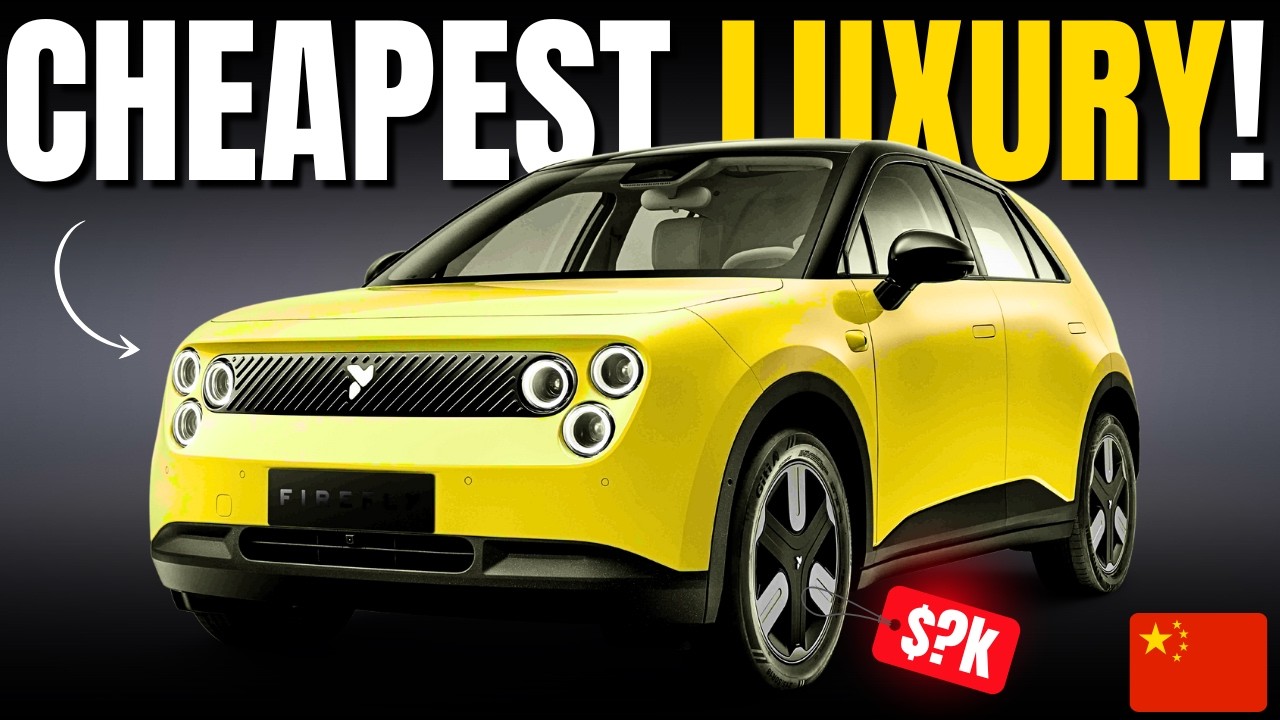
This Tiny Chinese EV Just EMBARRASSED the West! NIO Firefly
Imagine a sleek, compact EV that looks like it rolled straight out of a BMW or Mini showroom. Packed with luxury features, nextgen AI, battery swap tech, and interior design that screams premium. Sounds like something that should cost at least 50 grand, right? Well, let’s just say when you hear what this thing actually costs, you might start questioning every car purchase you’ve ever made. This is the NIO Firefly, China’s latest curveball to the global EV game. And the real shock, it’s not just what’s inside. It’s what they’re offering for the price that’s going to make the West nervous. So, if you’re ready to see how deep this rabbit hole goes, smash that like button, subscribe to Wheel Factor, because by the end of this video, you’ll either want one or want to move to China. Let’s roll. When NIO unveiled Firefly, they made it clear they were aiming straight at Mini, Smart, and the premium small EV class. It’s a 5-oor hatchback measuring 4,3 mm long, 1781 mm wide, and 1557 mm tall with a wheelbase of 2615 mm. That wheelbase is longer than you might expect, giving it better interior room and balanced proportions despite the compact overall length. The styling is bold without being over the top. Tight overhangs, sharp shoulder lines, and a sleek roofline taper. But here’s where designers got playful. Triple halo lights, three circular rings at the front and rear. It’s part insect, part futuristic icon. When you see those glowing halos at dusk, you’ll know what car it is from a block away. The body sides lean into minimalism with flush door handles, small character lines, and a subtle but purposeful belt line. It’s clean without being sterile. Wheel options are artistic. Dense spoke designs, two-tone finishes, the kind of detail you’d expect in the high-end, not in something priced like a commuter. The rear end keeps the halo motif and capsule ring motif in many forms, from tail light arcs to accent lighting. The overall look, chic, modern, expressive. Think of it as a BMW Mini, but warmer, bolder, and with more personality. Mini often plays safe. Firefly is saying, “I’m going to show off.” Tesla’s compact models tend to go minimal and flat. Firefly wants you to notice it. In terms of proportion, sometimes it reminds me of a downsized BMW 1 Series, but with more fun. Compared to a Toyota Corolla hatchback if it were electric, Firefly carries more character and design flare. You expect the Corolla to whisper reliability. Firefly wants attention. And yet, structurally, it’s not a flimsy show car. No has boasted that 83.4% of its body is high strength steel plus aluminum, giving structural integrity you usually see at much higher price tiers. So, front to rear, the Firefly is a statement piece. It isn’t hiding. It flaunts what it can do with design. That purity of form mixed with tech intention gives it that aspirational feel without making your bank account scream. Here’s where Firefly nails you. You sit in it and you expect some corners cut, but you don’t find many. There’s a 13.2 2 Retina central display with ultra thin bezels, multi-touch gesture control, and an intuitive layout. For the driver, a 6-in digital instrument cluster sits behind the wheel with essential info. Clean, precise, without clutter. The interface is powered by Nyio’s Aster intelligent OS. It only takes about 2 seconds to boot basic functions, and the car is drivable in under 7 seconds. The screen layout is clever. Upper left shows driving and navigation info. Lower left controls HVAC and settings. And the right side is for immersive content. Try swiping two fingers. One side changes the temperature, the other the volume. Blind control gestures they call it. Ambient lighting. 256 colors. The lighting changes with your screen swipes. Heat. Cool. Music cues. It’s not gimmicky. It reacts. Seats. Even the baseline gets heated front seats. Better trims include ventilated, 10-way power adjust, lumbar support, and massage. Upholstery is synthetic PU plus fabric, eco-friendly with stain and water resistance. There’s also a microfiber upgrade. The dashboard, doors, and armrests. They use the same theme materials for continuity. No cheap plastics where your hands touch often. Optional extras include a fragrance diffuser, wireless phone charging, and a panoramic sunroof. And the sound system, 14 speakers with a 7.1 setup enhanced by Dolby Atmos. For a compact car, that’s insane. Your playlists will feel cinematic. Voice assistant Lumo is builtin. You can say commands like, “Hey, Lumo, lower temp, play jazz, or change ambient to blue.” Over 86% of vehicle functions can be done via voice. App integration includes remote control, system updates, and climate preconditioning from your phone. All standard in a car at this price point. Storage is smartly handled, too. There’s a 92 L front trunk or frunk for personal items. The rear cargo offers 335 to 400 L to the ceiling with seats up and over 1253 L with seats folded. Additional cubbies are hidden under the rear passenger seat, 29 L, and under the front passenger seat in certain trims. It’s clever packaging through and through. I love how none of this feels like budget compromise. The interior feels more expensive than the price. You sit in it and go, “Wait, is this real?” If you’re enjoying this deep dive, go ahead and hit that like button. It helps me justify doing this kind of electric car obsession content long term. All right, now let’s get real. Can Firefly handle your life? Kids, groceries, weekend bags, dog chaos. It seats five people, though the back row is better suited for two adults and a kid than three full-grown adults. But for most uses, school drop offs, short commutes, it’s workable. Rear legroom and headroom are decent thanks to the clever wheelbase and higher roof line. Not monstrous, but not squashed either. Cargo space is generous for the segment. Fold those rear seats and now you’re in crossover territory for volume. Great for camping gear or weekend trips. The turning radius is tight around 4.7 m, making city maneuvering a breeze. Parking in tight spots, less stress than a full-size sedan or SUV. Compared to say a Honda Civic hatchback, Firefly might be a bit smaller in some areas, but it outdoes many compacts in usable height and clever packaging. Long story short, for small families, city dwellers, and those who don’t need a giant SUV, this car makes sense. For soccer moms needing three rows or towing a trailer, maybe not. Now, the guts. What drives this thing? It runs a single rear-mounted permanent magnet synchronous motor producing 105 kW, about 141 horsepower, and around 200 new m of torque. Yep, it’s rearwheel drive. Rare in this price class. It does 0 to 100 km/h in around 8.1 seconds. Not a dragster, but plenty peppy for everyday driving. Top speed is about 150 kmh. That’s about 93 mph. Not blazing, but fine for highway cruising. Power comes from a 42.1 kWh LFP lithium iron phosphate battery optimized for safety and longevity. The range is around 420 km under CLTC testing, closer to 330 km under WLTP in mixed conditions. Charging supports 100 kW DC fast charging, 10 to 80% and roughly 29 minutes under ideal conditions with AC handled through the onboard charger. It also supports battery swapping via NIO’s battery as a service or BAS, meaning you can buy the car without a battery and rent one instead, cutting the upfront cost significantly. It’s not a monster, but it delivers balanced performance, good range, and flexibility with the swap option. That swap aspect is tantalizing. Less charging anxiety if the infrastructure is there. If this landed stateside, you might get a car that feels luxury for the price of a welle equipped compact. And because cheap plus EV is meaningless if you don’t get safety, let’s talk protection. No achieved five-star CNAP testing, Chinese standard, and aims for equivalent Euro or NCAAP standards. Nine airbags come standard, including dualchamber center side airbags and curtain airbags. The active safety suite includes over 15 functions like lane keep assist, highway assist, autonomous parking, and obstacle avoidance. ADS is powered by AI grade hardware, offering supervised autonomy in specific conditions. Structurally, it’s a blend of high strength steel and aluminum, giving it excellent torsional stiffness. This matters because if you’re trusting a car to carry your kids, this needs to live up to. The fact that No is putting this level of safety into a lowcost hatch is bold. It’s a signal. We won’t cheap out on what matters most. All right, time to expose the number that’s making EV heads spin. When Firefly launched in China on April 19th, 2025, the initial pricing with battery included was 119,800 yuan, about $16,700 for the carefree edition and $125,800 yuan or about $17,500 for the glowing edition. But here’s the real kicker. With Nio’s Bass option, battery rental, the upfront cost drops by 40,000 yuan, $5,600, making it as low as $79,800 yuan, about 11,100 USD for the base model. You pay a small monthly fee, about 309 yuan or $56 for the battery rental. Yes, you can drive off in a car with premium features for about 11,000 USD upfront in China. That’s less than many mid-level compact sedans in the US. [Music] Compare that to a Toyota Corolla, brand new in the US, mid 20,000s. A Mini Cooper, fully loaded, 30,000 plus. Or basic EVs with similar tech, 25 to 35K easily. So, this is half or less the price of mainstream new cars here. Yet, it still packs more tech, more flare, and arguably more value. Even with import taxes, regulatory costs, and service setup, you’d probably see Firefly sell in US and EU markets in the mid 20,000s or low30,000s. But even then, you’d be getting features that many in that price range don’t offer. But wait, as the dramatic voice in my head screams, there have to be catches. And yeah, there are a few. First off, launch delays. Neo’s European rollout for the Firefly hit a snag and got pushed to Q3 2025. Apparently, they underestimated just how tricky it is to build sales and service networks from scratch overseas. Plus, the right-hand drive version isn’t even set to arrive until around October 2025. And if that wasn’t enough, the European Commission slapped over 20% extra tariffs on Chinese EVs in late 2024. a move that could seriously dent Fireflyy’s price advantage in Western markets. Then there’s the battery swap issue. While NEO’s swap technology is genius on paper, it’s still limited in reality. The swap stations aren’t everywhere yet, meaning if your road trip doesn’t cross one, you’ll be relying on fast chargers like everyone else. Some reports even suggest early Firefly models might not be compatible with older Neo Swap stations, meaning more infrastructure upgrades and potential headaches. Next up, range claims. Neo advertises around 420 km, about 260 mi CLTC range. But let’s be honest, that’s in ideal lab perfect conditions. In real world scenarios, freeway speeds, cold weather, blasting the AC, you’re probably looking at 250 to 300 km tops. And like any EV, the rapid charging speed will drop slightly over time as the battery ages. Then there’s brand reliability and service. Neo is a big name in China, no doubt, but outside of it, they’re still scaling up. Parts, software updates, and maintenance networks all need to catch up, especially across Europe and the US. And the long-term durability of those massive touchscreens, AI assistance, and smart features still an open question in harsher climates. Finally, consumer trust. Let’s be real. In markets like the US, the phrase cheap Chinese car still carries some baggage. Convincing people to trust an 11,000 to $17,000 EV with their family safety won’t be easy. Insurance, crash ratings, and resale value all remain question marks. So yeah, for all its flash, and futuristic tech, the Firefly still has a few mountains to climb before it can truly shine in the global spotlight. So, the provocative question I’ll leave you with, would you personally trust an $11,000 to $17,000 Chinese EV with advanced tech, swap batteries, and bold promises to carry your family safely. Or do you wait for the name brands you know? Let me know your gut feeling in the comments. Don’t hold back. This is the fun part. So, future family car or future flop, I want your hot take. Drop it below. If Firefly came to your city and I told you it’s 25K out the door, would you take one home or wait for something safer?
China just dropped the Nio Firefly, and it’s completely rewriting the rules of affordable electric cars.
For just $11,000, you’re getting a fully equipped luxury EV with AI tech, battery swap capability, 260-mile range, and 5-star safety — all wrapped in a design that looks like a mix of BMW and MINI.
In this in-depth Nio Firefly review, we break down the design, interior, performance, range, safety, and pricing to see if this is the best budget EV in 2025 or just hype. Spoiler: it might be the car that makes the West very nervous.
From luxury interiors and Dolby Atmos sound to AI voice controls and 100 kW fast charging, Firefly isn’t just another cheap EV — it’s a statement. If it ever reaches the global market, this could be the biggest threat to Tesla, MINI, and Toyota EVs yet.
🔔 Subscribe to WheelFactor for more EV reviews, car tech breakdowns, and future car concepts that are changing the game.
#car #automobile #electriccar #electricvehicle #luxury #luxurycars #chinesecar #carreview #futurecars #nio #bmw #audi #mercedes #toyota #tesla
Disclaimer:
This video is for educational and commentary purposes. All images, footage, and information belong to their respective owners and are used under fair use for reporting and analysis. No copyright infringement intended.