Kia PV5: This CHEAP Modular Van Is A Game Changer!
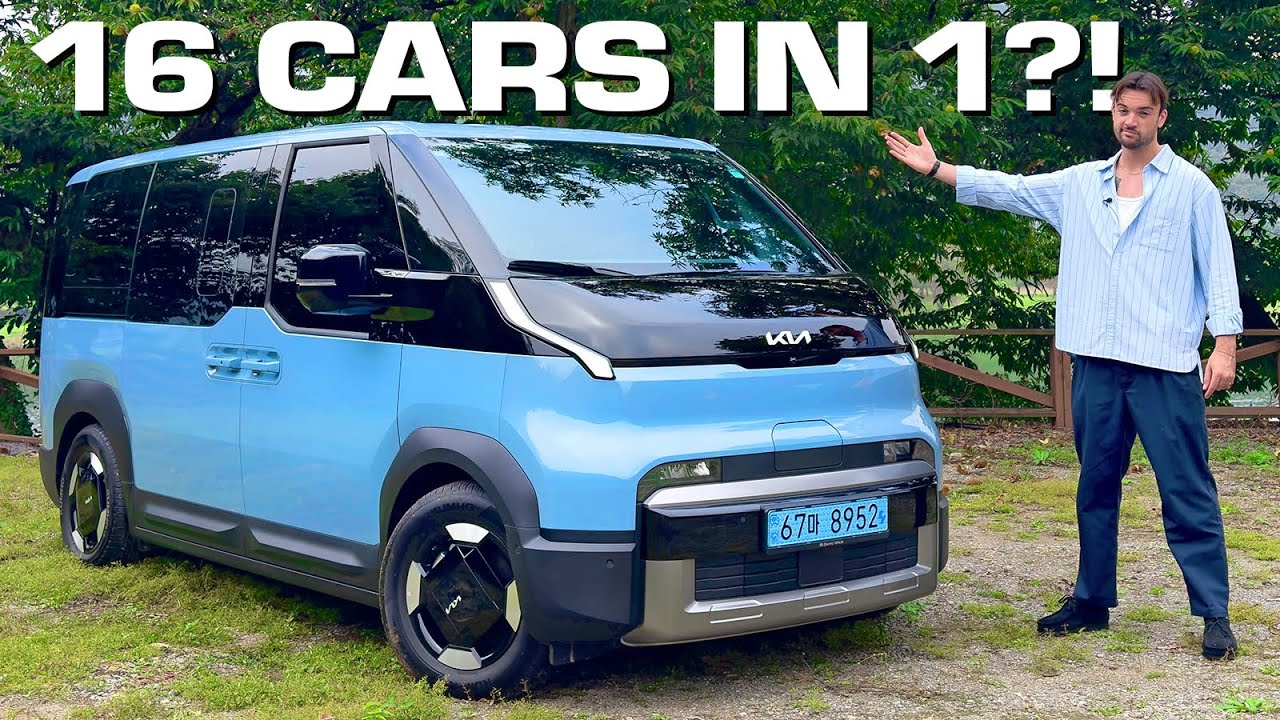
[Music] Every now and then, a new car comes along that single-handedly raises the bar for its entire segment, but not usually by this much. This is the new Kia PV5, and the step forward that it represents for electric vans would be hard to overstate. Yesterday, we were cavemen banging rocks together to make fire. Today, we’ve got an air fryer. In terms of practicality, in terms of modularity, and above all else, value for money, we have never seen anything close to this. which is why we’ve come all the way to its home nation of Korea to spend just a few hours with this one. So, shall we see what all the fuss is about? Welcome to the PB5, welcome to Seoul, and welcome to the Everything Electric Show. Our three free YouTube channels on EVs and clean tech are funded by our fun-packed test drivetastic events in Farra, London, the Southwest, the North, Melbourne, and Sydney, and next up, everything electric farra. And new for UK viewers, you can now buy a battery EV and much more at everythingleelectric.store. Now, back to the episode. [Music] So, what’s the big deal with this thing? Why have I got my knickers in such a twist over a van? Well, I think this is a bit of a Renault 5 moment, actually. Remember when that car came along? It wasn’t just better than all of its rivals. It was better and cheaper, and it shifted our collective perceptions of what we can reasonably expect of a certain kind of EV at certain price points. And I think this does the same thing. And goodness knows it was there for the taking because the electric van customer is still fairly starved of options. Think about it. We’ve got all of those Stalantis products which all of them are based on a multi-energy platform which means they’re slightly compromised and they’re really quite expensive for what they are. We’ve got the Ford Etransit. Same thing. We’ve got the ID Buzz. Buckets of charm but probably better as a passenger car. has its shortcomings as a full-blown commercial vehicle and quite expensive for what it is. And then we’ve got the Verizon SV. Now that’s more like it. Proper groundup bespoke electric van. Gly tech, but it’s a few sizes bigger than this and it’s quite expensive for what it is. What we have yet to see is a fullblooded attempt at a groundup electric van from a legacy automaker. one that takes advantage of everything that a skateboard chassis enables, all the versatility that it provides you, and does so at a really punchy price until now. So, yes, I think this is a bit of a moment. And by the way, this car is just the beginning of something because this isn’t just a new car, it’s a new platform, too. A new platform that will spawn a PV7 in 2027, a PV9 in 2029. Between those three models, Kia reckons they’re going to sell a quarter of a million of these electric vans before 2030. [Music] So, let’s get reacquainted with the PV5, shall we? Welcome to Kia’s shiny new ultra modular electric van. Remember the Xbus? We got very excited about the Xbus. Not sure what’s going on with that, but a lot of the fundamental good stuff about that modularity, lots of different versions, all applies to this as well. Essentially, there’s three versions of the PV5, but those versions will spawn many versions. So, for example, this is the passenger. This one is a five-seater, but there’s going to be a six-seater, a seven-seater, a wheelchair accessible version. And then you got the cargo, which you can have as a short van or a long van or a long tall van. And then there’s the chassis cab, the ny one. And typically the way that those work is you buy it from the brand, then you take it to some bloke under the arches of your local railway bridge and he will install a refrigerator box on the back or a drop side or a pickup bed. The really cool thing about the PV5 is Kira talking about doing a lot of that themselves, offering these various conversion modules for the chassis cab version. Limousine seating, refrigerator unit, camper, fingers crossed. They’re even saying they’ll do stuff like whack your branding on the side of it for you, which is really, really cool to be able to have this brand new vehicle delivered from manufacturer exactly as your business needs it. That’s the car. The platform equally exciting. They call this the PBV platform beyond vehicle. Yuck. And essentially, it’s a heavily revised version of the EGMP platform that underpins EV3, EV6, EV9. We know it. We love it. It’s just been tweaked to maximize standardization in the name of economy of scale. Basically, every PV5 from sort of here forwards and here downwards is the same. Couple of different battery options, but they just drop those in. Cell to pack, by the way. Very nice. And what that does is make it really, really easy to build these quickly and affordably, which enables a really, really tasty price. We actually had a look around the Hasang factory just outside of Seoul yesterday, which is where these will be built. By the way, can’t help but think sounds a lot like a British person ordering their breakfast in Paris. Anyone? Ham and cheese. Has please. Anyway, the point is these things literally clip together like big Lego sets. If, for example, you spec the longer version of the cargo, it’s just an extra bit of frame that kind of just clips onto the back of the main frame. It’s absolutely extraordinary to see. And that means that on the production line, you’ve got cargo, passenger, long one, short one, left hand drive, right hand drive. They’re just banging them all out one after the other, whatever you need. And that standardization, that production is what enables the price, which is absolutely central to the proposition that this thing represents. We’ll get to it in a minute. A few things worth highlighting of the design. I mean, you can just see kind of thoughtful van stuff absolutely everywhere. for example, super low belt line, enormous windows for immense visibility. Likewise at the front, huge glass house, absolutely no nose in front of it. Easiest thing to park in the entire world. Then you got these bumpers at the front and back which are broken up into three pieces, which means if you bash it at work, you don’t have to replace the entire bumper, just a third. Nice. We’ve got classleadingly low step height to get in at the side. We’ve got a class leadingly low lip for the boot at the back. We’ve got between 4 and 5.2 cubic m of space if you get the cargo depending on if it’s the short one or the long one. That means that even the smallest cargo has more room than the ID bars cargo which is a bigger vehicle. We’ve got, believe it or not, really impressive drag coefficient. 29, which is really impressive considering it’s, you know, the shape of a toaster. And also, it’s just really cool looking, isn’t it? I liked it when I saw it in a white studio, but seeing it out in the world, it looks like a cyberpunk cartoon. These funky little DRLs at the front. So unusual, so interesting. It’s turning a lot of heads in soul, let me tell you. And doesn’t really matter if a van looks good or not, but if you’re going to whack your branding on the side of something and use it as a billboard, it helps if it’s eye-catching, I suppose. Right. Bit of battery info. Now that we have proper WLTP range numbers, let’s talk about it. Two battery options, 51.5 or 71.2 kWh nickel manganese cobalt batteries. There is a smaller 43.3 kWh LFP battery for the cargo, but we’re not going to get that one in the UK. They just don’t think people will buy it. They reckon the big battery versions will be the most popular. Range figures for the passenger version respectively. Small battery, big battery, 183 or 256 miles. Couple more miles if you go for the cargo at least when it’s empty. One motor version because again maximum simplicity, maximum standardization, single motor, frontwheel drive. In the small battery version, it’s got 120 horsepower. In the big battery version, because of the way electronics work, power goes up to 160. It’s punchy, actually. And of course, no workhorse would be complete without a vehicle to load, which you can have on this. Up to 3.6 kW of output to run everything from your campsite to your building site. Right. Interior of the PV5. Where to begin? Space. All the space as you can imagine. Immense headroom. Very adjustable driving position, which is really, really nice. Not a given in all vans. We have spent some time in the cargo while we’ve been over here as well. And even with the bulkhead behind you, you can get the seat pretty far back. I can sit pretty comfortably in this, but even more comfortably still in this passenger version where I can put the seat all the way back where I like it. Lots of very useful storage. My goodness, so much storage. Obviously, there’s a glove box. Obviously, there’s huge door bins and cup holders in the middle and more bins here. But we’ve also got nice little storage tray just in front of the driver there. That’s quite useful for paperwork. But we’ve also got giant bins in the floor. Look at this. That’s fantastic. Ah, absolute smugglers dream this thing. That’s all very handy and it’s a bit drab on the eye, but that’s because it’s easy to wipe. Something that Kia are very proud of with this van is they took a huge amount of customer feedback when developing it. They went to brands like DHL and Uber and they said, “What do you want from an electric van?” And they got loads of useful feedback which they have implemented which is why in the PV5 cargo you can entirely remove the passenger front seat to make more room for storage. It’s the reason why the high roof cargo version can be a walkthrough with no bulkhead behind the front seats. It’s the reason why this cabin is all easy wipe anti-stain. the seats, the dash, the floor, everything. I can’t help but wonder that the person who submitted that particular request must have been a certain Mr. R. Llewellyn esquire because, well, I’ve frankly never seen that man get through a single lunch without ending up wearing some of it. It’s all very, very practical and sensible in here. And this is very, very practical and sensible. First time we’ve seen this on a Kia. This is Android operating system and it is great. The fundamental reason behind this is that it’s got third-party compatibility. So, if you’re an Uber driver, you can have your Uber software installed on the screen here. If you’re a delivery driver, you can have your delivery software on the screen here. If you have a refrigerator unit on the back, you can control it from the screen here. You can download all these third party apps. That is really, really, really handy. It’s a complete point of differentiation from something like an ID buzz cargo. But also, I do just think it’s really good software. I think it’s more user friendly and simple and straightforward than what all the other Kia have got. So, I kind of hope that they just go with this for all of their vehicles going forward. It just works really, really well, to be honest. And this is nice as well. We’ve got a familiar Kia steering wheel. Nice two-spoke number. Big buttons, no haptics, none of that nonsense. Proper buttons down here as well. Okay. The climate control is buried in the touchcreen, but I can live with that. This is good as well. Andy got very excited about this. 100 watt USBC’s down there. About as quick as they come. It’s really well thought out. It’s very, very practical. If I have a gripe, if I have a grumble with this car at all, it’s that it’s not especially exciting or interesting in here. That’s completely fine as a commercial vehicle, but I can’t help but feel that this slightly drab, although very effective interior is not going to capture the imagination of people looking for a really big, spacious family car like the ID Buzz very much does. It also doesn’t have the heritage that the Buzz has. Now, Kia says that they reckon about 50% of sales of this PV5 passenger will be private customers, not just taxi drivers. So clearly they know something that I don’t. But that’s my only thing. I think this probably is a better commercial vehicle than something like a Buzz. It’s a better thoughtout cabin for someone that uses their car for work, but it’s not as interesting. [Music] So then at long last out on the road in the Kia PV5, what do we reckon? Well, first thing I’m noticing, visibility out the wazoo. Look at these windows. Look where they end. It’s waist height. Combine these giant pieces of glass with the complete back of bonnet with enormous wing mirrors. I can see everything. It’s incredible. It’s such a confidence inspiring vehicle to drive because it’s so slabside and you have such excellent visibility. It’s really really good around town in that sense, especially when combined with a superb turning circle. Honestly, these windows are so big I’d feel mildly exposed and self-conscious like I sort of getting undressed in the window of my house with the curtains open were it not for the fact that we’ve got career spec limo tint on these particular windows because of course we do. its career. You have to have limo tint. Next thing I’m noticing is refinement. I guess I had this idea in my head going into this that the ID Buzz is the plusher, more comfortable, refined, familyfriendly van and this is the more practical, hardwearing, durable van. But in terms of how they ride, there isn’t much to split them. It’s quiet. It’s comfortable. And actually, I think even by bespoke EV standards, the weight is especially low down in this thing because of that PBV platform, which means it’s ridiculously flat through corners. It’s also in this bigger battery version with slightly more horsepower. No slouch. Honestly, if you drove a van for a living and you came out of some god-awful diesel manual thing where you’re kind of pressed against the steering wheel and you’ve got no space and it’s gutless and noisy and then you transitioned into one of these for your new company car, it would change your life. Okay, back seat jack test. Let me tell you, if your Uber driver rocks up in a PV5 passenger, you are going to be buzzing. Pun intended. Look at this. I mean, of course, it’s enormous in the back. Look at how much space that I’ve got. Nice flat floor. You can tell that they’ve spent a lot of time on this architecture because it is it is amazing to think that there is a battery down there. Where have they put it? Loads of space, nice seats. Hello. This is the upper spec version. So, I’ve got seat heating in the back. I’ve got USBC ports in the back of the front seat. This is nice as well. They’ve got these nice fixing points where you can put all these various accessories that they offer separately. So, I’ve got a little cup holder there. There’s an umbrella holder. All sorts. Just again, I’m not crazy about the all blue everything. And it is the only interior color that they offer. I think a bit of two-tone, a bit of lighter shades would just cheer this cabin up a little bit, but it’s the only grumble I have, honestly. But it’s one that I am more than able to forget and forgive when I keep in mind the price. Are you ready for this entry price for this PV5 cargo in the UK? 275,000. That’s before VAT, but it’s also before the £5,000 government plug-in van grant. And I think those pretty much cancel each other out. Big battery version, £30,000. Passenger PV5. This starts at £33,000. 36K for the big battery version. For context, a brand new ID Buzz Cargo is 40 to 50 grand. A passenger one is 50 to 60. Anywhere you slice it, this thing is comfortably£10,000 cheaper than its best and closest rival. [Music] On top of that, on this higher level trim, I’ve got all the driver aids. I’ve got the cruise control that keeps me in lane and does my steering for me. I’ve got auto e bra, which is essentially regenerative brakes set to whatever it thinks you need at any given moment. I’ve never much liked those systems in the past, but I think it’s really dialed on this car. It works really well. Essentially, what I want from regen is to have it in town when there’s a car in front of me and to not have it on the motorway and do lots of coasting. And it does that really, really well. The only time it gets caught out is if you hit a red light and there isn’t a car in front of you and then you have to break yourself. It’s just something you have to keep in mind. But it’s definitely the best execution of an automatic regen setting that I’ve come across. It’s just lovely to drive to be honest with you. And here’s the really, really, really ridiculous part. Efficiency. We’ve not done a huge amount of driving over these two days that we’ve had this car, but we’ve done we’ve done a fair chunk. And we’ve been averaging between four and 4 and a half miles to the kilowatt hour. That’s extraordinarily good for a big family car, let alone a slabsided van. Very impressive. That Citroen EC5 Airross we were driving the other day, we were just about doing 3 and a half miles to the kilowatt hour in that thing. That’s a car. This is a van to drive. I’d say it’s pretty much on par with the ID Buzz, but in terms of efficiency, I think it probably edges it. And let’s remind ourselves that in just about any version, it costs £10,000 less. It’s just extraordinary. I hope you’re starting to understand why throughout this video I’ve been, as the kids say, glazing. I’ve been glazing. And I don’t apologize for it. What Kia have done here is taken all their EV now from the myriad brilliant electric cars that they’ve built over the last few years and implemented it into the EV hardware of this vehicle. And then they’ve taken a huge amount of customer feedback from people who use and live with vans and taken all that to put a really, really, really good van on top. And then they’ve innovated a design for this vehicle and a method of producing it that enables them to hit a staggering price point. I just think it’s so exciting. This for me without question one of the most important and impressive new cars to come out this year. Maybe the number one because this segment of vehicle has been starved. We haven’t yet had a hero in the electric van segment. the segment that makes up 11 12% of all road users in the UK. We haven’t had the poster child yet. And now we do and it was worth the wait. [Music] So then PV5 thoughts. Well, I laid my cards down pretty early on in this video and you know about a year ago I stood next to this very river and reviewed it was either the Insta or the EV3 and talked about Kia Hyundai’s dominance about how they were the Tesla of today, the brand who are leading the way, blazing the trail, who everyone else is trying their best to copy and keep up with. Here is even better proof that that is the fact. It’s like I said at the start, it’s not that this thing is a step up. It’s how big of a step up that really rocks my world. And you know what the best thing is? This is just the start. This car is a blank canvas. We haven’t seen all the different versions that Kia will produce. We haven’t seen the endless conversions that people are going to build for it, exploiting its versatility, its modularity. I want to see PV5 campers, PV5 food trucks, PV5 ice cream vans, pickup trucks, one with a big slide like a pedalo, I don’t know, whatever you want. That’s what this thing is. That’s what it’s all about. That’s what it enables and that’s why I’m so excited about it. If I drive a more impressive, important car this year, I’ll be surprised. So, there we go. The Kia PV5. What do you think about it? and what would you build using it? Let me know in the comments. Do make sure to like and subscribe and if you have been, thanks for watching. Now visit electric vehicles.expert where you can follow everything electric and keep current with clean technica, the driven electric and many more.
*Headed to the UK?* Jack is in Korea to check out the all-new Kia PV5. With unmatched modularity, practicality, and value for money, the Kia PV5 pushes electric vans into an entirely new category.
We’ve never seen anything quite like it. See it yourself at EverythingElectric.Show in the UK this Saturday & Sunday!
Built on Kia’s flexible ‘Platform Beyond Vehicle’ (PBV) architecture, the PV5 isn’t just one van, it’s many. It can become a cargo hauler, ride-share shuttle, mobile workspace, and more, thanks to its interchangeable body modules and intelligent design. It’s built to adapt to the real-world needs of businesses and drivers.
Could this be the future of electric vans??
00:00 Kia PV5
01:30 Electric Vans
03:00 Kia Van Models
04:50 Platform
06:25 Design
07:00 Boot
07:20 Drag Coefficient
07:55 Battery, Range & V2G
09:00 Interior & Storage
11:30 Software
13:00 Test Drive
15:20 Rear Seats
16:30 Cost
17:20 Driver Assistance
18:20 Efficiency
20:30 Future of Electric Vans?
Why not come and join us at our next Everything Electric expo: https://everythingelectric.show
Check out our sister channel Everything Electric TECH: https://www.youtube.com/@EverythingElectricShow
Support our StopBurningStuff campaign: https://www.patreon.com/STOPBurningStuff
Become an Everything Electric Patreon: https://www.patreon.com/fullychargedshow
Become a YouTube member: use JOIN button above
Buy the Fully Charged Guide to Electric Vehicles & Clean Energy : https://buff.ly/2GybGt0
Subscribe for episode alerts and the Everything Electric newsletter: https://fullycharged.show/zap-sign-up/
Visit: https://FullyCharged.Show
Find us on X: https://x.com/Everyth1ngElec
Follow us on Instagram: https://instagram.com/officialeverythingelectric
To partner, exhibit or sponsor at our award-winning expos email: commercial@fullycharged.show
Everything Electric FARNBOROUGH – Farnborough International – 11th & 12th October 2025
Everything Electric MELBOURNE – Melbourne Showgrounds 14th, 15th & 16th November 2025
Everything Electric SYDNEY – Sydney Olympic Park 6th, 7th & 8th March 2026
#fullychargedshow #everythingelectricshow #homeenergy #cleanenergy #battery #electriccars #electric-vehicles-uk