
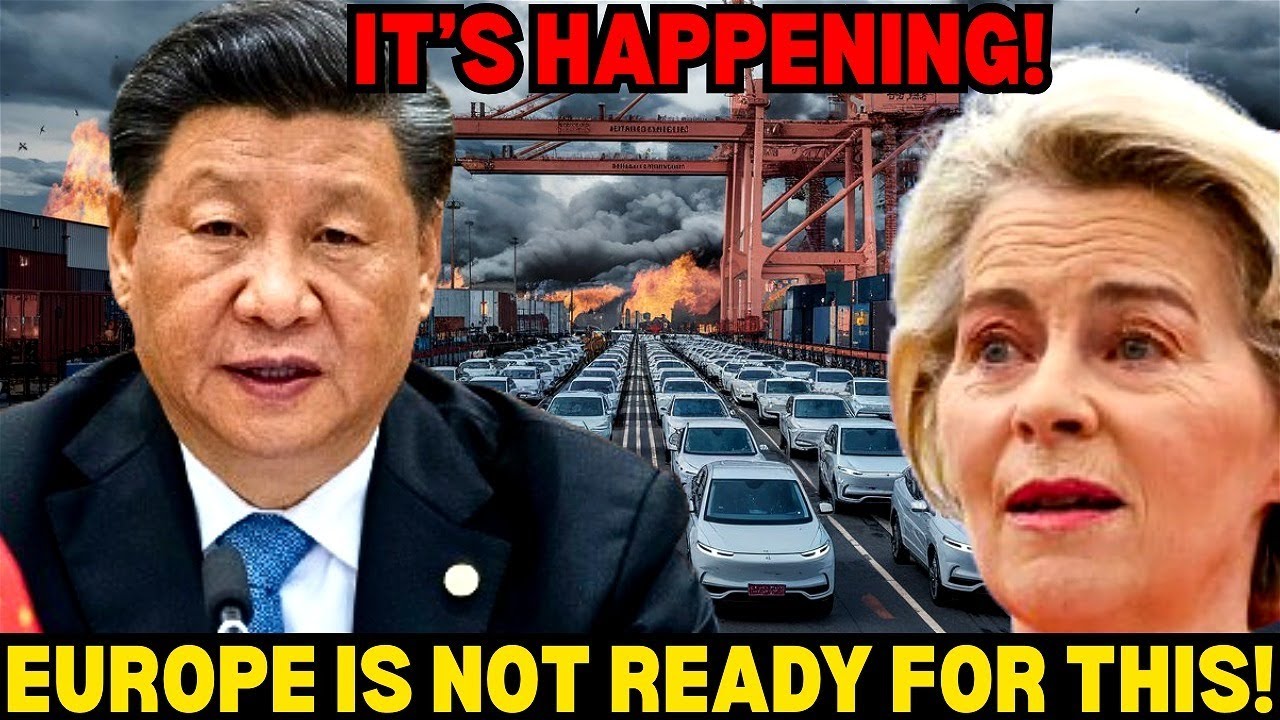
China DROPS The Unthinkable: “No Permit, No EV’s” | Entire Europe’s EV Dreams Shattered!
It started with a quiet announcement from an office in Beijing. A new rule starting in 2026. You need a special license to export electric cars from China. It sounds like simple paperwork, but this simple rule is about to shake the entire global car industry to its core. Think of it like this. China has been building a huge wave of electric cars, ready to send them all over the world. But now, they’re not just letting the wave crash. They’ve decided to build a gate and they are the only ones who hold the key. This decision doesn’t just affect China. It sends a direct shock all the way to Europe, to Germany, to France. It threatens what cars we can buy, how much we will pay for them, and who gets to lead the electric future. The race for the electric car just entered a whole new phase. So, why would China do this? If you’re winning the race, why would you slow yourself down? The truth is, they aren’t slowing down, they’re getting smarter. For the past few years, it’s been a free-for-all. Anyone could export electric cars, leading to a flood of models, with some being lower quality and very cheap. This was starting to hurt the reputation of Chinese car brands. It was chaotic. This new license rule is China’s way of taking control. It’s like a bouncer at an exclusive club. Only the biggest, most reputable car companies get the license to export. This means every Chinese electric car that reaches another country will be highquality, officially approved, and carrying China’s name with pride. They’re not just selling cars anymore. They are carefully managing their power. To understand why this new rule is such a big deal, you need to see how we got here. Just a few years ago, Chinese car brands were barely known outside their country. But they had a plan, a massive government-backed plan to become the world’s leader in electric vehicles. And it worked fast. Today, a staggering four out of every 10 cars China exports are electric. They built a giant non-stop factory for the world. From affordable city cars to luxury models that rival Tesla, they have it all. This wasn’t an accident. It was a calculated takeover. They poured billions into batteries, technology, and their own supply chains. So, when this new rule hits, it’s not a small player making a change. It’s the world’s biggest electric car producer deciding to flex its muscles. The world got hooked on their supply, and now China is changing the terms. So, who exactly is Beijing shutting out with these new licenses? They’re going after the gray market. Think of these as unofficial middlemen, exporters who would buy up electric cars, often in bulk, and then sell them overseas at the lowest possible price. This created chaos. It meant that a brand new Chinese EV could show up in another country with no official support, no warranty, and sometimes with features not suited for that market. For Beijing, this was a problem. It hurt their brand image and started price wars that even their own big companies didn’t like. The 2026 license is the solution. It pulls the plug on these rogue traders. Now only the big official manufacturers, the ones who care about their long-term reputation, can play the game. The freefor-all is over. The era of controlled quality only exports has begun. So what does this mean for you, the car buyer? Get ready for higher prices. It’s that simple. For years, the huge flow of cars, including those from the gray market, kept prices competitive. It was a buyer market. But now, with the gates closed and only the big companies allowed to export, that massive flow is shrinking to a controlled stream. Less supply with the same high demand means one thing in economics. Prices go up. Analysts are predicting the cost of Chinese electric vehicles in Europe and other Western markets could jump by 20 to 30%. That’s a huge increase. Think about it. A car that used to cost $30,000 could now cost close to 40,000. This isn’t just a small price hike. It’s a price bomb and it’s about to make the dream of an affordable electric car much harder for millions of people. Let’s make this real. Imagine a family that’s been saving up. They’ve had their eye on a particular electric model budgeting for a price of €30,000. They walk into the showroom in 2026 and suddenly that same car has a sticker price of 37,000. For that family, the dream isn’t just delayed. It’s over. This price bomb doesn’t just change spreadsheets. It changes lives and locks people out of the future. But the shock doesn’t stop at the showroom. It goes straight to the factory floor in Europe. Many of Europe’s own car factories are surprisingly dependent on parts from China, especially the most important part of all, the batteries. They built their production lines around this steady supply. Now, with China tightening its control, that supply chain is no longer a sure thing. If a factory in Germany can’t get the batteries or the key components it needs on time, the entire assembly line grinds to a halt. The constant hum of machinery, the workers on the line, it all goes quiet. This is not a future fear. This is a very real possibility. We’re looking at a scenario where European car brands, the pride of the continent, are forced to idle their factories, not because nobody wants their cars, but because their lifeline to the east has been squeezed. And when those factories go silent, the sound that follows is the sound of anxiety. It’s the sound of workers getting laid off, of local businesses that serve the plant starting to struggle, and of entire towns that were built around the auto industry facing an uncertain future. This isn’t just a supply chain issue. It’s a social and economic earthquake, and the tremors are being felt right now. This situation creates a massive problem for Europe’s biggest ambitions. For years, Europe has been pushing a green revolution with a huge goal to phase out gas cars and switch to electric. But that entire plan was built on one idea that electric cars would be available and affordable for everyone. Now that foundation is cracking with prices for EVs soaring and production in European factories stalling, that green dream is in serious danger. Experts are now warning that electric car sales across Europe could plummet by 15% or more in 2026. That’s a huge step backward. Instead of accelerating into an electric future, Europe is suddenly slamming on the brakes. The very policies designed to create a cleaner future are now colliding with a new economic reality. And it’s the average citizen who could end up paying the price. So, how did the West with all its technology and history end up in this vulnerable position? The answer is a classic story of short-term thinking years ago, it seemed like a smart, cost-effective decision to let China handle the complex, expensive work of building batteries and making key parts. Western companies focused on design and branding, thinking the supply chain would always be there. It was a comfortable partnership. But that comfort has now turned into a trap. By not building their own strong battery industry, the West handed over the keys to its electric future. Now, China controls the most critical piece of the puzzle. It’s a costly lesson in economics and security. If you don’t control the core technology yourself, you don’t control your own destiny. That reliance has now become their biggest weakness. So, if the doors are closing for Europe and the West, where are China’s electric cars actually going? The answer is reshaping the entire global map. China is now turning its focus to its allies and other growing markets, places like Russia, Southeast Asia, and the Middle East. In these regions, they aren’t facing the same tough rules or high taxes. They can sell their cars freely, building strong partnerships and becoming the dominant car brand for billions of people. This is creating a split in the world. On one side, you have the western markets where electric cars are becoming more expensive and harder to find. On the other, a new network of trade is booming with China at the very center. We are witnessing the birth of two separate electric vehicle worlds and one of them is accelerating ahead without the west. This brings us to the final multi-billion dollar question. What can the west do now? They are standing at a crossroads with only two real paths forward. The first path is to try and match China’s scale. This means spending an almost unimaginable amount of money and fast to build their own battery factories, secure their own mines for materials, and create a complete self-reliant supply chain. It would be a huge expensive race against time. The second path is to negotiate to try and make deals with China to keep the parts and cars flowing. But this path means accepting China’s terms and their lasting power over the industry. There is no easy third option. The choice is stark. Spend a fortune to build their own future or compromise and live by China’s rules. This is more than a business decision. It’s a question of sovereignty. Do they spend a fortune to reclaim their industrial independence? Or do they accept a new role? one where they are forever a customer to China’s manufacturer. The decision they make in the next few years will define the global balance of power for decades to come. The race for the electric car was never just about cars. It was always about who gets to control the future. The clock is ticking.
China DROPS The Unthinkable: “No Permit, No EV’s” | Europe’s EV Dreams Shattered
It started with a quiet announcement from an office in Beijing. A new rule. Starting in 2026, you need a special license to export electric cars from China. It sounds like simple paperwork. But this simple rule is about to shake the entire global car industry to its core. Think of it like this: China has been building a huge wave of electric cars, ready to send them all over the world. But now, they’re not just letting the wave crash.
They’ve decided to build a gate. And they are the only ones who hold the key. This decision doesn’t just affect China. It sends a direct shock all the way to Europe, to Germany, to France. It threatens what cars we can buy, how much we will pay for them, and who gets to lead the electric future. The race for the electric car just entered a whole new phase.
Information and Usage Disclaimer
Content shared here is produced under the guidelines of fair use as outlined in Section 107 of the Copyright Act of 1976. This allows for use in teaching, commentary, news reporting, criticism, scholarship, and research, all legally protected under fair use. For any related questions, contact us at “contact.darkspan(at)gmail.com”. We will adjust or remove content as needed.