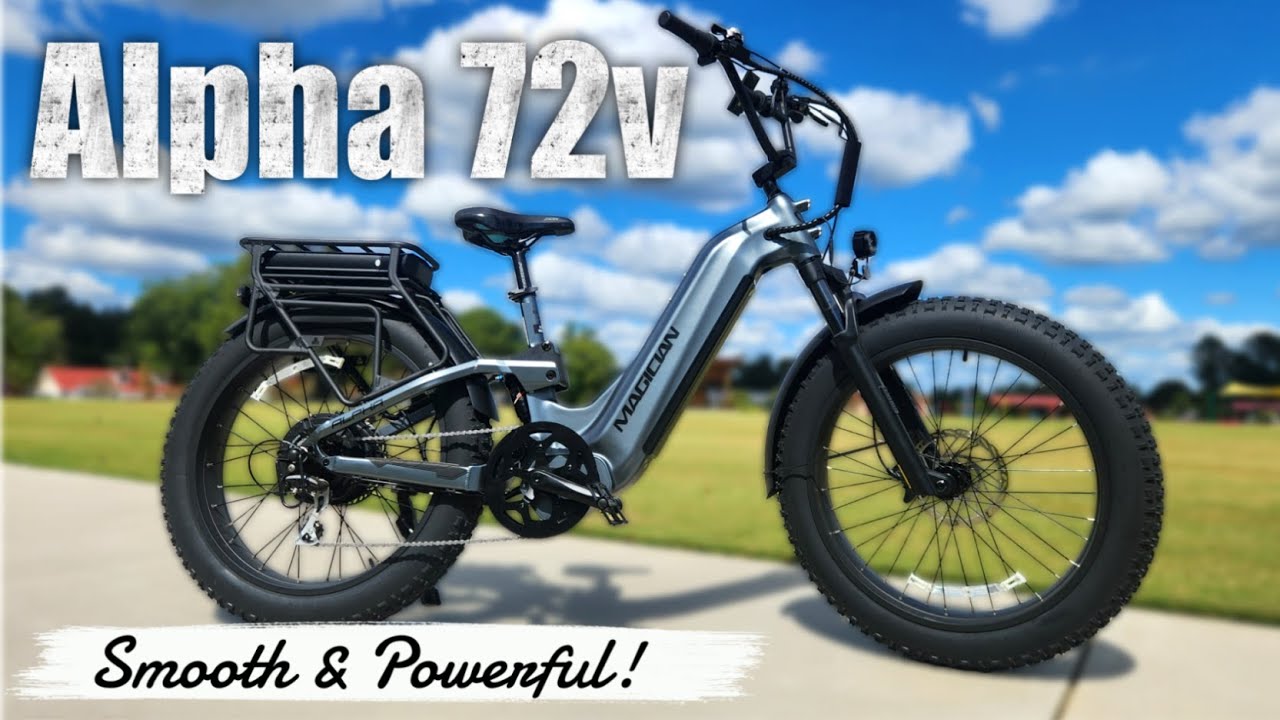
Magician Alpha 72v ebike: The Smooth & Quiet Power is Impressive!
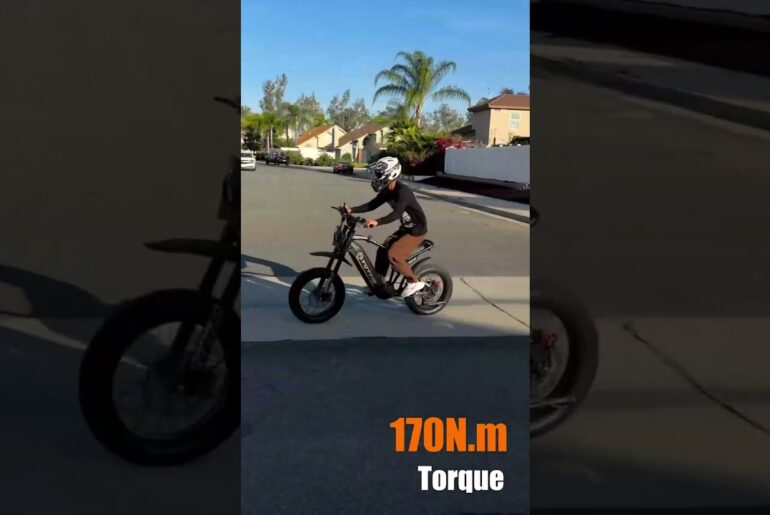
What’s going on everyone? Today we’re going to take a look at the Magician Alpha. This 72vt ebike offers some exceptional power that surpasses the capabilities of your average ebike. Let me show you some of the basic specs. The Alpha is a 26×4 in fat tire eBike with a serious powertrain. In the rear wheel is the new Buffang 3000 W continuous hub motor with a claimed peak output of 5,000 watts and 200 new m of torque. We’ll test those claims. It runs off of a Buffang 58 amp controller and is fed by a 72volt battery system. There’s a 20 amp hour pack housed in the frame and a 10 amp hour battery pack housed in the rear rack. Up front, it has an X show suspension fork with compression and preload adjustments. The rear suspension is a four-length design with an adjustable DNM air shock. The pedal assist system supports both torque and cadence sensing assist. And the gearing is 56 to up front with an 1134 freewheel in the rear. Just like the motor and controller, the display is also Buffang brand and allows the user to select class one, two, or three, or choose infinite mode to unleash full power. The display supports overthe-air updates through the Buffang Go app and even offers turnbyturn navigation. There’s a twist throttle on your right, display controls on your left. It’s equipped with a bright headlight, tail light, and a brake light. The Alpha has a minimum seat height of just over 33 in. It weighed in at 137 lbs on my scale, and it has a maximum payload capacity of 450 lbs. The base price is currently $23.99 plus shipping and tax. And if you decide this is the bike for you, you can use my discount code CC 100 and it’ll save you 100 bucks. All right, now that you know what we’re working with, let’s get into some of the ride experience and the performance. And I’ve done a lot of testing on this alpha bike, so I’m going to try to be very thorough. I’ll put all the timestamps below if you want to jump around. And toward the end of this video, I’m going to tell you what I think is the biggest selling feature of the Alpha Bike. But don’t skip ahead just yet because I’m about to show you what the top speed is. All right, let’s see what kind of top speed we’re working with here on the Alpha Bike. Boost mode, full power, throttle only. [Music] 47 48 49 50 like 49 GPS and it’s holding right there. Yep. Holding steady. 49 and 51. So Oh, there’s 50 right there on the GPS. Finally hit 50. So it’s a 50 mph bike, man. I mean, and you can see me keeping up with traffic, it’s fast. That 50 mph on a bicycle is fast. I mean, you don’t really need to even go that fast. All right, so that first speed run was flat ground. Let’s see now what happens if you hit just a little bit of downhill. [Music] Climbing steady up to mid40s, high 40s. [Music] 51 bike 50 GPS. About the same. It really didn’t climb much higher there. [Music] So, claim top speed of 50 mph definitely confirmed. And just so you know, I had this in the fully unlocked infinite mode. It’s going to ship to you as a class 2 programmed to 20 mph, but the end user can go in the display and reprogram it however they’d like. You can select class one, two, or three and have the bike automatically configure the parameters for you, or you can select the infinite mode and just really open up the performance. And just so you know, everything I do in this video is in infinite mode. But let’s get back to the speed and let’s do some real talk, cuz 50 mph on a bicycle is really fast. And honestly, it’s not the most comfortable spot for me to be in. And I come from a background of riding motorcycles, but doing motorcycle speed on a bicycle definitely feels different. So, be careful. And even though the majority of the time I spend riding ebikes are probably 35 to 40 mph and under, I do like these 50 mph bikes. And here’s why. It’s because they do 30 to 40 mph so easily. Other bikes you can be maxing out the motor completely at 30 35 miles an hour and then you approach a hill and it dies down to 20 and you become a hindrance to traffic at that point. On something like this you can jump out and just be right in the flow of traffic and it’ll do 3540 mph up a hill with ease. So it’s pretty nice to have that power on tap and it also gets up to speed really quickly as well. I mean here’s what the acceleration looks like. All right, let’s show you the acceleration from this perspective first. Then we’ll put the drone up in the air and give you a side shot. So, it’s a pretty smooth launch all the time. Doesn’t matter what mode you’re in. Let’s just go straight to boost most power. Right. Here’s the launch. 3 2 1 go. Smooth powerful launch. And you get the same launch every time. There’s no way to monkey with the start strength at all. So, let’s go down. There’s trail. That’s the next one down. Go. It’s a nice even pull and it’s strong. It’s It’s a delay start kind of. It really eases into it and then you really kind of feel it catch and go and you get a a great pull. I mean, it’s a smooth power delivery. I definitely got to say that about it. And it’s it doesn’t really get away from you ever off off the line anyway cuz it’s so tame when you’re rolling. Let’s see. We’re at 13 and you hit it now. I mean, it’s a pretty good pull. Well, it sets you back a little bit in the seat. It doesn’t really come in and hammer, but it’s a it’s a strong pull. All right, let’s just do like a zero to 20 or 30. Ready? 3 2 1 go. Even. And then right here, you kind of feel All right. Yeah, it’s picking up steam. There’s 20. There’s 30. I mean, we might get to 40 here. Yeah. All right. We just went 0 to 40 real quick. Strong pull. Let me show you from the side here. We’ll put up the drone. All right. Here’s my launch in boost mode. 3 2 1 go. Strong strong launch, but very, like I said, tame, very friendly launch. I guess we can do it here again for you. 3 2 1 go. probably outpaced our drone. I don’t even know if it kept up with me. One more. 3 2 1 go. So, there’s your launch. Smooth, steady, strong pull on the acceleration. I I cannot pull the wheel in the air. I cannot make it wheelie off. Even if I lean way back and smash the gas, it will not pull the front end up. It It doesn’t have the torque off the line to do that. It’s set up to be just really tame hit off the line. So, very gradual build into the power. Honestly, it takes a couple seconds before you really feel that power kick in. And the throttle always gives you the same launch. No matter what pedal assist mode you’re in, it’s always the same gradual build into the power. And there is no start strength setting to change. So, you cannot increase that power off the line. I’m sure this was done for safety reasons so that the bike remains controllable. And you know, even though it gives you a friendly launch off the line every time, that doesn’t mean that this bike is not powerful, take a look at how it does on the hill climbs. All right, time for our timed hill climb run. I’m expecting a good showing. This thing’s got some good power. So, see how we go. Throttle only. 3 2 1 go. Decent launch off the line. And you feel the power engage more once you’re already rolling. Oh yeah, it’s fast. Wow. We’re going to have to kind of wrestle this thing up. time. Very fast. That was very fast. That’s probably one of the faster times ever up that hill. It’s one of those bikes where you really got to wrestle it to get it through those curves. It’s too much for this. We We got to test it on like a different hill that’s more wide open. That’s too narrow of a path for it. All right. So, this is the road right next to the hill climb. Definitely more space suited for this. It’s probably even a little bit steeper than that path. Ready? Go. gradual start. Doing good. I mean, this is a it’s really flat where I live, so this is a really decent size hill, and it’s just crushing it over 30 mph. It’s got enough power to do pretty much any hill that you’re going to be out riding around and tackle with a bicycle. I don’t see this thing struggling on any hill like that. Any road or path. Where it’s going to struggle is when you get that motor under some serious stress. You’re starting from a dig on a sidehill. Let’s go try that. All right. So, here is our short little steep sidehill. I think this is like 28 to 30% gradeish. It’s from this angle. You can see it’s kind of like a wall right in front of you. From the side angle, it doesn’t look as steep, but it is steep. So, we’re going to test the down low power a little bit here. Let’s just start it right here. Point it uphill. I’m in boost. So, let’s just smash the gas here. See what happens. Go. I mean, that was fine. Right up it. No problem with ease. Let’s see if we can’t stress it out a little bit more. I’m going to go like halfway up the hill. Let’s just stop. And now I’m I’m in the hill. Let’s Let’s see if it’ll dig me out of here. Throttle only. I mean [Music] I mean barely. But I had to keep tapping the ground take the stress off it um to get up the hill. I mean I don’t know how often you’re really going to ask it to do this, but I just like to do it to test like that down low torque. It’s got some good torque. It’s not the certainly not the torque I’ve ever felt. It did pull me out of there. Let’s try it one more time. Let’s go. I’m going to put it in climb mode. That was boost mode. Let’s go. Climb. Supposed to have more torque, right? Let’s see if it does any better. Ready? Go. Feels the same. Barely barely get up. The motor never stopped. I’ll give it that. It never stopped. It pulled me out of there. All right. So, now I’ve got it dropped down into that 34 to gear. Pedaling gear number one. I’m gonna go partway up this hill here. Climb mode. I’m gonna push on the pedals to help it. Let’s see how much better it does with a little push and go. Oh, wow. Super easy. Super easy. So, this I think really illustrates how the power is set up on this bike. It’s a kind of a build into power. It’s not a full torque right from the jump. Great hill climb power. I mean, just crushed that timed hill climb. And when I went out on the road and did that long uphill, it didn’t bog down when I got on the hill. It just accelerated the whole way up. But you also see how the power is delivered. You don’t get that really heavy hit of full torque off the line. It kicks in kind of later in the power band. So, if you’re on that steep sidehill starting from a stop, struggled a bit there, you’re best to give it a little bit of pedaling help. But that’s probably an infrequent scenario. I did that more just to show kind of how the power is delivered. Now, bringing this bike to a stop, you got Star Union branded hydraulic brakes. There are 203 rotors and there are four piston calibers. Here’s a bit on those. All right, let’s do a braking test from like 30. See what happens here. About 30ish. That’s about as controlled as I can do it without skidding the back tires. There’s good braking force. These are Star Union brakes. four piston calipers, 203 rotors. Good stopping power. My only complaint is they can get a little bit noisy. They seem to be very quiet when I’m coming down from a a fast stop like that. When I’m really putting them under pressure, they’re getting hot. They’re pretty darn quiet. But if I spend a lot of time in a low-speed environment in a neighborhood or something, it’s likely when they cool down, they get a little bit squealy. [Applause] I don’t know why. So, they’re they’re off and on with their quietness. Let’s do it again here. Nice controlled stop. Very nice. Of course, you can skid the tire anytime you want. So, the brakes have ample stopping power, but they got really noisy for me at times. And I asked Magician about this. They said they tested resin brake pads, ceramic, and also metal. And that the metal brake pads gave them the best stopping performance and also the best longevity. And that they would eventually quiet down. So, what I can tell you is you really need to take your time and bed these brake pads in. Put some miles on them cuz I’ve got over 150 miles on this bike right now and I’m I just now kind of feel like I’m getting to the point where they’ve quieted down a lot. Now, we need to talk about some of the power claims of this 72volt bike because they have posted some pretty big numbers on their website. So, let’s talk about those. The first one is a claimed top speed of 50 mph. I’d say that one’s confirmed. You can definitely go 50 on this bike. The next big number is a claim of 5,000 peak watts. And I did my best to try to hit that mark, but even with 100% battery charge boost mode going uphill, I was maxing out just over 4,500 watts. Now, Magician tells me the output will increase with a heavier load on the bike. So, I guess I’m not heavy enough. So, I never saw the display read 5,000, but it’s still a very powerful bike. Now, there is one more big claim on the website, which is a claimed peak output of 200 new m of torque. As you can see from the previous clips I showed, you’re definitely not getting 200 new m of torque off the line. Now, is this bike peaking at 200 somewhere in its power band? Truthfully, I have absolutely no idea. There’s not really a way for me to prove that one way or the other. All I can say is I’ve ridden bikes that have lower torque ratings that feel much more torquy than this bike does because they’re giving you the power right up front, right off the line. It’s a heavy hit off the line. This one is kind of a slow ramp in. So, I guess that’s kind of my takeaway here. If you are looking for heavy hit of immediate torque with wheel lifting launch off the line, this isn’t your bike. But if you want a good strong pull with it feels the strongest kind of in the mid-range power, the Alpha will deliver for you. I’ve put on a little over 150 miles of ride testing on this and I can’t really say that I ever felt it was lacking power or lacking torque. Now, I’ve talked a lot about the throttle power delivery, but this is a bicycle with pedals. So, here’s some info on the pedal assist system. All right, this bike has a torque or cadence sensor feature. Torque or cadence, your choice. I’ve got it in torque. Let’s test it real quick. I’m in climb mode. This is the least amount of power. I think it’s like 20% power. Let’s start pedaling. Okay, kicks in. I mean, I’m I’m pushing pretty hard right now. I feel like I’m getting about 20%. Let’s go up to next level. Stealth. This is like 40%. It feels like 40. It’s a little bit more. Got to push to get it. Let’s go eco, which is like 60. Oh yeah, that’s a lot more power there. It feels like it’s working correctly. And if I just go Let’s I’m going to go straight to boost. This is the most power. Let’s just rotate the pedals. Is it going to kick in? There you go. That’s the beauty of the torque sensor. I’m turning the pedals right now. I’m getting 200 watts in full power mode. So it functions like I like them, right? It only responds to pedal pressure. So when I push hard, look out. Here we go. Off to the races. Okay, so torque sensor works. It is sensitive to the pedal pressure. Delivers power according to what I’ve got programmed in there. All good. Let’s check the cadence sensor now. All right, we are at cadence sensor now. Climb mode, least amount of power. I’m going to start rotating. Kicked right in immediately. That was instantaneous. Let’s try that again. Start turning. It engages immediately. You You don’t even get like a tenth of a rotation. Give me a constant power. Constant 900 watts. Holy cow. What happens when we go up a level to stealth? All right. I’m not pushing at all. I’m just rotating and turning. Give me a bunch of power. Eco. Even more. Not pushing at all. Yeah. Oh, there’s trail. Holy cow. And boost. Wow. Just turning the pedals. I don’t got the throttle. Okay. So, it confirmed there that the cadence sensor works like a cadence. All you got to do is rotate. You don’t got to push at all. So, I guess which camp are you in? I’m in uh camp torque. I like torque sensor. Torque sensor, cadence sensor, your choice. They both work great. And just so you know, with the gearing, you start to lose pedal resistance around 40 miles per hour. But that’s because this bike from the first batch has a 1434 freewheel on the back. But going forward, all the alphas will be updated to 1134 on the back to eliminate any ghost pedaling at high speeds. And while pedaling, the power delivery seem to accurately match what I had programmed into the display. There’s a setting in here where you can control how much power each pedal assist gets by changing the controller current settings. So, the power I was getting seemed to really accurately match that. The setting above it is where you can control the maximum speed setting for each pedal assist, but I tried changing that. It didn’t seem to really have much effect on the speed. So, I’m not sure that that function actually works right now. I guess if you wanted to limit the speed, you could always change it into class 2 or class 3 settings. You can also Bluetooth this bike to your phone and go into the Buffang Go app and change settings there. And there’s actually a couple more to pick from. There’s one in there for the start strength. But again, I tried manipulating that one and it didn’t seem to have much effect. But the one for the crank position sensor, which tells the pedal assist, like how fast to engage, I tried that one and it absolutely worked. You I have it right now set up where it kicks in immediately or you can set it to 180 rotation or 360 rotation of the pedals before it engages. And that one works. So, it seemed like some of the settings were active and working, others weren’t, but this bike is capable of overthe-air updates through the Buffang Go app. So, maybe that’s something they’ll update in the future in the software and send out to everybody. And there are some confusing parts to the system. Like, if you look on the display screen, it shows you the pedal assist levels as climb, stealth, eco trail, and boost. If you go into the settings, they’re listed as PAS 1 2 3 4 5. And if you go into the app, they’re actually listed as Eco Tour, Sport, Sport Plus, and Boost. But everything works just fine, and it all synchronizes together. It doesn’t affect the bike’s performance any. They just have different names. Okay, I’ve made you wait long enough. Here’s what I think is the biggest selling feature of this Alpha Bike, and that is that it has very strong power, and it’s delivered smooth and very quiet. I mean, think back to all those clips you watched. Did you hear the motor running? Here’s a few more. All right. So, I don’t know if you’ve noticed it in all the other clips, but this motor is silent. I mean, can you hear it at all right now? When you’re on grass and you don’t hear the tire hum, you can’t hear the motor at all. I’m stunned by how quiet the motor is. I don’t know how they did that exactly. For a geared hub motor, they’re usually got some sound to them. This one is extremely quiet. You get out on the pavement, you hear the hum or the tires. You really hear the motor at all. I mean, you really you kind of creep up on people. You really got to let them know you’re coming with the bell here. Well, let me run out here on a nice long straightaway where you can get a good feel for the noise or lack thereof. All right, here we go. Listen for motor noise. Ready? Go. It’s pretty silent. Right now, all I hear is wind in my ears. Wind and tire hum. All right. See if you can hear the motor down here. I’ll just keep punching the throttle. I can’t hear it at all. So, for being one of the largest, most powerful motors I’ve ever tested, its operation is also one of the quietest. Okay. Now, I want to go back to the Buffang app for a second cuz there’s a cool feature in there that I want to show you, which is the navigation. All right. So, if I go in and launch the Buffang Go app, it’s already paired to my bike. You can see the little Bluetooth indicator there. So, on Bluetooth to the display screen. On the main page here, you can see battery life and odometer and stuff like that and your different ride modes here. Anyway, the cool thing I want to show you is if you go to the maps. So, it pulls up the map, shows me exactly where I am. And if I want to go somewhere, let’s say Starbucks, right? Pulls up the map to get me to Starbucks. I hit the play button or the go button. It gives me this warning. Please focus on the road, obey traffic rules, yada yada. Confirm. I’m going to do that. And it shoots it over to right now my turn byturn directions are on the display screen of the bike. So, I don’t even need my phone. I can go back to my home screen, cancel out of there, lock the phone, stick it in my pocket, and we’ve got turn byturn directions right here. Blacks out the rest of the screen. All you’re getting is like your mile per hour, your pedal assist indicator, and what turns coming up. So, 62 ft. Castle Wood. There’s Castle Wood. Let’s make our first turn. I mean, it’s pretty accurate down to like the number of feet until you got a turn. We go 70 ft, 55 ft. We’re going to be Winston Point. Make a left. This is Winston Point. Let’s make our left. And we’re on our way to Starbucks. I don’t know that I would really use this all the time. You I’m out just riding for fun. If but if you’re using your bike as actual transportation, this might be pretty convenient to use. I rarely if ever use the apps that come with ebikes. I don’t record my rides or anything like that, but I got to admit, having the turnbyturn navigation on the display screen was pretty cool. So, how we doing so far? If you’re thinking this bike might work for you, let me show you how you might fit on the Alpha. All right, let’s talk about the size of this bike. Big bike. 26×4 fat tire bikes are big bikes. If you’ve never seen one in person, you’re considering buying one, go find one to look at in person. These bikes are really big. I’m 6 feet tall. This is up to the mid part of my chest here. Usually from ground to top of bars is like 4 feet. The tires, ground to top tires are 30 in. These are massive bikes. This one, this is a big bike. I would say 57ish is probably the minimum height you want to be to control one of these bikes. This one is heavy. This is 137 lbs of bicycle. It’s not light. You got to make sure you understand the size of these things before you buy one. The minimum sea height is 33 in. And I of course can put it up pretty much as high as I need to to ride it comfortably. Six feet tall. The step through to where the bottommost portion of that step through is about 19 and a half inches. So I don’t have any problem stepping through there. But that’s how tall that is. You’re going to have to bring your foot up to 20 21 in to get through the step through. I always recommend the step through frames are so much easier than trying to, you know, get your leg up over the rear rack, which again is probably 33 34 in high. But here’s what I look like on this bike. I’ll swing over the rack. Right. Let me put the seat at minimum. See how so you can see what that’s like for six feet tall. Right. There you go. That’s 33 in. Just a touch over 33 in. I’ll go through the step through this time. And you get a little bit of squish in the suspension when you sit down. Maybe another quarter inch or so. But they never appear as big on camera as they actually are. Definitely a big bike. It doesn’t feel super heavy when you’re driving it around. Unless you start to lose it. Unless it’s starting to like fall over on you and you got to catch it from this point, you’re going to feel that 137 pounds. As long as you’re you’re where you need to be upright on it, you don’t really feel the weight of it. It’s just when you go to lift it in any way, you got to put this you got to do a lot of lifting of your bike under your car or bike rack or up a flight of stairs or something. That’s something to consider. All right, go for it. You ready? I’m ready. Show us 5 foot three on the alpha. Okay. Get your feet down. Kind of. Tiptoes. Okay. Big bike though. Big bike. These bikes always look smaller online. But hopefully seeing differentiz riders on this bike shows you if it might be a match for you or not. Hey folks, just got an update from Magician. And for those of you thinking that maybe this bike was just a little bit too large for you to handle, I’ve got good news. They’re going to be releasing a smaller version later this month. They’re going to come out with the 72vt Alpha Mini, essentially the same bike, but on 20-in wheels. And I believe they may even be offering some special pre-order pricing. And of course, my $100 discount code works on that bike as well. So, keep an eye on their website for the release of the Alpha Mini. And back to the video. Next question I get asked a ton lately is stability. Does the bike wobble? Let me show you my experience there. All right. All right. So, a common question I’ve been getting a lot lately is what’s the stability like on these bikes? You know, does the steering wobble at all? What happens when you let go of the bars? Well, let’s find out. I’m going to let go of the bars at 20 mph. I’m pedaling in torque mode, climb mode. I can ride it no-handed. Motor’s engaged right now. I’m pedaling. What I found on these bikes, these fat tire bikes, they all seem to kind of do similar things, which is you can let go of the bars and you can ride like this no-handed. I don’t know why you do this. Why? Keep your hands on the bars, people. But what happens is if you disrupt the steering, Yeah. then it’s probably going to go out of control. You ready? It’s actually hard to do. I’m getting too slow here. Let’s get up to speed again. Yeah, let’s go back that road. It’s nice nice path. No one’s on it. We’re running up into the 20s something mph, right? All right. So, there. Now, if you knock it out of alignment, yeah, it wobbles crazy out of control. [Music] It doesn’t recover. So, I tell you, keep your hands on the bars. I mean, it’s it’s fine unless you do that. like you let go and something jars it out of alignment, then it can go crazy on you. So, I can make this bike wobble if I want to. But in my normal riding, I didn’t experience any issues with it. Now, if you are experiencing some wobbling on your ebike, here’s four things I can tell you what I’ve learned from riding all these fat tire ebikes. Number one, keep your hands on the bars. Enough said. Number two, any weight that you’ve got behind the rear axle is going to affect your steering. Number three, make sure your tires are seated on the rim evenly. And number four, lower tire pressures on the front wheel seem to make the front end easier to oscillate. So, I hope that helps you. Now, let me give you some info on how far you can ride this bike cuz I kept track of my range on three different rides. The first ride was 33 mi and I had 40% battery remaining. The next ride was 43 miles and I had 23% battery remaining. And the third ride was 53 miles and I had 13% battery remaining. And these were all done with minimal pedaling, heavy throttle use, a lot of high-speed riding. Everybody’s range is going to be different. This is just some pieces of data for you to consider. The most important thing I can tell you about the range is that once you get under 30% battery remaining, the power falls off. Here’s what I mean. All right, we’ve worn our battery down to 26% on this charge. Let’s hit the gas here in uh boost mode. Definitely feel a loss of power. Not climbing nearly as fast. Still up over 30. Taking a long time to get there, though. Think we’re going to get to 40. Maybe not. 38. I mean, it was the same last time I ran the battery down this low. Once you get down into the, you know, 25 28% battery, it’s got a fall off in the power. Maybe the battery enters like some conservation mode or something and it just kind of decreases everything, but you’re not when you’re down to 20 something% battery, you’re not getting 50 mph or even 40 out of this. So, when you get to the bottom third of the battery life, you should probably be on your way home. One of the last things I want to comment on is the suspension. You’ve got adjustable forks up front. Really no problems there. The rear suspension is a fourlink. Looks to be great build quality. You got an adjustable DNM air shock. And I really took some time to dial it in. Out of the box, this was set up pretty stiff. I checked the pressure in the air chamber. It was well over 200 PSI. So once I knocked that down to maybe 170, 180 PSI, it was a lot smoother ride. After I put about 70 miles on the bike, just felt like it was still too bouncy. The rear rack was shaking a lot. All the bolts and everything were tight. It was just really shaking. So, I started trying to adjust the rebound setting and after playing with that for a while, I just really wasn’t getting the ride quality that I wanted. Then I remembered I had the tire pressures set really high. I was doing speed testing, so I had them pumped up near 30 PSI, so they were really super firm. So once I took those air pressures down in the tires to about maybe 16 17 PSI, it got way smoother and the back end of it didn’t seem to be rattling so much. So I tell you this whole story to basically tell you that the suspension is pretty adjustable. You should be able to dial it in to get the ride quality you want and don’t forget about your tire pressures cuz that definitely has an effect. Now Magician is a brand new company and this is their first bike and I would say it still needs some tweaks here and there, but overall pretty good job. The frame design looks really nice. All the welds are ground smooth, really nice paint job on there. Appears to be a really nice build quality. It’s very fast, very powerful bike, yet the power’s very approachable. If you’ve ridden an ebike before, I don’t think you’d have any trouble transitioning to this bike. I actually think it could probably be your first bike. The motor is just buttery smooth and whisper quiet. I think that might be one of the bike’s best qualities, but it’s also got some cool features, too, like the turnbyturn nav on the screen. That was my ride experience with the Magician Alpha. I’ll put a link to the bike below if you want to pick one up and you can use my $100 discount code CC100. I believe these bikes are still on pre-order, but they’re still also at the lower pre-order price. I think it’s $23.99, but that may be increasing. I’m guessing once the bikes are in stock, they may increase the price back up. And also too, don’t forget that there’s taxes and shipping charges in there as well. So, really out the door, this is about a $2,800 bike. And that’s all the info I got for you on the Alpha. I really hope you found this video helpful, informative, maybe at least entertaining. If you did, consider hitting subscribe on the way out.
https://magicianebikes.com/discount/CC100?ref=Citizencycle (affiliate link)
$100 Discount code: CC100 (discount will work for both Alpha and Alpha Mini)
Alpha Mini Launch Deal: $2299
Includes $100 Early Bird Discount — Limited to First 100 Customers. Do not miss out!
The Magician Alpha is a 26×4 Fat Tire ebike with features including: 72v Battery System, 3000w Continuous Bafang Hub Motor, 50mph Top Speed when unlocked, 4-Link Rear Suspension with Adjustable DNM Air Shock, Hydraulic Disc Brakes, Torque or Cadence Sensing Pedal Assist, Color Display with Bluetooth APP connectivity and Turn by Turn Navigation. This bike is the Strong & Silent Type offering big power with minimal motor noise thanks to its Bafang Inrunner Motor.
Thank you to Magician for providing the 72v Alpha for testing and review. I hope you found this video helpful and informative.
Ride Safe
~Citizen
Timecodes:
00:00 Intro & Specs
1:43 Top Speed
3:25 Speed Discussion
4:40 Accelerations & 0to40mph
7:14 Acceleration Discussion
7:37 Hill Climbs
9:14 Steep Hill Torque Test
11:18 Hill Climb Discussion
11:49 Brakes
13:31 Website Claims
15:08 Pedal Assist System
17:45 PAS Discussion
18:06 App Settings & Confusion
19:42 Biggest Selling Feature
21:31 Navigation
23:14 Sizing, Weight, Ride Position
25:30 Short Rider
25:53 Alpha Mini 20in Wheel bike
26:20 Stability/Wobble
28:27 Range
30:09 Suspension
31:20 Wrap Up