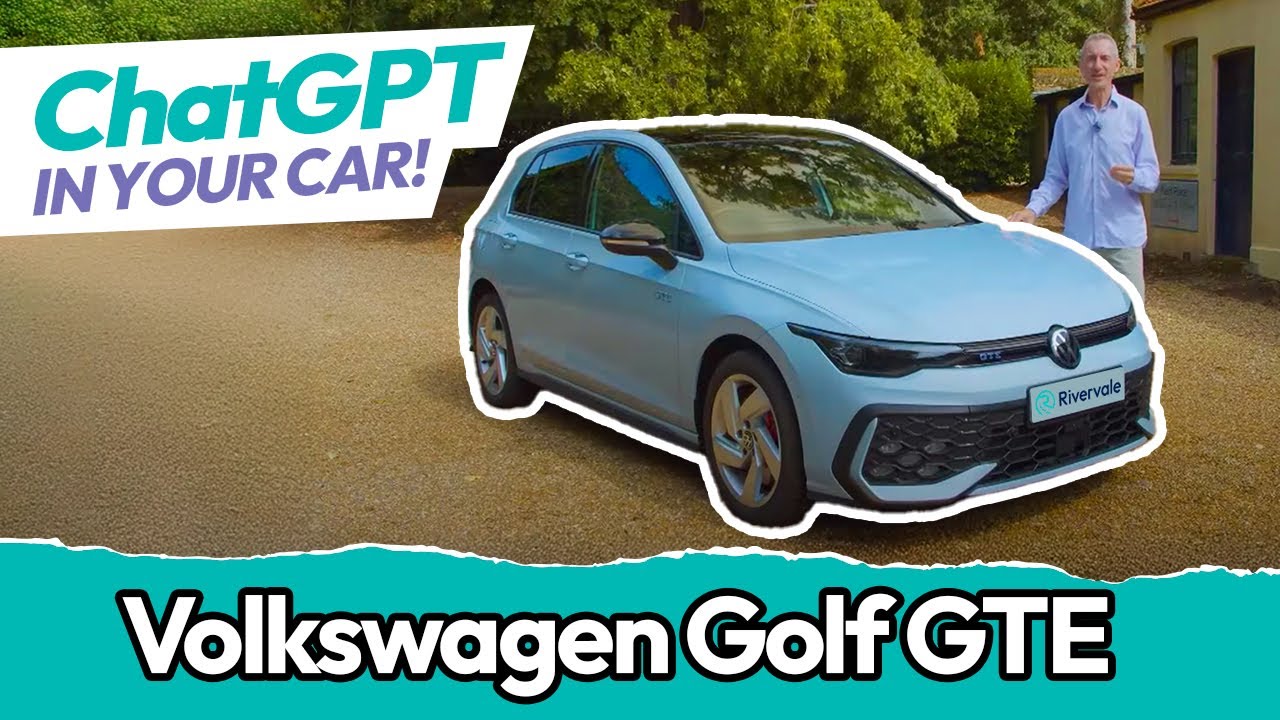
Volkswagen Golf GTE Plug-in Hybrid 2025 Review
The improved version of Volkswagen, a second generation golf GTI continues
to offer a more dynamic, if rather pricey, take on plug in hybrid
technology, combining sporty styling and pokey petrol power, along with
real world battery range and frugality. The idea is to deliver GTI responsiveness along with ID3 style EV sustainability. It felt spoken has done just that, and this could very well be the ultimate
all round family. Hatch. Volkswagen’s pioneering plug in model,
the golf GTI, get smarter and more frugal with this updated version
of the second generation design. Here, we’re going to take a closer look. Back in late 2014,
the first generation golf GTI was one of the market’s
very first plug in hybrids. But back then, expectations
weren’t particularly high when it came to the kind of EV range of car
that this should be able to manage. By the end of the decade,
though, things had changed a great deal. Hence the need for the second generation
CD one era replacement with a considerably larger
13 kilowatt hour lithium ion battery, and that usefully extended the Wltp rated all electric driving range to 40 miles. Volvo knew that if this plug in hybrid
golf was really going to be a properly credible alternative to a full EV,
a better technology still was needed. So in mid 2024, the brand provided it
further, updating this powertrain by installing an even larger 19.7kW
hour battery that more than doubled the EV range. It’s that smarter, further ranging version of the second generation
golf GTI that we look at here these days. This isn’t the only kind of plug
in hybrid golf you can have, but it remains the most powerful
and the most dynamic looking flavor of heavy golf you can choose. You can find out
more about this kind of car by downloading the car and driving app. And if your interest is specifically
in this golf GTI, then stay with us for the industry’s
most comprehensive review. The current driving road test. Mid-term model updates
aren’t usually accompanied by much in terms of re-engineering, but
that’s very definitely not the case here. In place of the 1.4l
engine and 13kW hour battery of the GTA we tried back in 2021,
there’s now a 1.5l unit and a much larger 19.7kW hour usable capacity battery
in this model. It’s the battery, of course,
the big change there that’s significant. It allows for an enormous boost
in driving range, up from 40 miles before to 82 miles in this improved GTA. That’s obvious in day to day driving
is a claimed performance gain, supported by a 110 electric motor and generated through a six speed DSG auto gearbox. The total output of this facelifted model is up from 245 to 272, although that makes only an insignificant
0.1 of a second difference to the 0 to 62 miles an hour
sprint time of 6.6 seconds. Which, if you’re interested, is just 0.7
of a second slower than a golf GTI. Top speed here is 143 miles an hour
for that kind of driving. The car will already have switched into the more combustion
orientated of its two drive settings. That’s hybrid. It always starts off though, in the other
setting, and that’s all electric mode. And if you’re light with your right foot,
it’ll do its best to stay there until the charge runs out. In theory, the car can drive in
E mode at up to 80 miles an hour. If you have inputs in the navigation
destination, then your GTI will also use
an incorporated predictive hybrid control system
that takes into account road and topographical data to ensure the most
efficient use of the remaining charge. Also automatic is the car’s
brake energy recuperation setting, which a central screen menu
will also allow you to manually set in low or high settings. If you want to take control of that yourself,
if you want to save your battery charge until the end of the journey,
save for some city driving at the end of a long highway trip. Then there is a central screen option
to do that too. If all of this could have been provided
with a really authentic golf GTI like driving experience, then
you would have the best of both worlds. But of course it can’t. Under strain the little 1.5l engine. There’s nothing like the Gti’s
sweet two liter turbo, and enjoys being read a lot less at speed
through the twisty stuff. This plug in hybrids extra
111kg of curb weight is also very evident, although the dynamic spec steering
is pleasingly accurate. That bulk doesn’t affect ride comfort
too badly though. In fact, if you do pay extra for the DCC adaptive damping system
that’s been fitted here to this test car, you’ll find the bumps and potholes
all dealt with really very smoothly. Before finishing this section, though,
we should point out that the GTA is no longer
the only plug in hybrid golf on offer. The same basic powertrain features an
detuned 204 PSE form and the lesser burnt. That’s the golf E-Hybrid, though
the performance figures of that variant are 0 to 62 in 7.2 seconds en route to 137 miles an hour
really aren’t very different. As before, a big part of the Gti’s appeal is that it doesn’t
look that different from a GTI. Although, as ever with the GTA blue
rather than red detailing sets this Chevy model
apart from its hot hatch stablemate. Like the GTI, there’s no estate variant. Having said that, here at the side,
we’re not sure that this GTI model has 17 inch Richmond
alloy wheels look particularly GTI like. You can, however, swap them out for
larger, more hot hatch like 18 inch rims. And we probably would. With that done, there’d be very little to differentiate
this Plug-In hybrid model from a GTI, except the badge below the wing there
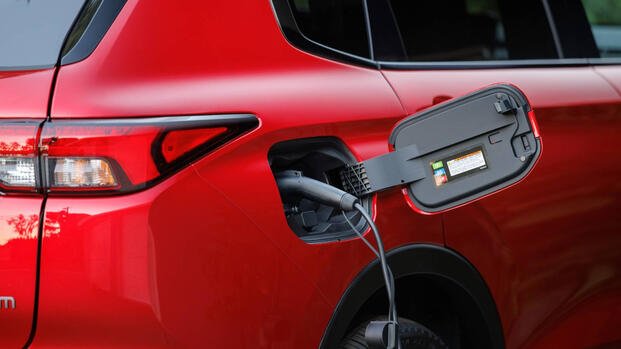
and the charging flap just ahead of it. Particularly
if you add in the optional black Exterior Styling pack,
which has been fitted here. As with every other,
go for significant changes to the updated version of this Mach
two model, you have to look to the front where the light bar that sweeps
across the bonnet edge now incorporates an illuminated VW badge, and it links angrier looking LED headlamps. The bumper here has been restyled too,
with lower body colored fins
now angling up into the lower grille. The rear gets the restyled bumper two, along with revisions
to the smoked LED tail lamps. As before, there’s a subtle roof spoiler
and the blue tinged GTI badge sits underneath
the central brand roundel. Right. Let’s take a look inside. Whereas usual with the GTI, there’s a blue theme for the upholstery
on the steering wheel trim. Look closely at the instrument screen
and little bottom frame. Digital show combined battery and petrol
range on the right and your chosen brake energy recuperation level on the left
and on the central monitor. There are added charging
and also recuperation sections. Otherwise, things are pretty
much as they were with any other updated CD1 era golf,
which means that if you’re graduating on from the pre
facelifted version of this model, you’ll notice a small
but significant improvement in quality with more soft touch materials and better
finishing. The redesigned steering wheel
now has a proper buttons instead of fiddly haptic touch pads,
and there’s before a dynamic vibe is offered up by the sports seats
and by the silver pedals. Detail cabin updates include a better
but optional head up display
and more powerful usb-C ports. Also improved is the 10.2in
Digital Cockpit Pro instrument display. We referenced earlier. It offers three layout formats choose
either twin dials or twin square boxes, both featuring a central digital speedo
and drive assist graphic or there’s a GTI specific layout
which sees a central dial showing revs on the right
and a power meter on the left. Then we mentioned this new central screen. It’s now almost too big,
having grown to 12.9in from ten inches before any larger, and had encroach on forward visibility. This vastly improved MIB for setup
is not only easier and more intuitive to use,
but also now incorporates ChatGPT tech, which can be used to control navigation,
phone and climate functions. The advantage here is that if
Volkswagen’s own voice control setup doesn’t know the answer to a question
that you might be asking the car, then it will be relayed
to an incorporated ChatGPT AI system. Although the same VW voice
will still give you the answer, this monitor also offers faster loading
times. Wireless app connect for Apple CarPlay
and Android Auto, and of course, there’s Wi-Fi
and over-the-air updates. As usual with current VW monitors. The home screen displays
either with customizable widgets or, if you press the top right
button, rows of little icons. Otherwise, things are much as they are
with any other golf, so you get near faultless ergonomics, a great build
quality, plenty of cabin storage space, and lots of nice touches like the flock
lion door bins and the ratcheting center box lid that serves as an armrest
and adjusts for five stages of height. The combination of these tiny
front quarter lights and slim a-pillars mean good front end vision, too. Over the shoulder
vision isn’t quite so good. The large C pillars there rather
get in the way, so it’s just as well as a rear view camera and a park distance
control system are both standard fit. Right. Let’s take a look in the rear. Where? As usual in the market golf, a pair of six foot adults
could be accommodated reasonably easily, providing front seat occupants
don’t slide their seats fully back. It is disappointing that
the height of this central transmission tunnel makes it so difficult
for a middle seat passengers to be comfortably accommodated, though
two people should be quite happy. They’ll benefit from this fold down
central armrest with its twin cupholders and twin beamed overhead
reading lights. Seatback pockets are provided,
plus on each seatback. You also get these, neat couple
of upper pouches, the door cards. Unimaginatively designed,
but they do incorporate decently sized, flock lined illuminated bins. There are twin usb-C ports,
and with a three zone climate system fitted as standard. You get this rear
seat temperature control panel, too. Let’s finish with a look at boot space, which is accessed
by a press of the central badge and the raising of this manually operated
tailgate. Not all EVs are engineered
in such a way as to rob you of significant amounts of boot space,
but thanks to the positioning of its hub system batteries under the cargo
area of the floor here, the golf GTI has always been
one of the plug in hybrids that does. Obviously, nothing’s changed
in this regard as part of the facelift. So the 380 liter luggage capacity total you’d ordinarily get in the golf falls
to just 273l here. Just like the car we tested back in 2021. Another downside of having all that
engineering bulk beneath the boot floor is that there’s no space to store
anything there. There’s nothing under there, but,
some rather useless shallow compartments. And that is really annoying
because it means that your charging leads, have to slide around on the boot floor
and get in the way of anything that you want to carry. There’s not even enough room
for the tight inflation kit. That means that has to sit in this tight,
right hand corner recess, getting in the way of any awkwardly
shaped items you might want to stow in width
wise, like, a pushchair, for example. Otherwise, this cargo area
is just like that of any other golf hatch. So there are two, bag hooks. There are four tie down points. An escape hatch pushing forward
the conventional 6040 split rear bench frees up 1130l. That’s down from 1237l in a normal golf. Everything is going up in price
these days, isn’t it? And the price of this CD one era golf
GTI has gone up rather a lot since the last time we tested it back
in spring 2021, from around 36,000 pounds to just over 40,000 pounds
at the time of this test. In late summer 2025,
which is only a few hundred pounds short of the model that visually it’s
supposedly modeled on the golf GTI. A more relevant price comparison
here is with the car that shares nearly
all the same engineering as this. 272 PSE golf GTI, but has a detuned 204 PSE
version of this car’s plug in hybrid drivetrain,
namely the golf A hybrid. Consider that option carefully
before committing to GTI purchase. After all, the hybrid version
comes much more affordably priced from just over
35,000 pounds in match form or for around
1,000 pounds more with Plusher style trim. If it’s a GTI you really want, then console yourself
for the thought that your comparable segment choices
will probably cost you more. The most direct rival
to a golf in this form is the identically engineered Cupra Leon, a hybrid in 272
guys, which, as we filmed, cost nearly 2,000 pounds more in
its base vs at one level trim. But plug in hybrid version of the Audi
A3 Sportback is only offered with the detuned 204 PSE
version of this EV powertrain, yet it still costs
1,500 pounds more than this GTI. With that A3 and comparable S-line trim
outside of the VW Group, the closest match to what’s on offer here
is probably offered by Vauxhall, whose Astra GSI
doesn’t look very tempting. It costs around
3,500 pounds more than this golf GTI, and offers just 225 pounds. It might also consider a perdu
308 plug in hybrid in sporty GTI trim, or a Mercedes 850,
but both of those cost over 1,000 pounds more than a GTA offer
quite a lot less power and EV range. Any other similarly sized
heavy alternatives that you could name? Either not as powerful as a GTI or a SUVs, or they’re both. So you might conclude there’s
nothing quite like a golf GTI, in which case you’re going to need to know
just how generous VW has been here with the standard specs. So let’s take a closer
look at that right now. Standard equipment includes
matrix full LED headlights, which are separated by a front grille,
light bar, and which feature high beam
assist and dynamic cornering lights. Plus, there’s also keyless
access, 17 inch Richmond alloy wheels, front
foglights, adaptive cruise control, keyless access and alarm,
power folding mirrors, LED tail lamps and a Park Assist Pro Park
distance control system to stop you
from reversing into things at low speeds. The brand also includes sport
suspension, sharper dynamic steering, its Xds electronic differential lock, and the Driving Profile Selection
driving mode system, along with its Travel Assist feature,
which allows the car to accelerate to steer and to brake on motorways
at speeds of up to 130 miles an hour. Plus, a traffic jam assist system can
almost drive the car for you in low speed. Urban queues. Inside, there’s a 12.9in center dash, infotainment screen with navigation,
wireless app connect, a six speaker audio system and an operating interface
which responds to the command Hey, Volkswagen,
followed by whatever you want to ask. And that’s aided by ChatGPT. This is the segments
most interactive voice control system. Also standard is 30 color
ambient lighting. Plus you get a rear view camera,
front sports seats, Jaka upholstery inserts, a 10.2in Digital Cockpit
Pro instrument display, heated front seats, and three zone
climate tronic air conditioning. As with the golf GTI,
probably the key option available on this car fitted here is Dynamic
Chassis Control adaptive damping. It’s a hefty 735 pounds more. Other features fitted here that you might want to consider
to include a head up display. There’s an area view camera system, a panoramic sunroof
and Vienna leather upholstery. This test car also has Volkswagen’s
optional black exterior styling pack, which darkens
the headlights, adds rear privacy glass and blackens the mirror covers
and the radiator grille strips. Remember, too, that
unless you order your golf in solid white or gray, you will be paying extra
for your chosen paint shade. We’ve got, crystal ice Blue Metallic here. You can also add a towbar
and heated rear seats, and we’d be tempted to find the 600 pounds
extra that, Volkswagen wants for the smarter
available wheel option. 18 inch Catania black diamond turned rims. Standard safety kit includes the brand’s
emergency braking front assist system
with pedestrian and cyclist monitoring, plus lane assist, dynamic road sign
display, a speed limiter, rear traffic alert, a lane change system,
an exit warning system for passengers. There’s Swift Sport
and an oncoming vehicle when turning. Feature two, which helps you avoid
approaching traffic at junctions. Emergency assist will bring the car
to a controlled halt if you’re taken ill at the wheel, and a multifunction
front facing camera for rides. A distance control system. There is also a proactive passenger
protection system and curtain and side airbags in front, with a center airbag
to all linked to the usual eCall system, plus a driver
attention and drowsiness monitor. The published figures for the GTA,
look undeniably appealing. Volkswagen claims a combined fuel economy
figure of 796.3 miles per gallon. Yes, you heard that right. An emissions of up to 8g/km. Compare that to 235.4 mpg and 26g per km for a pre-facelift model. For reference, the alternative golf
E-Hybrid 204 PSE version manages 992.4 mpg and six grams per km of CO2. Readings like these, really point
to the deficiencies of the TPI economy tests for measuring cars like this, rather
than the real world abilities of the GTA in pure electric mode,
activated at the press of a button. The GTA can travel up to 82 miles,
42 miles further than before. It’s 89 miles
for the E-Hybrid variant, though. In other words,
if the vehicle is only used for short commutes and recharged
regularly overnight, it’s conceivable that this GTA could be regularly run
almost entirely without fuel. And conceivably, if you get your charging
regime right to on off peak electricity, which will hopefully cost pennies
rather than pounds to consume. Yes, the charging system, that’s changed
quite a lot here. As before, you can set charging via
a provided app or via the central screen menu. A key difference, though, with this latest
GTA powertrain is the addition of DC fast charging, which means the battery
can be recharged at speeds of up to 40kW. The home AC charging speed
has changed to up from just 3.6kW before to potentially as much as 11kW now, charge up to 11kW,
and you could potentially completely replenish the 90.7kW hour battery
and just 2.5 hours. Which, of course, is a different world
from the overnight charging period that you need for the much bigger battery
of a comparably sized full EV. Not so good is that total operating
range is rather restricted by the fact that the usual 50 liter
fuel tank, in a golf, here falls to 40l and tanks. Well,
business users will really like the way that the lengthier
EV range of this facelifted model, drops this golf down into the 5% benefits
income tax bracket. That’s just a fraction
above the 3% that you get, with, full EV, service intervals are every year or 10,000
miles, whichever comes around first. You can expect residual values
after three years and 36,000 miles to be in the 43 to 50%
bracket. Insurance group 30 a
and there’s usual three year, 60,000 mile warranty
and a year of roadside assistance. We have to judge this updated take on the CD1
era second generation golf GTI, quite differently from the pre-facelift version
of the model that we tried back in 2021. And there are pluses and minuses to that. On the plus side, is the game
changing nature of this enhanced model’s much larger 19.7kW hour battery, which is able to make this GTI something
its predecessors never really were. Namely a credible alternative to a full EV about 70 to 80 miles of range
a day is all most people actually need. And this golf provides that fossil free
without the lengthy charging and the long range restrictions of an EV two, you could make much the same argument
for just about any similarly sized EV modal hatch or SUV,
but this golf delivers on it with an EV range figure
that’s difficult to better in the segment. Most competitors are way off. The Vauxhall and Peugeot Stellantis Group
alternatives, for example, can’t even break the 50 mile EV barrier
before combustion power cuts in. For all that, we would struggle to justify a golf GTI at a time
when Volkswagen will sell you an almost equally impressive
golf, a hybrid heavy model for around 5,000 pounds less a car, which
would take you even further on EV charge, and in which you’d struggle to notice
much difference in power that E-Hybrid wasn’t available the last time
we tested this model, but it is now, and we’d counsel you to first try that car
before signing off on this one. With any hybrid test drive completed,
you might still be seduced by this gti’s sportier looks,
and you might still feel that one of these will be a clever choice
than you could make by spending the same kind of money on a comparably
sized EV right here, right now. We struggle to disagree.
The updated second-generation Golf GTI plug-in hybrid doubles down on usability and tech. A larger 19.7kWh battery more than doubles WLTP electric range to 82 miles, while total system power rises to 272 PS via a 1.5-litre engine, 110hp e-motor and 6-speed DSG. Now with DC fast charging (40kW) and up to 11kW AC, it’s far quicker to top up than before. Standard kit includes matrix LED headlights, Travel Assist, and a 12.9-inch infotainment screen. The idea is simple: GTI responsiveness with ID.3-style sustainability, making this a credible daily all-rounder for family hatch buyers.
On the road it starts in E-mode and will hold it up to 80mph if you’re gentle, with predictive hybrid control using navigation and topography to deploy charge smartly. Regeneration can be set to auto, low or high, and you can save battery for city sections. Optional DCC adaptive damping smooths potholes, while dynamic steering, XDS diff lock, PAS and Travel Assist boost confidence. It’s not as fizzy as a 2.0-litre GTI and the extra 111kg shows when pressing on, but ride comfort, real-world pace, and refinement impress, especially given the near-silent EV running for short hops.
Facelift tweaks bring an illuminated VW badge, sharper bumpers and lighting, while the cabin gains nicer materials, proper steering-wheel buttons, a 10.2-inch Digital Cockpit, and that 12.9-inch MIB4 screen with ChatGPT-assisted voice control. Practicality takes a hit: the boot drops to 273 litres due to battery packaging, and the fuel tank shrinks to 40 litres. List price is now just over £40k (late summer 2025). Against rivals like the Cupra Leon e-Hybrid, Audi A3 TFSI e, Vauxhall Astra and Peugeot 308 PHEVs, the Golf hits back with standout EV range, DC charging, and class-leading polish.
For more details, call us at 01273433480, and our vehicle specialists will help you find the perfect lease! And don’t forget to subscribe to our channel to stay updated on the latest automotive reviews!
⏳ TIMESTAMPS ⏳
00:00 Overview
00:32 Background
02:21 Driving Experience
05:47 Design & Build
13:19 Market Model & Range
19:29 Cost of Ownership
22:27 Summary
#carreview #carguide #rivervale #carleasing #leasing #volkswagen #vw #vwgolfgte #golfgte #volkswagengolf