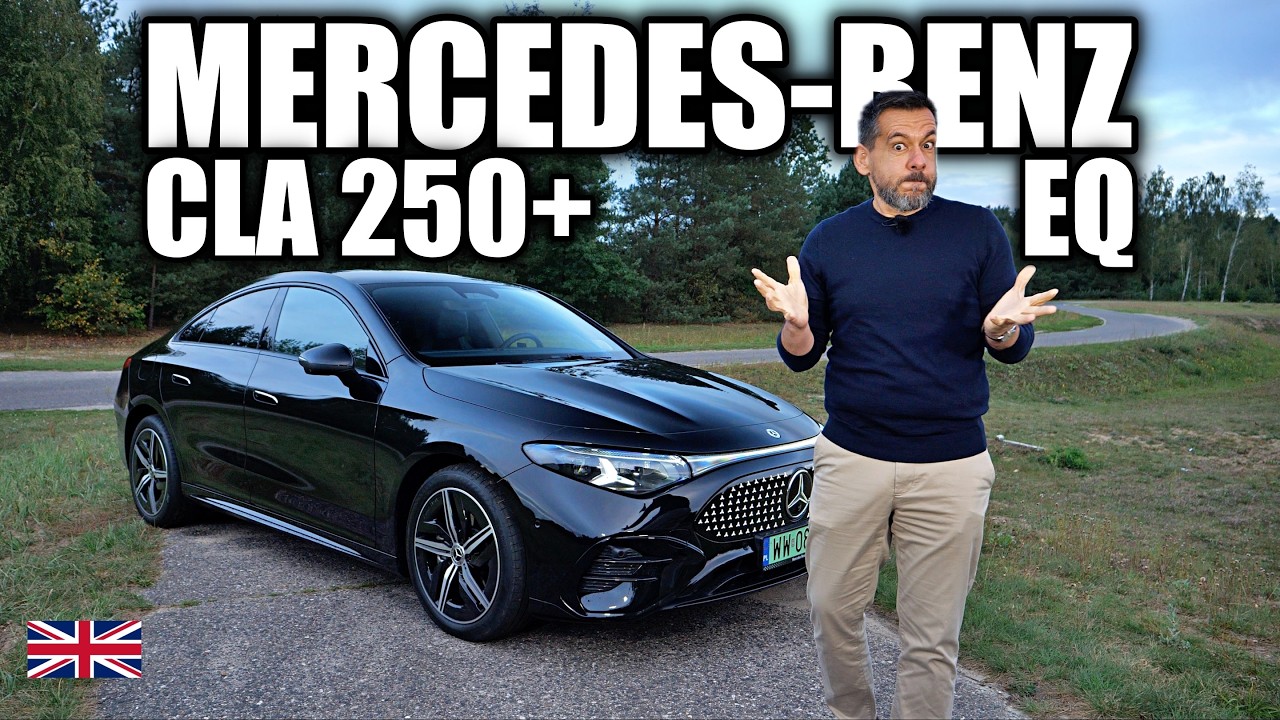
2026 Mercedes Benz CLA 250+ with EQ Technology – Can It Beat Tesla? (ENG) – Test Drive and Review
This is the new Mercedes-Benz CLA. If you think
it looks very similar to the model it replaces, you are right. However, this is the CLA 250 Plus
with EQ technology, a fancy way of saying it’s electrified, and in this case, it’s even fully
electric. It features a lot of tech, which current Mercedes EV lineup lacks, and it improves
on some of the stuff we’ve already seen. Is this the EV you finally want without an asterisk?
asterisk asterisk. the little goal. Anyway, let’s find out. [Music] Come on. Come here.
Come a little closer. Don’t be afraid. No, I don’t want to hurt you little more. Come
near. Let me just show you. Don’t know. Can’t talk. Let me just show you. Don’t
be obsessive. It could be intensive. We could be explosive. We could be offensive.
Don’t be defensive. Don’t be aggressive. It will be a waste cuz we could be expensive.
You need a little in your life. You need a little me in your life. I want to see the
sea in your eyes. You need to be free. [Music] The new Mercedes-Benz CLA is indeed
very similar to its predecessor. It’s literally 2 3 cm longer and wider. The wheelbase has been
extended by 6 cm, and the new CLA is 3 cm taller than the model it replaces thanks to the traction
battery being located in the floor. More on that in a moment. After the enthusiastic reception of
the design language of earlier electric models, Mercedes decided that all its cars should now
look relatively standard and relatively similar. New models feature slightly bolder headlights and
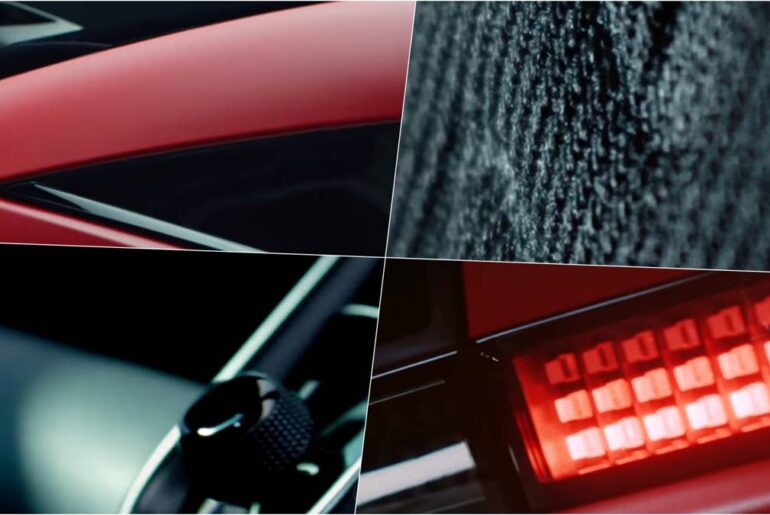
tail lamps with a star motif, but the radiator grill is less conspicuous. Do you recall those
little chrome dots on grills in earlier Mercedes models? And recently, the E-Class had these little
chrome stars. Here, they’ve been replaced with 142 illuminated LED stars. From a distance,
you can tell it’s a Mercedes. Up close, it’s not too flashy. I like it. Aerodynamics have
also been improved and the drag coefficient is now just 0.21. Besides the streamlined front end,
the retractable door handles help and they finally work here. I remembered that in earlier Mercedes
models, especially the EQS and EQE, the sensor on the retractable door handles had some sort of
delay. This meant a tug on them because since nothing happened, it was just a reflex. Here they
finally work properly. I have three pieces of good news. First, Mercedes has decided that every new
model will now be in both electric and electrified versions. This means we’ll soon see the CLA with a
mild hybrid combustion engine. Second, the Aclass in its current form will be available until
2028. Production was supposed to seize in 2026, but there is no point axing a model that’s still
in demand. And third, the electric Mercedes-Benz cars finally have a frunk, so you don’t have
to wonder what to do with your dirty charging cable. The frunk floor is at a slope. Mercedes
claims a capacity of 101 L, but this isn’t a VDA figure. The frunk is approximately 25 cm deep,
approximately 45 cm long, and approximately 75 cm wide. So that’s more or less 85 L, roughly the
size of a carry-on suitcase. The boot capacity has decreased compared to the previous generation. Now
standing at 405 L, it measures approximately 100 cm long, approximately 90 cm wide at its narrowest
point, and approximately 46 cm high. Just behind a still too high sill, there is a small compartment
under the floor for a repair kit and other small items. Inside things get interesting. Mercedes
has published a table comparing dimensions between the old and the new generation. And it
seems that there is about 1 2 cm less hip and shoulder room here and 7 mm less leg room despite
6 cm longer wheelbase. However, there is almost 3 cm more headroom. Now, this is strange since the
traction battery is in the floor. Does anyone have any ideas what’s going on? I have a suspicion,
but I’ll tell you about it when I get to the front. Meanwhile, the leg room is fine. Headroom
even more so. There are door pockets big enough for my water bottle. The floor in the middle
is flat. There are air vents and USBC ports. The back rest splits 40 20 40. There’s an armrest
with cup holders and behind it a pass through to the boot. Iceix anchor points are only on rear
side seats. In theory, I should have 15 mm more headroom than in the previous generation, but uh
I feel like my head is scraping against the roof. What’s the deal? This is how I see it. The CLA
has a standard panoramic glass roof. I’m assuming headroom is measured to the glass and not to the
parts which are closest to my head. The seat can’t be dropped lower, so my head may be closer to the
roof than in the old generation, but further from the panoramic glass roof in the new generation. A
side effect beside the feeling that I’m about to bang my head on the roof is that I constantly see
the orange passenger airbag warning light in the corner of my eye. The light stays on constantly
and only the message changes to indicate that the airbag is either active when someone sits in
the passenger seat or not when the seat is empty. To the best of my knowledge, the CLA recognizes
when a rear-facing car seat is installed in the front seat and deactivates the passenger airbag.
From the description, I don’t really trust this solution, and I would prefer a physical switch.
Perhaps then I wouldn’t have that orange light constantly in my eye. Other than that, the driving
position is good. The seats are comfortable, but the seat memory settings are on the screen.
Recently, while reviewing a Chinese car, I ranted about burying seat settings somewhere on
the screen because it’s a bad idea. So, imagine you have two drivers of significantly different
height and they share one car. The taller driver will always have trouble squeezing into the seat
and to reach the screen to adjust the um seating position. I assume the problem is partially solved
when you have two separate profiles assigned to separate keys which can even be your phones. But
in my opinion, this is an unnecessary complication of a solution that’s memory buttons one, two,
three on the doors or on the seat. Why complicate it? Speaking of buttons, Mercedes also got rid
of two rear window switches. Instead, it took the approach that Folkswagen is abandoning after
a few years. buttons for right and left side and an additional button to activate the right or left
side but in the rear. I suspect that like BMW also Mercedes analyzed data from hundreds of thousands
of cars on the road and concluded that they could save a few cents here and a few centimeters there
by getting rid of these two rear window switches which few people use. Just because I’m not using
something often doesn’t mean I don’t want it. And a premium brand should understand that. Other
things that perhaps few people used. Mercedes trimmed down the infotainment system interface.
It’s closer to the iPhone than to Mercedes. I’m sure very few people change the virtual cockpit
skins, but I always thought it was a nice feature. The center display looks suspiciously small,
and that’s because above it sits a camera that monitors the driver’s attention level and
recognizes their face. You can link it to a profile, and the seat will adjust itself. But
first, you have to get in behind the wheel. An optional third display is also available on
the passenger side. This really isn’t necessary, but I’m sure it makes more money for Mercedes.
I guess the passenger will be playing games and streaming videos because the driver can’t because
you know they’re driving. The simplified interface has one advantage, a home button and several
recently used app buttons. While the windshield defroster is on a panel with a couple of
buttons below the display, the rear window defroster is in the climate control submen
and you have to click through to get to it. Mercedes boasts it now offers OTAA updates
which will help users enjoy their cars longer. The virtual assistant is now all AI and can solve
problems that reveal your lack of personality. The press release literally gives an example of asking
the virtual assistant what’s interesting in the area because you’re going on a date. If this isn’t
a red flag, I don’t know what is. I mainly use the virtual assistant to find out that this car
isn’t equipped with things like heated steering wheel or maybe a system to darken this panoramic
sunroof. Another feature this car didn’t come with preconfigured is Android Auto. Apparently, at a
later date, it will be possible to download it from the App Store. Meanwhile, I have to rely on
Mercedes’s navigation, which is based on Google Maps, but it’s not Google Maps. It’s nice to see
where the charging stations are and information about parking capacity, but I would prefer
information about alternative routes or police along my route. The door pockets are spacious.
There are cup holders on the center console and a very good wireless charger. Below the console is a
shelf and two USBC ports. The storage compartment under the armrest is small. The glove box is
also tiny. If you’re looking for a start button, there isn’t any. You get in with a key, press
the brake, and select reverse or drive. [Music] [Music] I’ll start with the drivetrain parameters.
Initially, the CLA is offered in two versions. The rear wheel drive 250 plus and
the 350 formatic all-wheel drive. Both are equipped with NMC traction
batteries with net capacity of 85 kW hours. A model with an LFP battery with
net capacity of 58 kW hours will follow. The batteries are more efficient than in the
previous generations of Mercedes electric models and require fewer resources. The batteries
consist of four cell modules. The modules are compact and flat, and the energy density is 20%
higher than in earlier versions. There’s also a standard heat pump, which further increases
efficiency. The Mercedes-Benz CLA 250 Plus with EQ technology. This is the model’s full
name, has a promised WLTP range of up to 792 km with energy consumption between 14.1 and 12.2
kW hours per 100 km. I suspect that in eco mode with only city driving and good weather, this is
achievable. In my non-scientific combined cycle, I achieved around 15 kW hours per 100
km, giving me a realistic range of 560 to maybe 600 km. Even on the highway, the CLA
consumed just over 15 kW hours per 100 km. In addition to the aforementioned
excellent aerodynamic properties, the electric CLA features a two-speed
transmission just like the Porsche TYON or the Mercedes AMG C63S Performance Hybrid. The
gear ratios are 11:1 and 5:1. The shifting occurs depending on the driving scenario and speed.
So, for example, during my speed test runs, I felt this shift shortly after exceeding
100 km/h, probably around 110. Second gear allows for a top speed of 210 km/h and
full power delivery at higher speeds. The claimed 0 to 100 km/h time
is 6.7 seconds. In sport mode, I achieved 6.3 seconds. And in comfort mode it
was 6.8 seconds. The outside temperature was around 10° C and the battery state of charge
was around 70%. I mentioned this because for example in Kra born full performance was
only available at the right temperature and with the battery charge above 80% which is
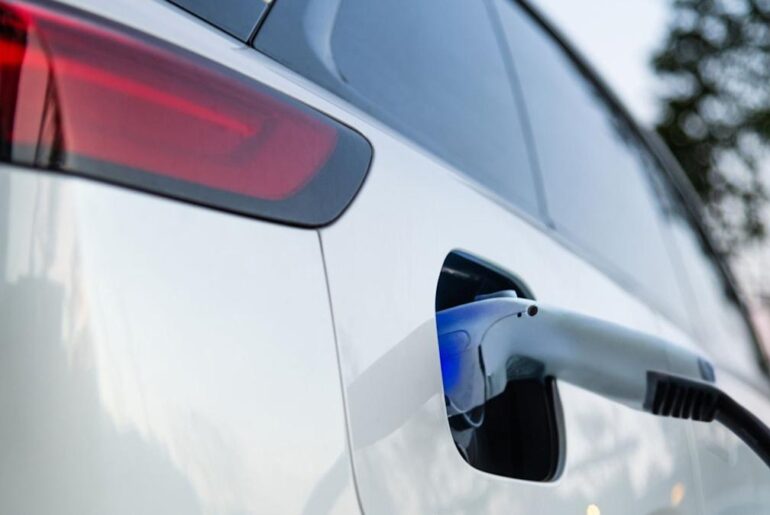
practically never when the car is used properly. Speaking of charging, the electric CLA features
an 800vt architecture and can DC fast charge at up to 320 kW. This means it can recoup
up to about 300 km of range in 10 minutes under favorable conditions. Of course, 11 kW
AC charging is standard and there is a 22 kW option. Vehicle to home and vehicle to grid will
become available with a future software update. And what’s it like to drive the CLA 250 Plus with
EQ technology? Honestly, I didn’t expect much, but I’m pleasantly surprised. It took me a
few dozen km to get used to the CLA, but then I discovered that the car is rear wheel drive,
which is noticeable when taking sharp corners at speed. This means the front wheels only have to
do the steering rather than simultaneously fight to propel the car. The steering is nicely tuned,
offering more feedback than even some cars with conventional drivetrains. Overall, I feel like
the CLA 250 Plus is 272 horsepower and 335 Nm of torque were set by a committee to save something
for more powerful versions because the car feels like it’s capable of much more. The perfectly
tuned suspension allows for quick cornering without too much body roll while getting you over
bumps without any unpleasant noises or vibrations. It certainly helps that the AMG package selected
for this car includes only 18-in alloys and no one bothered to order larger ones. Sound in
electric cars. This is often a divisive issue. Some like it, some don’t. I don’t mind as long as
it adds to the experience rather than annoy me. In case of the CLA 250 plus, there is no artificial
sound most of the time. Under hard acceleration, there is something like an engine purr, which
is fine, but then there is also this kind of strange noise like worn brake pads when I’m
braking. And this bit I don’t like so much. The soundproofing is very good. Visibility is
decent, especially for a car with a sloping roof line. A 360 camera helps with maneuvering.
The turning radius is over 5 1/2 mters, quite a lot. Furthermore, the reverse emergency
braking system makes it difficult for me to reverse into my driveway. Adaptive cruise
control with lane keeping assist works well, though. There is also a lane change assist
system, which is active on highways. I also suggest you turn on automatic regenerative
braking. The car will begin slowing down not only when there is a slower vehicle in front of
you, but also before intersections or tight bends. This is a good feature. Unfortunately, it
needs to be reactivated every time you restart the vehicle. If you order the optional toe
bar, the electric CLA can tow up to 1.8 tons. This is more than many Chinese combustion
engineed cars available on the European market. Prices of the new electric Mercedes-Benz CLA start at €53,280. That’s about €10,000 more
than the previous generation ICE model. A new hybrid CLA will be launched at a later
date. However, the outgoing CLA250 Formatic, which offers performance similar to that of the
CLA 250 Plus I’m reviewing, starts at 56,300. So, the EV may not be so expensive. After all,
this test car with options costs 66,219. Assuming you’re considering a compact Mercedes
and aren’t interested in the base model, the electric CLA 250 plus with EQ technology is
no longer the compromise like previous generation electric cars where after a few years of learning,
Mercedes has finally learned its lesson and either people will start buying new electric cars or we
should end this experiment. And what do you think about the Mercedes-Benz CLA with EQ technology?
Let me know in the comment section below. If you like my sarcastic, down to earth, and possibly
mildly amusing car reviews, join me every Friday, 3 p.m. Central European time. And don’t forget to
subscribe and like this video as it helps me with the YouTube algorithm. Thanks for watching
and I will see you in the next one. [Music]
We’re testing the new Mercedes-Benz CLA 250+ with EQ Technology! This all-electric, sporty sedan enters a highly competitive segment dominated by the likes of the Tesla Model 3 and BMW i4. Can this new version of the CLA win over customers? We’re finding out its real-world range and if its sporty character is a good match for an electric powertrain.
In this video, you will find out:
How does the Mercedes-Benz CLA 250+ with EQ Technology differ from its combustion-engine counterparts?
What are the driving impressions of this new, zero-emission CLA?
What is the battery’s range and how fast can it be charged?
Does the Mercedes-Benz CLA still impress with its sporty design and digital MBUX cockpit?
What are the main pros and cons of this electric sedan?
The Mercedes-Benz CLA 250+ with EQ technology is a promising rival in a segment that has been defined by the Tesla Model 3. This new model combines a futuristic design with an innovative powertrain, all while maintaining the luxury and comfort Mercedes-Benz is known for.
2026 Mercedes-Benz CLA 250+ with EQ Technology – Key Information and Specs:
↔ Mercedes-Benz CLA 250+ EQ dimensions:
✔ length: 4723 mm
✔ width: 1855 mm
✔ height: 1468 mm
✔ wheelbase: 2790 mm
✔ boot/trunk: 405 L + frunk 101 L
💲 Mercedes-Benz CLA 250+ EQ starting price: 53 280 euro
💲 Mercedes-Benz CLA 250+ EQ price as tested: 66 219 euro
🎯 Do you like my channel? Subscribe here: https://bit.ly/SubMarekDrivesENG
💥 Follow me here:
https://facebook.com/marekdrives
Tweets by mwieruszewski
https://instagram.com/marek_drives
📢 I started a new channel – https://bit.ly/MareksGear, where I’m talking about the gear I use to make my shoe-string budget car reviews. Check it out, and please consider subscribing: https://bit.ly/SubMareksGear
🚙 Also watch:
Audi A6 e-tron https://youtu.be/0dLJUrMhaYI
BMW Serii 2 Gran Coupe https://youtu.be/T2hT4znmc38
BMW i4 https://youtu.be/2wxflDxfKMs
Mercedes-Benz A Class https://youtu.be/da8U0_Q3OC0
Mercedes-Benz CLA Shooting Brake https://youtu.be/KHKPGMTN21o
Volkswagen ID. 7 https://youtu.be/tC9AXtwKUqQ
#MarekDrivesENG #MercedesBenz #MercedesCLA
📌 Thanks for watching Marek Drives reviews. If you liked it, here are several other channels you may enjoy: Autophorie, Autogefühl, Bob Flavin, Carfection, Carwow, Doug DeMuro, Driven Car Reviews, Fully Charged, TheSmokingTire, TheStraightPipes, VINwiki.
💲Transparency note: 💲
Marek Drives reviews are independent and based on personal experience with cars provided by car manufacturers for media to review. No carmaker has any influence on what is being said in the review, nor are they given a preview. No carmaker pays me to do these reviews. My sponsors are you – the viewers, Channel Members, and occasional non-carmaker entities, whose sponsorship is always clearly marked.
Chapters:
0:00 intro
1:20 design
2:49 frunk
3:42 boot
4:08 rear seat
5:09 cockpit
10:40 powertrains
11:19 range
12:20 performance
13:35 charging
14:03 driving impressions
16:50 pricing
17:26 conclusion