BMW Neue Klasse – Seamless Digital Technology Explained | Inside Neue Klasse.
When Daniel first showed me this idea, removing all the screens while at the same time creating the largest image that we ever had in the windscreen, I was completely blown away. Inside Noya Classer, a video series with people at BMW shaping the future. Hello and welcome back to Inside Noac Classer to our fourth and final episode. And I’m delighted to say that for this one, we are live at IAA Mobility. Very excited indeed. Particularly because I have a new friend behind me. Doesn’t she look beautiful? The BMW iX3. More on that in a moment because today we are going to be talking about seamlessness, connectivity, and how we interact with our cars. And I’m delighted to say we have two experts along for the ride. Let me introduce. We have Marcel Otman who is the head of user interface design systems and alongside him we have Daniel Fischer who is senior creative technologist. Welcome guys. Before we get into all the details congratulations. How does it feel? Your baby is out in the open. Thanks. Yes. Another one has been born to the world. But it it’s hit the headlines. Everyone’s talking about it. Yeah, it is. But was a stony road but now Yeah. It’s a It looks perfectly. It’s really ready to ship. You can sleep well tonight. The hard work is done. I mean, how do you reflect? You must be very proud looking at it. Well, honestly, um I arrived this morning, just this morning. And seeing this now in the public, like we obviously saw the car before in closed rooms, etc. or with camouflage on it. But now when you see it here um in this beautiful city in this beautiful location um it just fits you know everything fits the exterior the interior um the UI which makes me most happy actually um but everything comes together in a way that I think this is one of the best projects that we have done here. Smiling from ear to ear. Yeah. Well done. Well guys let’s crack on. Um, before we really get into all the details, I want to ask you both a very complicated question. First of all, to you, Daniel, what is the favorite app on your phone? Right now, I would say it’s Chet. Did you use it to prepare for this interview? Uh, indeed not, but uh to find the right parking spot, I I used it. That’s fair enough. Daniel, we talk a lot about seamlessness, particularly when it comes to the No Classroom and how that technology that is in the car gives us that seamless experience. Can you just explain why a it’s so important and and what we’re now seeing in the No Classo when it comes to seamless technology? For me, seamlessness starts at home. Our car now provides a good energy management for the whole house. So we have a system called vehicle to home and we can like use our photo tag solar energy to store in the car and to the car will give it back when the sun is down. So I think this is something seamless which is quite worth uh notion and I then coming inside the car um having the right tracks of my music um listening my my favorite Spotify podcast like seamless coming from home into the car I know exactly it will start this is something which is also for me quite uh seamless experience and uh quite normal if you want if you’re used to it. Now, there are also lots of interactions that you know you have with your car that happens before you get into the car. Can you give us some examples of what they are? Yeah, preconditioning the car like doing the preheating of the car like electric cars have so much energy with them. So, they can just climate your car on the in freezing temperature. We have in Germany sometimes feel cozy if you come inside coming from the shopping and it’s just nice and warm inside. And I think something like that, it’s quite an experience. If you have it once, you never want to miss it. It is honestly the best thing for me. One of my memories of driving to school as a kid in the winter was despite the freezing temperatures, we still had all the windows open because that, you know, it was going to steam up in the front. And it was honestly horrendous. So the fact that we don’t have to do that anymore is such a luxury, such a joy. Years never will experience that again. They’re spoiled. Absolutely spoiled. But no, it is so nice to just walk into a, you know, a warm temperature and drive off in the winter. Exactly. Exactly. Heated steering wheel just perfect. Yes. Couldn’t live without it. Um, and then customization again is is a massive feature when it comes to No Classer, but how far does it go with customization? You know, it’s developed so much over the last couple of years. That’s true. Like um for instance the panoramic vision is like a perfect stage where you can set up your own preferences like the driver axis is quite preset because from our point of view this is like quite stable. You have to see right at a glimpse of a second what speed you are at what’s the allowed speed but the rest of the stage you can customize by your own. You have your own particles. You can get your weather data there. you can have your uh signal strengths of your mobile phone there because many people know if you run into like low signal areas then having a phone call is like a hassle. You be aware of that uh if you have that in your line of sight. So this is something we we do a lot with the like terms of customization but also setting like the the own color setup when you come enter the car and all that uh I think is something which comes when we talk about customization in digital way it basically the car just knows you so well doesn’t it knows your life maybe better than my wife yeah I mean 100% the car knows you better than my husband that’s for sure and also the joy of the car is it’s a planner unlike my husband So you can plan ahead or the car plans ahead for you. Tell me more about that. Especially if you go uh route like to a further distance um destination getting like people to electric mobility helping them to reduce the range index. Um, a good route planner is like crucial and therefore we have like a really good system which leads you to the perfect charging spot on on your route where you can have your 400 kilowatt of charging power and be there at your destination like I think in the same time like with a combustion engine car just brilliant brilliant and again it just it takes another level of stress away from your journey. It’s pre-planned. you don’t have to worry. You get in the car and go and you can send it from your mobile as well the destination and it will already tell you where to stop and so you can prepare quite good for it. And obviously emotion, you know, it’s so important that we get that joy and emotion when we’re driving a BMW. How do you keep that within the car given that we have so much technology as well at our fingertips? The emotions that those those twinkles in the eyes are I think coming with our uh personal assistant. Um like we have those small dots which has like um smiles at you like if you turn tune up the music it it cheers a little bit. So it has some emotions and I think the people will uh really like it uh when it comes to emotionality and over the air updates will come and bring even more of those. So they kind of personality full of positive energy. Exactly. Exactly. like it feels completely natural if you jump in the car and um have everything set by your preferences. And for me, panoramic vision was just such a game changer in terms of roominess of the car. Like we don’t build up big walls of displays. We want to like have having a a living room experience in the car feeling home when you get exactly what I was going to say. Those home comforts there. Exactly. Um but whilst also looking beautiful and uh interacting so well. Um if someone hasn’t driven a electric BMW before, what do you think they can expect? And and again going back to that kind of intelligent drive and using that seamless integration, what can they expect? People they need to feel at home when they enter an electric car. So, we choose to not like get rid of a gear selector like others do. We want to everybody jump in the car and feel at home right away. Like I know where to open the windows. I know um where my turn indicators are. um all those um little things which makes you like connect with the car in in a like historical way more or less but you don’t have to adapt to it. I think this is one crucial and then like we said the range inexi um route planning that’s crucial and also um charging that that is a really seamless uh experience. You drive to the charging station the car will open its charging lid for you automatically. Nice. You just plug in and charge. The authentification paying process is all done automatically. So, it’s just plug in, wait a couple of minutes, and then off you go. Love it. Just another thing to just remove another element of stress from your life, isn’t it? Life stressful enough. It is. It is. It’s like just one less thing to think about. Over to Marcel. Um Marcel, let’s just start from the very beginning. I mean, seamlessness, not an easy thing to design. How do you design that? What’s your approach? Well, usually when you interact with user interface, um the user always needs to needs a wish to be fulfilled. He has a certain goal and what we try uh to use is a method called user journey. So we map each starting point which of which may be many um to the goal that the user wants to achieve and then we we go each and every step and identify if there is friction right because friction is bad for the user flow and then we um remove as much of the friction as possible and that becomes very interesting when you switch from one touch point to another right the user may start in the app and continue in the vehicle uh or other way around. Um the user may also switch modalities. He might want to start with a voice interaction and finish with touch interaction. And so this this user journey is not one single path but it’s so many possibilities and all of those need to be ironed out and smoothed over as good as possible. So not an easy task. It’s interesting. Um, talk to us about the relationship between the two of you and the two sides of the business, you know, the the creative side, the technology side, bringing it together and how have you ensured that that design development when you’ve got such a huge goal to achieve and it’s kind of it’s not the first time that you’ve been working together like this, but it’s the first time where maybe the project has been such a on such a big scale in such granular detail. How do you make sure you get to the end destination together in the right place? Well, I have to say one thing first. Um, before we for a long time, we thought now we have digitized every instrument in the car. Everything is on a screen and uh well now we just iterate on this on this platform, right? But uh years ago, we showed a car. It’s called uh the vision next 100 and it had not a single screen in the car. And we realized that this is much more what BMW actually wants to be, what we stand for, right? Um we don’t want to display a lot of screens to you, but we want to integrate them as well into the product as possible. So now with the panoramic vision display, it is an image. Yes, but the user does not see a screen at all. It’s fully integrated. You just see the light. When Daniel first showed me this idea of removing all the screens while at the same time creating the largest image that we ever had in the windscreen, I was completely blown away. Like that was the most revolutionary thing that I ever uh saw come out of this R&D uh uh department. And I knew immediately that this will be like one of the biggest challenges in my designer career to be able to help make this a good product. So this was the start basically and then we um we did a lot of iterative work together. So there would be new hardware uh new drivers that interpret the design and then we would come up with new designs and seeing your the design on a screen um and you think yeah I’ve been doing this for the last 10 years I know what this looks like on this new technology but you don’t because the size is completely different that viewing distance is completely different and so basically new hardware ware new design we would meet we would integrate this into a prototype we would not only then repeat this process like I don’t know hundreds hundreds we we did a lot of mockups yeah but not drivable or non-drivable and we did we conducted also user studies a lot and uh design clinics to make really sure that in each market this new technology and design will like hit the right spots and like giving the the customers what they need. Were there any points in the journey where you were like, “We’ve got to get here.” And you’re going, “Well, we can’t get here.” And you sort of reach the end of the journey, but obviously you do find a solution in the end. Were there were there a few roadblocks along the way? Yeah. So, um sometimes we have to change the design um which we usually don’t but they always right at the first. Yes. Exactly. But then we we realized that this new technology has certain strengths that we uh could play towards with the design language and then on the other hand obviously there are a few requirements that are out of the question that need to be fulfilled. So also the technology was changed um during this iterative process to match the design requirements and this uh each department took the possible steps into the direction of like the perfect fusion of design and technology. Personalization absolutely critical when it comes to BMW in the new class. But maybe you could explain some of the things that we might not realize are personalized now because it’s hit a whole new level, hasn’t it? Well, that’s actually a difficult question because almost everything is personalizable, right? So, um you would be able to set the your preferred color of the whole interior. Uh we sync the interior light to the user interface design so you get this holistic experience and this will be obviously remembered. Do you want your UI to be in a dark mode or in a bright mode? This will be remembered. And then comfort features like activation points for certain functionalities. I can for example set an activation point somewhere uh where the car automatically lowers the window um and it will remember this uh activation point. Um but it’s not the car itself that remembers this. Um it’s more your it’s safe to your profile right and if you sync your profile from the cloud to a different EX3 then this car would remember all your preferences. Amazing. So you don’t have to reset it jumping from one to the other. You you go from the airport, you pick up your rental, you log in with your ID, and it just feels like it’s your car. The My BMW app, brilliant, brilliant app. But just explain how that is doing things. U you know, before you even step into the car, you know, outside of the car, how is that working? So, with the OSX update, um we you continue the development of the existing app. We have a a user base of 14 million users. That’s quite significant. Just a few. 14 million. Wow. And uh they get to enjoy features like uh monitoring your charging. As Daniel already said, you can preheat or pre-cool the car when you know you’re about to leave. Um you can access the 360 cameras so you can see what’s going on around your vehicle. Uh you can find your car in case you ever lose it in a large parking lot, something like that. It I would never do something like that. Yeah, you would. and then it would map the best pedestrian route uh to your vehicle. Um so all of all of this will obviously remain and be uh uh furthered in terms of development. Um but for for the OSX update, we did something uh that enables us to do a lot more. Now with OSX, the the phone and the car will be synced in real time. So all of those functionalities will be much quicker, much snappier. There is no reloading the data from the server but it will be instantaneous. So I think this this real-time connection between the car and the app gives us the next step in terms of seamless experiences. I mean it is honestly brilliant the the location finding of the the car. Countless times I drive don’t admit it to the station and then I come back from work via taxi. So my husband goes to find the car in the morning and it’s not there. It’s at a station somewhere nearby, but at least he knows where to find it. You know, I’m helping him out. Thank you to the My BMW app. Um, and and also let’s talk a little bit about how you bridge the gap between real life and then the digital world, you know, give us I mean maybe some sort of real world examples of how that connectivity plays out. It’s not a new feature, right? But that was very striking when I first experienced it. um when you can send your the key to your car just like it would send a text message to someone else but then it turns into something so powerful. Um, that was amazing. And what was even cooler was the reaction of the person who received the key because he he thought, “Well, what are you sending me here?” And then he slowly realized that I send him access and allowed him to drive my car just by sending a text message basically. I swear all of this technology has basically saved my marriage because there may have been a small chance that I took the car key with me abroad so my husband didn’t have a physical car key. Now you can send it back. Exactly. It wasn’t a problem. So once again, thank you BMW. No, it really is. It’s it’s technology that we we sort of integrate into our lives so seamlessly that you forget Yeah. that you have it until it’s taken away. Exactly. Exactly. It’s brilliant. Um, driving pleasure, right? Bringing the joy to driving is absolutely critical. You know, a lot of people talk about, oh, you know, cars today, they’re like mobile phones with wheels, which clearly isn’t the case, but I see their point. How can you ensure that we still bring all of that joy and Freud to the driving experience? Well, you know, the digital features and intelligent features that we implement into the car, um, like Daniel already said, no interaction is sometimes the best interaction. and they get you get used to that stuff. Um our customers live in a fully digital world. Uh they expect their services to work across different platforms and the car is one of them, right? But when the integration is done perfect, then as you said, you only realize that all these systems are there to assist you when you remove them. So again, let’s share a car. Um, if we had no BMW ID and I would let you drive my car and then I would somehow find it. Um, yeah, maybe uh I would get in and it would not feel like my car because you would have changed the mirrors, you would have changed the steering wheel, you would have changed the seats, media source, maybe different design of the UI, etc. And I would have to go back and do all that manually. Yeah. But I don’t, right? I just approach the car, my ID is loaded automatically. Everything is being set up even before I enter the car and it just feels like mine. I just open the door and drive off. Very seamless integration of those intelligent functions is something that you forget about and you just drive. Exactly. And that’s the beauty of it. You want to forget about it. You don’t have to think about it. Thank you so much for joining us for Inside No Class. It’s a big goodbye from us here live at IAA. Thank you for joining us along for the ride. If you do have any comments or questions, you know what to do. Put them below and of course we will respond. Um, and it’s just a big thank you and goodbye. See you soon. [Music] [Music] [Music]
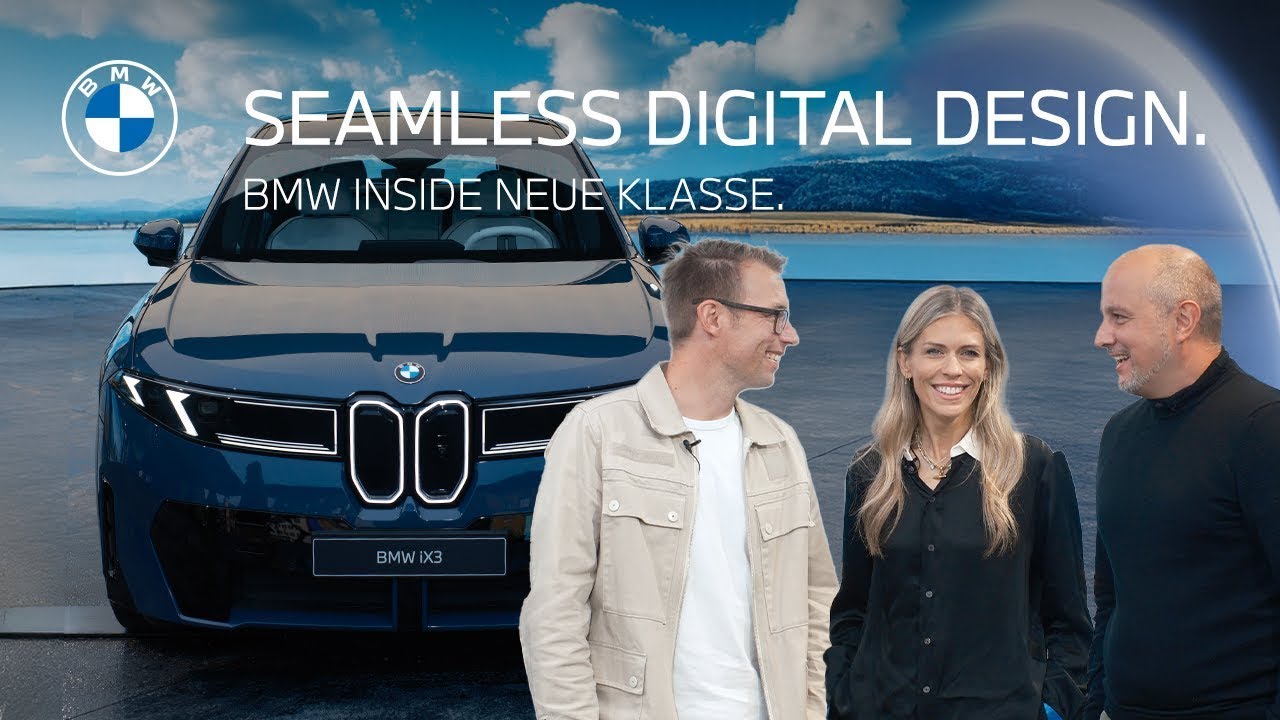
Nicki Shields joins BMW experts Marcel Ottmann, Head of User Interface Design Systems, and Daniel Fischer, Senior Creative Technologist, to explore how seamless digital design is transforming the way we interact with our cars.
Filmed live at the 2025 IAA Mobility in Munich, this episode puts you at the heart of the next-generation digital experience from BMW. Step inside the Neue Klasse with the new BMW iX3 and discover how seamless technology redefines every journey. From predictive climate control and Plug & Charge to adaptive mood lighting, personalised interfaces and comfort features in the My BMW App – every element is intelligently connected, anticipating your needs to make the driving experience effortless, intuitive and distinctly yours.
Inside Neue Klasse is a four-part video series offering exclusive insights from BMW experts into one of the most significant transformations in the history of BMW – from intelligent systems to visionary design.
🎯 Key moments
• 00:00 – Introduction
• 02:05 – What makes design feel seamless?
• 03:37 – Anticipation: when the car knows before you do
• 09:57 – How to create a seamless user journey
• 15:19 – Personalisation: how the Neue Klasse adapts to you
• 16:30 – Connecting your digital life with your car
• 21:24 – Outro
🔔 Subscribe for more BMW content!
👉 Visit our website: www.bmw.com
📱 Follow us on social media @bmw
#NeueKlasse #BMWiDrive #BMWOperatingSystemX
BMW iX3 50 xDrive: WLTP energy consumption combined: 17,9 – 15,1 kWh/100 km; WLTP CO₂ emissions combined: 0 g/km; CO₂ class: A; WLTP electric range: 679-805km.
BMW Individual Steering Wheel in digital white available for order optionally starting from 01/26.
Screen contents are subject to change due to ongoing software updates.