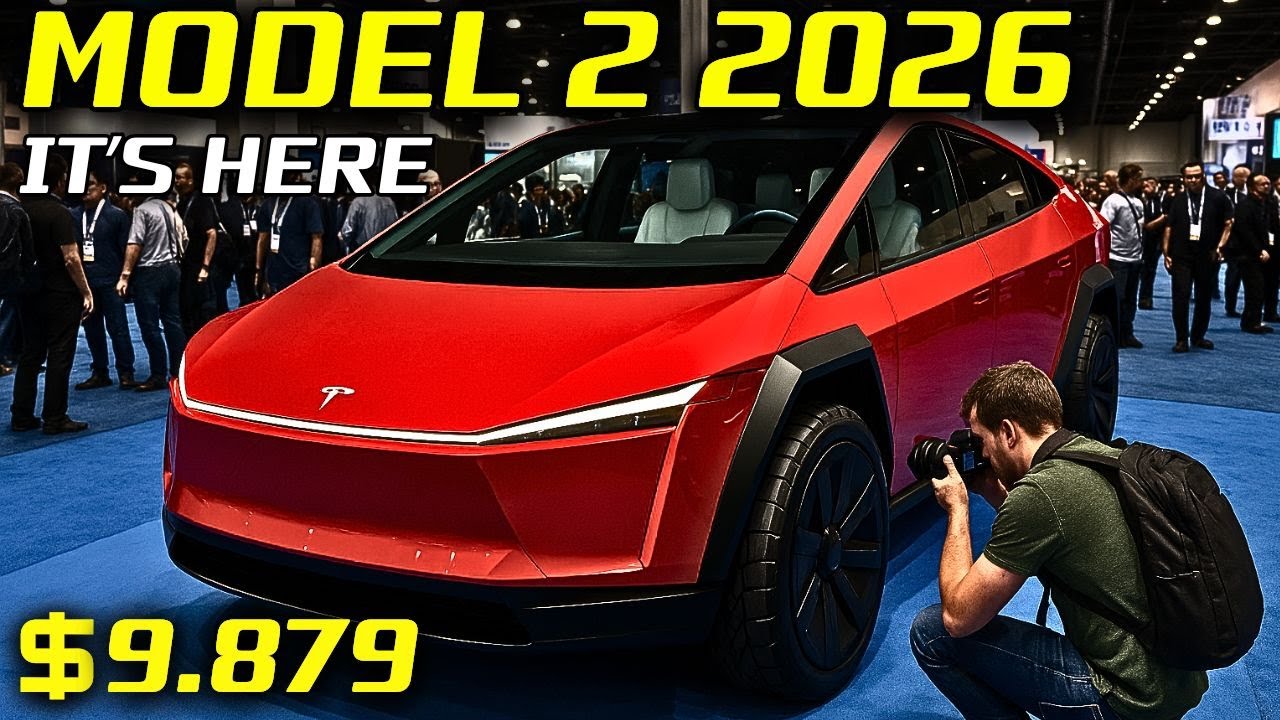
IT’S HERE! New 2026 Tesla Model 2 SHOCKS with 450-Mile Range & Self-Healing Battery
When Tesla confirmed that the 2026 Model 2 had begun production, many people only paid attention to the price. But what went unnoticed by many was a detail that could change the lives of millions of people. The focus on accessibility for seniors. It’s no exaggeration to say that this car was designed with those over 65 in mind and who struggle with simple tasks like getting in and out of a vehicle. For those dealing with joint pain, limited flexibility, or fear of falls, every detail of the Model 2 seems calibrated as a quiet relief. The engineering here goes beyond technology. It touches real life with a sensitive eye for those who need autonomy without sacrifice. Starting with the ground tofloor height, which varies between 16 and 18 in, the difference may seem small, but in everyday life, it represents up to 40% less strain on the knees. For the 54 million Americans with arthritis, this difference isn’t a luxury. It’s the chance to leave the house painfree. And as if that weren’t enough, the seat’s h point has been raised to between 23 and 25 in. This reduces hip rotation when sitting and standing, avoiding that typical painful and risky maneuver that many seniors are familiar with. All this without sacrificing the comfort of a soft seat that hugs the body effortlessly. But what’s truly surprising is the swivel seat system. The door opens and in less than 2 seconds, the seat automatically rotates outward up to 15° as if to say, “Come in. Take your time.” This simple rotation eliminates the need for the driver to contort himself to get in. It’s almost like sitting in a living room chair. And the most ingenious thing, the system automatically locks if the car reaches 8 km, ensuring safety in any situation. For those living with reduced mobility, this technology is more than comfort. It’s dignity. Of course, access doesn’t end at the seat. The handles were positioned based on ergonomic engineering studies. They’re reinforced with a diameter between 3 and 3.5 cm, precisely sized to increase grip strength in arthritic hands. The surfaces have a soft touch rubber coating, which reduces the risk of slipping even with shaky or weakened hands. These are small details that prevent major accidents. The feeling is that every millimeter was designed to welcome, not impress. Furthermore, motion sensors with 98% accuracy analyze the entry angle and can adapt the seat’s rotation to the user’s needs. This eliminates the effort of pulling oneself into the car. And yes, this intelligence works even when there are variations in the wheelchair’s position or the way the person approaches the vehicle. The fluidity of entry and exit is something that needs to be seen to be understood. It’s as if the car is waiting for you, understanding your pace and never rushing you. Another point that many overlook is the interior lighting. Soft lights with ambient light sensors turn on automatically when the door opens, preventing glare or shadows. This spotlighting is crucial for those with impaired vision or who are easily disoriented in dark environments. It’s a simple detail, but it ensures safety, especially at night or in poorly lit parking lots. Tesla didn’t just add lights. It considered the type of light that really makes a difference. Even the car floor has been redesigned to be flatter with fewer obstacles and more grip. Non-slip mats and smoothed edges drastically reduce the risk of tripping. This may seem insignificant to a young person, but for those who rely on canes or have difficulty walking, every step inside the car is a potential threat. Here, this risk has been eliminated at its source with a clean and intelligent design. Even the footwell has been increased, allowing better movement even with orthopedic shoes. The overall experience the Model 2 delivers is one of a car that’s effortless. It cooperates. It understands. It cares. This completely changes the relationship between driver and vehicle. You no longer need to adapt to the car. The car adapts to you. And for someone who spent their entire life forcing their body to fit into a standard car, this reversal of logic is thrilling. It makes you want to drive, not only because it’s possible, but because it’s finally become pleasurable. A simple act like going out to buy bread becomes a little adventure again, not a physical challenge. It may seem strange to talk about emotion when the topic is ergonomics. But when a senior returns to driving with confidence without pain, without fear, without needing assistance, it goes far beyond engineering. It’s about freedom. It’s about being the master of one’s own time again. And the most intriguing thing to consider is if the Model 2 starts with this level of care for the body, what else could it hide when it comes to making everyday life easier? The same logic that transformed the Model 2’s accessibility also extends to its performance in urban environments. In cities where parking has become a test of patience, this model seems to have been designed to simplify everything. Parking in tight spaces, maneuvering on narrow streets, or navigating heavy traffic is no longer a daily stressor. The autonomous parking system, guided by artificial intelligence, is capable of fitting the car into spaces just 1.20 m wide, something previously only seen in stunt videos. And with automatically retractable side mirrors, there’s a minimal margin of just 5 cm the on each side, almost surgical precision. This level of control reduces urban stress by up to 60%. According to Tesla’s own data based on tests with the auto park system, and the convenience doesn’t stop at parking. The Model 2’s adaptive headlights deliver 200% more intense illumination compared to conventional headlights. dramatically improving visibility in adverse conditions. This is especially useful for those who need to drive at night in poorly lit neighborhoods or during sudden storms. The lighting adjusts to the environment and the light beam follows the direction of the steering wheel avoiding dangerous blind spots. But what really catches the eye are the seats with active posture correction. When it detects prolonged body inclination, like that famous tired slump after a busy day, the seat gently vibrates to remind the driver to adjust their position. It may seem like a no-brainer, but NHTSA studies show that fatigue related accidents can be reduced by up to 45% with such technology. And when you consider that many older drivers drive long distances to visit doctors, grandchildren, or run errands, every comfort detail makes a real difference. The Model 2’s modular architecture is also a spectacle in itself. Even though it’s 10% smaller than its direct competitors on the outside, it offers 25% more interior space. How? With an interior designed from the inside out, where every curve and every fitting serves to maximize usable area, it feels like you’re in a compact SUV. Even though it takes up almost the same space as a city hatchback, there’s no tightness in your shoulders, nor the discomfort of having to pile things into the back seat. And speaking of space, the expandable trunk is one of the most creative solutions ever seen in an electric car. With a capacity of up to 680 L and supporting up to 680 kilo, it adapts to the driver’s lifestyle. Whether it’s a quick trip to the supermarket, a trip with large suitcases, or transporting medical equipment and wheelchairs, there’s a place for everything. The rear seats fold in four different ways. allowing for everything from a simple partial folding to a flat configuration, ideal for larger items. Its agility in traffic is also impressive, thanks to rear wheel steering and a turning radius of just 4.5 m. The Model 2 can negotiate tight turns with an ease that borders on absurd. On the narrow streets of older neighborhoods, in underground parking lots, and even in alleys where other cars would make multiple maneuvers, it weaves in and out with disconcerting fluidity. This dynamic is a relief for those with reduced mobility who need to avoid excessive steering effort or complex maneuvers. To top it all off, the choice of interior materials demonstrates a concern for well-being over time. Tesla opted for lightweight aluminum composits and recyclable surfaces that reduce the car’s weight by 136 HS without compromising strength. This not only improves performance, but also makes driving easier, especially on steep inclines or when making sudden stops. And because the car is lighter, energy consumption also drops. A plus for those who drive a lot and want to save money. Another curious detail is the instrument panel. It’s tilted 10° toward the driver to reduce glare and make it easier to read data. This tilt combined with 500 lm ambient lighting reduces eye fatigue by up to 40%. According to research in opthalmology applied to mobility for those whose vision is already compromised by age, this small adjustment makes the entire driving experience more enjoyable, less tiring and much safer. All of this makes driving lighter, more fluid, and almost instinctive. Nothing is overdone. Nothing is superfluous. Every function, every adjustment, every sensor was put there with a clear purpose to simplify everyday life. And after experiencing this urban practicality, it’s hard to imagine going back to the discomfort of a conventional car. But what about keeping that car running smoothly without headaches and unexpected costs? That’s where the Model 2 shows it still has many more tricks up its sleeve. If there’s one thing that worries any driver, especially older ones, it’s car maintenance. Frequent visits to the repair shop, confusing diagnosis, unexpected bills. All of this generates anxiety. But with the Model 2, this reality changes radically. Tesla has implemented a predictive maintenance system based on artificial intelligence that resolves 85% of problems remotely without the owner needing to leave home. The car itself detects anomalies, downloads updates via satellite, and fixes software glitches during the early hours of the morning while the driver sleeps. It’s like having an invisible mechanic who works silently and avoids headaches. And it’s not just the digital component that’s impressive. The Model 2’s chassis was designed with nanotechnology capable of withstanding 15 years of exposure to road salt, something that severely affects cars in cold regions like New York or Boston. This material, according to laboratory tests, extends the body’s lifespan by up to 50% compared to standard models. And with special corrosion protection for the floor, owners save an average of $300 per year on rust repairs. It’s a kind of silent savings that adds up slowly, but ultimately makes a huge difference in your wallet. Tires have also entered the age of intelligence. Equipped with sensors that monitor wear in real time, they warn drivers when they reach the safety limit, usually around 100,000 m. For those who live in cities with uneven pavement, this feature can be a real lifesaver. And the suspension system with adaptive dampers reduces the impact of potholes by up to 25%, maintaining the car’s stability and preserving the health of those inside. For people with sensitive spines or balance issues, this isn’t a luxury, it’s a necessity. The batteries and motors are a separate chapter. With an 800,000 km warranty and a minimum capacity of 70% at the end of that period, the Model 2 redefes the concept of longevity in the electric car world. Sealed components prevent contamination from dust or moisture, reducing the need for mechanical maintenance. Everything was built to last and last a long time. It’s a paradigm shift for those who grew up accustomed to oil changes, belts, and spark plugs. Here, the car doesn’t require constant maintenance. It takes care of itself. An overlooked but crucial technical detail is the thermal management system. Instead of wasting the heat generated by the batteries, the Model 2 recycles 30% of that energy to heat the car’s interior on cold days. This reuse not only saves energy but also relieves strain on internal components, reducing the risk of failure due to overheating. It’s as if the car breathes intelligently, controlling its own temperature with the efficiency of a living organism. In practice, this translates into less downtime, fewer parts replaced, and less money spent. A survey comparing combustion engine cars and the Model 2 reveals that the average cost per mile drops from 9 to 2. For someone who drives 20,000 m a year, this represents a savings of over $7,000 over 10 years. For retirees living on a budget, this difference could mean one trip a year or simply the peace of mind of knowing their car won’t turn into a cost black hole. And when the unexpected happens, because yes, even the best systems fail, Tesla support is already structured to act quickly. Because the vehicle itself sends automatic reports to the cloud, the diagnosis is ready when the technician receives the notification. This shortens response time, avoids unnecessary trips, and gets the car back on the road in a matter of hours. No more weeks of waiting, no inflated costs for unsolicited services. It’s maintenance without the mystery. Ultimately, the Model 2 doesn’t just eliminate trips to the mechanic. It eliminates the worry of maintenance. The sense of security this provides is hard to describe. It’s like having a car that not only gets you from one place to another, but also takes care of itself. And if all this already sounds surprising, wait until you understand how this intelligence extends to the battery, which in addition to lasting longer now also learns from its owner. If the idea of a self-repairing car already seemed like the stuff of science fiction, what the Model 2 does with its battery is even more impressive. Tesla created something called an adaptive energy ecosystem. A system where the battery literally learns from its owner. Yes, it does. The internal modules are equipped with micro sensors capable of detecting usage, temperature, and charge and discharge patterns. Based on this information, the cellular architecture itself reorganizes itself to optimize energy delivery in a personalized way. It’s no longer the driver who adapts to the car. It’s the car that adapts to the driver’s lifestyle. This adaptive behavior increases efficiency by 28% in urban traffic situations where there are constant stops and starts. And for seniors who use their cars for simple daily tasks like going to the grocery store, picking up grandchildren from school, or visiting the doctor, this means more autonomy without having to change their routine. The battery understands that these short trips require a different pace and responds in real time, balancing power and conservation. All of this is based on neural networks trained on over 800 million km driven by other Tesla vehicles. But what’s truly surprising is the self-repair system. Every battery experiences internal wear, particularly in micro cracks formed between charge cycles. The model 2, however, uses an automated process with nanocale electrolytes that activate upon detecting this invisible damage. They seal the cracks before they cause performance loss. The result, the battery’s lifespan can reach 1.2 million km, something never before seen in a production car. For the user, this represents decades of use without ever needing to think about replacing the battery. Furthermore, the Model 2’s battery doesn’t just serve the car. With integrated birectional technology, it can also power an entire home for up to 48 hours in emergencies or power outages. When connected to solar panels, it functions as a power bank, storing excess power during the day and returning it to the home at night. This feature transforms the car into a silent, efficient, and automatic generator. Imagine an elderly couple living in a rural area or with an unstable grid. Now, even during a blackout, comfort is guaranteed. Range is another point that challenges current standards.
The long-awaited Tesla Model 2 2026 is finally here, bringing a wave of innovation that goes far beyond affordability. Designed with seniors in mind, this electric car introduces ergonomic engineering never seen before: swivel seats that rotate automatically, reduced step-in height, and intelligent grab handles that make entering and exiting effortless. Add to that AI-guided parking that fits into 4-foot spaces, posture-correcting seats that reduce fatigue, and adaptive LED headlights that boost visibility by 200%. Elon Musk’s creation redefines comfort and accessibility while still delivering the thrilling performance that Tesla is known for. Every feature of the Model 2 has been built with data, precision, and the real-life needs of everyday drivers, making it one of the most disruptive vehicles ever announced.
But the surprises don’t stop there. The Tesla Model 2 integrates a groundbreaking adaptive energy ecosystem, capable of learning driver habits, self-repairing microfractures inside its cells, and extending battery life up to 750,000 miles. With up to 724 km (450 miles) of range in eco mode, 5.1 miles per kWh efficiency, and a cost of just $0.02 per mile, it beats gasoline cars and EV competitors alike. More than just a car, it doubles as a home energy hub, powering your house for 48 hours during outages and syncing with solar systems for maximum savings. From long-term durability with nano-coated materials to AI predictive maintenance that solves 85% of issues remotely, this is the moment Tesla shifts the EV industry forever. The question is: are you ready to witness the future of driving right now?
___________
Here on the EV Briefing channel, you’ll get the latest updates on Elon Musk, Tesla, new Tesla Model 2, Model 2, Tesla Model Y, Model Y 2025, Tesla Model S, Model S, Model X, and Model 3. Our focus is to bring you everything about each Tesla EV, whether it’s an affordable Tesla, a potential Tesla cheap car, or a new Tesla car on the horizon. We cover daily Tesla news, EV news, Tesla update, and tech advancements coming straight from the Gigafactory.
If you’re into electric car, future EV, Tesla 2025, improvements in Tesla battery, increased Tesla range, and everything involving Tesla innovation, you’re in the right place. We also track every Tesla reveal, Tesla launch, and of course, all major Elon Musk news and developments shaping the world of electric vehicles.
_____________
#tesla #elonmusk #teslamodel2 #teslamodely #modely #gigafactory #electricvehicles