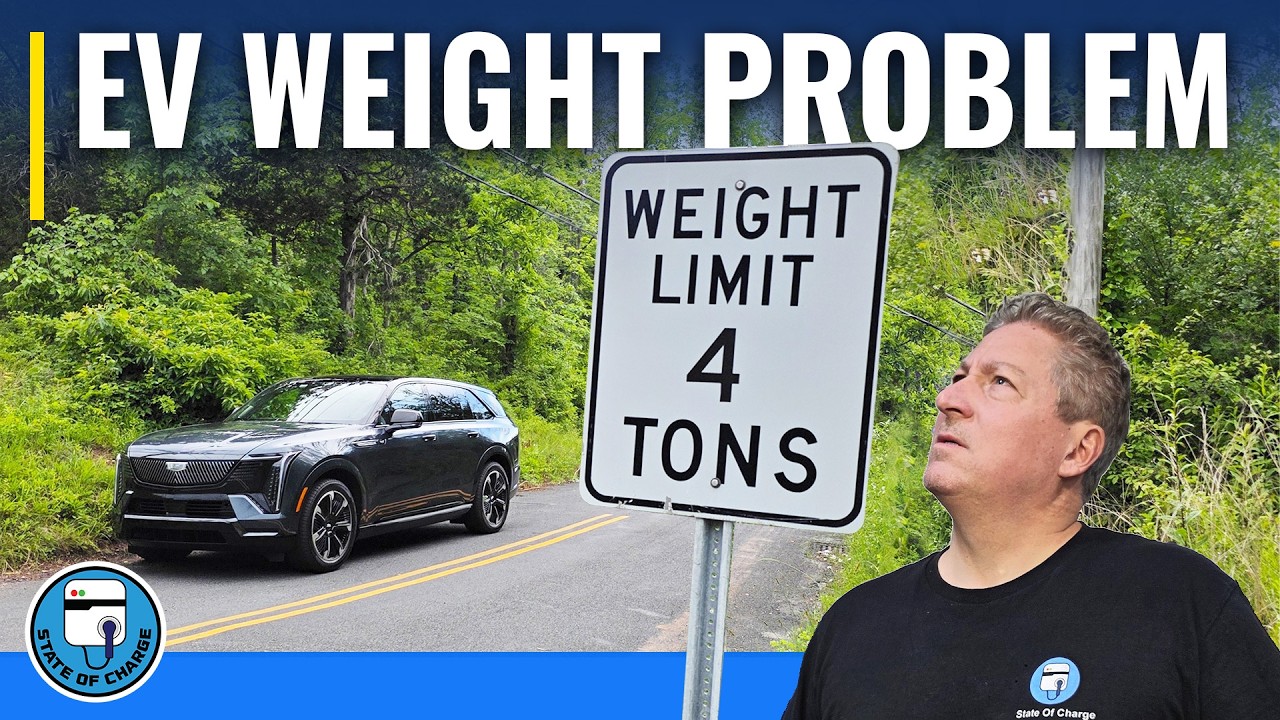
Are General Motors Electric Vehicles Too Heavy For Some Public Roads?
The Cadillac Escalade is the brand’s pinnacle offering. It’s also been its bestelling models for many years now. So, when it was time to engineer an all electric version of the Escalade, Cadillac had a lot writing on its success. Now, I’m standing in front of a 2025 Cadillac Escalade IQ, the allect electric version of the Escalade, and I’ve had it for a few weeks now to do range and charge testing. And I have to say, I am extremely impressed with the vehicle. It’s packed with the latest technology, things like self-closing doors and infrared night vision, so you could see if there’s any animals or people in your path as you’re driving. and they both work really well. I mean, those are just a couple things it has. It’s packed with features. It’s got a 40 speakeraker AKG sound system and executive seating in the rear. This thing is deserving of being called the pinnacle of the Cadillac brand. And it’s also performed really well in my range and charge testing. It charges exceptionally well, so you can charge up and get back on the road pretty quickly if you’re on a road trip. And the range is incredible. At a steady 70 mph, I was able to drive 482 miles. And when I drove it at 60 mph, it went 67 miles, which is the farthest I’ve ever been able to drive on a single charge with any electric vehicle. So, in my opinion, Cadillac got a lot right with the Escalade IQ. The interesting thing is though, I was driving around my town recently and I happened to notice that many of the streets that are off of primary streets, the secondary streets I’m talking about, have signs posted on the corners that say weight limit 4 tons. Now, these signs have been there for a long time, but quite honestly, I never really noticed them because they really didn’t pertain to me. I didn’t have to notice them. But the thing is, in order to get that extraordinary range for the Escalade IQ, Cadillac put an enormous battery pack in it. And the vehicle, because it has this huge 225 approximate kilowatth battery pack, weighs over 9,000 lb, which is more than 4 tons. So, it got me thinking, am I breaking the law just driving this thing around my town? Do those signs pertain only to commercial vehicles? Doesn’t say commercial vehicles. It doesn’t say truck weight limit. It just says weight limit four tons. So, I would think that that would apply to any vehicle. So, that’s what we’re going to take a look at here today. The Cadillac Escalades enormous porky 9,000 lb weight versus weight restrictions on roads. Particularly here in New Jersey where I live. I know other states have different weight restrictions also, but I don’t really know the regulations from state to state. But I am going to find out if I am breaking the law here in my hometown of Chester, New Jersey, just by driving this thing home. So, let’s get into it. [Music] All right. So before we get into this, I want to point out that although I was talking about the Cadillac Escalade IQ, General Motors has three other vehicles that uses the same 24 module double stacked battery pack that the Escalade IQ does. And that would be the GMC Hummer EV, the Chevrolet Silverado pickup truck, and also the GMC Sierra Denali pickup truck. Those all use the same battery pack and they weigh similarly, maybe within a couple hundred lbs of each other, but they all weigh right around 9,000 lb and are certainly over the 4 ton weight limits that’s imposed on the roads in question. Uh, I will note that I do have a Ford F-150 Lightning pickup truck and that also has a large battery, but nowhere’s near as large as General Motors double stack 24 module pack does. My battery pack has a total capacity of around 145 kilwatt hour, a usable capacity of 131 kilwatt hour as compared to the GM pack that has a total capacity of somewhere around 225 to 230 kwatt hour and a usable capacity of right around 215 to 220 somewhere in that area. So, as you could see, it it’s not quite double the size of my Lightning’s battery pack, but it’s a lot larger. And my Lightning, which is a full-size pickup, weighs right around 5800 lb. So, considerably less than General Motors vehicles. So, in order to try to figure out if I was breaking the law or not, I reached out to my local police department, Chester Police Department, and was told that I needed to speak to the corporal in charge of the traffic division. That would be Corporal Bradley Elman. And I did reach out to Bradley and uh he responded within a day which I was very appreciative of in an email. So let’s see what the corporal had to say about the weight limits and whether or not I was breaking the law in town. Hello Mr. Mogy. This is a very interesting question indeed. I will be reaching out to our township engineer to inquire if there is a specific reasoning for the weight limits, whether it is due to the road construction to protect the structural integrity of the roads or to mitigate potential safety hazards. I am just speculating here, but I would assume it would be to restrict commercial vehicles from transversing residential roads, which would reduce congestion, noise, pollution, and potentially extend the life of the pavement. Heavier vehicles exert greater force on the pavement, leading to faster wear and tear. Another reason could be for any bridges or culverts that may cross the roadway as the added pressure and weight from large vehicles could affect their structural integrity and greatly diminish the lifespan of the bridge or worse cause a complete failure. As for your question on whether this pertains to passenger vehicles, I do not believe code 161-17 was enacted for the purpose of diverting passenger vehicles. Code 16116 though it pertains to commercial trucks states vehicles will be permitted on all streets for the purpose of pickup and delivery of materials. If one were to interpret this for passenger vehicles or residents, then the vehicles would be permitted on all roads in the township. I did some digging through the township ordinances and did not find anything limiting or prohibiting passenger vehicles on certain roads. Once I have an answer from our township engineer, I will be sure to advise you of his findings. Okay, so from the sound of it, it seems like Corporal Elman is taking the position that passenger vehicles are not included in this weight limit rule. And uh although the signs don’t say for commercial vehicles, they just say 4 ton weight limit. So one would assume it meant for everything. But he’s the one in charge and he’s taken a position that it’s not going to pertain to passenger vehicles. But he wants clarification from the township engineer which he got in an email. Hi Tom, below is the response that I received. Ordinarily, when I have seen weight limits applied throughout my career, it is for one of two reasons. The first is there is a specific structure such as a covert on the roadway in question that cannot support the loading of vehicles over the particular weight limit outlined. The second is that there is a specific truck route designated throughout a municipality. That seems to be more of the intention of Chester’s ordinances given the contents of section 161-16. However, I do find it interesting that the truck route roadways are not defined therein. The wording in that part is interesting, too, as it seems to discuss trucks over four tons being prohibited on all roads, not including the unestablished truck route streets. while section 161-17 outlines all vehicles over four tons being prohibited from certain roadways. And Corporal Elman added, “So, as you asked in your first email, it would be my understanding that these vehicles would not be prohibited from these roadways.” State of Charge is powered by Cumeric, North America’s premier installer of electric vehicle charging equipment. After I’ve helped you decide which charger to buy, follow the link in the description of my videos and have Q Merritt install it. And if you do follow that link, Qmer will wave the $150 installation deposit. But this is an exclusive offer for State of Charge followers. So in order to get that offer, you must follow the link in the description of my videos. Okay. Well, there you have it. I’m not in any danger if I drive any one of these electric vehicles that have the huge double stacked 24 module battery pack that General Motors uses. But the interesting thing is it doesn’t seem like the ordinances have clarity on this. U and the officer and the engineer are kind of defaulting to the fact of well we’re not going to harass the residents in town here. these are personal vehicles and we’re not going to restrict them from the roadways. Perhaps with the uh proliferation of electric vehicles, townships and municipalities are going to have to start looking into these uh weight restrictions and defining whether or not they pertain to all vehicles or just commercial vehicles. Now, this is just where I live here in New Jersey. Uh other municipalities may view it differently. We all know that there is push back against electric vehicles. Quite a few people out there that are not excited about transitioning to electric vehicles that don’t believe in them, that don’t want them. And if you had somebody that was in a position of power in those municipalities, I mean, Corporal Elman, for instance, he’s in charge of the traffic division here in uh Chester. I believe he could have just taken the position of saying, “Look, uh, there’s nothing here that states specifically that this is just for commercial vehicles.” So, any vehicle over 4 tons, I don’t want on the roads that are marked, you know, weight limit 4 tons. And that wouldn’t be unreasonable for him to take that position. So, what I’m getting at is where you live, wherever that may be, if you have weight limits on roadways that say 4 ton weight limits and aren’t defined clearly as commercial vehicles, you could have an issue. I’m not saying you’re going to, but I think that uh this kind of needs to be addressed and uh you know sorted out at some point in the future because I know that 4-tonon weight limit is a very common weight limit and I’ve seen it around uh you know all over the place. I’ve seen it in other states. I’ve seen it in other municipalities here in New Jersey. You know, I go up to Vermont frequently. My in-laws live in Vermont. There’s a lot of covered bridges up there and I suspect that the posted weight limits on those bridges might apply to all vehicles because those bridges are designed specifically they’re old covered bridges and I would imagine that the weight limit is the weight limit and uh you might have a problem if you get one of these electric vehicles that weighs you know close to 5 tons and you’re driving it over a bridge that says a 3 or 4 ton weight limit. uh you could have a problem with your local authorities once they figure out that these vehicles weigh a lot more than most passenger vehicles do. Now, I will say there was a little bit of a light at the end of the tunnel, and that’s because batteries are getting better and better. They’re becoming more and more energy dense, and the more energy dense a battery cell is, the less battery you need to have it propel a vehicle to go a certain distance. So every year we’re literally getting better and better battery so that smaller and smaller battery packs will take vehicles the same distance as larger battery packs did in the future. And also the electric vehicles are charging much faster today than they could just a year or two ago and they keep getting faster. So the combination of more energy dense battery cells and the batteries being able to be charged faster means that you might not need your electric vehicle to have such long driving range I if there’s better infrastructure which we’re getting constantly. There’s DC fast charging infrastructure is being installed all over the country and the vehicle charges faster. So if if a 10 or 15 minute stop means you’re adding 2 or 30 hund miles, which it can today in some electric vehicles, if that’s common place in four or 5 years, where you know 10 12 minute stop gets you 300 m of range, then you maybe don’t need to carry around this huge battery pack that weighs so much and is the root of this issue that we’re talking about here. And while we’re on this topic of electric vehicles weighing more, I have a little bit more information on this subject. And that’s because a couple of months ago, a follower of the Batteries Included podcast, I’m one of the members of the Batteries Included podcast, we do a live electric vehicle podcast every Friday at 9:30 Eastern, wrote a comment on one of our streams. That week we were discussing the fact that the government was thinking about making a national tax on electric vehicles and we got into the discussion of uh perhaps that that should be weightbased. The lighter vehicles pay less than the heavier vehicles. And out of that, uh, one of the followers that was listening that week who is an expert on this subject matter wrote a comment that I think is really interesting and I’m going to read it here now because it does pertain to the weight of electric vehicles and the potential damage they could do to roadways. Hey guys, great show as usual. However, you happen to repeat what I strongly feel is some misinformation that is often put forth by EV opponents. In discussing the new blatantly unfair, punitive US federal tax on EVs being proposed by some backbench congressmen. You mentioned that EVs cause more pavement damage than ICE cars. While this is literally true, in practice, the difference is insignificant. Pavement designers don’t even count light trucks and cars in their calculations because the overwhelming prepoundonderance of damage is caused by large heavy trucks. As an analogy, you can truthfully say that a dragonfly buzzes louder than a housefly. But when you put them next to a jet engine at full throttle, the volume difference between the flies doesn’t matter. I can speak authoritatively on this subject. I’m a licensed professional engineer who holds a PhD, has nearly 40 years of professional experience, and specializes in pavement and materials engineering. Prior to my retirement in 2014, I was the state pavement design engineer for a state department of transportation for over a decade and have either performed or supervised designs on several thousands projects worth billions of dollars. My agency owns most of the roads in my state, totaling over 41,000 centerline miles and ranging from unsurfaced rural roads to urban interstates. and I have worked on an array of road types. I had a former colleague who used to say that cars are about width while trucks are about depth. What he was saying is that the cars and light trucks are what control the number of lanes on most projects while large heavy trucks control the pavement thickness. Even the heaviest Silverado EV or Hummer EV doesn’t weigh enough to matter. EV owners should not be paying more than ICE owners for similar vehicles for damage to infrastructure. Now, he didn’t leave his full name, but judging from his YouTube account name, I think I was able to figure out who it was, and I found somebody on LinkedIn with a LinkedIn profile that perfectly matched what he described as his career. And I left him a message. Unfortunately, he didn’t respond, but he did say in that message that he’s been retired since 2014, so he’s probably not active on LinkedIn, reading his LinkedIn messages. I was hoping to talk to him about this, maybe even get him on camera to do a little short interview. But for now, I’m going to have to live with that uh comment. If he does eventually respond, maybe I’ll bring this back up and do a short video and we’ll talk about uh EVs weights and whether they damage roadways or not. And uh you know, it’d be interesting to talk to somebody with his experience on this subject matter because he would be the person that would really know how much damage that uh these vehicles do cause. I’ve always assumed that they do would cause more damage, but it seems like in the grand scheme of things, it’s an insignificant difference. All right. Well, that’s all I have here today for uh electric vehicle weights and weight restrictions on my roadways. For now, I guess I’m safe. I could drive pretty much anything I want here in town. But um that doesn’t mean that other people in other municipalities couldn’t have a problem with this. It really depends on the uh the person who’s in charge of the roadways, the sergeant or lieutenant that’s in charge of the traffic division. It it seems like uh here it was just a a call that uh uh the the corporal made to say, you know what, we’re not going to harass the the the township residents. But other people can take this differently if it’s not clearly defined in the the municipal code. And I suspect in many municipal codes it isn’t clearly defined. So we might not have heard the last of uh electric vehicles and weight restrictions on roads here um in the country. All right. Well, that’s all I have here today. Listen, if this is your first time here at State of Charge, please hit that subscribe button and ring the notification bell so you don’t miss any upcoming electric vehicle news and reviews. And as always, thanks for watching. [Music]
In this video, I examine the four-ton weight limit imposed on many of the roads near my house to determine if some of General Motors’ heaviest EVs are allowed to drive on them.
This video is powered by Qmerit, North America’s leading provider of installation services for EV charging equipment. Follow this unique link, and Qmerit will waive the $150 deposit: https://qmerit.com/ev/charge
Use my “STATEOFCHARGE” coupon to save on your NACS adapter here: https://a2zevshop.com/?ref=lsh8xAcYPbdmNg
Order the Lectron Vortex NACS adapter here: https://shareasale.com/r.cfm?b=2540907&u=2912074&m=96492&urllink=&afftrack=
Check out my new EV charging website: https://evchargingstations.com/
Order one of my currently top-rated EV chargers:
Grizzl-E Ultimate 48-amp: https://grizzl-e.com/products/grizzl-e-ultimate-48/?hr=KRHU2MRQGI2A
Grizzl-E MINI: https://grizzl-e.com/products/grizzl-e-mini/?hr=KRHU2MRQGI2A
Emporia 48-amp: https://amzn.to/3EgDRGS
ChargePoint Home Flex: https://amzn.to/2V3Ye79
Wallbox Pulsar Plus 48: https://amzn.to/4fTQqbR
Autel Maxicharger W/Integrated Holster: https://amzn.to/3TVd20G
EVIQO 48-amp: https://eviqo.io/?ref=c0nLwakF8tvZBN
Tesla Universal Wall Connector: https://amzn.to/3DZWKBx
Chapters:
00:00 Intro
03:32 What’s the problem, and what vehicles weigh over 4 tons
05:10 My local police department’s response
07:49 My Township Engineer’s response
14:07 An engineer who specializes in pavement design chimes in
18:20 Summary
Note: I earn a commission on sales from the above links.