
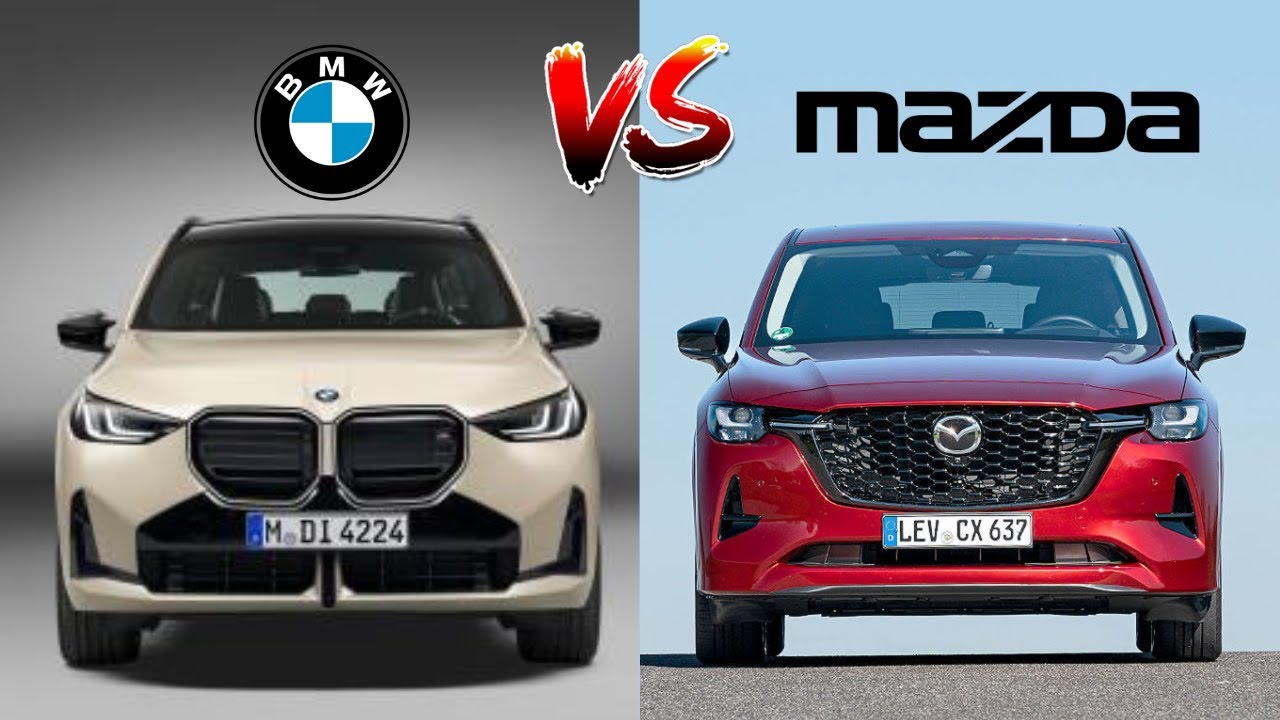
2026 BMW X3 PHEV vs 2026 Mazda CX-60 PHEV | Plug-in Hybrid SUV Comparison
The SUV market is evolving fast and plug-in hybrids are taking center stage as the perfect balance between efficiency and performance. In 2026, two models stand out in this space. The BMW X 3P and the Mazda CX 60PH EV. The BMW X 3PHEV or the X330 continues its legacy as a luxury compact SUV. Now offering improved electric range, advanced driver assistance, and that signature German handling feel. It’s built for drivers who want premium comfort without giving up sporty dynamics. Meanwhile, the Mazda CX 60P GEV represents a bold move for Mazda into the premium SUV segment. With a striking design, a refined interior focused on Japanese craftsmanship, and a plug-in hybrid system that promises both power and efficiency, it’s set to challenge some of the biggest names in the market. So, which SUV really delivers the smarter choice for 2026? In this video, we’ll compare them side by side, covering design, interior, luxury, infotainment, tech, safety features, plug-in, hybrid performance, realworld range, and pricing, so you can see which one deserves a spot in your driveway. So, let’s get started. This is Parth, and you are watching Motor Nation. The 2026 BMW X 3PG and the 2026 Mazda CX 60P EV both aim to capture drivers who want efficiency without sacrificing power or premium feel. BMW’s X3P builds on its reputation as a luxury compact SUV, now offering a more refined plug-in hybrid system with improved electric range, advanced connectivity, and a sporty handling BMW is known for. It’s designed for those who value technology, performance, and upscale comfort. On the other hand, the Mazda CX 60P GEV is Mazda’s most ambitious SUV yet. Crafted to compete directly with established luxury rivals, it features a bold design, highquality interior materials inspired by Japanese craftsmanship and a plug-in hybrid setup that delivers strong performance along with everyday practicality. When we compare the 2026 BMW X 3P GEV and the 2026 Mazda CX 60P GEV in the powertrain segment, it quickly becomes clear that while both were the plug-in hybrid badge, they go about it in very different ways. Let’s start with the BMW X 3X drive 30E. At its core, it uses BMW’s proven 2.0 0 L turbocharged inline 4 from the twin power turbo family. On its own, this engine produces about 190 horsepower and 310 new m of torque. But the real magic comes when it’s paired with a 135 horsepower electric motor integrated directly into the 8-speed Steronic automatic transmission. The system’s combined output is 299 horsepower and 450 Newton meters, driving all four wheels through the X Drive AWD system. Battery capacity is a standout here. BMW fits a 22.7 kW hours lithium ion pack with 19.7 kW hours usable, one of the largest in the segment. That’s why it achieves an all-electric range of up to 88 km WLTP, 55 mi, far ahead of most rivals. In US EPA terms, this will likely translate to 35 to 38 mi of usable EV range, which is still class leading. With an 11 kW AC onboard charger, the X3P GEV can recharge from empty to full in about 2 hours 15 minutes on a three-phase wall box or roughly 7.5 hours on a standard 2.3 kW household socket. Unlike some competitors, BMW doesn’t offer DC fast charging on this PHV, but its fast AC capability makes daily topups easy. In performance terms, the BMW strikes a balance between efficiency and speed. It does 0 to 100 kmh in 6.2 seconds. That’s around 6.1 seconds to 60 mph and reaches a top speed of 215 kmh with a respectable 140 km per hour pure EV top speed. Fuel economy on paper is quoted at 2.8 to 3.0 0 L/100 km with 16 kW hours per 100 km electricity use. But in real world mixed driving, expect around 6 to 7 L per 100 km once the battery is drained, which translates to 34 to 36 m per gallon US. Now, let’s shift to the Mazda CX 60PV, which takes a more traditional mechanical approach. It uses a naturally aspirated 2.5 L Skyactive G4 cylinder, producing 192 horsepower and 261 Newton meters on its own. The difference comes from Mazda’s powerful 129 kW electric motor, 174 horsepower mounted between the engine and transmission. Together, the system develops a robust 327 horsepower and 500 new meters of torque, making it one of the most powerful plug-in hybrids in this class. Unlike BMW’s torque converter setup, Mazda uses an 8-speed automatic with a multiplate clutch instead of a torque converter designed to deliver sharper, more direct shifts. Power goes through the iactive AWD system, which continuously monitors will slip and distributes torque proactively. The Mazda’s 17.8 kWh battery is smaller than the BMWs, giving it 63 km WLTP range, about 39 mi or roughly 29 to 31 m EPA equivalent. Charging is handled by a 7.2 2 kW onboard charger, meaning a full charge takes about 2 hours 30 minutes on a wall box or 7 to 8 hours on a regular socket. Again, no DC charging is offered here either. Performance is where Mazda pulls ahead with its higher combined power. It launches from 0 to 100 kmh in 5.8 seconds. That’s just under 5.7 seconds 0 to 60 mph, making it noticeably quicker than the BMW. Top speed is limited to 200 km per hour, slightly lower than the X3, but not a dealbreaker. Fuel economy on paper is an eye-catching 1.4 L/100km on WLTP, but as with most FEVs, that’s only achievable if you recharge daily. Once the battery is depleted, realworld consumption ranges from 7 to 8.5 L per 100 km, 27 to 33 m per gallon US, which is thirstier than the BMW due to its larger naturally aspirated engine. Open the door to the 2026 BMW X 3PV and you’re greeted by an interior that feels like a blend of futuristic tech and classic German precision. Right up front is BMW’s sweeping curved display, a seamless glass panel that houses a 12.3in digital drivers cluster and a 14.9 in touchscreen. It runs on the latest iDrive 9 system which is faster and more intuitive than before. Complete with wireless Apple CarPlay, Android Auto, and even an in-car app store. You can stream Spotify, watch YouTube while parked, or simply use the natural voice assistant that responds to conversational commands, almost like talking to a co-pilot. And for a bit of BMW flare, yes, you still get gesture controls where simple handwave adjusts volume or skips a track. The materials immediately remind you that this is premium territory. Even in base trims, the X3 gets high quality sensin leatherrett. But move up and you’ll find leather or even full grain marino leather paired with open pore wood, brushed aluminum, or carbon fiber accents. If music is your escape, BMW offers two serious options. a 16 speakeraker Harman Cardon system that already fills the cabin beautifully, or a 20 speakeraker Bowers and Wilkins Diamond Surround setup with 1,500 Ws of power. It literally feels like sitting in a concert hall on wheels. Comfort is another strong point. The front seats can be 16-way power adjusted with heating, ventilation, and even massage, while rear passengers get a surprisingly generous 37.5 in of headroom and 36 in of legroom. Families will appreciate the trizone climate control, USBC ports for everyone, and ambient lighting that can be tailored to your mood. Cargo space sits at 15.9 cubic feet behind the second row, expanding to 53 cubic feet with the seats folded. It’s not the class leader, but it’s enough for a couple of suitcases and a family grocery run. Now, slide over to the 2026 Mazda CX 60P, and the atmosphere is completely different. Where BMW feels futuristic, Mazda feels handcrafted. Designers drew inspiration from Japanese artistry. So, you’ll find Nappa leather, real maple wood, Musubu hand stitching, and woven fabrics that look like they belong in a boutique hotel rather than an SUV. It’s warm, elegant, and minimalistic. Mazda clearly wants you to feel connected, not distracted. In terms of tech, the CX60 brings a 12.3 in central display, a fully digital 12.3 in instrument cluster, and a crisp head-up display projected onto the windshield. Unlike BMW, Mazda sticks to its rotary command dial for navigating menus, which some drivers will love for reducing screen distraction, while others may miss the touch first experience. Wireless CarPlay and Android Auto are included, and software is kept fresh via over-the-air updates. Sound comes courtesy of a 12 speakeraker Bose premium system, carefully tuned for cabin acoustics. It doesn’t blast with the brute force of BMW’s Bowers and Wilkins setup, but it’s clear, rich, and immersive, perfect for long commutes or night drives. Mazda also focuses heavily on seating comfort. Using its Geneba It Thai design philosophy, the seats are sculpted to keep your spine and pelvis aligned naturally, reducing fatigue on long journeys. Up front, you get heating, ventilation, and memory settings, while the rear offers around 37 in of headroom and 36 in of legroom, comparable to the BMW, but with a slightly cozier feel thanks to the narrower cabin. Here’s where Mazda lands a big punch. Practicality. Behind the rear seats, the CX60 offers 20.1 cubic feet of cargo space. And with the seats folded flat, you get a massive 61 cubic feet. That’s nearly 15% more than the BMW. Enough for camping gear, strollers, or just about anything an active family might throw at it. When it comes to safety, both the 2026 BMW X, 3PG, and Mazda CX 60PH EV pack a serious suite of driver assistance features, but they approach it from slightly different philosophies. The BMW X 3PHEV offers a comprehensive active driving assistant, which includes lane departure warning, lane keeping assist, blind spot monitoring, and rear cross traffic alert. BMW doesn’t stop there. Higher trims add extended traffic jam assistant, which allows semi-autonomous driving in heavy highway traffic at speeds up to 60 mph. This system can manage steering, acceleration, and braking, making stopand go traffic far less stressful. The X3 also features adaptive cruise control with stopand go, automatic emergency braking, and evasive steering assist. All designed to react intelligently if you suddenly encounter a slower vehicle or a potential collision scenario. In daily use, BMW’s cross traffic alert and blind spot monitoring are particularly helpful when maneuvering in tight city streets or crowded parking lots. The front collision warning with pedestrian and cyclist detection provides real-time alerts and if needed can intervene with automatic braking. BMW also integrates driver attention monitoring, which keeps an eye on steering patterns and suggests brakes if it detects signs of fatigue, something many daily commuters will appreciate. Meanwhile, the Mazda CX 60PHV leans on its iactive sense suite designed to keep the driver fully aware while providing proactive assistance. This includes adaptive cruise control, lane keep assist, lane departure warning, blind spot monitoring, and rear cross traffic alert, all working together seamlessly. Mazda adds thoughtful touches like traffic sign recognition, which reads speed limits and no passing zones, displaying them directly on the dashboard on long drives. This helps reduce the chance of missing important road signs, subtly improving safety without being intrusive. Mazda also equips the CX60 with 360° cameras and front/rear parking sensors, giving drivers confidence when navigating tight spaces, reversing, or parking in crowded lots. Smart brake support works in urban environments to prevent low-speed collisions, while driver attention alert monitors steering input and can suggest a break if signs of drowsiness appear. When it comes to pricing, both the 2026 BMW X 3PH GEV and the 2026 Mazda CX 60PHEV offer multiple trims, giving buyers a range of options depending on budget and feature priorities. Starting with the BMW X 3PV, the base trim, often referred to as X Drive 30e, starts around $60,000 in the US. This includes all the essentials. The 2.0 L turbocharged engine paired with the electric motor, X drive all-wheel drive, curved display with iDrive 9, and standard safety features like lane keep assist, blind spot monitoring, and adaptive cruise control. You also get sensin leatherrett seating, trizone climate control, and eight speaker audio system. Move up to the luxury trim priced around $65,000. And BMW adds upgrades like Verasca leather, ambient lighting, a panoramic sunroof, and larger wheels, plus advanced tech like extended traffic jam assistant for semi-autonomous highway driving. At the top end, the M Sport trim, which can reach $70,000 to $72,000, focuses on performance and style. You get M Sport suspension, sportier interior trims, Bowers and Wilkins audio, heated and ventilated seats with massage, and exclusive M styling elements inside and out. It’s the trim for those who want the full BMW experience, combining luxury, tech, and sporty dynamics. On the Mazda side, the CX 60P GEV takes a slightly different approach. The base Pure Plus trim starts around $54,000, giving you the 2.5 L Skyactive G engine with a 129 kW electric motor, iactive AWD, 12.3 in central display, digital gauge cluster, and I active sense safety suite, leatherrett seating, basic climate controls, and a 10 speaker audio system come standard, giving strong value for the entry- level buyer. The select and preferred trims ranging from $58,000 to $62,000 add features like Nappa leather, power adjustable seats with memory functions, Bose 12 speaker audio, 360° cameras, and premium trim details. This is where the CX60 starts to feel more upscale, bridging the gap toward a luxury experience without reaching BMW pricing. At the top, the signature trim around 66,000 to $68,000 delivers the full Mazda premium package. Handstitched dashboard details, real wood inlays, heated and ventilated front seats, premium audio, and all safety systems included. Unlike BMW, Mazda’s top trim focuses less on sporty Mstyle cues and more on luxury, craftsmanship, and passenger comfort. So, after putting the 2026 BMW X 3PG and Mazda CX 60PHV side by side, what’s the verdict? The BMW X 3PG is perfect for those who want cuttingedge technology, futuristic interiors, and semi-autonomous driving features. Its larger battery, longer EV range, and advanced driver assist systems make it an ideal choice for commuters who want efficiency without sacrificing luxury. Add the M Sport trim, and you also get sporty handling, premium materials, and high-end audio, giving you the feel of a full-fledged luxury SUV. On the other hand, the Mazda CX 60P focuses on driver engagement, comfort, and craftsmanship. Its refined interior, handstitched details, and classleading cargo space make it a practical yet premium option. It’s slightly more affordable, yet still offers strong performance and a powerful hybrid powertrain. Mazda leans into a human- centered driving experience where safety features, seating comfort, and cargo practicality all feel natural and intuitive. So really, it comes down to what matters most to you. If you prioritize technology, semi-aututonomous driving, and a tech luxury feel, the BMW X 3P GEV is your go-to. Both are excellent plug-in hybrids, and either one will leave you impressed, but in slightly different ways. So, that’s it for today’s comparison. If you enjoyed this video, don’t forget to hit the like button, subscribe, and ring the bell for more detailed car comparisons, reviews, and the latest automotive updates. Comment below, and let us know which SUV you’d choose between the BMW X 3PE and Mazda CX 60P. We’d love to hear your thoughts.
2026 BMW X3 PHEV vs 2026 Mazda CX-60 PHEV | Plug-in Hybrid SUV Comparison
In today’s video, we compare two of the most exciting plug-in hybrid SUVs of 2026 — the BMW X3 PHEV and the Mazda CX-60 PHEV. From engine performance and 0–60 times to interior quality, cargo space, tech, safety features, and pricing, we break it all down to help you decide which one is the better choice.
⚡ The BMW X3 PHEV brings German precision, cutting-edge tech, and semi-autonomous driving features.
⚡ The Mazda CX-60 PHEV focuses on craftsmanship, comfort, and value while still delivering strong hybrid performance.
Which one should you choose? Watch until the end for our final verdict!
🔔 Don’t forget to like, subscribe, and hit the bell icon for more car comparisons, reviews, and automotive updates from MotorNation.
#BMWX3 #MazdaCX60 #PHEV #HybridSUV #BMWvsMazda #CarComparison #MotorNation #2026mazdacx60 #2026cx60 #2026mazdacx60phev #2026cx60phev #motornation #2026bmwx3 #2026bmwx3phev #2026×3 #2026x3phev
————————————————————————————————————————-
Heroism by MaxKoMusic | https://maxkomusic.com/
Music promoted by https://www.chosic.com/free-music/all/
Creative Commons Attribution-ShareAlike 3.0 Unported
https://creativecommons.org/licenses/by-sa/3.0/deed.en_US
Bliss by Luke Bergs | https://soundcloud.com/bergscloud/
Creative Commons – Attribution-ShareAlike 3.0 Unported
https://creativecommons.org/licenses/by-sa/3.0/
Music promoted by https://www.chosic.com/free-music/all/
Take It Easy by Luke Bergs | https://soundcloud.com/bergscloud/
Music promoted by https://www.chosic.com/free-music/all/
Creative Commons – Attribution-ShareAlike 3.0 Unported
https://creativecommons.org/licenses/by-sa/3.0/
Sound Effect by whoisbenjamin from Pixabay
Sound Effect by Modestas123123 from Pixabay
Sound Effect by Matthew Vakalyuk from Pixabay