Exactly How to Drive Your Electric Car Efficiently
There are so many simple steps that you can take to get the most range out of your electric car battery without spending a penny. In this video, I’m going to explain every way that your electric car could be more efficient, including the number one way which I use to get the most miles out of this, my budget electric car. I’m Alex, an engineer traveler, but most importantly, I recently bought one of the cheapest electric cars in the UK. My journey with my electric car so far has been great. Despite only costing £2,400, I’m on a mission to show everyone that you can live with a budget electric car in a simple minimalist way. Owning and driving an electric car involves a mindset shift. It’s not just a new fuel type. They’re designed and engineered differently to a petrol or diesel car, which is good cuz you can tweak the way you charge it and drive it and can run it for as little as 2p per mile. But more of that in my other videos on this channel. Now, why does efficiency matter? My Nissan Leaf that I’m sat in right now in 10 years has only lost about one battery bar, which is around 18% of its original capacity. When it was new, it might have managed 90 or maybe even 100 miles on a single charge. And now it ranges between 83 84 miles, which is not bad considering its older technology. And newer EVs are much better than this thanks to something called thermal management with the batteries. But it does mean every mile is precious. For me, having done a few long distance trips now, charging it after 90 minutes of driving hasn’t really uh been very good. But obviously, all of that will be fixed if I buy a car that’s got much better range. Anyway, enough about me. If you have a newer electric car, efficiency still matters. But most of all, it helps avoid public charging, which is the most important thing, as that’s really expensive. One of the first things to explore in your car is the different driving modes. Most electric cars now have driving modes. So you’ve got normal, eco, sport ones for maybe improving the regen braking and also like winter mode. Eco mode. Now this is good for daily efficient driving, especially around town and in cities with low speeds. In eco mode, the car typically lowers the throttle response, so the car doesn’t leap forward when you slightly touch the pedal. Also limits the air conditioning to not be as powerful, and it reduces the top speed and acceleration in general. So ultimately, it’s less likely to waste energy. Think of eco mode as helping you out to be a bit more gentle. It can feel a bit slow to drive at first, but generally electric cars are much more powerful with acceleration than petrol or diesel cars. So, you might already be used to that and your battery will last longer generally as well. Normal mode, you can drive efficiently in normal mode and it won’t restrict any power on your car either. If you trust yourself not to accelerate too quickly, then normal mode is ideal and it’s even sometimes necessary when you’re driving on uh motorways and longer distances. Just remember as well that fast acceleration is more energy used in the battery. There’s one thing that you always want to avoid if you want to drive efficiently, and that is of course any sport mode. Sport mode usually makes the acceleration really sensitive. It allows you to drive for maximum power. It’s fun to show other people maybe the power of your electric car and how quickly they accelerate, but for driving efficiently, it’s definitely worth avoiding that. It’s like driving everywhere in first gear if you have a petrol or diesel car. It sounds really loud and it’s really fast at the offset, but you’re going to be wasting energy and it can be really uh unpleasant to drive if you drive too much in sport mode and it’ll just completely drain the battery as well. Regen is only generally found in electric cars and it helps power the batteries by using the motor when you want to slow down. Many electric cars let you adjust the strength. For example, in this car, even though it’s 10 years old, it had a thing called B mode, which increases the regen braking. In other cars, it’s levels. So you might have 1 to five or 1 to three. Now this is what might surprise you about electric cars and regen braking. Having the highest setting on your regen braking doesn’t mean that the car is going to be more efficient because it’s only used when the car needs to be slowing down. If you’re cruising on the motorway at say 60 70 mph and maintaining a constant speed, then regen is kind of pointless and won’t be necessary to slow the car down and put power back into the battery. I had it when I first bought this electric car and driving it back. I had it in B mode when I was driving along the motorway at about 60 mph and I realized that my pedal my foot was really hard on the pedal and it felt like I was fighting it all the time and it doesn’t always work in that instance because as soon as you take your foot off you’re then slowing down really fast which is not very efficient at all especially when you want to maintain a certain speed. And also because my foot was planted so far down on the accelerator it felt like I was losing range all the time. So definitely avoid this. And my advice for any new electric car drivers is to start with the minimal level of regen braking that you can. Essentially, let it coast so when you lift your foot off, it doesn’t slow down too much at all. Then you can use the brake pedal when you actually need to slow down. And regen will still work in this instance as well. So, no need to worry. It will usually kick in the regen first before it starts using the actual brakes on the car. Unless, of course, you break really hard. So, driving efficiently, you want to avoid this as well. So, it just purely uses the regen. Once you get used to electric cars and how they drive, you can start switching up and thinking about doing uh one pedal driving, which is much more common in electric cars nowadays. And it essentially allows you to take your foot off the accelerator and completely stops the car eventually, slowing down naturally and using the regen braking modes. A quick note on cruise control, too. It’s great when you’re driving on level ground, but when you’re driving up hills, the cruise control will work harder and therefore use more battery power to try and accelerate to get up the hill and maintain the speed. So, it might be more efficient for you to drive without cruise control when you’re going up a hill because you can maintain the speed much smoother than you would be able to than the cruise control would. So, use cruise control wisely. It’s better on flat roads with a constant speed limit, too. Now, next, let’s focus on planning on where you’re going to drive. Planning your route can have a massive impact on driving efficiency. Google Maps has now an efficient route feature which has a little leaf and shows you the most efficient route based on your vehicle. Electric cars are much more efficient when they’re driving on level roads and not going up and downhill and not going at high speeds. So, it will choose that route based on these factors. So, the most efficient route might be longer and it might be even longer to drive on, but it will be more efficient for your battery. and Google Maps will still tell you that there is a faster route available, but it will have a little green leaf icon and show you this is more efficient route to go on if you want to choose this instead. I’ve started using this feature all the time. It’s just a free way to extend your battery range. Basically, it might seem obvious, but driving at high speeds will drain your battery quicker because of aerodynamic drag. The same can be said with driving up steep hills, but in any car that’s the same. But also with electric cars, you actually get the benefit of when you go downhill, you can get some regen braking. I’ve done trips where I’ve taken the scenic route instead of the motorway. And not only did I save energy and got more range out of my car, it also was more enjoyable. There were really nice views of the British countryside. And I even stopped off and found a nice coffee shop on the way. So give it a try next time you go on Google Maps. Take a look at that most efficient route option. Now let’s look at how much your tires and weight affect things. Now, this is either widely overlooked or people just ignore it. There’s no kind of in between moments where you should be doing the right thing with your tires. People think that tires are the most efficient way to get the most miles out of your electric car and over complicate it. But that’s not necessarily true, and I’ll explain later why tires are not so important. That tires can make a big difference though, especially when they’re underinflated. Low inflation means an increased rolling resistance. Basically, because the tires are a bit more flat, then they have a bigger surface area on the road and therefore it requires more energy for the tires to move and to move the entire car. For 10% under the recommended tire pressure, you lose about 2 or 3%. So, it’s not much, but it does make a difference. And also, don’t forget it wears out your tires typically around 10% faster as well. Even more importantly though, underinflated tires are actually unsafe. They can overheat the tires as well and make it really tricky in terms of handling around corners and stuff like that. Modern cars, even this one actually, has a tire pressure monitoring system which monitors the pressure, but it only works when the pressures are really low. So, my car will only flag up uh a warning with the tire pressures if it’s below 30 PSI. And the recommended pressures on mine are 36, so that you know 10 20%. So, don’t rely on the tire pressure monitoring system. Always check your tires at least once a month just to make sure that they’re at the right levels. And also, cold weather can naturally lower tire pressures, too. I do this as a ritual. It only takes 5 minutes at a petrol station or at home if you’ve got a portable air pump. This is the one that I use. Link in the description for that if you’d like to pick one up. I like it because you can plug it into your home socket or you can use a 12vt socket on the car. To get the maximum efficiency in my car, I pump my tires up to 39 or 40 PSI. But at 40 PSI, it is the maximum level that you should be pumping it up to. So, I like to go just below that. You can find that on the sidewall of the tires. It will tell you the maximum pressure. I found that 39 PSI is also the sweet spot because it doesn’t affect the handling too much and the ride comfort, but also it’s great for range. Properly inflated tires saves you money in the long run as well. So, the right tire pressures is a triple win. Better on your wallet, better for efficiency, and much safer. I’m going to do another video on tire choice, so please hit subscribe so you don’t miss out when that drops. What I will say is there’s loads of tires available that have low rolling resistance, which is suitable for electric cars as they’re designed to reduce friction and improve efficiency of your driving. These low rolling resistance tires can help with a few percentage maybe of improvement of your efficiency. So, it’s not too much. Then, of course, there’s weight. Any extra weight means that you have to use more energy to power the car. So, take any unnecessary weight out. I removed all the clutter and junk from my car before I went on my long range road trip challenge, and I’m very sure it made a big difference. Also, less weight can mean like better acceleration and handling. So, it’s a win-win really. Often overlooked things are things like roof racks and roof boxes. If you have a roof rack that you might use occasionally, make sure you remove it any time that you don’t use it because not only do they add weight, they add a massive uh drag on your car and you know decreases the aerodynamic kind of efficiency of the car as well, which obviously will reduce the battery range of the car and will do havoc on your mileage. It could be as much as 10 or even 20% just having a roof rack on your on your electric car. Now, next is dealing with climate control or aircon. Heating or cooling the inside of your electric car uses power from the battery, which is different to petrol or diesel cars because they can use the excess heat from the engine to feed into the cabin and heat you that way. Some electric cars do this too by taking excess heat from the batteries and pumping it into the cabin, but not all of them. Some electric cars, especially like my older Nissan Leaf, use a thing called resistive heaters to warm the cabin. These heaters work a lot like an electric space heater, which is what you’d find at home typically. They’re coils that glow and they consume a lot of power. Others, like a lot more modern EVs, will have heat pumps which are much more efficient than these storage heaters. They’re like reverse air conditioners where they move heat from the outside to the inside. It’s something that you might see on homes now because they’re replacing gas boilers here in the UK at least. And it’s something that I’ve got on my home actually attached to my wall. And it’s a great eco-friendly solution, but also it’s because I had a £75,000 government grant to install one. So, it really didn’t cost me much at all. Anyway, heat pumps in cars and in general, like my home, are generally very efficient. In fact, a study found that EVs with heat pumps only lost about 8 to 10% range in really cold weather versus around 26% on average. So, if your car has a heat pump, which it probably will do if it’s newer than my 2015 Nissan Leaf, use it to your advantage. But if your car doesn’t have a heat pump, you need to be a bit more strategic in the way that you heat and cool the inside of your cabin. I know it’s not currently winter. In fact, it’s 22°. It’s lovely and warm in the UK at the moment, but when it is in the winter, it’s best to preheat your car’s cabin using an app uh that you might have paired with your car uh before you even set off in the morning. Most electric cars allow you to do this via an app or through the car’s settings. This draws power from the grid to warm up the car, and it also can warm the battery depending on your model. And once you’re on the road, stick to using seat heaters and steering wheel heaters if your car has it because heating yourself directly is way more efficient than heating the entire air around you. Also, dress for the weather, too. You know, if it’s a cold day, you know, put on a couple more layers. I know it’s a bit extreme, but I’m teaching you how to drive most efficiently. Anyway, we’re making this video in the summer, so let’s talk about summer. In summer, air conditioning plays a big part obviously in your driving and comfort, but it uses less power than heating would in the winter. My advice is obviously to use the AC wisely. So, make sure you park in the shade whenever possible and precool the car when you are plugged in, just like you would when you’re preheating the car. If you’re trying to drive efficiently on a mild day, then consider just cracking the window open slightly if you’re driving at lower speeds or just simply turning off the AC and using the fan just to blow air into the cool into the cabin. At higher speeds, having the windows open will affect the aerodynamic drag of the car and it will actually waste more energy than using the air conditioning. So, generally the rule I apply is that you have windows down at, say, under 50 mph and driving around town and use the AC when you’re on motorways and driving motorway speeds. One more trick is recirculation mode in your climate control settings. If you’re cooling or heating, set the setting to recirculate that air that’s already in the cabin instead of constantly pulling the outside air because reheating or recirculating the existing air in the cabin will use less energy. Remember to switch this off occasionally because then you’ll have fresh air and that will avoid fogging up the windows as well. For winter, use defrost and demyisting. Using the windows and mirror defrosters only for as long as you need them. So, when it’s clear and when the frost has disappeared, turn it off. And when the front window fogs up, the air conditioning system is actually your friend because it also dehumidifies the air. You might not think it, but this next part affects your efficiency, too. And it’s charging. So, where and how you charge can also affect your efficiency. And it’s not necessarily something that’s talked about too much in this community. Obviously, if you’re familiar with electric cars, there are two ways to charge, AC or DC. AC is at home where you’ve got uh your home wall box or your three pin plug or even those slower chargers in public charging spots. And the DC charging is direct current and it’s those rapid or fast charges that you get at service stations. And both of them are actually different when it comes to efficiency. It’s also important to know when you charge your electric car, there are some losses. So not all energy from the grid makes it into the battery. Some is lost as heat in the cables, heat in the charger, and the chemistry of the battery. If you use a three pin granny plug charger that I use at home without any wall box or home charging then that’s typically a bit less efficient around 80 or 85% because simply the car systems cuz it takes longer to charge at slower speeds the car systems will use up energy for a longer period. But at home with the 7 kW charger that you might be familiar with with a home charger the actually efficiency goes up to around 90 or even 95%. So this charging rate at home using a wallbox charger is very efficient. Now DC rapid charging can also be quite efficient. Some studies show that DC rapid charging actually has over 90% efficiency too, but with an important caveat. They can be efficient partly because they need to convert the AC current that’s going in into DC using all of the systems and control systems that the car has which uses power to actually convert the current. So DC charging will go straight to the DC charger that you’ve got inside the batteries or next to the batteries in the car and it will charge the batteries directly. But and it’s a very important but fast charging heats up the battery. Not only that, it heats up the charging system and the car has to work harder to cool everything down again. And of course that uses extra energy. Of course, with a battery above 80%, then charging happens at a much slower rate. And also, charging happens much slower when they’re cold. So, if you’re fast charging to 100%, you’ll see a lot of efficiency loss rather than if you were to charge it just to 80%. And also, it will take a lot longer. But think practically here. Think about the cost and the battery health. Charging at home using AC and a, you know, a wallbox charger or a granny charger will do wonders for your wallet. It’s the cheapest and generally the most gentle way to charge your electric car as well. And also, I switched to a cheaper energy tariff, Eon, which is in the description if you’d like to sign up, and you get a free50 voucher. Um, I get between uh midnight and 7:00 a.m. only 6.7p per kilowatt hour, which is the cheapest rate I could find in the UK at the moment. I talked about this in my other video, which you can see here, so please do that as it greatly helps out my channel. Charging overnight means I also wake up to a full battery for typically less than two pounds per charge. Plus also charging overnight at slow speeds is way better for the battery health. And with expensive rapid public charging, I only use it when I need to top up on a long journey, for example. So, in 3 months of ownership of this electric car, I’ve only used public rapid charging about five times. It’s important to know to not to charge to 100% unless you need it. And it’s also important to know not to drain your battery down to 0% either. Batteries are most efficient between 20 and 80% typically because I found out recently having to wait 42 minutes at a rapid charger to get between uh around 20% to 96%. And I could have stopped at 80% but I needed to have the full charge to get home because my car has limited range. Obviously with lot of newer electric cars you won’t have that problem. Okay, now we’ve covered a lot to improve efficiency, but this is the number one thing that I recommend that you should do to improve your efficiency. And best of all, it’s totally free. There’s no fancy tech and it’s not a secret setting on your car. The answer is actually within you. Your driving style is the biggest factor when it comes to driving efficiently. Let me talk you through exactly what I did on my recent video where I tried to get the most miles out of my car and how you can do it, too. First, I pumped the tires up to the high end of the recommendations around 39 PSI. Route wise, I avoided motorways completely. No motorways. So, I stuck to 30 50 mph roads and I drove carefully, most of the time under 40 mph on those roads. I even time the trip in the middle of the day so it would avoid the stop start traffic. When I say I drove gently, I mean really gently. I accelerated really slowly and I kept at a constant speed whenever I possibly could. I had regen set to low, so it was coasting most of the time. And I only flicked it back up when I needed to come to a complete stop. And for that, I used the B mode that I mentioned earlier. I treated the accelerator like there was an air gun under it. The climate control was off uh except I had to open the windows a crack when I uh on the second half the journey cuz it was just too hot otherwise. I even took it one step further where I made sure to maintain my speed as much as possible. So, I was watching out for traffic lights, uh, trying to keep sane speed on roundabouts and anticipating kind of future events that might happen with the cars in front of me. It was actually playing like a little game and it made it quite fun. Even though it took a bit longer to drive to my destination, it was actually quite fun. And I tried to eek as many miles out of my car as I could. And you know what? It worked. Now, I’m not going to tell you the result, but I did actually make it to the coast, which is where I wanted to go on one charge. And I was surprised at how much range I had left really. So, be sure to check out that video next. So, if you only take one thing out of this video, you are the most efficient way to drive your electric car. And changing those habits will improve efficiency massively. Watch this video next where I try to get the most range out of my electric car, and you’ll be surprised at the results, too. Thanks so much for watching, and see you on the next one. Peace.
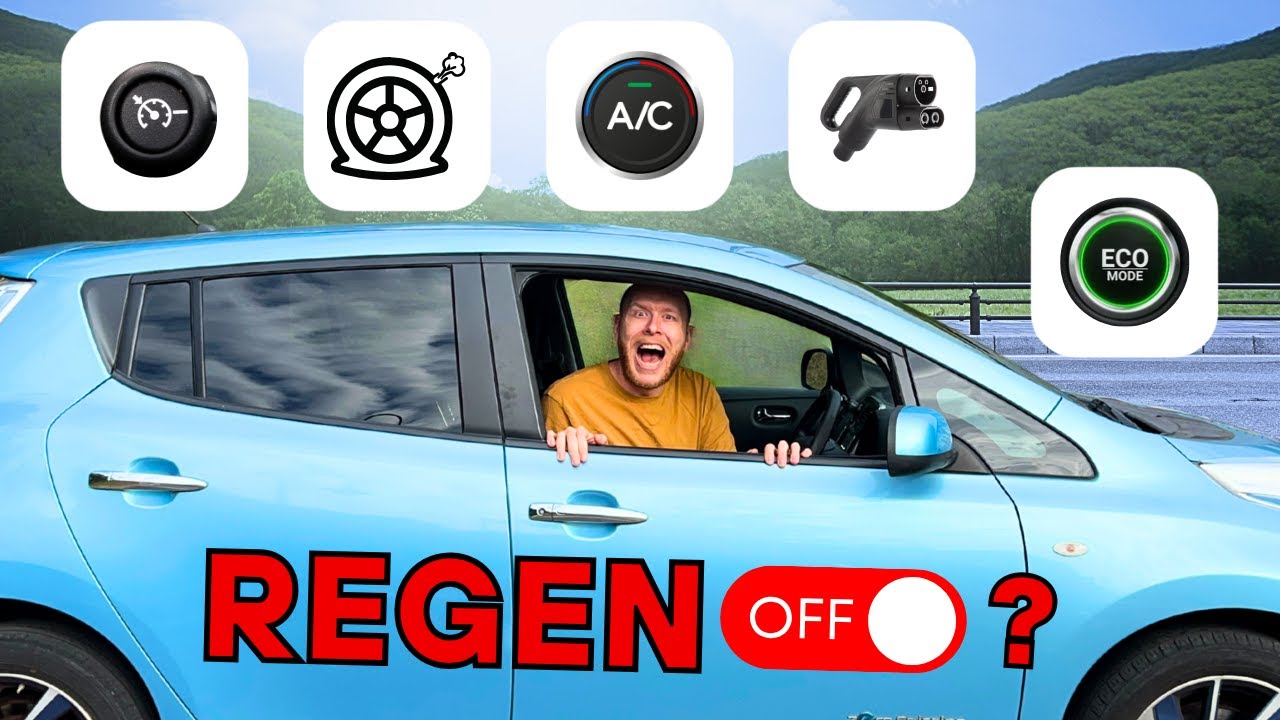
This weeks video covers everything you need to know about driving your EV efficiently.
Including how heat pumps and air conditioning affects range, does ECO mode do anything? If tyres really make a difference, and, what you can do to maximise the range of your EV.
Please hit SUBSCRIBE as I am getting closer to 2,000 Subscribers and it’s totally free to do!
🍿 WATCH NEXT
Can My Old Electric Car Do 100 Miles on 1 Charge? https://youtu.be/eKxhLKhzbjY
🔗 ELECTRIC CAR MUST-HAVES
1️⃣ FREE £50 For Switching to EON Energy Tariff: https://mention-me.com/m/ol/hk1sd-alexander-bull
(Plus they offer the cheapest rates in the UK at the moment at 6.7p per kWh)
2️⃣ Tyre Pump: https://amzn.to/4lqaJ3Y
3️⃣ ZapMap to Find Public Chargers: https://apps.apple.com/gb/app/zapmap-ev-charging-points-map/id964082746
4️⃣ Charging Extension Cable: https://amzn.to/43Ue6dx
⏰ MY FAVOURITE TOOLS & GEAR
Camera: https://amzn.to/3T75nhU
Tripod: https://amzn.to/3FShlcm
FREE £10.00 Sign Up Bonus and Cashback on Everyday Purchases: https://www.topcashback.co.uk/ref/alexcarsmedia
🐦 My Other Socials
Instagram: https://www.instagram.com/alexcarsmedia/
👋 Who Am I?
I’m Alex, a British guy sharing all of my experiences in my 30s.
I was an automotive engineer, turned digital nomad and traveller. I want to teach you how to live a financially responsible life and going outside the norm.
I’m just starting out, so please do hit the SUBSCRIBE button to learn more about living with a budget electric car.
📖 Chapters
00:00 Intro
01:36 Driving Modes
03:14 Regen Braking
05:16 Cruise Control
05:46 Route Planning
07:01 Tyres
09:39 Weight
10:25 Climate Control
12:37 AC or no AC?
14:11 Charging
17:57 How I Extended Range
🎵 Music from #Uppbeat (free for Creators!):
https://share.uppbeat.io/8ryasnm0fs85
PS: Some of the links in this description are affiliate links that I get a kickback from ✌️