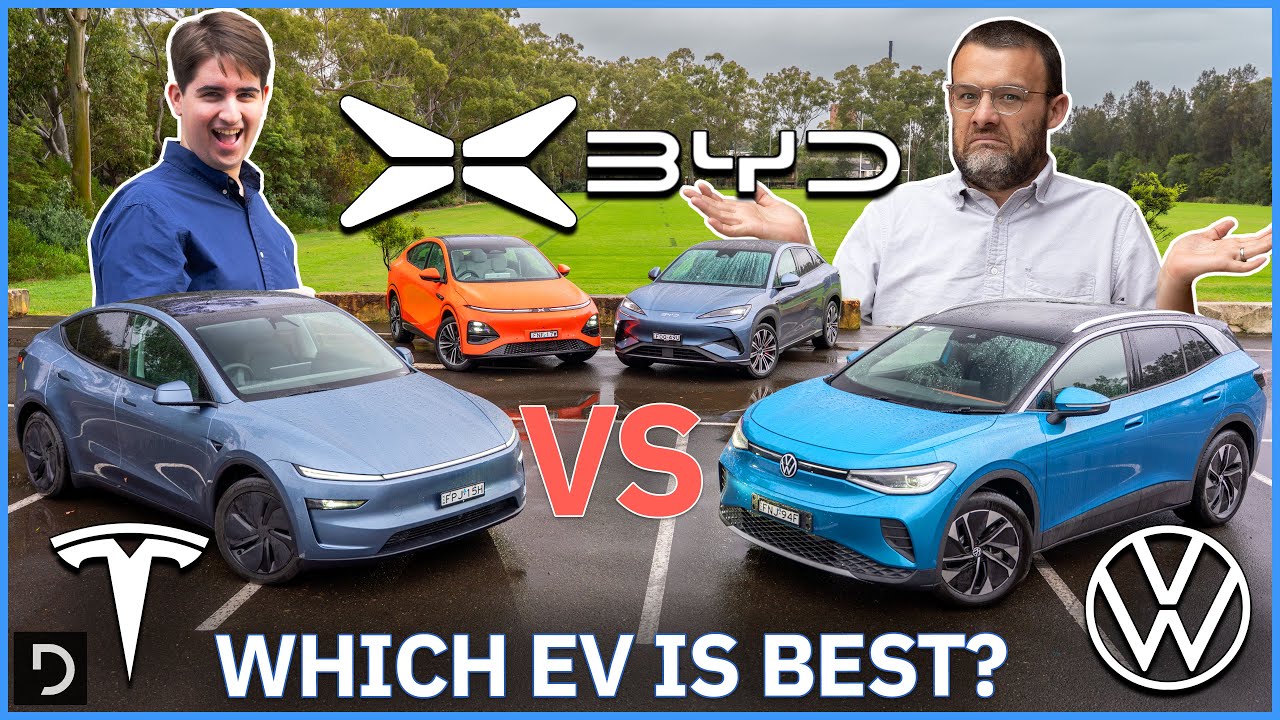
Tesla Model Y v BYD Sealion 7 v Xpeng G6 v Volkswagen ID.4 Comparison
Behind us are four of the newest and most compelling midsize electric SUVs on the market. And in this video, I’m going to tell you which one is best. And they’re all priced from around $60,000 as well. Family electric cars. This is going to be a really competitive comparison. I think pretty impressed with the look and feel. Particularly, I think a lot of buyers will be as well. While the Tesla is shorter at 4 years or 80,000 KS, tailgate is very love. I hit my head on that many times during filming this video. I’ve got to say these brakes are a real let down. Now, the newest face in this group is the updated Tesla Model Y. But then again, not everyone wants a Tesla. No, that’s right. And we have more options these days. So, we’ve got something like the BYD Cine 7 that’s from China. That’s a very popular option in itself. And we’ve also got one up the back there that you maybe haven’t heard of before, the Xpang G6. But, Alex, tell me about this wild card option. It’s the Volkswagen ID4. This car has taken its time to get to Australia, but hopefully it should be its best form yet. I’m curious to see how it stacks up against these other Chinese-made options. Yes, we got a lot to get through, so let’s get into it. We picked these four cars because we think they represent the best of the best in the midsize electric SUV class around the $60,000 mark before on-road costs. There are naturally plenty of cars that haven’t made the cut here. The KEV5 wasn’t competitive enough on value. The DPAL S07 wasn’t quite as refined to drive in terms of its safety features. The Cupra Tavver Scan was better represented on value by the Volkswagen ID4 and something like the Ghily EX5 is a much cheaper offering. BYD is one of Australia’s biggest sellers of electric cars and this is its Tesla Model Y rival. It’s called the Cline 7. It’s effectively an SUV version of the Seal Sand that we’ve known in Australia for a little while now. We wanted a rear wheel drive premium model for this test. We couldn’t get one here for testing, so we had to make do with the allwheel drive performance. We won’t focus too much on the straight line speed of this car in this video though. It is mostly the same apart from bit of extra performance and a few extra features here and there. The newest kit on the block here is the updated Tesla Model Y. It’s had a pretty substantial upgrade for 2025. You can see new Cybert truck inspired styling up front. A bunch of changes inside to make it more comfortable and more high quality terms of materials and finishes as well as some changes on the road make it a bit more comfortable and a bit quieter to drive as well. We previously tested the longrange model, so dual motor all-wheel drive. This one here is the base model rear wheel drive, which should be the top seller in the range if history is a guide. We’ve been waiting a long time for this ID4 in Australia. But one benefit here is that we’ve now got an updated product. So, we’ve got more power and torque from that rear mounted electric motor. And we’ve got updated infotainment as well. But one thing I find interesting is the fact that this is the only one of these four not to be made in China. So, how is it going to stack up for value for money and quality? Let’s find out. You probably haven’t heard of Xpang before, but this Chinese brand is trying to make a big name for itself in the EV space, and this is the FG6. It’s a mediumsize electric SUV. Now, this has very fast charging thanks to 800 volt infrastructure. Not all other electric SUVs have that, and also we’ve got a lot of cool technology in this car, and it’s pretty good value for money. So, let’s see how this newcomer stacks up. There’s a lot to digest in terms of prices and specs. So on screen now are the list prices before on-road costs for each of the four cars, the driveway prices as tested, including premium pay and any options, as well as the claimed driving range of each car on test. We’ll touch on interior features later in this comparison, as well as motor outputs, real world range and charging speeds. But let’s cover some exterior basics first. Standard on all four cars are LED headlights and tail lights, alloy wheels measuring 19 in on the Tesla and Volkswagen or 20 in on the BYD and Xpong, autofolding mirrors and rain sensing wipers. The Volkswagen is the shortest car here bumperto-bumper measuring about 4.6 m long, while the BYD is the biggest at more than 4.8 m long. But all are pretty much in that same realm of midsize electric SUVs around the 4.7 m mark. Overall, all cars in this group offer autoclimate control, power adjustable front seats, voice control, a glass roof, heated front seats, wireless phone charging, ambient lighting, a heated steering wheel, and a power tailgate. In terms of perceived value when you first sit in the car on the showroom floor, this BYD takes the win without a doubt. It feels much like a luxury car in here. The door closes with a louder stunk and all the materials are really soft and really plush. leather-like materials up here on the armrest. The doors, even down to the glove box is actually soft touch down there. The BYD is loaded with features. It gets a 15.6 in touchscreen with wireless Apple CarPlay and Android Auto, satellite navigation and overtheair updates, plus a 10.25 in driver instrument display, heated and ventilated front seats, heated outboard rear seats, leather trim, a 12 speakeraker D audio sound system, a head-up display, and a panoramic sunroof with an electric sun shade. Now that touchcreen as with all BYDs is super fast and super responsive as well. The software is based on Android like you find in a smartphone. So again it is really uh snappy and quite quick to use. As with all BYDs, it does the rotating things. So you press down there and it turns from portrait to landscape. Though annoyingly, you still can’t use Apple CarPlay and Android Auto uh in that portrait mode. Those versions are wireless and they do work pretty well. We’ve had a decent connection uh on test in this car. It is worth noting BYD has made some steps to make the system a little bit easier to use in terms of accessing your climate controls and things which do run through the screen in this car. For example, your your row along the bottom here is now pinned when you’re in Apple CarPlay rather than having to swipe up. And I can do three finger swipe. So up and down for temperature and then left and right for controlling a fan speed, which is a handy thing. Uh it means you can pretty much do it without having to take your eyes off the road. Other things can swipe down for shortcuts for your safety stuff and things like that. And overall it’s a pretty easy to use system. We’ve had a couple of stutters throughout the week uh with this car, but overall it does work pretty well. This driver display ahead of me here is clear and it’s pretty easy to read. There’s a lot going on in terms of uh what it shows, but it does the job pretty well. The biggest biggest issue is how it’s mounted in the car. You can see it’s sort of flush with this uh gloss black panel across the dash, which means that can attract dust quite easily and then get some sun glare as well, which means it can be hard to read in certain scenarios. And overall, the cabin is very wellappointed. Plenty of materials, uh soft materials, as I said before, and also lots of amenities as well. These leather seats have a fair bit of bolstering to them. And they are quite comfy. And you even have under thigh support as well, which is rare in a Chinese car. That’s something that Xping uh doesn’t have over there. Plenty of storage, too. You’ve got some space underneath the console. Decent size glove box as well as a decent size uh center armrest spot as well. It’s a nice cab. There’s some things that could be improved from a usability point of view. But overall, we’re pretty impressed with the look and feel particularly. I think a lot of buyers will be as well. Now, the cab of this Xpang has a very similar vibe to some of the other cars we have on this test here, but it’s a bit of a mix of BY design elements and Tesla design elements. Things like the screen, obviously, everything does run through it. 15 in across, which so it’s pretty competitive with the other cars we have on this test. The software is okay, but it’s not quite as intuitive as what you get in the Tesla, and it’s sort of very smartphone like screen. Things are a few more taps away than you might otherwise like. Things like switching from Apple CarPlay to the main screen is just a little bit harder than you might otherwise like. You can swipe up and down, swipe up from the bottom is can be a little bit stuttery at times to get shortcuts as well as shortcuts at the top. But yeah, it could be a little bit better. And things like the lumbar support for the driver seat and even your side mirror controls are hidden in the screen even beyond what Tesla does in its car. So, not great there. Do have wireless CarPlay and Android Auto, so it does work pretty well, but yeah, could be a little bit of improvement there in the touchcreen. The adjustment of your air vents also runs to the screen, very similar to the Tesla. And you get dual zone climate control in this car, as well as a whole bunch of other different features that make it competitive with its rivals. Features in the G6 include a 14.96 in touchscreen with wireless Apple CarPlay and Android Auto, navigation and overtheair updates, a 10.2 in driver display, heated and cool front seats, synthetic leather look trim, an 18 speaker in-house Xpunk sound system, and heated rear seat cushions. It and the Tesla are the only cars with two wireless phone chargers, but the Xping has no privacy glass. The driver display in this car is pretty clear and pretty easy to read, though it can be a little bit confusing at first in terms of navigating between its various views. And this steering wheel was a point of contention, I have to say, on this test. I’m not a huge fan of its shape and how thick it is. It fits a little bit clumsy to use at times around town. Then again, not everyone on the drive team was put off by the design of this wheel. There are some places also that the Xpang could do a bit more work ergonomically. this uh button for the center console, which is quite big, I should add, is sort of where your arm tends to lean when using the infotainment screen, which isn’t great. Uh, and these cup holders are quite small, which may not fit larger bottles. These seats, this is the white interior option in this test car here, is no cost option. Black is a standard choice. They are pretty comfortable. They’re sixway adjustable on the driver’s side, so no underfly support, which is a bit of a shame, but and the material is a little bit plasticky, but I think on the whole, uh, you will be okay with that. Plenty of storage around the place. Lots of room under here under the center console. Decent sized door pockets as well and that big uh center console box I mentioned before. But yeah, no glove box in this car, which is a bit of a shame. And also no overhead sun shade for the sunroof, which something the Tesla is in that same boat as well. Feels well presented. The materials are quite nice around the place. I think a lot of buyers will like the way that Xpang feel inside the cabin, but there are some places where it could be improved compared to some of its rivals on this test. Now, all the cars that we have here on test have minimalist cabins, but this Tesla takes it to a whole new level. The learning curve in this car is very, very steep, but once you get the hang of it, it does work quite well. Everything runs through this big 15.4 in touchscreen here, and the software is smartphone like super fast, quite easy to navigate. There’s so many menus uh that are in this car. We wish there was Apple CarPlay and Android Auto. Tesla’s never really had those in its cars, but the inbuilt navigation is fantastic. The way it can route you from different superchargers and and actually accurately predict the amount of battery you’ll have on arrival is also fantastic. And look, after you get used to the system, this infotainment screen does work really, really well. Now, when I said everything goes through it, I do mean everything goes through it. Your speed is up there uh in the top corner of the screen. You don’t have any sort of instrument display in front of me here. Things like your mirror controls, your steering column controls are all uh hidden in this screen, which again takes some getting used to in this car. Now, the Tesla may be short on buttons, but it certainly is not short on standard equipment. Those include satellite navigation, music and video streaming, and overtheair updates, an 8-in rear touchcreen, heated and ventilated leather look front seats, heated outboard rear seats, a power adjustable steering column, dual zone climate control, a 9- speakeraker in-house sound system, and keyless entry through the phone key only. Some of the new features for 2025 in this Model Y include this new seat design, more comfortable than before, more supportive as well. New steering wheel. You now have your gear shifter on the touchcreen, which is a little bit fiddly at first. There is some software where the car will actually anticipate your moves in the three-point turn and make it a little bit easier on a day-to-day basis to live with. You just have an indicator stalk though, which something that Tesla didn’t give you in the updated Model 3 sedan. And the design of the cabin has changed a bit. There’s nice sort of fabric material up here on the dash. Feels much nicer than the old wood grain you got in the outgoing Model Y. Lovely ambient lighting running around the cabin, as well as just a general higher sense of build quality and fit and finish. You can see fewer squeaks and rattles in this car than the old Model Y had. Got nice sort of leather-like materials on the center armrest, all the sort of door panels, and center console. Every touch feels really nice and really high quality, which is not something you could say about the previous Morai interior. Storage in this car is the best of the bunch. You got a really, really deep uh center bin there. Even more space under this armrest with a single USB port, which can be a bit hard to find at night, but you do have a wireless phone charger there that do take a bit of a load off that. got a glove box which is a bit small and you have to open it uh through the screen which this one is not opening quite as quickly as we’d like but there you go. It is a little bit fiddly but it is quite small as well and I suppose when do you really use your glove box? Decent size door pockets as well and overall a general nice cabin well presented plenty of technology and definitely a standout in this midsize EV class. Now this Volkswagen is the most conventional car here in terms of it interior design and it is quite similar to other cars in the Volkswagen range. Got a 12.9 in touch screen here. And look, the software is fine. And the screen is a pretty decent size, but it’s a bit fussier than some of the other cars we’re testing here. And look, speaking of fussy, these touch sensitive controls under the screen are really not great. Uh, slider control there for the volume as well as air temperature on the sides. And you even got the touch sensitive buttons on the steering wheel as well. And we found that while driving this car, perhaps in a tight corner, I’m always hitting this uh heated steering wheel button just by accident. And yeah, really not great and not a great experience there. Volkswagen has committed to getting rid of these. For some reason, that hasn’t flowed on to the ID4 just yet. There is plenty of stuff you do get in this ID4 Pro, even for a base model. That includes a 5.3 in driver display, leather and microfleece trim, power adjustable heated front seats, keyless entry, trizone climate control, a sun shade for the glass roof, and a hands-free power tailgate. Some other emissions, however, include ventilated front seats, inbuilt satnav, overtheair updates, heated rear seats, and premium audio as other cars here offer. Its phone companion app is also not as capable as the other cars here. Now, you can tell Volkswagen has been making cars for a long time because the basics and the fundamentals of the interior are very well executed. I love these seats in particular. Sort of synthetic leather and microfleece centers here with his no cost option brown accents on them. Super comfortable, super supportive, loads of adjustment as well, including um thigh bolsters you can actually extend from the bottom of the seats there. Lovely uh leather steering wheel wrap as well uh with the heating as I mentioned before. Overall, the material choices in this cabin are pretty nice. Some pretty soft stuff up here and all feels well built, well screwed together. There are some sort of hard scratchy things lower down and there’s a lot of gloss black around the place from the center console down here to even the door handles on the doors where you grab uh for example in a tight corner. That’s gloss black. As you can see in this car, which is only has 2,000 KS on the clock, it’s it’s marked. It’s all, you know, covered in fingerprints. I don’t know why you’d put gloss black somewhere your fingers go, but anyway, perhaps um something that can be improved with a future version of the ID4. Storage is okay. Got a fair amount of room in the center console down here with your wireless charger there as well. I think the fact that the ID4’s interior is quite conventional is probably a good thing uh for this car. And isn’t probably the best equipped here in terms of features. and doesn’t have all, you know, the nice trimmings that perhaps that BYD does, but it just feels really nice, well put together, and like a company that knows how to make a good car. If that was a lot to digest, let’s rank them. The Xpen comes fourth. It’s well trimmed, but hasn’t had as much thought put into the ergonomics as the other cars here. That’s followed by the Volkswagen. It’s well built and comfortable, but lacks the features of the others. Then the BYD. It’s loaded with equipment and super comfortable. But the driving position isn’t great, and the infotainment screen isn’t quite as good as our first place finisher here, the Tesla, which is clean, spacious, comfortable, and feature-laden. As long as you can get used to that user interface. The BYD is the longest car of this group from nose to tail. So, it does make sense that there is the most knee room in the back here. You can see acres of leg room for the front seat. And you do feel quite low in this car with quite a bit of uh bolstering on these back seats. I will say it’s not perfect. Tow room is okay, but not as quite as good as some of the other cars here. And forward visibility is also not amazing given how big this sort of sporty front seat is. The headroom is actually surprisingly good uh for a car with such a sloping roof line. That’s something you’ll hear a lot uh I say in this video. And the rest of the back seat experience is pretty good. You can see decent under thigh support as well. It helps that you can stretch out so much in the back here. phone pockets, map pockets on the front seat backs, uh full length and armrest with uh quite a complex cup holder arrangement perhaps as well as some little bit of storage in there as well. Flat four of course and you get some heated outboard rear seats in this performance spec as well as uh air vents and some USB ports that come out there. It’s a really nice space in the back of the BYD. You even get the same soft materials in the back of the BYD that you find in the front seats of this car. And look, on the whole, it is quite a premium space back here. It feels luxurious when you get into it. I think for a lot of buyers, as I mentioned before, that will really, really appeal. Space in the back of this Xpang is actually pretty good for a car of this dimension. You can see plenty of knee room there for the front seat. Surprising amount of headroom under this glass roof. The tow room is a little bit on the tighter side, but it’s not too bad. Uh, overall, see quite a flat floor, so I can sort of stretch out again as with the EV platforms on these cars. And you have the usual things like mat pockets back here, two USBC ports, air vents, as well as um a fold down center armrest with a pair of pop out cup holders there. A little bit finicky, but they are uh pop out cup holders. Now, you can recline these seat backs with a little lever that’s on the right hand side, and they do go a fair way back, which is quite nice. Uh and they are quite comfortable overall in terms of the under thigh support you get. They’re a little bit flat, but overall they are actually pretty decent there. Now, both the Tesla and the Xpong have electric door releases both for the front and the back. In the Tesla, there are sort of up here on the handle. In the Xpong, they’re here uh on the side of the armrest, which is a little bit less natural. In the Tesla, but still, it’s okay. Now, the problem is though, obviously, in an exit or if the car the power dies, for example, you need to get out without the assistance of the electric door releases. How do you do it? Well, there are manual releases in the front and the back of this car as with the Model Y, but they are in a bit of an awkward spot. in the back here. You’re sort of behind a piece of trim in the door pocket that you have to sort of bush out of the way. It feels like you’re breaking the bit of trim and then pull a lever and then open the door manually. It’s just not good enough. It needs to be better. Needs to be clearer cuz in a crash, in an emergency, I’m not going to be fumbling around in that door trim trying to find that. It’s just too hard. Manufacturers need to find a better way to do that uh with that manual release or just go back to an oldfashioned handle like the Volkswagen and like the BYD. This Model Y is one of the more spacious cars we have on test here. You can see loads of knee room behind the front seats, loads of head room as well, and more tow room than any other car here. Actually, a shocking amount of toe room under that front seat, even for the middle passenger as well. They’ve got loads of tow room cuz this sort of center area has been uh carved out there, which is great to see. This is the only car here with a rear touchcreen for the passengers in the back. So, you can do things like play games, um play different videos, Netflix, YouTube, stuff like that. As well as your, you know, your normal climate controls. You’ve got heated out port seats in this car, as well as your control of your air vents. Now, you do have to do that through the screen. You can’t just move a little lever. That is a bit of a shame, but again, that is something uh you do get in the back of this Tesla. Now, new for the update uh this year with the Model Y are power reclining rear seats. So, little button on my right hand side here, or lefties if you’re sitting there, I can tilt that back or tilt it forward. So, yeah, pretty cool feature. Um rather than just pulling a lever, which can be a little bit awkward at times. And I can actually even recline these back seats from the front seats. So, for example, you got something big to load in. You can drop the back seats without having to actually get out of the driver’s seat, which is pretty cool there. Other thing to point out, under thigh support is better than the old Model Y, but still compared to the other rivals here, it’s not quite as good. Um, and amenities are pretty well covered off. You got a fold down uh center armrest with a pair of cup holders here, the usual ice fix points and top tethers that all three of these cars have. Um, air vents, two USBC ports there, as well as some space uh in the door pockets there, which actually flock line too, which is pretty cool. On the whole, really like the back of this Model Y. It’s a spacious place. Plenty of amenities, too, and I think a lot of families really like the back seats of this car. The Volkswagen is a smaller car on the outside in this group, and it does feel it to an extent in the back seats here. I don’t have as much knee room as I do in the other cars in this test. Head room is pretty good up there behind the glass roof. Yeah, tow is a little bit on the tighter side, and the floor is mostly flat, but not quite as flat as the other cars in this test. The seat base is quite comfortable. Decent support there. It’s a little bit flat in places, but the under thigh support is actually pretty good. And you got the usual things like phone pockets up here, map pockets down there as well. There’s no reclining function that I could find, at least on this seat. But comfort is okay otherwise, not quite as good uh as some of the others. There are some other places where the Volkswagen is not quite as good as the others. For example, some hard scratchy materials up here and things like your climate controls down here. You do have air vents uh and a separate zone of climate for the back seats. usual things like fold down some armrests with a pair of cup holders and also a ski port there um for folding through really long items. Look, overall it’s a pretty nice space in the back here. Not quite as roomy as the others and yeah, some places where it could be improved compared to other cars in this test, but comfort levels are pretty good overall. The Volkswagen places fourth in terms of rear seats simply because it’s not as roomy as the other cars on test here. The Xpong is next. It’s pretty roomy, but not quite on the level of the others in terms of features and space. Then on a tie is the BYD and the Tesla. The BYD wins on knee room and overall space, but the Model Y has a handy rear screen, the power adjustment in the rear seats, and the general all round appeal and comfort that you see in the Tesla. We struggle to split the back seat comfort of these two cars, but what about you? Which one would you prefer? The BYD, the Tesla? What about the other cars in this comparison? Which one would you buy? Let us know in the comments down below. The boot capacities for three non-Tesla cars in this test are pretty similar on paper around the sort of 500 L mark or so. Volkswagen has a bunch of useful things like this net here for keeping stuff down as well as a ski port for particularly long items. Xpank’s a little bit more simple. Tailgate is very low. I hit my head on that many times during filming this video. Uh bit of space under floor, but is a pretty simple space overall. The B80s is the smallest on paper and it does look good. There’s a lot of sheet metal around the boot and the load area opening isn’t as big as the others, but it is pretty clear the Tesla is the winner of this. More than 800 L of quoted storage. I’m pretty sure that is still measured to the roof, so it probably isn’t quite like for like, but it’s pretty clear this is the biggest space. Uh when I start to lift up this parcel shelf here, if that wasn’t enough, there’s even more storage under the floor that can fit an entire carry-on suitcase, as well as pockets on the side that will actually fit small items, pretty much anything you want down there. often your groceries can fall over and roll into there, but still it is nice to have that than not. That’s all not to mention the frunks of these cars or the front storage areas under the bonnets. The Tesla and the BYD the only ones with a frunk to use the American term or front trunk. This Tesla’s one though is much bigger, 116 L. There’s 58 L in the BYD and it’s the only one with a drain plug up there as well. All four cars are closely matched in terms of safety features. Each offering auto emergency braking, adaptive cruise control, lane keep assist, lane centering assist, blind spot monitoring, rear cross traffic alert, front and rear park distance warnings, and plenty of parking cameras. The Tesla is optioned with auto lane changes as part of the $5100 enhanced autopilot pack. The Tesla gets auto parking as standard. Again, that’s optional on the Model Y. And the BYD uniquely offers front cross traffic alert. The Volkswagen is the only car here without traffic sign recognition and direct tire pressure monitors. The Tesla is the only car without a top- down 360 camera. While only the Tesla and the Xpong have blind spot cameras when you put your indicator on. In terms of how the safety systems work in the real world, the Volkswagen takes the win here. Closely followed by the Tesla. The BYD and Xpung systems aren’t terrible, but they do need a bit more work. Now, where this Seine 7 no doubt swings its strongest punch in this company is value for money. Now, let me explain that with all the numbers and specs. The value of the BYDC line is best summed up by the fact that we have the topsp spec all-wheel drive model on test here, which gives big outputs of 390 kW and 690 new m. However, the price doesn’t necessarily blow out that massively compared to the others. That means it’s good enough for a naugh to 100 km an hour dash in 4.5 seconds. And it’s got a big 82.5 kWh battery. So that means the Cine 7 is relatively heavy as well. It comes in at 2,340 kilos. But the driving experience of this Seion 7 is perhaps the least polished or refined out of these four. It’s got a fairly soft ride quality, so you do feel the body moving up and down at times, but at the same time, you don’t get good bump absorption like you might expect. So, the body does get a lot of movement, but you’re still getting some pretty big inputs from things like going over potholes and bumps, speed bumps, and that sort of thing around town. Steering does feel to be okay overall, but when you really put it to task, it can feel a bit inconsistent and ponderous at times when you’re driving on country roads or starting to push it through corners a little bit. And just like what that badge says on the back, quoting the 0 to 100 performance times, this is a seriously fast vehicle. Depending on your driving mode, the throttle isn’t overly responsive to start with, but you’ve definitely got a lot of punch there when you need it. likely way more than you’ll ever need for driving around town. But unfortunately on the dynamic side, the chassis of this Cline 7 doesn’t really keep up its end of the bargain. You got plenty of straight line performance, but once you start pushing this thing through corners and handling mid-c corner bumps and that sort of thing, you get that squidgginess that tends to put the steering out of whack a little bit. The body starts to move around. you’re definitely not as confident behind the wheel and you don’t get the same sort of reward at the same time. So, while this Cine 7 might go really hard in terms of bang for buck, it does fall behind in terms of just the level of quality in the driving experience overall. Once again, it’s not bad. This is part of the final four, the top four in this segment, which has so many options to choose from. But in this company, it does fall behind the pace a bit. Recent updates to the Volkswagen ID4 gives it more power from that single electric motor at the rear. We’ve now got 210 kW and 545 Nm. And we’ve also got an upsized 77 kWh battery pack. Now, it is the second heaviest in this comparison, weighing in at 2,140 kilos. One important inclusion here is the adaptive damping, which is standard fit in the ID4. These are controllable shock absorbers that can go firmer or softer through different driving modes or through its own range of settings. And other details include progressive steering for the ID4 in Australia and 19in alloy wheels. Thanks to a recent round of updates to this Volkswagen ID4, what we get as a first taste in Australia, don’t forget this has been available for a number of years in other markets. This car does feel like it offers a really strong balance of value for money, but also good standard specification. And even though this is Volkswagen’s first fully electric mediumsiz SUV, it does feel very Volkswageny, if that makes sense. This German brand has been building cars for a long time that get that balance right of driving, feedback, performance, ride comfort, and all those things. And you get that sense here that that dial hasn’t really shifted, even though we’ve now got fully electric motor. This car steers and rides fairly typically, I suppose, and doesn’t really shift the needle around that much compared to an internal combustion or hybrid powered vehicle. Yes, you can feel the weight of this ID4 at times. All electric cars are heavy and this is no exception to the rule. But the ride quality is really good. You got adaptive dampers here. They’re nicely balanced. There isn’t a huge amount of change between the stiffest and the softest suspension setting, but that’s actually not too bad of a thing because to be honest with you, it feels pretty good somewhere between the middle and the bottom of that rung. Yes, you can tighten things up if you want, but I prefer the ride quality. You’ve still got a nice balanced steering feel, but I’ve got to say these brakes are a real let down. I’m not sure if it’s because of the drum brakes we have fitted at the rear of this ID4 that uh slow down the response of the brake pedal, but you’ve got a real sponginess there initially and a lot of travel to get through before you get any meaningful bite in the braking system. You might get used to it maybe, but I would argue that you shouldn’t have to. The braking should be better in a car like this. But put the braking aside and you’ve got a driving experience that is actually quite good. This is rear wheel drive only. You’ve got ample power and torque there. I think this car has enough performance for the application. But in terms of the way this car steers through corners, the way it handles bumps and that sort of thing, this does feel quite nice. And when you’re on the right kind of road, maybe out in the country somewhere, this does have that extra little bit of salt and pepper in the driving experience. I think it’s just a little bit more rewarding, a little bit more responsive and alive on the road. And some people I think will appreciate that. Not so much around the BBS and that sort of thing. Yes, the ride comfort is good, but the drivers will like this car on the right patch of road. But overall, this ID4 is really nicely balanced. I think the ride is good. The steering is easy and it’s got a really conventional sense to it. I think it doesn’t shift the dial and feel radically different for any reason. It feels just like a regular car really. just happens to be electrically powered, but also really nicely engineered. The Xping G6 does undercut the key rival of the Tesla Model Y on price, but it still offers plenty of technical specification. This has an 800vt powertrain architecture, which is definitely impressive for the price, and there’s a single electric motor at the rear that makes 190 kW and 440 new m. Now, in terms of weight, this standard range G6 is just over 2 tons. Now, for those who opt for the longrange model with a larger battery, power is nudged up to 210 kW to account for the extra weight. And for those who want all-wheel drive power with two electric motors, hang on because there is a performance variant of the G6 coming. Now, you’ll notice that the Xpang G6 is the only one of these final four to be one of those really newcomer brands to the market. We’ve had so many Chinese electric brands arrive recently. But the Xpen does feel like a cut above the rest in many regards and a lot of that to be honest with you comes from what you get for the asking price. And the driving experience of this G6 is quite good overall. There are no major issues with it. It’s also almost kind of forgettable in a way. It doesn’t really get in the way of driving. It’s very easy, very convenient, quite comfortable as well for punting around town like we’re doing at the moment. Steering is light. It’s nimble enough. Visibility is good. That all works quite well. But when you start driving this thing on rougher roads, when you start punting it through corners and that sort of thing, that’s when you’ll notice that there is a bit of a bobbling feeling to the ride quality. Steering isn’t perhaps as dialed as some others in this comparison. You’ve got ample power and responsiveness from that single electric motor at the rear. Although this brake pedal in comparison to what you have with the Volkswagen ID4, which is overly soft and spongy, this is perhaps a little bit too tight and grabby. Another thing to talk about is the technology that you’ve got on board with this G6. There’s no shortage of it to be honest with you. And a lot of it, it’ll wow your friends. It’s all modern and fancy, but the driver monitoring system is a little bit frustrating at times to be honest with you. It gets cranky at you for your hand position on the steering wheel. It can go off at you if you don’t have enough inputs into the steering at random times. So, it’s a little bit overbearing and really does take away, I suppose, as the major flaw, I would say, from otherwise a very serene and easy driving experience. But overall, this G6 is quite effortless, quite painless, comfortable, and easy to drive. Although, when you really start getting down to the nitty-gritty, it’s perhaps missing just a little bit of that polish that you get with the Tesla and the Volkswagen in particular. The Tesla Model Y is the most powerful of the three rear wheel driven SUVs in this comparison. It’s only beaten by the dual motor BYD. 255 kW of power is impressive. This means the Tesla Model Y can get from 0 to 100 in a shade under 6 seconds. And a relatively small 60 kWh battery pack means the Tesla Model Y is the lightest in this comparison at just under two tons. Now, out of the four in this comparison, the Tesla Model Y is certainly the most space age feeling and modern to drive, I think, for a few reasons. And the one thing that stood out to me mostly is just the vision from the front. The bonnet falls away quite aggressively at the front here, so you can’t see that. And you’ve got this sort of great visibility in front of you with a small steering wheel and nothing really impeding your view. It’s quite different and interesting to drive. Now, the steering wheel is relatively small, and the steering ratio is quite fast, so there’s not many turns from lock to lock in this car. Now, the turning circle maybe isn’t the best out of the four in this comparison, but I think it’s it’s okay for the job. But you’ve got a throttle and brake that are pretty responsive, quite touchy at times, but I think overall very well balanced and you can get used to driving this car quite well, especially with that sort of one pedal driving experience that you can plug in. Only this and the Xpang actually have that as an option. Perhaps the most important improvement for the Model Y, I think, in the sake of this comparison, is the ride quality. Now, this is not as tur and jittery as it used to be. You’ve got a little edge of compliance there. Bump absorption, which goes a long way for this car, but you’ve still got good amounts of body control going on here. So, the car doesn’t feel soft and wallowy and bouncy. You’re absorbing the bumps well, but this car actually steers quite nicely at the same time. It feels balanced. It feels responsive. It gives you a little bit of feedback in terms of what’s going on underneath the car. And even though you can option up to a much more powerful all-wheel drive model, there’s a lot of responsiveness from this rear wheel drive model here at the moment. Now Tesla doesn’t quote a torque figure for this vehicle, but from the seat of pants, even though there is a all-wheel drive BYD in this comparison as well, not the rear wheel drive model, this feels like one of the perkiest of the bunch. Definitely. Now, in terms of technology and driver assistance and that sort of thing, the Tesla has historically been very good and advanced in that regard, and that continues to be the case here. You’ve got really, really good adaptive cruise with lane centering. The thing will practically drive by itself as much as it can within the letter of the law. And there’s driver monitoring, and there’s all sorts of technology going on here, but it is nicely integrated, and it doesn’t tend to impede too much in the everyday driving experience. And that is really important, I think. Now, there are some things that definitely need getting used to. Things like the gear shifter, it’s a bit weird. The way the indicators work, that’s a bit of a funny one as well. And you’ve got nothing in front of you as a driver. So, visibility is fantastic, but you don’t exactly have an overloading of information at the same time. So, that all takes getting used to. But overall, this Tesla Model Y doesn’t do much wrong. In fact, it does a lot of things really, really well. And that’s pushing it right up towards the pointy end of this comparison. I think this is a really nicely polished car. Overall, on screen now is each car’s claimed energy consumption rating as well as what we saw in our test loop in the real world. [Music] Maintenance costs also vary between our contenders. Over four years, the Volkswagen quotes $1,190, the BYD $1854, and the Xpunk $1826. While there is no servicing schedule or pricing for the Model Y, as maintenance is condition based, that means the car will tell you when it needs to be serviced, rather than taking it in at set intervals. The BYD ask for service visits every 12 months or 20,000 km, whichever comes first, while the Volkswagen is set at 24 months or 30,000 ks. It must be noted that whereas Tesla and Volkswagen operate their own service centers as does BYYD in addition to its arrangement with my car, Xpunk factory maintenance is conducted through the Ultrune network of third party service centers, not its own dealers. Vehicle warranties ring in at 5 years unlimited kilm for the Volkswagen. Though at the time of testing, you can boost the Xpong’s warranty up to 10 years or 220,000 km as part of a special offer. The BYD quotes 6 years 150,000 km now with fewer asterisks on different parts of the vehicle, while the Tesla is shorter at 4 years or 80,000 KS. All vehicles quote an 8-year battery warranty. These are four of the best $60,000 electric SUVs on sale, but there can only be one winner. It didn’t take much time behind the wheel for the judges to split the field in two. The two best cars and the two least impressive. Fourth place is taken by the BYD Sea Lion 7. It’s dripping in showroom appeal with a spacious cabin, sharp price, long list of equipment, and prodigious power in this performance model, but it disappoints on the road with an inconsistent ride, mediocre handling, slow DC charging, and a thirsty electric drivetrain that really limits its real world range. Third is claimed by the Xpunk G6 by a whisker. It’s a solid all rounder, better to drive, faster to charge, and more energy efficient than the BYD or being the cheapest car to buy here. It’s wellappointed and it techy feel will appeal to plenty of buyers. However, it doesn’t excel in any particular area, space, ergonomics, tech, or driving dynamics to really make an impression on the judges and come away with a win in this comparison. And that servicing arrangement with Ultra Tune rather than in-house dealers would give us pause for thought in buying one. Now, that leaves only two. And in second place, we’ve got this Volkswagen ID4. This is a really impressive and well-rounded car overall, I think. And one big benefit for me, I think, from this ID4 is the driving experience, but it’s not a perfect offering, and there are some areas where it starts to fall off the pace a little bit. One big bug bear for me is definitely that brake pedal. It’s just too soft for my taste. Yes, some might get used to it, but I would argue you shouldn’t have to get used to it. And in terms of space, it’s just not as spacious as others from a family usage point of view. And the packaging in particular, I’m going to call it out in comparison to the Tesla. It’s just off the pace there. That’s right. And that’s why this Tesla is the winner of this comparison. This car is a fantastic all round offering both as a family SUV as well as a cutting edge electric car. It’s got loads of room inside as you said, great packaging, a massive boot in particular, and how Tesla has used that space and basically given it all to you. It’s not lost in the structure of the car. It’s all there. The tech is fantastic. It’s great to drive as well. Bit sportier than some of the other cars behind us particularly, but still really wellrounded. A really fantastic package overall. There are some places where we wish it could be improved. Apple CarPlay and Android Auto may be a bit of an annoyance or the lack thereof for some buyers. The warranty is very short as well. 4 years 80,000 KS compared to up to 10 years for that Xpang. It’s a little bit of a weakness of this car, but on the whole, there are no obvious shortcomings that you can’t get over with this car. This is a fantastic all round package, and that’s why it’s the winner for this comparison. If you’re after something else to watch, click on the video on your screen now for our electric car winners from the recent Drive Car of the Year judging. From sub50 grand sedans to luxury SUVs. [Music]
The family electric car segment is growing, but which of the newest mid-size electric vehicles is best? Let’s find out!
Click Here to Subscribe: http://drivesoci.al/1Cuo50FO51C
00:00 Introduction
01:05 Explainer
03:08 Pricing & Inclusions
04:10 Sealion 7 Interior
06:36 XPeng G6 Interior
09:18 Model Y Interior
11:54 ID.4 Interior
14:19 Interior Summary
14:47 Sealion 7 2nd Row
15:51 XPeng 2nd Row
17:25 Model Y 2nd Row
18:58 ID.4 2nd Row
19:59 2nd Row Summary
20:35 Boots
21:47 Safety
22:39 Sealion 7 Driving
25:14 ID.4 Driving
28:55 XPeng G6 Driving
31:44 Model Y Driving
35:13 Range & Efficiency
35:26 Maintenance & Warranty
36:32 Summary
#Bestelectriccar #bestEV #EVComparison
______________________________________________________________________________________________
At Drive we pride ourselves on being the future of automotive and letting you, as the driver and reader, know where it’s all headed.
Drive showcases the best of all things automotive, covering all brands and areas of the motoring industry providing Australia’s most engaging and entertaining content.
The dedicated team at Drive are here to bring you their trusted advice, share their passion for all things motoring and to help simplify the Australian motoring landscape for all types of drivers.
We’re here to help you discover the Best of What’s Next.
Drive’s YouTube channel showcases new car reviews, car comparisons, mega tests, great drives and the latest car news. We want to deliver everything you need to know about the car or cars you are interested in.
Our team of motoring experts drive and review every car in the Australian market keeping the needs of both consumers and brands at the forefront. They are driven to help consumers navigate the dynamic and ever-expanding new car market, to help buyers find their best next new car.
Visit our website: https://www.drive.com.au/
Join our facebook community: https://www.facebook.com/Drive.com.au
Check out the latest cars on our instagram: https://www.instagram.com/drivecomau/
What Is The Best Car Of 2025? Watch the winning video from our 2025 Drive Car of the Year
See One Of Our Latest Comparisons: Hybrid Ute Comparison: Ford Ranger PHEV vs BYD Shark 6 vs GWM Cannon Alpha PHEV
Watch The Best EVs Of 2025 Reviewed By Drive: Electric Car Reviews Australia | Best EVs 2025
Take A Look At A Car Review From The Drive Team: 2026 Kia Tasman Review | Is This Ute A Game Changer?
See Drive’s Latest Ute Reviews: Ute Reviews by Drive.com.au
Watch One Of Our In-Depth Off-Road Reviews: 2025 Toyota LandCruiser Prado Altitude In-depth Review | On-road & Off-road
Watch Season 8 of Drive TV:
Watch This Road Vs Track Video: Can A Road Car Outrun A Race Car? We Find Out With A Chevrolet Corvette!