The Truth About Electric Towing
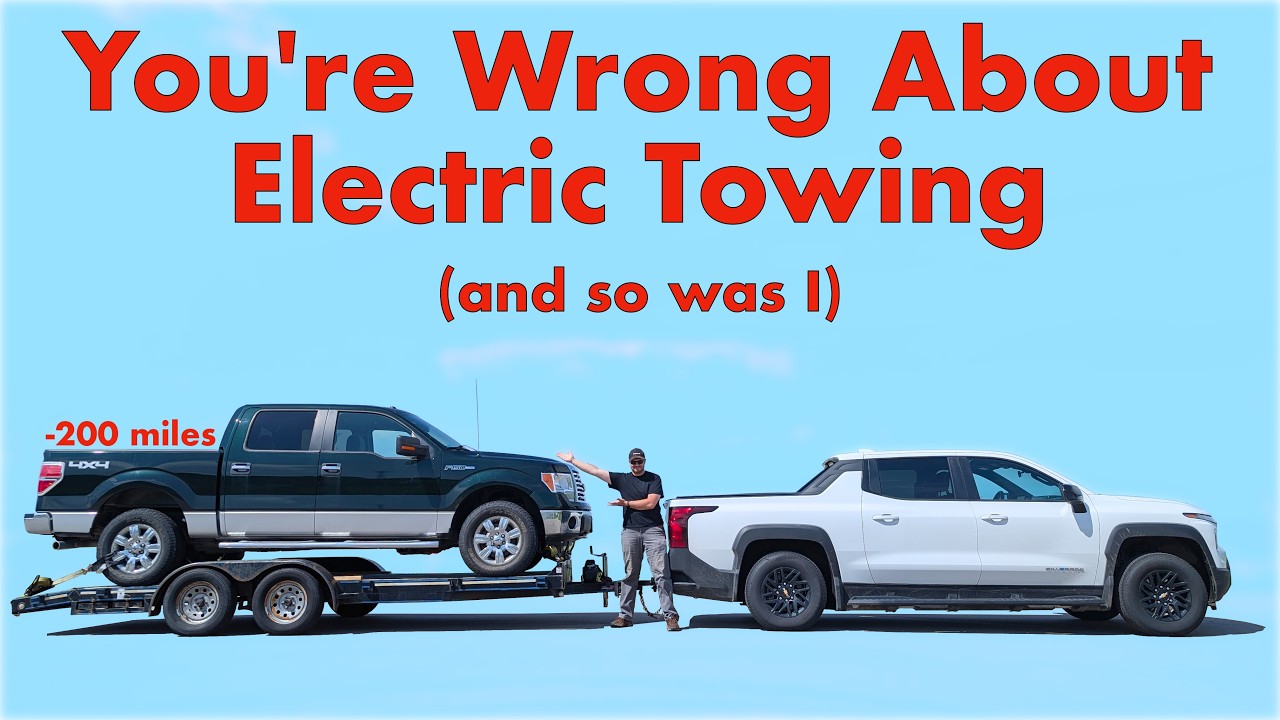
Towing with an electric truck. Forget what the internet has to say about it. I’ve encountered people in real life who openly scoff at the concept of pulling a trailer with an electric truck. They act like I just told them I’m going to try to climb Mount Everest in a wheelchair. Now, don’t get me wrong. If your main use case for a truck is long distance towing, then an electric truck probably isn’t for you. But it can do it occasionally. It’s not some big joke. Hooking a trailer on the back of an electric truck doesn’t magically drop its range down to 50 miles. Well, unless you have a standard range Lightning. And that’s especially true with the Silverado EV, because the Silverado EV isn’t like other electric trucks. It’s much heavier. It has a much larger battery. So, to give you a basis of understanding just how useful an electric truck is for towing, and to show you how far it can go while pulling different kinds of trailer at highway speeds, I did a bunch of testing with weight, without weight, with empty trailer, with different things on trailer, with different electric trucks, and so on. And with all of this testing done, I can answer more than just how far will it go. I can answer other questions like what affects range more. Is it weight or is it wind resistance? How much does it cost to fuel this pig? Does the efficiency of the tow vehicle really matter? Or is it all about the trailer? And finally, why is this DRL so much brighter than this one? Okay, maybe I don’t have an answer for that question. This is a video about towing, but first I wanted to talk about the impact of gaining weight in in your vehicle. I mean hauling stuff. I have seen far too many comments online to the effect of, “You can’t have an electric work truck. Once you load that thing up with tools, it won’t have enough range to go anywhere.” That’s not how it works at all. But rather than just tell you weight has almost no impact on the range, I tested it. I designated this 30 mi stretch of interstate as my test loop. I started at this exit where I reset my trip computer. Then I drove at a constant 75 mph until I reached this exit where I turned around and came back at a constant 75 mph until I reached the start point, which is a way too wordy way of saying I did a 60 mi test loop at 75 mph. In fact, I did all the tests in this video on this same loop at 75 mph, similar to how out of spec does it. We’ll set cruise to 75. This route isn’t flat. In fact, it’s fairly hilly, but at least I know the start and end point are at the same elevation because they’re the same point. I drove this test loop twice in the Silverado empty with nothing in the bed and the tano cover closed. And then I did two runs of the test loop with some weight in the bed. What did I use for weight? Well, I wanted to max out the Silverado’s payload capacity. So, I went to Home Depot and bought this half pallet of shingles. And yes, he did dent my tailgate. If the info I looked up is correct, each bundle of those shingles weighs about 70 lb. There were 22 bundles on that pallet. So, that pallet weighs a little under 1,600 lb. Given the Silverado’s payload capacity is 1,400 lb, I’d say I maxed it out plus a couple hundred pounds. A and me, it’s fine. Don’t worry about it. 1,500 lb in the bed, and there is no difference in the power delivery. There is a difference in the suspension field, but that’s something different. Conveniently, the Silverado EV shows energy usage down to a tenth of a kilowatt hour, and it separates that out into energy used for drive and energy used for climate control of the battery and cabin. The results. The energy usage of the two empty runs averaged together was 31.8 kwatt hours for an efficiency of 1.86 miles per kilowatt hour or 532 watt hours per mile or 63 MPG equivalent or 75 m per UK gallon equivalent or 3 km per kilowatt hour or 333 W hours per km. For the rest of this video, I’m going to keep conversions to a minimum and I hope you understand why now. Anyway, that efficiency would result in a fully charged range of 390 mi or 632 km. And the results of the two fully loaded test loops averaged together was 33.4 kwatt hours of energy usage for an average of 1.78 m per kowatt hour, which would work out to a full charged range of 374 mi. Fully maxing out the Silverado’s payload capacity and then some, resulted in an efficiency drop of just 4.3%. You wouldn’t notice that in real world driving given the Silverado was like 400 lb over capacity. I’m comfortable saying weight doesn’t matter. And actually, there was a slight aerodynamic difference between empty and fully loaded because I found out I couldn’t close the tano cover with the shingles in the bed. So, it’s possible the efficiency difference was because of that rather than the weight. Obviously, this is a highway test loop. The results may be different in a stopand go city driving scenario. Now, you might be curious how this compares to a truck with a engine. Does extra weight impact a gassy truck more or less than a whispery one. I wanted to test this and I have an F-150 with a 5 L V8 to test it with, but I wasn’t super comfortable buying and returning the same half pallet of shingles from Home Depot a second time. So, this time I went to Lowe’s. I again bought a pallet of 22 bundles of shingles, which should weigh just under 1,600 lb. The guy at Lowe’s also dented my tailgate. I don’t actually know what the payload capacity of the F-150 is, but I’m sure it’s fine. Don’t worry about it. I ran the same test loop at 75 mph, but this time, for reasons that ended up not mattering, I repeated each test three times. Listen to that V8 struggle. First, I did the loop with the truck empty. 16.6 6 m per gallon. That’s terrible. This one loop in the F-150 used more energy than two loops in the Silverado. Actually, it used more energy than three loops in the Silverado. To be fair, I’m pretty sure some portion of that gas tank was ethanol. It won’t matter for this test cuz we only care about the difference between empty and full. And I did all the tests on the same tank of gas, but ethanol content in the gas will lower that gas mileage number just a little bit. And then I did the test loops with 1500 lb of shingles in the bed. Oh, you could definitely feel the weight in this one. This 5 liter V8 sounds great, but it sure is gutless. Come on. Before doing this test, I was positive that the F-150 would be more affected by weight than the Silverado. It was just a foregone conclusion. Well, the average of the three empty runs in the F-150 was 16.7 m per gallon, and the average of the three fully loaded runs was 16.6 m per gallon. I was wrong. That’s not even a statistically significant difference. In the Silverado, weight barely made a difference, but in the F-150, it essentially made no difference at all. Welcome to complaining about the Silverado EV. Sponsored by Factory. being held. So, even though the frunk doesn’t leak, after it rains, everything in this frunk is wet because that water that’s being stored in there evaporates up and condenses on the underside of the hood and drips down and drenches everything in the frunk. You know the powerbased function that allows me to use the outlets when the truck is off isn’t working. The button doesn’t do anything. So, to use this microwave right now, the truck has to be on. And it? This DRL is significantly brighter than this one. And that extended to the blinkers, too. Look at that. Why? If you want to try make a service appointment. Now, let’s do some actual trailering, shall we? Weight affects efficiency very little. So, this next set of test loops will show some factors that do affect efficiency a significant amount. First, I did the test loop empty with no trailer as a baseline. Again, at 75 mph on the same 60-mi loop of interstate. From this point on, I stopped repeating all of the test loops because it required more time than I had available. The result of run one, empty, 1.93 m per kowatt hour. Very slightly more efficient than the test loop I did 2 days prior. The first loop with the trailer will be this mostly empty trailer with an inconsequential amount of wood on top. One of the things I love about this truck is with that empty trailer back there. I can’t tell it’s back there, which is a problem in some scenarios if I forget what I’m doing, but mostly it’s a good thing. This empty trailer run dropped to 1.45 m per kowatt hour. If we extrapolate those numbers out to a full charge range, that’s going from 405 miles of range down to 304 miles. As we’ve already established, weight alone barely makes a difference. So, why does this empty trailer have such a noticeable impact on energy usage? This empty trailer is very low profile, but it does still create some amount of wind resistance. It is wider than the truck after all. And also, this trailer is adding four whole extra wheels worth of rolling resistance. For the next loop, as less of a test and more of a demonstration, I didn’t add or remove any wood from the trailer, but I did slightly rearrange it [Music] again. No more or less wood, just slightly rearranged. Rearward visibility is impacted slightly, and I can really feel it buffing in the wind. I don’t like this, but it’s for science. Obviously, this is meant to demonstrate the effect of wind resistance. Fortunately, the demonstration worked a little better than I expected. We have a slight issue. I didn’t budget for how much energy this is using. I have to abort and dismantle this nonsense to make it home. I’m currently at 7% and I’ve got 20 m left in the Tesla. 6% now. I’ve got 20 m in the test loop left. As it turns out, pulling a 5ft tall sail down the highway at 75 mph uses a lot of energy. Who knew? I started that test loop at 36%. I expected the sail to drop efficiency down to about 1 mile per kilowatt hour. And at 1 mile per kilowatt hour, I would have been able to make it home. Yep, this is what’s happening now. Driving with my hazards on at the state legal minimum speed limit. I’m pretty sure I could have made it to the charger. I drove 15 miles and used just 2% of the battery driving as slow as I was going, even with a trailer. But I started worrying about what if I die in traffic or some other bad situation. So, 5 miles away from the charger, I pulled over to somewhere safe, unhooked the trailer, and called a tow truck. Let’s be clear about this. This is entirely my fault and it sucks. But to make myself feel a little bit better, I had the tow truck driver take me to a charger that was free. So, that’s something. After that humiliation, on a different day, and starting with a much higher state of charge, I completed the test loop with the air brake trailer to get a complete result. And then to show the effect of wind resistance versus weight, I loaded up 45,500 lb of Polestar onto the trailer behind the air bra. And then I did a loop with the polestar but without the air bra. The results, the loop with the wall of death on the front of the trailer, but without the polestar used 83.4 kilwatt hours. That’s more than the entire battery capacity of a Model Y. And the efficiency was 0.72 miles per kilowatt hour. Remember, the empty trailer used 1.45 miles per kilowatt hour. So, erecting a wall of wood under the front of the trailer cut efficiency in half. So, how did adding 4,500 lb of weight to the back of the trailer behind the wall change things? Well, the loop with the polestar and the air bra used 83.9 kwatt hours for an efficiency of 0.71 miles per kilowatt hour. Remember, erecting a wall of wood under the front of the trailer cut efficiency in half. But adding 4,500 lb of weight to the trailer lowered efficiency by 0.01 m per kowatt hour. Weight doesn’t matter. You hear me? Weight doesn’t matter. And then on the loop with the polestar, but without the silly air brake on the front of the trailer, it used 54.5 kwatt hours for an efficiency of 1.09 m per kowatt hour. Pretty dramatic drop. Last minute edition. I did one more loop with the F-150 on the trailer. It weighs about 6,000 lbs. So, the total trailer weight was about 8,8500 lb. And it’s quite a bit taller than the Polestar. Look at this jerk tailgating me. It used 63.3 kwatt hours for an efficiency of 0.94 m per kowatt hour. You’re probably curious what sort of range those efficiency numbers would result in. Well, here’s the fully charged and 80% to 10% range of not just the Silverado, but three other electric trucks, each shown with their max available battery size at 1.4 m per kowatt hour, 1.1 m per kowatt hour, 0.9 m per kowatt hour, and at 0.7 m per kowatt hour. Of course, those numbers are all theoretical. Will different electric trucks get the exact same efficiency numbers as the Silverado pulling the same types of trailer? No, probably not. But given the results of a test that you’ll see later on in this video, I’m betting they won’t be too far off. Moral of the story, wind resistance matters a lot. Weight doesn’t. So, stop worrying about it. And again, these are highway results. Stop and go city style driving would likely yield different results. Obviously, the dead flat wall that I put on the front of my trailer is going to have a more dramatic effect on consumption than something with a more sculpted aerodynamic shape like a cargo trailer or a camper. I wanted to test more variations of trailer, but A, I don’t have infinite time, and B, I don’t even know where to go to borrow things like a camper. I was able to borrow a cargo trailer for the test in the form of a U-Haul trailer, but we’ll get to those results later in the video. All right, let’s talk about how much it cost to fuel that big white whale. EVs have a lower cost of maintenance, too, like no oil changes and dramatically fewer brake pad replacements, but we’re just going to talk about the cost of fuel. This will vary wildly by region, so I’m just going to talk about the cost of things where I live at the time of recording. If you want to know what these things I’m about to talk about cost where you live, you can just substitute in your own numbers. And the cost of both gas and electricity where I live is very cheap. The price of gas right now is $2.99 per US gallon. We’ll call it $3. And the price of electricity, it varies, but it’s around 9 cents per kilowatt hour. The EPA says that one US gallon of gas contains 33.7 kwatt hours of energy. The real number is a bit fuzzier than that, but this is the conversion number used to calculate miles per gallon equivalent. For example, if my EV is averaging 3.5 m per kilowatt hour, well, we take 3.5, multiply that by 33.7, and we get the equivalent of 118 m per gallon. And it works the other way around. If my car is getting 35 miles per gallon, say I’m driving a Ford Focus or something, well, we take 35, divide that by 33.7, and we get the equivalent of 1 mile per kilowatt hour. Yeah, that’s right. Your Ford Focus uses more energy than my 9,000lb truck pulling a 7,000lb trailer. I bring this up because $3, the price of a gallon of gas, divided by 33.7 is 9. So right now where I live, the per unit cost of gas and electricity is the same. Normally miles per gallon equivalent is kind of a silly unit, but in this exact moment it directly correlates to cost. On the test loop in the F-150, I got 16.7 m per gallon. Let’s lie and say it got 20 m per gallon. And in the Silverado EV empty, I got 1.86 m per kowatt hour, which for an electric truck with nothing in it is terrible. But that’s still 63 miles per gallon equivalent. To get the cost of fuel over a 100 miles in the F-150, we take the distance traveled 100 miles, divide that by the miles per gallon figure, which I’ve made up and called 20. Then we take that result and multiply it by the price of gas, and we get $15 to drive the F-150 over 100 miles. To get the cost of fuel over 100 miles in the Silverado, we take 100 miles, divide that by 1.86 m per kilowatt hour. We take that result, multiply it by the price of electricity, and then we take that result and multiply it by 1.1 to add 10% to account for charging losses, and we get $5.32. A third the cost compared to the F-150. Oh, but it gets better. The absolute worst run I did in the Silverado was the loop where I had the air brake trailer. I got 0.7 miles per kilowatt hour, which is very low. But that’s still 24 miles per gallon equivalent. So over a 100 miles, that would cost me $14.14, which is still less than the F-150 empty with no trailer. So it’s settled then. EVs are a lot cheaper than their gas-powered equivalents. Even if my electricity price were to double, it would still be a lot cheaper for me to drive the Silverado compared to the F-150. However, there is one caveat. I’ve been talking about home charging. The calculus changes quite a bit with rapid charging. For example, at the Bies in Springfield, Missouri, on one side of the parking lot, there’s a Tesla Supercharger and on the other side of the parking lot, there’s a 400 kW Mercedes charger. The price at the Tesla Supercharger is 46 cents per kilowatt hour. Without a membership, if you have a membership or if you have a Tesla, it’s 33 cents per kilowatt hour. And at the 400 kW Mercedes charger, which is a lot faster, the price is 40 cents per kilowatt hour. This is fairly typical pricing, but prices do vary quite wildly, so look up chargers in your area. And at 40 cents per kilowatt hour, the cost to drive the Silverado EV empty over 100 miles becomes $24, which is more than the F-150 by a non-inssignificant amount. So that’s the one caveat. Within your range bubble around your home charger, EVs are a lot cheaper than combustion powered equivalents. But outside of that range bubble, they’re probably not. Unlike with a gas car, the cost to fuel an EV depends heavily on your use case. If you don’t have access to charging at home or work, or just don’t do that very often, then it’s going to be a lot more expensive and a heck of a lot less convenient. And in my opinion, if you have an electric truck but don’t have access to home charging, what are you doing? That’s like trying to start a pineapple farm in Montana. But wait, there’s a second caveat. There aren’t many of them out there, but some DC fast chargers are free, and there happens to be a free one near me. So, a lot of the Silverado EV testing I did in this video was done for free. For this next test, I’ll need a volunteer. This is Andrew, and this is Andrew’s Rivian R1T tri motor max Pack June Edition. I have a theory. I don’t think the efficiency of the tow vehicle matters very much. I think trailers are the great equalizer. Without a trailer, this is much more efficient than this. But with a trailer, I think they’ll be about the same. This is something I claimed in a previous video. You can make the truck as efficient as you like, but when it comes to towing, you just need raw energy. Thing is, I didn’t actually know for sure if that claim was true. I made an assumption. How irresponsible of me. Well, now let’s put that assumption to the test and find out if I lied to you. To find out, Andrew and I ran the test loop side by side. Him and his Rivian, me and my Silverado. The Rivian was in conserve mode and the Silverado EV work truck spec doesn’t have drive modes. We did one run empty, trading places at the halfway point to cancel out any potential gains from drafting. And then at the very end of the loop, this happened. [Music] And after that brief raintorm, we stopped to trade scores. So I used 30.4 kwatt hours. We had to slow down at the end. So that was my like my most efficient loop yet. And I averaged 1.96 m per kilowatt hour. What’ you do? Okay, I used 26. 26, putting me at 2.32 miles per kilowatt hour. 2.32. That’s how much more efficient your truck was. Then this time with two identical rented U-Haul trailers. We repeated the test again. I rented two U-Haul trailers, so they would be theoretically the same. But all U-Haul trailers are not created equal, and I think one of the wheels on this one is square. For this run, the Rivian was in tow mode, and again, the Silverado doesn’t have drive modes. Again, just like with the empty run, we traded places at the halfway point to cancel out any potential drafting gains. And also, just like with the empty run, at the very end of the loop, this happened. We happened to time it just right so that the heavy rain happened at almost the same point on both loops. Because we were traveling side by side, we were affected by the same conditions at the same time. So, the rain really didn’t invalidate anything. Besides, it was only for a tiny portion of both loops. Again, we stopped to trade scores and I used 53.5 kwatt hours and averaged 1.11 m per kowatt hour. What were your numbers? He didn’t have his camera on. He used 55 kwatt hours for an average of 1.08 m per kowatt hour. You used more energy. Without a trailer, the Rivian’s much more efficient. But with the same trailer, I used 1.11 m per kowatt hour and he used 1.08, 08, which is essentially the same number. I like it when I’m right. And now that I verified my claim, I’ll repeat it. When it comes to towing, the efficiency of the tow vehicle doesn’t matter much. You just need raw energy. And the Silverado has quite a bit of raw energy. My max range Silverado EV’s battery pack has over 60 kwatt hours more energy than the Max Pack Rivian. The Rivian’s better in every single other way, but Silverado has a bigger battery, so there. And it charges faster. Speaking of charging, the Silverado EV, specifically with the largest battery pack that I have, is by far and away the fastest charging electric truck you could buy in terms of DC fast charging, assuming you keep climate control off. It peaks at around 370 kW. It has a pretty flat charging curve and 10 to 80% takes about 40 minutes, which is good for 160 mi of driving at 75 mph while pulling a Polestar or a U-Haul trailer. If you’re unloaded, you can go almost 300 miles at 75 mph from that 40-minute charge. Every other electric truck available, including the different battery packs that are available in the Silverado, charge slower. For example, the Cybert truck with its positively microscopic 123 kWh battery pack, still takes 40 minutes to charge from 10 to 80%. But the battery pack is just a little bit more than half the size of the Silverado’s battery pack. So, it charges essentially half as fast. So, if you’re charging for 40 minutes and you’re pulling a Polestar, you won’t be able to go 160 miles at 75 miles an hour, you’ll be able to go like 80 or 90 miles. And that’s it. Nope. I did one more test. I recorded the effect of regenerative braking with and without weight. It didn’t really fit anywhere in the rest of the video. So, here it is tacked onto the end. Now, I’m going to floor it from 0 to 70 mph. And as soon as I hit 70, I’m going to let off the throttle and regen all the way back down to zero. and we’ll see how many kilowatt hours that takes net. 0.1 kilwatt hours is the starting point. Let’s floor it. I got to put it in drive first. Let’s floor it and then watch the speedometer at 70. Release. So net that took 0.4 kilwatt hours and you could watch it regenerate in real time. I repeated that test two more times and got the same result. And then I did the 0 to 70 to zero run with that pallet of shingles in the bed. All right. 0 to 70 to zero with 1500 lb of shingles in the back. Run one. Got to put it in drive first. Go. Make sure to watch the speedometer at 70. [Music] That used less energy net than the empty run. What? I repeated that test two more times and got the same result. I don’t know what to make of that. I guess regen is more effective with more weight. And that’s it. There was a lot of data in this video, a lot of numbers. Numbers are very useful, but it could be hard to get a feel for what something’s really like by just looking at a bunch of numbers. So, in the next video with this truck, I’m going to take you on a road trip with me. We’re going to take a car on a trailer and tow it to someplace that’s over a thousand miles away so that you and I can see what that experience is actually like. There’s a lot more testing I wanted to do in this video. I wanted to try several more variations of trailer campers, etc. I wanted to compare all the results I got in this with results in the F-150. I could have spent a month just driving up and down the highway gathering test results, but I don’t have infinite time, so I just had to pick a small subset of tests to show you. I hope this video was enlightening. I made it to clear up several misconceptions, but as it turns out, I was wrong about some stuff, too. That’s thunder. I have to finish filming now. Anyway, thanks for watching. I’m going to pack up and leave.
Use code 50AGINGWHEELS to get 50% OFF plus free shipping on your first Factor
box at https://bit.ly/4dIBzjz!
Patreon: https://www.patreon.com/agingwheels
Merchandise: https://crowdmade.com/collections/agingwheels
Silverado EV Charging: https://evchargingstations.com/chargingnews/2024-chevrolet-silverado-ev-rst-dc-fast-charging-analysis-0-100/