
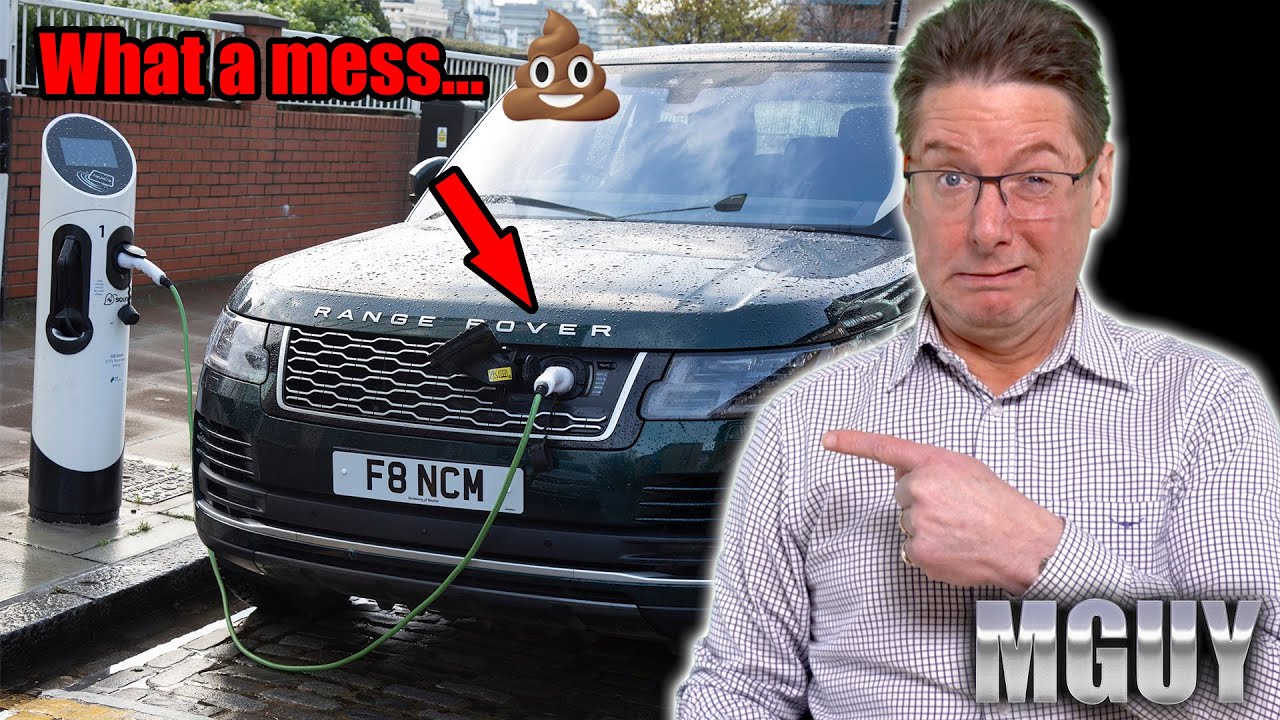
CHAOS: Electric Range Rover DELAYED as JLR offers 500 redundancies | MGUY Australia
Jaguar Land Rover’s in the news yet again for all the wrong reasons as it not only delays its forthcoming electric Range Rover, I mean, who wants a supercharged 5 L V8 anyway, and announces redundancies for over 500 managers. The trouble is that auto manufacturers are caught between a rock and a hard place. They know that their customers want regular combustion cars. But governments who are always picking winners, or more frequently, should I say, picking losers, are forcing them to build battery electric cars to meet arbitrary targets set by bureaucrats in ivory towers. So, brands that were previously bullish about electrification are pulling back and waiting for the much anticipated customer demand to materialize, which it isn’t, except very slowly. and reluctantly. And very gradually, this tension between demand and mandates is killing the auto industry in the west and sacrificing it all to China. Welcome back to Muy, governmentmandated policy like this is that any slight change to that policy is like a seismic shock through the industry. There’s no way that governments will be able to stick to the arbitrary and ludicrous deadlines for phasing out combustion cars. And so the policy will continually need to be watered down or adjusted. And every such alteration is just another hurdle for the industry to leap over to keep competitive. It’s a disaster in the making. We’ll look at Jaguar Land Rover specifically very shortly, but there’s another great article I’d like to share with you which highlights just how the governmentmandated push to make our cars fully electric is essentially sacrificing our auto industries on the alter of net zero. The rush to EVs is causing real damage. Car manufacturers are in an impossible situation, forced to balance what their customers want with what politicians think they should want. The market is always right. It certainly is. Historic luxury car marks are finding this to their cost as they delay overly ambitious electric vehicle EV plans, including Volvo last September and Jaguar Land Rover JLR this week, coincident with laying off 500 staff or 1.5% of their British workforce. The Land Rover customers are not putting in sufficient orders to justify rapid expansion and for JLR relative laggers in EV development. This is a second delay and it’s combined with generally bad market conditions. the UK’s expensive energy tax rises, expected rises in the cost of labor from employment legislation, it still being difficult to build or expand anything anywhere, restrictions on skilled worker visas and in export markets, Trump tariffs and their ripples across global supply chains. The JLR move also follows the relaxation of the UK zero emissions mandate, ZEV, targets in April. The scheme compels manufacturers to sell a rising ratio of their output as EVs or be heavily fined. A daft idea akin to taxing typewriter makers for not selling enough word processors. The changes allow suppliers to delay compliance to nearer 2030 when it is assumed demand will be higher and it will likely be delayed again if it isn’t. No government likes presiding over plant closures, even less so when their own policies are to blame. And the article rightly identifies the key problem for auto manufacturers, which is the impossible balance between actual demand and government dictats. Manufacturers are then required to triangulate between the real market, anticipating what their customers want, political oversight, what politicians might say their customers should want, and as an afterthought, supply, what they can actually build and still make a profit. So, the government will continue to produce EV targets and mandates, demand industry to dance to that tune, then change the record. The confusion will continue and the costs of that certain uncertainty will be reflected in higher prices, lower demand, and a slower transition to newer vehicles, whether EVs or anything else. Car manufacturers may well be in the headlines again soon. So, so true. And all of those points are exemplified perfectly by the mess that Jaguar Land Rover finds itself in right now. on the one hand bullish about moving Jaguar to all electric but at the same time hesitating with Land Rover because of lack of demand. Jaguar Land Rover delays launch of new Range Rover electric exclusive customers are told the car maker is allowing more time for testing and for demand to pick up. Britain’s largest car maker, Jaguar Land Rover, has delayed the planned launches of its new electric Range Rover and electric Jaguar models to give it time for more testing and for demand to pick up the Guardian can reveal. JLR has written to customers waiting for the Range Rover electric to inform them that deliveries of the new version of the model will not start until next year after initially aiming for late 2025. Two people with knowledge of the car maker’s plans said that two plan Jaguar models, much anticipated since a viral pink and blue rebrand, may also be pushed back by several months compared with original plans. JLR has been hit by the impact of Donald Trump’s tariffs in recent months. This week, it reported a 15.1% drop in sales in the 3 months to June after a temporary pause in exports to the US. It has also opened a voluntary redundancy scheme for up to 500 managers in an effort to save costs. However, sales are expected to improve after the UK’s limited trade deal with the US provided for lower 10% tariffs on the first 100,000 exports. The company has reported a profit for the past 10 consecutive quarters after a turnaround effort. The car maker owned by the Indian conglomerate Tatar has been more cautious in embracing electric technology than luxury vehicle rivals. That had left it in danger of steep fines for failing to hit UK electric vehicle sales targets. But that pressure has eased after the UK weakened the rules known as the zero emission vehicle ZEV mandate in response to heavy lobbying by car makers including JLR. And despite official silence from JLR on the matter, insiders give a more accurate response. JLR declined to comment on specific model launch dates. Two people with knowledge of JLR’s manufacturing operations said the delays had partly been caused by the need to carry out extended testing because they are the first electric models to be directly built by the manufacturer. JLR previously sold the electric Jaguar IPACE, but it was built by a contract manufacturer. One of the people said the delays may not harm JLR financially because they will allow the company to continue to sell its lucrative petrol and diesel hybrid versions. People inside JLR have said, “The delay has worked in our favor and let’s not rush this.” The person said, “Exactly. petrol and diesel models are the lucrative ones that they want to keep building and selling. But it’s the electric nonsense that they’re being forced to shift towards. And every time the policy changes, which it inevitably will again, it just spooks the industry even more. It’s an abject lesson in why state intervention in a market, especially one as significant and valuable as the auto industry, has always been and still is today a complete disaster for everyone involved. Thanks very much for watching.
It’s not entirely JLR’s fault, because every auto manufacturer is trying to keep up with the endless changes to the EV mandates… but JLR isn’t helping itself that much tbh…
👕 Annoy your local EV zealots with some cool MGUY “No EV’s” merch! 🧢 Check out the MGUY store ➜ https://store.mguy.tv
☕️ Want to support this channel? Buy me a coffee! ➜ https://m-g.uy/donate
✉️ Send tips and stories ➜ simon@mguy.tv
🗞️ Signup for MGUY newsletter ➜ https://m-g.uy/news
Telegraph article: https://m-g.uy/20bde6
Grauniad article: https://m-g.uy/0acfce
MGUY social media links:
Twitter/X ➜ https://twitter.com/mguytv
Instagram ➜ https://instagram.com/mguy.tv
Contact MGUY: simon@mguy.tv
#electricvehicle #electriccar #evfire #ev
FAIR USE DISCLAIMER
Under Section 107 of the Copyright Act 1976, allowance is made for “fair use” for purposes such as criticism, comment, news reporting, teaching, scholarship and research. Fair Use is a use permitted by copyright statute that might otherwise be infringing.
The Copyright Laws of the United States recognizes a “fair use” of copyrighted content. Section 107 of the U.S. Copyright Act states: “Not withstanding the provisions of Section 106 and 106a, the fair use of a copyrighted work, including such use by reproduction in copies of phonorecords or by any other means specified by that section, for purposes such as criticism, comment, news reporting, teaching, scholarship, or research, is not an infringement of copyright.”