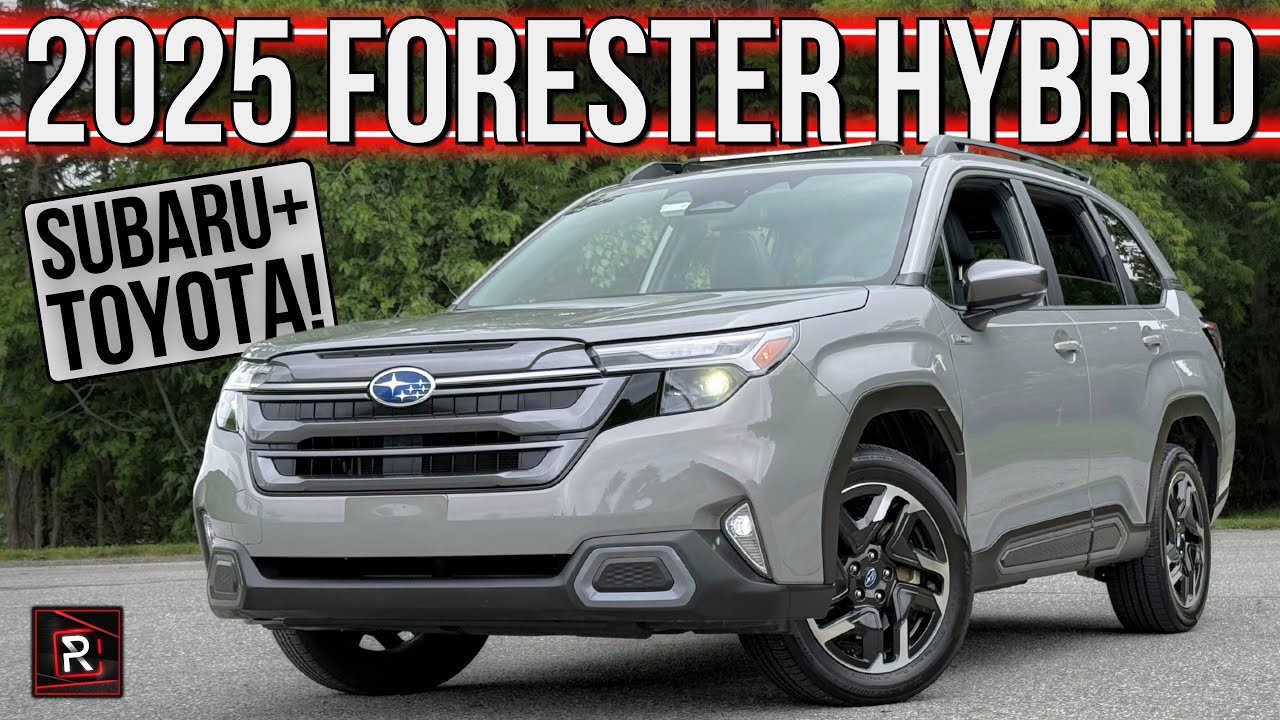
The 2025 Subaru Forester Hybrid Limited Is A Fuel Thrifty SUV With A Unique e-Boxer Engine
The Subaru Forester has been a critical part of Subaru’s North American lineup for nearly 30 years. When the company first introduced this name plate back in 1997, it was essentially Subaru’s answer to the also new unibody crossovers from Honda and Toyota. Now, last year, Subaru introduced an all-new redesigned sixth generation Forester. It got updated styling on the outside, a new interior with their latest 11.6 6-in touchscreen and the promise of a first ever fuel sipping hybrid variant. So, as you can see this week, Subaru has loaned us the latest 2025 Subaru Forester Hybrid Limited. It has a new powertrain under the hood, a combination of a boxer flat 4 with two electric motors sourced from Toyota. So, the big question I want answered, for those of you who have always had your eye on a Forester, but wanted something with even better gas mileage, has Subaru created the ultimate Forester with this new Forester hybrid? Stay tuned to find out. [Music] Now, before we start talking about the exterior styling for the latest sixth generation Forester, the big story, of course, is the hybrid model has finally arrived. So, as you can see, we’ve popped the hood because this powertrain is super unique. Subaru went a completely different approach versus Mazda when they borrowed Toyota’s hybrid technology. Now, as you can see underneath the hood, the car is actually on and running, but because this is a full series hybrid, the vehicle can essentially just stay on without the engine coming on at all. Now, it will occasionally turn on to recharge the battery when the battery starts to get low. But what you’re looking at here is a very unique powertrain. Essentially the perfect marriage between Subaru and Toyota because this combines the company’s latest gasoline direct injection 2.5 L double overhead cam boxer flat 4 with a pair of electric motors. So essentially two electric motors. The big difference between the Subaru and the Toyota hybrid system is this actually has a mechanical linkage going from the engine to the rear axle, preserving, of course, the company’s trademark symmetrical all-wheel drive system with their dual or with their X mode functionality, which is a software that can improve off-road traction. The gas engine on its own delivers around 154 horsep or 162 horsepower and 154 pound- feet of torque. It’s electrically assisted, of course, by an electric motor that delivers 118 horsepower and 199 pound- feet of torque. Uh, combined, Subaru says the total output is 194 horsepower total. So, that’s an increase of about 14 horsepower versus the non-hybrid version of this powertrain. The engine does run on the Atkinson cycle, which is why it makes less power, but it is going to be more efficient running on that Atkinson cycle. Now, it draws its power from a 1.1 kWh nickel metal hydride battery that lives underneath the cargo floor. So, it’s a different position versus where Toyota puts their battery pack, which is underneath the rear seat. And like I said earlier, symmetrical all-wheel drive is standard. This does not have a separate e- axle providing power like the RAV 4 does, which should in turn give it better traction for off-road driving. Now, the transmission is also super unique. It’s their linearronic CVT uh housing, but within the housing, it actually has the Toyota internals for their eCVT. So, it’s a combination again of both where Subaru has essentially tuned the transmission to run perfectly with, of course, their boxer flat 4 and that two motor hybrid system. Fuel economy is rated at 35 in the city, 34 on the highway, about 35 combined. The fuel tank is still 16.6 6 gallons. So, you’re looking at a pretty astonishing 580 mi of total driving range. Now, the company doesn’t quote a 0 to 60 time. We got 8.5 seconds the last time we tested this vehicle out in California. Top speed should be around 127 m an hour. Uh, and towing capacity tops out at around 1500 lb. This vehicle also weighs in at just over 3,900 lb. So, it’s around 300 lb heavier versus the gas only non-hybrid Forester. But closing up the hood, let’s go ahead and talk about the exterior styling for the latest sixth generation Forester. As you guys know, Subaru first showed us this all-new car last year, but without the hybrid variant. Uh, this particular one that we’re showing you is the Limited trim. It’s technically one notch below the top touring, but it still gives you some unique styling elements. First of all, this exterior color is called River Rock Pearl. It’s an extra 400 bucks. It certainly is a very trendy almost like ceramic silver cement colored gray that all the other brands are kind of doing. It does pair nicely with the glossy darker gray accents you get in the hexogonal grill on the Limited trim. You can hear the engine just turned on uh because occasionally the engine will turn on like it just did to re to recharge the battery pack. But then it just goes back to just being a silent electric car. You can see the headlights are their signature are full LEDs. So, you have an LED daytime running light, LED turn signals, LED low and high beams. They’re also swiveing and adaptive. There’s a little Subaru logo in the headlight. And it looks nice, of course, with the LED fog lights at the lower fascia. There is some unpainted plastic cladding down there along with uh some of the, you know, glossy pit bits that you get with this particular trim. And overall, the look of this car is certainly very recognizable to me, at least as a Forester. Although some of you have said it looks kind of like a Ford Explorer. I can kind of see why you’re seeing that. But again, a lot of SUVs have a kind of a similar shape at the front end. Now, moving around the side profile, this is where I think the latest Forester kind of looks a little ungainainely, especially if you guys don’t go for a model with the 19-in wheels because this model here has the smaller 18s. And in terms of its size, the regular or the new Forester is pretty much the same size as last year’s fifth generation. So, you have a 105.1 in wheelbase, which is the same. You have an overall length of 183.3. It’s about an inch longer than the previous generation. Also, it’s around a half an inch wider, but they are roughly the same heights. Remember, this car is built on the same Subaru Global product architecture. Now, looking at the wheels, you can see these are the included 18-in wheels that you get with the Limited. They are definitely looking a little small, especially with all the cladding around the vehicle. You can see all disc brakes. You have a 225x 65 R18. It’s a Falcon Zeke allseason tire. So, again, if you go for the Touring, you’ll have a 19-in wheel. Same thing with the Sport on a fatter 235 width tire. All Foresters still continue to have 8.7 in of ground clearance, which is actually a pretty healthy amount. The upcoming Wilderness uh will be uh will be driving that sometime later this year will have 9.3 in. Uh as you can see, same plastic cladding around the side and around the side skirts of the vehicle. Although it’s a tasteful amount, I think Subaru did a good job at restraining themselves from putting too much cladding on the vehicle. You can see there’s a very subtle hybrid badge here with the uh two pistons to signify this is a boxer engine, which I love how SURU went with their own engine and kind of developed this powertrain into their own after borrowing the electric tech. You can see the Limited includes a dark gray painted plastic or dark gray painted side mirrors with integrated turn signals. The Sport and the Touring will have a black uh side mirror. Uh the mirrors are not power folding. However, you do have blind spot indication, but no 360 camera on this trim. you have to go for the uh touring grade to get that. Now, you can see the panoramic style sunroof is standard on all Forester hybrids uh not included on the base trim, which isn’t available as a hybrid. You can see you have the raised roof rails, which essentially allow you to kind of put things like a tent or actual uh heft hefty stuff like on the roof for camping. And then looking at the rest of the profile for the vehicle, you can see the design is pretty recognizable to me. The overall shape hasn’t changed. I mean, obviously Subaru made some, you know, changes to the tail light design. And you can see the tail lights on this Limited trim are a combination of LED and incandescent. And you can see their tail lights are LED. Reverse reverse lights are LED. The turn signals, however, are not LED. Um, and then in terms of badging back here, there’s kind of like a gloss gray Subaru badge there with the Forester badging. And then again, there’s a subtle hybrid badge here at the back that you the same one you see from the fender. Uh, in Canada, I think Subaru puts an E boxer badge as opposed to that hybrid badge. The rest of the rear bumper, you can see there is still an exposed exhaust tip, although you can really tell this vehicle could have had a dual system on the left side there. That little panel could be removed to include a dual system. You’ve got a chrome tipped exhaust with integrated parking sensors, which is kind of a nice surprise to find. You can see there’s a subtle a subtle little spoiler back here with a third brake light, and then you have the rear wiper that kind of sits there in the middle of the glass. Now, looking at the cargo area, you can see a power lift gate that’s hands-free is also included. And here’s kind of the beauty about the new Forester uh hybrid is the um technology, the hybrid tech doesn’t actually take up any cargo space. You have the same 27.5 cubic feet of storage space with the back seats up. You can see um there are little uh buttons back here uh or you where you can actually fold the seats down. You have a 120 volt power outlet, but no actual um or you have a 12volt power outlet, I’m sorry, but no 120 volt power outlet. That would have been nice to include, especially for the hybrid model. You can see, open that up. That’s where you’re going to find your air compressor. Uh, and that’s because the battery pack for this vehicle lives underneath the cargo floor. So, as you can see, underneath this little gray piece in the middle, that’s where the battery is. And you have a little subtle storage area here. But this is where you kind of lose the spare tire and the additional underfloor storage that you got with the non-hybrid model. So, kind of keep that in mind. The subwoofer for the 11 speaker Harman Cardon stereo, which is standard on the hybrid Limited, optional on the regular Limited, uh, is pretty decent sounding. And then if you want to fold down the seats, you can see just push on that little toggle that folds down the seats and expands the cargo to around 69.1 cubic feet of space. Again, that is the same as the regular non-hybrid Forester. And it’s also pretty competitive within the competitive set. A RAV 4 has a little bit less space. A CRV does have a little more space, but I really appreciate how Subaru again packaged it really well, uh, where you don’t lose any cargo capacity. you just lost the spare tire, which is kind of a sad omission, especially for a vehicle that has the off-road uh credibility of a Subaru. So, on the outside, Subaru didn’t make very many changes to the exterior design for the hybrid version, but what about the interior? Before we get inside, however, let me show you guys the key fob. As you can see, this is the standard Subaru intelligent access key fob. Uh that hasn’t really changed much over the years, but it is a nice key with a nice design that feels pretty sturdy. It has usual buttons here for lock, unlock, power uh liftgate functionality, and then you have your panic function. Subaru does not do a phone as a key option, which is what some some competitors are starting to do, but perhaps they’ll add that for in the future for some of their newest models. Now, as you can see, approaching the door handle, it’s a traditional pull style. Uh there are these little two ridges here where you could basically tap your finger that will lock the door for you. No power folding mirrors on this car. Subaru also doesn’t offer an auto walkway lock or unlock feature like some competitors. just touch the back of the door handle. That will unlock the door for you. Now, as you can see, my particular test car is the Limited trim with the black Starex interior. Now, you can get uh a gray Starex as well, although it’s not available on this color. I’m surprised Subaru didn’t want to do a gray on gray. Subaru does also offer a brown leather interior on the Touring grade, but as you can see, compared to the gas powered uh Limited version, the hybrid actually gets Starex. The gas powered gets real leather for the Limited trim, but not this trim. You get the Starex, which is a synthetic leather. It’s more durable. It’s kind of, you know, easily easy to wipe this interior down if you happen to get dirt all over it. And uh it certainly looks good with the contrast blue stitching. Uh the seats, as you can see, have perforations in the seats themselves, but they are only heated. You cannot get cooled seats on this model. Uh cooled seats are only on the limited grade. Uh the driver’s seat is a 10-way power adjustable with two-way lumbar. You have an eight-way power passenger seat. No memory seats on this trim. you have to go for the touring grade to get the memory seats unfortunately. And then in terms of the door panels, you have a soft touch injection molded plastic. There is some suede on this little area here along with the Starex and the contrast blue stitching. Some piano black trim here. Chrome door handle as you can see. And this area could be more padded. I have to say it’s definitely, you know, soft, but it kind of feels a little cheap, almost like a recycled material down here. It’s all hard touch plastic with this kind of interesting texture. uh along with the 11 speakeraker Harman Cardon stereo. That’s standard on the hybrid limited, optional on the gas powered Limited, standard of course on the Touring grade as well. But overall, the interior pretty much looks like every other Forester uh especially if you guys are familiar with this current generation. Now, stepping inside with 8.7 in of ground clearance, you have a really easy step-in height. And then as I shut the door, the door has a solid sounding thunk. Remember, this is built on their Subaru Global product architecture, which is 10% stiffer in torsional rigidity than the old model. Now, starting the vehicle up, you can see start stop button hasn’t really moved. Put your foot on the brake and when you turn the vehicle on, you can see the headlights. They do that little swiveing functionality to kind of level themselves out. But that’s what’s interesting about this car is I have the car on and there’s no engine sound. Actually, it just says ready and it says EV. All hybrids come with the fully digital cluster here, which is also slightly customizable. Uh, and the engine just isn’t on. I really appreciate that. It’s the first time you’re experiencing that in a Subaru Forester. Uh, which is a great thing. It’s really great to see Subaru giving customers what they want, and they what they want is a hybrid powertrain. Now, in terms of the rest of the materials, you can see the upper dash has a rubberized soft touch injection molded plastic. This area is hard touch plastic. Subaru does not offer a heads-up display on this model. The steering wheel is basically unchanged. Uh, you have a manual tilt telescoping adjustability which offers a good amount of adjustability and range. You have paddles to control the linearronic CVT which is technically an ECVT housed within their linearronic CVT. I like the real leather on the dash or on the steering wheel with the contrast stitch. You don’t have a heated wheel. However, the gas limited includes a heated wheel, but not this trim. You have to go for the touring grade. For some reason, Subaru took away the the hybrid or the heated wheel on the hybrid limited. Um, lots of buttons here to control your audio, to control the eyesight with their adaptive cruise control. Of course, the horn. Oo, it’s really loud and obnoxious, but it also uh lets people know to get out of the way, which is kind of appreciated. Uh, and then, of course, in the center here, you have their 11.6 in touchscreen, which includes wireless Apple CarPlay and Android Auto. It has their Subaru Starlink headunit software, but it’s not their newest system that you get in the Outback, which I’m looking forward to testing at some point. You can see there’s almost like a wood-like trim here on the dash. This area here has that hexagonal texture, although it’s uh completely hard plastic, although it tries to make it look like it has stitching. That’s actually a faux stitching. The driver focus features would be here on the touring, which would watch your face to make sure you’re not asleep, uh that you’re paying attention. If I put the vehicle into reverse, you can see there’s your backup camera, which includes trajectory, distance markers, parking sensors, reverse automatic braking, but 360 camera, that’s only on the touring grade, not on the Limited. So again, there’s a lot of features that Subaru throws in on the limited grade. You can still kind of adjust this upper portion here to show you your X mode if you want to change that to go into a snow, dirt, normal, or deep snow and mud. Weather information, of course, you can also pull it up there along with your temperature gauges and your GPS functionality. This system, as you can see, is really slow and kind of annoying to use, especially when you first start the vehicle up. It’s really, really slow to start up. It does include GPS, like I mentioned earlier. It’s their TomTom system. It’s nothing super special. And then if you’d like, you can go into the settings here and you can also again you can see how slow it is. It’s kind of annoying how slow it is. Um you can adjust a couple of things here. Uh and then you can also adjust the gauge display cluster which however unlike the Outback um and the Subaru WRX which had a separate button here on the steering wheel to change that. To adjust that, you actually have to go into the screen here and you have to basically find the unit here to change the display, which I think is actually in general. It’s really hard to kind of navigate and find this on a at a glance. Uh go to meter screen here. And if you go to the meter screen, you can go to the meter uh view or display mode, which basically allows you to change between the normal setting here where you can go to the map display there if you’d like, which is kind of nice. And then if you want, you can go to the eyesight display. Uh, and then I think you can also put the GPS functionality for CarPlay when you have your phone connected. Mine’s not connected. Most of the times I like it in the normal display here. But I wish Subaru would have just included a button here like what you get on the WRXTS. I imagine the Outback, the new version, will also have that as well. So overall, a little annoying to use this. The graphics of the screen also kind of gets washed out from the exter external light which again they need to do something about the screen clarity. Uh but other than that it’s perfectly fine. You have a dual zone automatic temperature control functionality. Your heated seat is located in the screen as you can see but no cooled seats. You can see my the air conditioning is on but the car still remains off which I really love. You can see the wireless phone charging pads included as well in this trim um which holds bigger phones with ease although they will get hot pretty easily because there’s no kind of ventilation there. You have two USB charging ports, an A and a C, of course, along with an auxiliary port. Traditional shifter for the CVT, which a lot of people will appreciate. You have a 12volt power outlet here along with your electronic parking brake. I love how Subaru resisted the urge to put piano black plastic here, but there is a little bit here. Padded center console area. It’s actually really nicely padded if you open that up. It’s relatively deep. Good amount of storage. Like I said earlier, good storage in general in this vehicle. You can see the seats. While the Starexs I would have preferred real leather, they do do a really nice impersonation. I really wish Subaru would have included cooled seats at least. You have to go for the touring trim, but they are comfortable and supportive. Not much in terms of lateral bolstering, but good for longer trips, which is important for a lot of people in this type of vehicle. Open that up. You can see it’s a bin style. It’s damped, but not lined with felt. And then visibility in this car is also good. You’ve got a low dash, very good sight lines, thin A-pillars of course, and above me, you can see the Limited does not include an auto dimming rearview mirror. It’s got the cheap, you know, manual style. You do have LED map lighting at least. Subaru used to put incandescent in a lot of their cars and a woven material here for the headliner. And if you want to open this up, you can see it opens up to vent air. There’s a built-in wind blocker as well. The glass, however, is not very dark tinted, but it is nice how at least it opens up completely. Uh, and you can also open it up a little bit more. So, this is fantastic, especially if you guys are looking for a panoramic style sunroof. But overall, the interior pretty much is the same. Aside from the fully digital cluster, which isn’t even available on the non-hybrid Foresters, it’s pretty much the same deal. I just I’m hoping that Subaru will eventually update the software whenever they decide to refresh this car. But let’s go ahead and hop into the back seat area because that’s where the Forester also kind of excels in this space. You can see when you open up the rear door, it opens up in a very huge opening. Uh material quality unfortunately is hard touch plastic. They downgraded it from the front seat area. You do still have the Starex and the suede Alcantara slightly padded over here. Windows like I forgot to mention earlier are onetouch up down for the front. However, the rears are not onetouch. You only have that functionality for the front area. And then you can see the rear seats have the same Starex with the contrast blue stitching. No heated back seats back here. And then if you want to fold the seats, I showed you earlier. You basically pull on that tab that folds the seat down. Gives you a almost a completely flat load for it. But what’s interesting to me is the seats don’t have a recline function, but the way they’re positioned, they almost look like they’re already reclined. Uh it almost has like a a lean that most competitors don’t even give you if you don’t have the option for a reclining rear seat. But once you get back here, you can see the leg room space is unchanged from the non-hybrid. You have 39.4 in of legroom, which is among the best. You have you have around two more inches of leg room versus the current RAV 4, which is nice. This is basically my driving position. I can kind of get back here and cross my legs pretty easily. that can stretch out. The floor is not completely flat, and that’s because there’s a drive train or drive shaft that uh gives you all-wheel drive. Going from the engine to the back, you can see you do have rear seat air vents. You have two USBC or USB charging ports, an A and a C or an A and a C. Uh that button would be for your heated seats that you get on the the touring grades. You can see you have nice storage compartments in each of the front seatbacks. And as you can see here, the seats, they have adjustable headrest. Uh and then you also have an armrest that folds down, gives you two cup holders. In terms of the headroom space, you can see it really does feel like I’m leaning back, guys. Um, I have a solid maybe 3 4 in of headroom. So, even though the sunroof does take up some room over here, there is a nice little cutout in the ceiling that gives back some headroom space. But overall, the interior back seat area definitely is spacious. It has most of the features that you’d like, uh, except for, you know, the touring grade, which includes a couple of additional options. But overall, if you plan to use this as a family car, the Forester is certainly going to make you happy. So, here we are back behind the wheel of the current generation Subaru Forester. However, this time we are driving the hybrid version of this car. This has been a really long awaited arrival for Subaru to finally give us a hybridized version of one of their bestselling vehicles. Again, Subaru decided to go a completely more unique route with this powertrain, combining their boxer flat 4 with Toyota’s two electric motors. One of the electric motors is similar to the one in the RAV 4. The other one Subaru says is more powerful and it uses a unique CVT transmission that combines their linearronic housing with Toyota’s ECVT. The result, 194 horsepower, which is not a lot. This is like 10 less horsepower than the CRV. Toyota’s upcoming RAV 4 next generation hybrid offers even more power than the old models 219. So, this is kind of where I was a little disappointed that Subaru didn’t give this more power uh to kind of keep pace with all of its rivals, but it still has more power than the non-hybrid version of this car. Now, the last time I 0 to 60 tested a Forester on this stretch of road, we got 8.6 seconds for a sport non-hybrid. Um, so let’s go ahead and see how much better the hybrid can do on this same stretch of road. Now, I have the car in its sport setting, um, which is basically the way you want to drive it if you want to get better acceleration. We’ll basically just floor it and see what we can get here. It definitely doesn’t launch hard, but the engine is relatively smooth. It’s not as loud as I thought it would be. All right, we got 8.26 seconds there. So, that’s around a 0.4 second improvement versus the non-hybrid version of this car. Now, remember, Subaru did add around 300 lb of weight to the hybrid version. So, the extra 14 horsepower almost gets canceled out, but it’s nice to see that this car still is faster. However, if you’re thinking you can drag race the RAV 4 hybrid or the CRV hybrid or the CX-50 hybrid or even the Tucson or Sportage hybrid in the light next to you, you’re going to be, you know, sad because this car is still the slowest accelerating hybrid that you’re going to find in the segment. The beauty about it, though, is it it feels responsive, and that’s kind of the whole point of a hybrid. It’s not the 0 to 60 times. It’s the response when you put your foot down. And the engine is also quieter versus the last Rav 4 hybrid that I tested. Let’s try another run here. [Music] Again, the revs build as you put your foot down harder. It’s still relatively refined. 8.9 seconds there. That’s with it more going slightly uphill. So again, in the real world, you’re going to be doing around the mid 8 and a half second range, which is pretty similar to the non-hybrid version of this car. So again, from an enthusiast perspective, it’s disappointing. But let’s be honest here. How many enthusiasts actually buy a Subaru Forester? Come on, guys. So this powertrain, it is definitely an improvement. It just doesn’t give you the same kind of quick acceleration that you were kind of expecting. This is not a replacement for the old Subaru Forester XT. Now, in terms of the handling dynamics, the smaller 18-in wheels on this car contribute to a great ride quality. Uh, the handling of this car, however, is definitely not sporty. The steering is pretty quick, however, and precise. The body just has tons of lean, so you’re kind of, you know, feeling the car almost like roll over on itself when you start to really attack your favorite back roads. But the benefit, of course, is a really smooth and compliant ride. This vehicle is also pretty quiet. At higher speeds, I did notice there’s a little bit more wind noise than I would like, but road noise is pretty hush. The engine, like I said, for a boxer engine is pretty refined. It I wasn’t expecting it to be so smooth and quiet. So, I appreciate how Subaru has kept the refinement in check. It is definitely a quieter engine than the last RAV 4 hybrid that I tested or the CX-50 hybrid. Of course, the Hyundai Tucson hybrid uh definitely has uh, you know, a unique but also more conventional approach with its six-speed auto, but I think this is definitely, you know, nice. You put your foot down, the CVT automatically adjusts the ratio, so it, you know, puts the power down and it just makes the car feel quicker and more responsive than it actually is. With the real symmetrical all-wheel drive system, it definitely, you know, feels a little more sure-footed than the last RAV 4 that I tested. Cuz remember, the RAV 4 has a separate e- axle that delivers like 50-ish horsepower on its own. This again has the fulltime four-wheel drive system that you expect to give you that added traction and grip that Subarus are known for. And that’s the whole point of Subaru going with this route. It’s the reason why their fuel economy and their power is a little bit less versus what you get in the RAV 4 hybrid. Now, I want to try one more 0 to 60 time. This time, I’m going to brake torque the vehicle and see if that makes a slight difference. Here, it’s still in sport mode. Let the revs build up. 7.98 there. So, there you go. 7.98 is our best time. And that makes this car around a half a second faster versus the non-hybrid version of this car. So, I’ll take that time. It certainly is an improvement. Still not the quickest accelerating Forester that Subaru’s ever done, but getting under the 8-second mark, I think, is definitely a nice improvement. Um, and I think for the most part, buyers are going to be driving this vehicle in day-to-day driving, and you’re going to just appreciate how responsive, how smooth, how, you know, quick the car feels in real world driving. So, that’s the whole point. But, uh, I’m going to take the transmission out of its SI Sport mode. We’re going to go into the intelligent normal mode here and just drive the Forester normally. This is again where you can take advantage of the quiet engine, the smooth ride, the good visibility. I can see out of the front, the side, and rear quite nicely with its big side windows and the big glass at the back. The seats are also cushy, supportive, comfortable. I can take this car on a long road trip all day long, and it’s just easy to drive. It’s really easy to drive, and that’s what makes the Forester so successful with people is it’s just an easy car to live with on a day-to-day basis. Now, let’s go ahead and talk about the fuel efficiency. Because when I picked up this car, the trip computer was showing around 480 mi of range on a full tank. That is 100 mi less than what the car should be getting an actual according to the EPA. In my week’s worth of testing, uh this car was averaging around 32 m to the gallon, which 32 m to the gallon is actually pretty good. It is a pretty significant 6 MPG less versus what you’re going to get in a RAV 4 hybrid. Again, Subaru rates this car to get 4 MPG less. 32 is what I was getting in a mixture of city and highway. Um, so that is pretty decent and that’s particularly why this car was only getting around 480ish miles of range on a full tank. I imagine if you guys drive even more conservatively, you could get um into that mid30 MPG mark, which should push the range to over 550 mi in this car. But again, it range your mileage will always vary. I mean, 32 MPG is around 7 MPG, I think, better versus what I got in the non-hybrid version of this car. So, there is a significant improvement. I think most people will probably end up doing doing better than that, especially the typical Subaru Forester, you know, owners. They’re going to drive the car a lot more conservatively. They’re not going to be pushing the car like I was, trying to accelerate, you know, 0 to 60 wise, but and also just trying to test out the responses responsiveness of the transmission. But, I mean, overall, I think it’s definitely an improvement. There is a win-win situation here. And Toyota’s hybrid tech is always really good. Subaru got their hands on it. They added their quirkiness to it with the boxer engine, but at the same time, they also made it more refined sounding than the last RAV 4 hybrid that I tested. So, there’s a lot of positives here with the hybrid version of the Forester. It has the better acceleration, although not the best. Still the slowest accelerating hybrid in the segment. It’s got the improved fuel efficiency, even though there is a compromise to be made with the fulltime all-wheel drive system. But for typical Subaru Forester owners, if you’ve been waiting to get into a hybrid model, this is still, you know, better in every way possible, and you have none of the compromises with, you know, they’re all with traction because you have the same full-time four-wheel drive system. You have the same easy driving nature, good visibility, comfortable seats. So, yeah, I mean, I think Subaru nailed it with the hybrid mission, and I’m looking forward to driving this powertrain in the upcoming Cross Track hybrid, which should be showing up by the end of this year. And I’m hoping Subaru will also do a Outback hybrid, although I suspect the Outback Hybrid won’t use the naturally aspirated engine. They could use the turbocharged engine with the Toyota hybrid tech, which I think would be the ultimate combination. So, only time will tell, but this hybrid Forester shows that Subaru is heading in the right direction with their next generation of products. So, after spending a full week with the first ever Subaru Forester hybrid, I have to say this is definitely the perfect addition to the Subaru family. I mean, Subaru dealerships, Subaru customers have been begging for Subaru to kind of dip their toes back into the hybrid space. The company again kind of had like a spotty delivery there with the Cross Track hybrid over 10 years ago. They followed it up with a Cross Track plug-in hybrid, which also again was kind of a compliance vehicle that borrowed technology from Toyota. But this time, Subaru took the hybrid mission a lot more seriously. And that was a critical role here in again kind of grabbing a bigger market share for Subaru because the Forester as you guys know is one of the company’s top selling models. The company did around 175,000 units last year. It was second to the Cross Trek which did around 181,000 units. The Outback did around 170,000 units. So again, Subaru is kind of on a roll. They’ve always had very successful sales numbers. And I have no doubt with the addition of the hybrid powertrain that’s going to improve things because as you guys saw the driving dynamics of the hybrid are pretty similar to the non-hybrid of course, but you have better torque delivery. You have a quieter engine, a more refined drivetrain, which is kind of what Subaru needed because the base powertrain was very underpowered. And while this model certainly won’t blow the doors off of any sports car or even like a CRV or RAV 4 hybrid, it certainly has much better acceleration along with much improved fuel efficiency. X. I estimate a lot of customers are easily going to get around 10 MPG better versus a non-hybrid version of this car, which again would easily pay for the increase in cost of this vehicle over the life of 5 years, which is how long most people tend to pick or tend to keep a vehicle. Although Subaru Foresters, Subaru owners tend to keep their cars for a lot longer. So you will you will essentially recoup that savings back a lot quicker. The interior, I’m a little disappointed that it still has their older 11.6 6 in screen with their o their older soft starlink headunit software which I’m excited to finally get behind the wheel of the new Outback which has their newer system which I imagine Subaru has borrowed some technology from Toyota’s latest system which is one of the better systems in the business. So I’m hoping that Subaru will eventually update the software for this car but I also am not going to hold my breath because it would probably require them to redesign the dash. But who knows Subaru could definitely surprise us. The back seat area is spacious. the cargo area spacious without any compromise to the cargo space. Although again, you do lose that spare tire. And overall, I think Subaru has also kept the pricing in line with the latest Forester hybrid, especially if you guys, you know, are looking for a variety of trims because here in America, Subaru offers the hybrid in four different trims starting at the base premium going all the way up to the touring, which kind of surprised me. I wasn’t expecting them to offer the hybrid on so many trims, but basically you can get into a regular non-hybrid Forester for just under $30,000. But that’s for a base trim. You at least want to pick the premium trim, which is what most buyers upgrade to anyways. The premium trim starts at around $36,000 for the hybrid, which sounds pretty expensive. It’s around $3,200 more than the non-hybrid premium version of the Forester, but again, it comes with a lot of equipment, including that fully digital cluster. Uh, and then if you guys want to step up to the Limited trim, the Limited trims are going to start at around $41,000, around $3,700 more. However, the Limited does come standard with the navigation and the Harman Cardon stereo, which is technically an upcharge on the non-hybrid Limited trim. Now, that particular test car with destination charge and this upcharge for the River Rock color comes in at around $42,800. So, just under 43 grand is actually a little bit more expensive versus what the actual window sticker of this car is showing me when Subaru dropped off this car. And that’s because I think Subaru has quietly increased the price by around $1,700 most very recently. I suspect that’s due to the Terrace uh that they’re kind of trying to deal with. the fully loaded touring grade if you guys want that, which will basically give you their driver focus, the real leather with the Alcantara, uh the 360 camera, and the heated back seats and heated steering wheel. That will cost you an extra three grand going up or pushing the price to just over $45,000. So again, the Forester hybrid may not sound very cheap on the lower end, especially when you’re comparing it to cars like the RAV 4 hybrid, which offers a baser LE grade. However, Subaru throws in a lot of tech. Uh, they throw in their actual symmetrical all-wheel drive system. And if you guys can get past some of the frumpier looks of this car, which most Subaru owners can, it definitely has a really smooth and refined drivetrain coupled with a good ride quality, some actual off-road capability. But it would be nice to see Subaru do a wilderness version of this vehicle with the hybrid powertrain. So, who knows, maybe they’ll add that. But without a doubt, I do find the new Forester hybrid to be the perfect addition to the Forester family. If you guys are in the market for a compact crossover SUV, this one should easily make it to your short list as long as you’re okay again with a design that isn’t quite as sleek as some of its rivals along with an infotainment system that isn’t among the best, but it is still very much average to use, at least in my book. With all that said, hope you guys have enjoyed my full overview on the brand new 2025 Subaru Forester Limited Hybrid. If you’re also looking to see latest cars I’m testing, be sure to follow me on Instagram at redline_reviews. Please like us on Facebook and as always guys, please keep subscribing to the Redline Reviews YouTube channel for all the latest reviews. Thank you so much for watching. I’ll catch you all in the next video. [Music]
The first-ever #SubaruForesterHybrid has arrived and #Subaru makes the #ForesterHybrid possible by borrowing #Toyota #Hybrid tech with a more efficient version of the trademark #SubaruBoxer engine. The latest #Forester first made its debut last year and the Hybrid model brings extra power and big fuel economy improvements to a family friendly SUV.
We’re also on:
Instagram: https://www.instagram.com/redline_reviews
Facebook: https://www.facebook.com/liketheredline
Twitter: https://twitter.com/tweettheredline