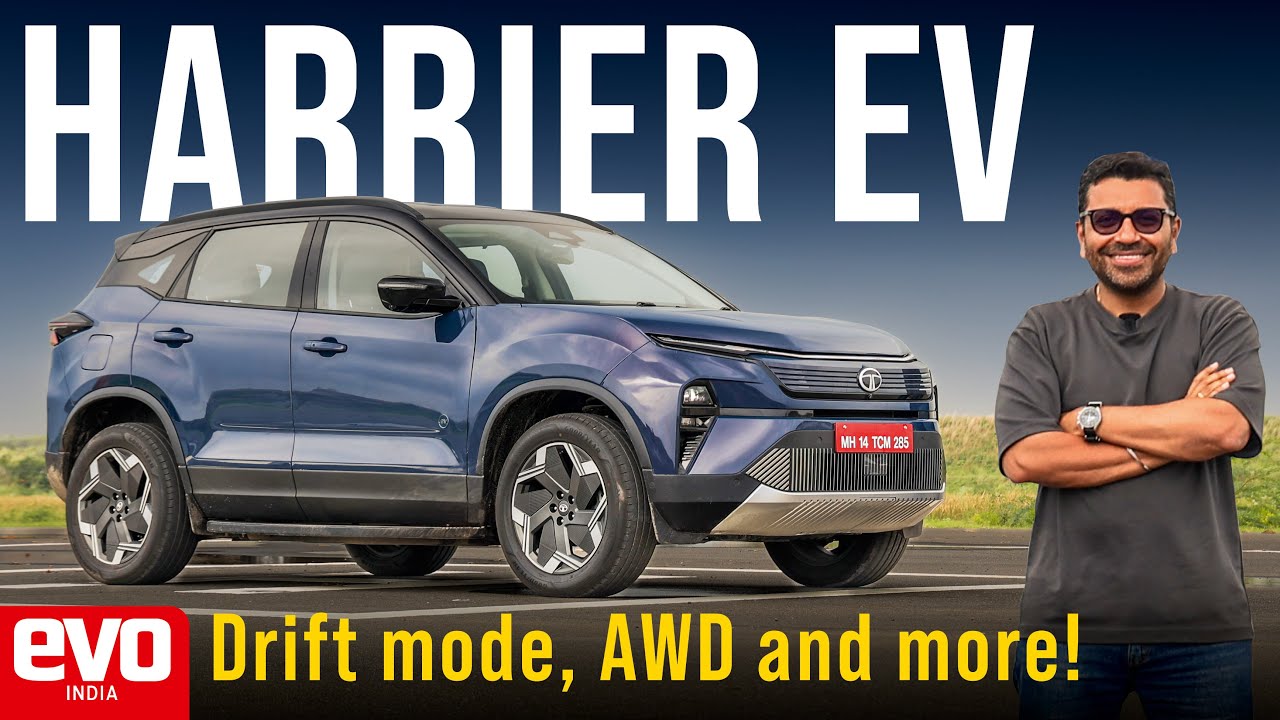
Tata Harrier EV is the best electric Tata today | evo India
This is the Tata Harrier EV and it’s the first Indian car to get drift mode. [Music] What a lo drift mode. Nothing honestly is happening. What actually is happening is every time the rear starts to overtate which is goes sideways the ESP cuts in. Now the Tata guys said that ESP is not fully off because they want to have some sort of safety net. They don’t want idiots doing well what I was trying to do. But honestly why call it drift mode? Because this is not drifting. Maybe on gravel it might and when we went on the off-road course the tail was sliding around a bit in those off-road modes but here with the drift mode there’s no driftings happening. Now, the reason why it gets this so-called drift mode is because the drive goes not to the front wheels, but to the rear wheels. The Harrier EV is natively rear wheel drive, which in effect makes it superior to the Ice Harrier, which is only front-wheel drive. And that’s not it. The Harrier EV also gets the option of all-wheel drive. QWD means quadwheel drive. That is marketing speak for all-wheel drive. And thanks to electric propulsion, all-wheel drive is back in Tata Motors’ portfolio. Moving from frontwheel drive to rear wheel drive means a complete re-engineering of the platform. This is still called the Harrier, but in effect, this could be an all new car because the driving is completely different. The interiors are similar to the Ice Harrier, but you have different colors. So, the Stealth has got an all black interior. The only real difference is this screen 14.53 in. This is a Samsung Neo QLED screen. The first time it is being used in an automotive application. It is powered by Harmon. The electrical architecture obviously an active. Acti.ev architecture with Snapdragon’s digital platform with advanced OTAA capabilities. It’s got JBL’s black speakers, 10 speakers, also Dolby Atmos. It sounds really good. The drive mode selector, well, it’s similar to the Ice Harrier, but it’s similarly fiddly to use just like the Heist Harrier. Multiple drive modes. So, you get the snow grass, mud, rods, sand, rock crawl, and a custom mode. This button here, eco. The rocket like button that is for the boost mode. The running button that is the sport mode. And also, you have the automatic parking. In fact, on the key now, this is a new key. This is the new key. It also has a summon mode. So, you can lock the car and then you can summon it if you’d like, which honestly speaking, it might sound like a gimmick, but I think it’s actually a very practical feature. If you park it in a really tight parking spot, don’t have to worry about somebody else parking close to you and you can’t open the doors. You summon the car. There’s a weird problem though, and that is these front seats, electrically operated, but they don’t slide far back enough. So, my knees are bent. Normally, I like to get the steering wheel nice and close and my feet a little outstretched, but I can’t. And this is kind of cramped. Even when I’m getting in and out, my knees, it fouls with the steering column. Now, this is unique to the EV. The Ice Harrier has no problem in terms of the driver seat position. The passenger seat moves further back, but the driver’s seat, it strangely doesn’t. And this is at the lowest height setting also. Weird. [Music] There’s a completely flat floor, no transmission tunnel, and that tells you this is a new floor plan. So now this is easier for the rear seat passengers also, the guy sitting in the center. And as you can see, the under thigh support is actually pretty good. You tuck your toes under the front seat, you get decent under thigh support. This is actually one of the nicer electric cars to be seated in. Also, the seat backs, the headrests have got these wings. Headroom is also good. I got some this is what 3 4 in of free headroom. You obviously have your panoramic sunroof. So, this is actually pretty good. All versions get a 235 bhp PSM motor on the rear axle. The QWD version adds a 156 bhp motor on the front axle. So for the QWD version, you get a total system output of 304 bhp and 504 Newton m of torque, which is best in class amongst any Indian car. Forget ICE or EV. 0 to 100 in a claimed 6.3 seconds and top speed limited to 180 km/h. Now the battery packs. The base versions get a 65 kWh battery pack and the all-wheel drive version gets a 75 kWh battery pack. Now this is the same LFP batteries with the same cylindrical cells as the rest of the Tata EV range. But Tata’s engineers say they have unlocked 1.5C charging. Earlier it was 1.2C. And how does that help you? In 15 minutes you get 250 km of range. The claimed range for the all-wheel drive version is 622 km. That’s on the MIDC cycle, not the WLTP cycle. But Tata Motor says in the real world, you should get between 460 and 490 km of range. Obviously, not when you’re using boost mode and sending this. Now, crucially, you get a lifetime battery warranty with unlimited kilometers. That is now offered over the entire Tata EV range. And Tata’s marketing people, they say that the sales pickup for the EV range has increased after that lifetime warranty. In fact, they are confident that the Nexon EV will go back to being India’s bestselling electric car. Now, in terms of dimensions, the one crucial aspect is the wheelbase. 2741 mm is identical to the diesel Harrier. Of course, weight is not identical. The EV with the all-wheel drive that weighs 2,335 kilos, 2.3 tons. And when laden, it has a 50/50 weight distribution just like a BMW. So, you get a frunk. On the all-wheel drive version, it is 35 L. And on the rear wheel drive version, you get a bigger 67 L franc, five-star bhat endcap crash safety rating. Tata Motors is committed to making safe cars. In fact, this has seven airbags including a knee airbag. The rear suspension is all new. For the first time on the Harrier, you get multi-link rear suspension. The Ice Harrier, the diesel Harrier, has got a torsion beam. Multilink clearly superior to torsion beam. Also, it has got the FDD dampers which are basically FSD dampers or as Mahindra calls it MTVcl. Basically, what it does is at slow speeds, it gives you better bump absorption and at higher speeds it gives you better stability. How does it work on the road? Well, honestly, it transforms the driving dynamics of the Harrier EV. It is more planted and it is more comfortable. And it’s time now to hit the road. Now, why do I say that frontwheel drive is better than rear wheel drive? When you’re doing these regular cruising speeds, 60, 80 km/h, you’re really not going to make out any difference except for the fact that because it has shifted from frontwheel drive to rear wheel drive, there’s no longer the torsion beam rear suspension. You get independent rear suspension. And that makes a big difference in terms of the ride comfort and also in terms of the stability. So the diesel Harrier, the ice harrier is got a torsion beam rear and that’s not an independent rear suspension. Basically the right and the left wheels, they don’t move independently. Whereas now with this fourlink setup, the right and the left rear wheels, they do move independently. So if the right rear hits a bump and the left rear is on a straight patch, it won’t get jolted around so much. And that’s why over bumpy roads, there is a big difference. Even when you corner in terms of cornering, the ability, the speed that you can take around corners and the stability, that is a significant improvement. Now body roll is not completely eliminated. You do have fairly good body roll, but that’s because T start motor says that they want to make a car that is stable but also comfortable. And honestly speaking, that’s what everybody would want, right? You buy a Harrier not to go around corners like a madman like what I was trying to do when it was in the so-called drift mode. But you want it to be stable, you want it to be quick, you want it to be unfaced by all the stuff that you find on Indian highways. And in that sense the Harrier EV this setup is actually spoton. So you go around corner also there is a fair bit of tire squeal. Now these are obviously eco tires. So they don’t give you as much grip as the regular tires that you and me are used to but it also tells you the limits of grip. It under steers but it doesn’t under steer too aggressively nor does it steer too early. But crucially you’re confident about the car. You’re safe, secure, you’re stable, you’re no longer second-guessing things. This also has the electric power steering. Now, this we saw in the Harrier facelift and that also makes a big difference in terms of how effortlessly this chews miles. And if it can give that realworld 450 km of range, you are in for a treat. This is an EV in which you can actually chew in the miles. Now all your regular driving is going to be in the city mode and here the power is metered out very predictably. It’s not too jumpy. So every time you press the throttle now in EVs you obviously get instantaneous response but this does not snap your neck back. It doesn’t become uncomfortable. Crucially passengers don’t get uncomfortable. So the driver obviously knows what the driver is doing. So your body has already braced itself but your passengers don’t and they tend to get sick with this very urgent, very immediate power delivery. Here it’s deliberately metered out in a more precise and linear fashion. So you do have all the benefits of performance of an EV. This acceleration is pretty darn quick. And I’m in city mode. Put it into boost mode and you can clearly make out the difference in the performance. This is a quick car. No question about it. And it’s quick in a very nice manner. Now Tata Motors in their press brochure, they’ve called it like supercar kind of performance and all that. It’s not supercar kind of performance, but this is actually pretty quick. And if you’re used to like Indian cars now, no Indian car has given you this kind of performance to be honest. Now, how different is the Harrier EV from the diesel Harrier? Now, honestly, I’m real nervous that you guys are going to shoot me, you know, V, Evo, India, thrill of driving and everything. But fact of the matter is this electric Harrier is a better Harrier than the diesel Harrier. A, it is far quieter, far more refined. B, ride comfort is better. C, handling is better. D the performance is obviously so much better. In fact, in every measurable aspect, the Harrier Electric is a superior car to the Harrier Diesel. And the Harrier Diesel, make no mistake, is actually a very good car. My only real criticism on this car is the fact that this driver seat is not moving far back enough. But apart from that, there really is nothing to criticize. Also, the fact that why give a drift mode when it does not drift. This is like this is like you’re getting a banana but you can’t eat it. It’s it’s really I don’t know what you call it, man. It’s quite ridiculous having this and not being able to do anything better not to have it, right? But anyway, apart from that, man, this is this is really really good. This is not cheap but just as a regular car. Forget the fact that is electric or petrol or diesel or whatever but as a regular Indian car this is like one of the high points in terms of Indian design engineering and out and out capability. If it can deliver the range that it claims it’s really really good. Prices start at 21.49 49 lakhs and this fully loaded all-wheel drive version is 28.99 lakhs. Now if you want a 7.2 kW AC wallbox that is another 49,000. If you want your Harrier EV in the stealth mode that is in full black that is another 75,000. What do you think of the Harrier EV? Will you buy this over the Mahindra BE6 or the XEV9E? Let us know in the comments.
The Tata Harrier may have been around for a while now, but the Tata Harrier EV is more than just an EV version of the diesel SUV. Tata has significantly re-engineered the Harrier EV, with the SUV now being natively rear-wheel-drive and coming with the option of AWD. The Harrier EV also gets a more sophisticated 4-link independent suspension setup at the rear, replacing the torsion beam, and it can be had in two battery pack capacities – 65kWh and 75kWh. Editor Sirish Chandran drove the AWD version of the Tata Harrier EV and it produces a combined power output of 304bhp, along with a claimed 0-100kmph time of 6.3 seconds. And it comes with a drift mode! The Harrier EV AWD also gets a MIDC-tested range of 622km and we tell you how different it is to drive compared to its ICE-powered sibling.
#evoIndia #TataHarrier #tatamotors #tataharrierev #SUV #electricsuv #EVs #carreview
Want more #ThrillOfDriving videos? Subscribe to the evo India channel: https://bit.ly/2VfzioP
Read our stories here: https://evoindia.com/
Buy #EvoIndiamagazine here: www.evoindia.com/magazine
Follow us on Instagram: https://www.instagram.com/evoindia/
Find us on Facebook: https://www.facebook.com/evoindia/
Follow us on Twitter: https://twitter.com/evoindia
Official merchandise on 100kmph: http://www.100kmph.com/evoindia