Tata Harrier EV review – The 313hp all-electric Tata SUV | First Drive | Autocar India
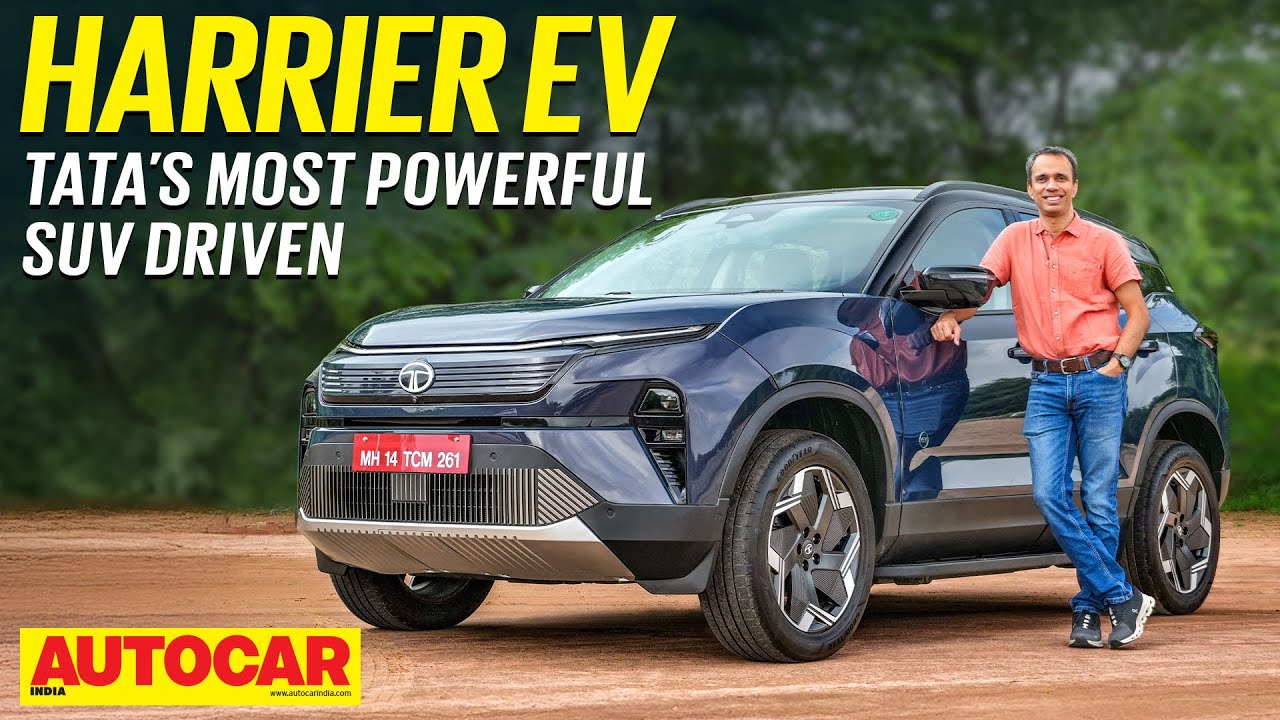
By now you probably know a lot about the electric Harrier. You know the pricing. It starts from 21 to 30 lakh rupees which is a very good price. You’ve seen it outside and in. You’ve even seen what it can do off-road. The only thing left is what’s it like to drive onroad. So today let’s get straight to that and let me summon the Harrier EV for you. Yes, the electric Harrier has a summon mode, which though I have to say does not move very smoothly, but it’s one of the many cool driving features. So, let’s get straight out onto the road. The motor setup, well, the front is a 158 horsepower induction motor. The rear is a 238 horsepower synchronous motor. Now, don’t add the two up because that’s not actually how they work. Quite often manufacturers don’t let both motors give out max power and that’s sometimes for uh handling and balance but also because of uh in this case the EV the battery um discharge rate. So the discharge rate of this battery cannot support all of those horses together. So, the total system power is 313 horsepower. Still plenty. And that Tata says can propel it from 0 to 100 km/h in a very quick 6.3 seconds. And in our initial run, we got 6.67. The brakes though aren’t as quick in bringing it to a halt, and I would have liked a better pedal feel, too. In terms of the motor setup, the rear is the main motor. So, in a two- wheel drive variant of the Harrier EV, you will have the motor only on the rear. Of course, in the four-wheel drive, you’ve got uh obviously both. The rear motor does most of the driving work. So, for example, right now, I’m driving just steadily cruising along at around 60 km/h. It’s only the rear motor that is working. If you put your foot down like this, then you’ll find the front motor also comes in to aid that acceleration and have a smoother takeoff. So your wheels aren’t sort of scrabbling for power or breaking traction. The motors are also very silent and on the whole driving refinement is good. Now the battery on this four-wheel drive version is a 75 kWh battery and Tata claims there’s a 622 km range on the MIDC cycle. Though they also have what they call the C75 range which is basically based on their customers driving data. They think that 75% of customers should see around 490 km. So that’s a real lot and more than enough for everyday use. On our shoot day, we got a 436 km range, which is impressive. Charging too pretty quick on a 120 kW DC fast charger. It can go from 20 to 80% in about 25 minutes. Now, the Harrier gets drive modes. Of course, you’ve got eco, normal, and sport as also a boost mode uh for, you know, a quick acceleration or an overtake. And what’s nice is that the calibration in all modes is really, really spot-on. In fact, right now we’re crawling, as you can see, in some traffic. I’m in city mode. It’s absolutely fine. I’m going to move to sport. Yeah, sport mode. And uh even now it’s not hair trigger sharp the throttle. And I like that because this is a family SUV at the end of the day and it doesn’t need that hair trigger response ultra light throttle. So, you know, it’s it’s just perfectly calibrated. If you do want to get a move on when things clear out, flow the throttle and yeah, you’ll move off. It is on the heavier side. So, if you like that really light uh sort of throttle and you know, tap it and it zooms off, that’s not what you’ll have here. And speaking of uh weight, it’s not just the throttle that’s calibrated that way. It’s the steering too. It isn’t super light. So, you know, around uh let’s say traffic or in uh tight parking spots, uh there is some amount of effort that you do require. But uh I would say it moves from medium to heavy. It’s not really light. So, in that sense, for me, I just like it. The other bit I like is that the ADAS calibration worked very well in our brief drive and there’s even auto braking for low speeds that you can turn on or off. Now with the move to electric motors, Tarta has had to redo the rear suspension and it’s an all independent uh setup and I have to say it’s really really remarkable ride quality over rough roads. Outstanding. It just soaks up everything. uh you keep a steady pace over them and uh it’s it’s almost like there’s a separate layer between you and the roads. Tata calls it ultra glide suspension. And I normally hate marketing terminology because it’s always overhyped, but here I would well give it to Tata because it does feel like you’re gliding over broken surfaces and stripped away tarmac. Potholes, yes, you will feel them, you know, especially the sharp ones, but for everything else, uh, you know, ruts and broken roads, it’s really, really nice. It’s also pliant over the odd trail and there’s a full range of traction modes which we will thoroughly test offroad. So stay tuned to the Autoca India channel. What’s nice is that this doesn’t come at the expense of handling. So around corners for example like this uh you know slightly spirited cornering even if you were to push it a little harder body roll is well contained. So that’s really nice to see. The only area where I can see some criticism with the suspension is on a straight level road with some undulations. There is a little of float from uh the rear axle especially. Let’s head to the rear seats then shall we? Now the ride quality at the rear is just outstanding. Soaks up all of the imperfections on the road, stripped away tarmac and things like that. But on a road like this where there are sort of gentle uh crests and undulations, you can feel that rear heaving up just a little bit. So perhaps with it weighed down, things would be a little better. Coming now to equipment levels. Now at the rear, it’s fairly wellappointed. So, you’ve got a tray here for your phone. Uh, two type-C 65 watt USB chargers and, uh, in case you want to cut the glare from outside and you’re just sitting here baking in the sun. You’ve got these handy sun blinds, too. Uh, there’s also a flip down armrest with some cup holders here. And what I really like to see uh, is this uh, these little extended wings for the head restraint. So, if you’re catching a nap, your head won’t roll off. It’s a little firm to press down or up, but it’s a nice handy touch to see. Really nice. I I like that. Now, seating posture. Well, this is an EV, so the first thing I wanted to see was how do you sit? Is it a knees up position? And I’m happy to say it’s not really. In fact, if you look at me right now, I’ve got my legs fairly level. Uh the floor is flat as you can see here. So, I think Tata have done a good job of space packaging and uh there is decent amount of headroom above too. There’s about a four or five finger gap to the roof liner here. I’m 5’8 for reference. Now, leg room, there is a scooped out portion here for the seats, but there’s also this boss mode, the two buttons here. So, if I want to liberate more room, uh I can do that right from here at the rear. And as you can see, that’s uh plenty of leg room. And I can flip down uh you know, the front as well there. So, gives you a nice and open feel at the front too. It’s comfy and well equipped. Highlights are powered and cooled front seats with memory for the driver, a 10.2 in digital instrument panel, and a center touchcreen that Tara says is the first auto application of a Samsung OLED panel, and it does look very clear. The inner rear view mirror also has a camera feed, which is very smooth and absolutely lag-free, unlike though the 360° cameras, which do stutter a bit. There’s dual zone climate control with toggles for temperature, but not so easy to use touch surfaces for other controls. And on top of course, there’s the crowd favorite, a panoramic sunroof. [Music] So, let’s take a quick tour around the outside. Now, as you’ve seen, it is pretty much the Harrier, but there are a few small subtle changes. Like, for example, this grill area here, it is actually sealed off. And I’m quite happy to see that Tata, despite having sealed off the grill area, has kept these little grooves here. So, it gives it that uh air intake or a grill look. I personally don’t like the sealed off look. So, happy to see that here. Uh the DRLs, they’re on top and extend into this light bar that go right across. And you have the headlamps down below. And of course down here is where you have all of the air intake for the cooling. Now this may share the top hat with the regular internal combustion Harrier but Tata says the bottom half or the bottom floor is all new. And in fact they have an acronym for the new architecture. They call it tidle which is Tata intelligent digital architectural layer. Uh quite a mouthful but what that means of course is they’ve managed to package things in really quite nicely as we’ve seen. Uh you’ve got the front motor, the rear motor, battery in between there, the seating position, quite natural. And you also have a small frunk up here. Uh 17 kgs max is what it says. And it’s quite broad, so you can put uh you know, your charging cable, for example, if you want in here. At the rear too, it’s very familiar territory. But if you look on top at the shark fin antenna, you’ll notice there is a camera there. And that’s because it’s feeding the inside rearview mirror that you saw earlier. You’ve got the spoiler here with a highmounted stop light. You’ve got the LED stop lights here that extend all across and of course the daytime running lamps as well. And down below, no exhaust pipes. Now, since we’re here at the rear, let’s take a look inside the boot. Uh Tata says it’s 502 L of boot space. That may seem more than the regular diesel Harrier, but that’s because 502 is up to the roof. on the diesel Harrier uh it’s around 435 if I remember right but that is still a parcel tray this is actually a smaller boot only by a slight amount and as you can see that’s because of this raised flow here now the flow is raised not because of the battery that’s of course between the uh front and the rear wheels the flow is raised because of the rear motor on the regular Harrier it’s a frontwheel drive so there’s no differential as well so they’ve had to make space for the motor which is down below and what I also like is that Tata has retained the spare wheel too. So it’s a space saver spare but at least you have that. So that has raised the flow a bit but I think that’s a nice happy balance and for me that nicely sums up the electric Harrier. It’s a great balance. Perhaps it should have had more wow factor than its ice sibling but it still looks smart. Power isn’t explosive but it’s plenty and fed out in a nice and strong fashion. The ride gets floaty over crests, but over the rough stuff, it’s simply superb. And body control is also very good. The feature list may not be the lengthiest, but it’s got all the expected widths and a few more, too. And of course, interior space and comfort is good. And then uniquely in this segment, it has the option of all-wheel drive. With prices from 21.5 to 29 lakhs, it’s more attractively priced against its main rival, the Mahindra XV90. So all in all, the electric Harrier strikes a very good balance.
We’ve seen the Tata Harrier EV’s evolution from concept to production car, and also got a taste of its off-road capabilities. But what’s the Harrier EV like to drive on the road, in everyday conditions? Sergius Barretto has the answer.
Cameraperson: Sharad Vegada, Naushad (+ official B-roll)
Editor: Siddhesh Kadam
SUBSCRIBE to Autocar India for the hottest automotive news and the most comprehensive reviews ► http://bit.ly/AutocarInd
Autocar India is your one-stop source for test drive reviews & comparison tests of every new car and motorcycle launched in India. We also offer a great mix of other automotive content, including weekly news, motor show reports, travelogues and other special features.
Website: http://www.autocarindia.com
Facebook: http://www.facebook.com/autocarindiamag
Instagram: https://www.instagram.com/autocar_india/
Twitter: http://www.twitter.com/autocarindiamag
New car reviews ►http://bit.ly/ACI-NewCarReviews
Comparison tests ►http://bit.ly/ACI-Comparison
New bike reviews ►http://bit.ly/ACI-BikeReviews
Features ►http://bit.ly/ACI-Features