The 2025 Toyota Prius Nightshade Is A Spicy AWD Hybrid Commuter Car That Is Anything But Boring
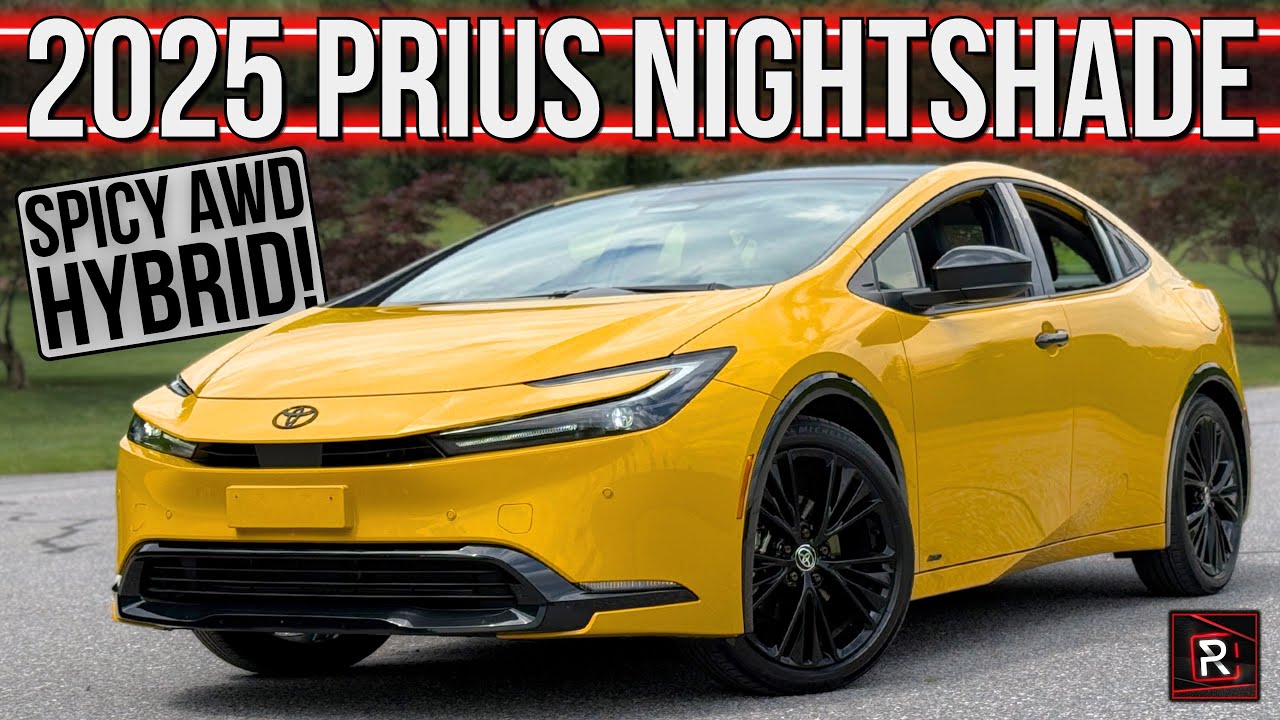
Roughly 25 years ago, Toyota first entered the hybrid vehicle space when they introduced the Prius to America all the way back in 2001. Now, at the time, Toyota was technically a year behind its arch rival, Honda with the Insight. However, unlike Honda, the Prius was an instant sales success with Toyota selling as many as nearly a quarter million units in the US every year. Now, a couple years ago, Toyota introduced an all-new generation Prius finally getting rid of that really ugly looking shape. and its kind of uncool factor with a sleek, sexy, and far more powerful version of the Prius. And as you can see this week, the company has loaned us the latest Prius model. This is a new trim level for 2025 called the Prius Nightshade. Essentially takes the XLE trim of the Prius, adds some black wheels, black accents, and a sportier, darker, sinister vibe, and it’s also painted in this unique color called Karashi, which is essentially a Japanese version of spicy brown mustard. So, the big question I went answered for those of you who are looking for a fuelefficient commuter car with the availability of all-wheel drive and getting over 50 MPG, how does the latest version of the Toyota Prius Nightshade stack up? Stay tuned to find out. Now, before we start talking about the exterior styling for the allnew fifth generation Prius, I thought I’d pop the hood and remind you guys what’s powering this thing. Now, Toyota gave it a significant power boost when this new version came out a couple of years ago, making it essentially the most powerful non-plugin Prius that Toyota has ever made. Now, as you can see underneath the hood, it’s not the prettiest looking engine bay. I’m actually surprised there’s no engine cover underneath here, but what you’re looking at is essentially their fifth generation of the Toyota hybrid synergy drive. I think the company is actually now on their sixth generation that they just introduced on the new RAV 4 hybrid. Uh, however, this model here combines essentially a 2 L naturally aspirated direct and port injected direct injection 4 cylinder uh with their variable valve timing technology. Of course, it is supplemented by three electric motors. And that’s because this model that I’m showing you here is the all-wheel drive version, which means you have two electric motors at the front and a separate e- axle at the back, giving this vehicle a total of 196 horsepower combined. Around 150 horsepower comes from the gas engine alone. And around 111 and another 40 horsepower from the rear electric motor comes from the EV side for a total of 196. That’s an extra two horsepower over the front-wheel drive version. Toyota does not quote a torque figure for their hybrid powertrains. It all goes out through an electronic CVT transmission. Uh, and like I said earlier, this vehicle does have electronic all-wheel drive. It’s an ondemand all-wheel drive system. There’s no separate mechanical linkage from the engine going to the back axle. The back axle is powered exclusively by that 40 horsepower rear electric motor. Now, the electric motors draw their power from a very small 91 kWh lithium ion battery pack. So, this is not the plug-in hybrid model. We’ll save that, of course, for a different review. Um, this version here is rated at 49 in the city and 50 on the highway, around 49 combined. It has a 10 and a half gallon fuel tank. The fuel tank is technically about a gallon smaller for the all-wheel drive versus the front-wheel drive version of this car. Now, Toyota says the all-wheel drive model should be capable of 0 to 60 in around 7 seconds. We’ll try it out when we get this vehicle out on the road. Cruising range should be around 514 miles when you factor in the combined rating with that fuel tank capacity. Of course, that is on regular gas. Top speed for the latest Prius is around 115 miles an hour. And as this car sits, it weighs in at just under 3,300 lb. It’s a good 100 lbs heavier versus the nonall-wheel drive version of the Prius. Now, closing the hood, let’s go ahead and talk about the exterior sheet metal for this fifth generation Prius. As you can see, when this car first came out 2 years ago, it was such a radical departure. Toyota made this car so much more attractive versus the previous generation of the Prius because the car is so much wider. It’s so much lower. It’s so much longer and it definitely looks a lot more sleek, a lot more desirable and less just kind of clown car. It’s it’s much more of a sleeker aerodynamic shape. You can see the Prius was the first vehicle to introduce Toyota’s newest design language with their hammerhead head headlights. You can see there’s an LED daytime running light, LED turn signal, you have an LED projector, uh, low and high beam, of course, in the lower portion. And then down here, there’s an LED accent light. Those are not fog lights. Uh, as you can see, there is a slight little male slit here at the front fascia that functions as a grill because the gas engine will need cooling. There’s more additional functional openings down here. The night shade essentially blacks out the lower uh front splitter of the vehicle. Uh, and it kind of goes interestingly well with the karachi yellow exterior color. You can see that’s for the front license plate bracket. You have integrated parking sensors. No front camera, however, on this car. If you want the 360 camera, you have to buy the Limited model. I really do like the black accents here or the black badging for the Toyota logo obviously. But overall, you can really see that the Prius just looks a lot lower, a lot meaner, a lot sleeker, and a lot wider because it’s a little over an inch wider than the previous generation. Now, moving around to the side profile, you can see the Prius is uh a compact sedan. It competes head-on with vehicles like the Honda Civic hatchback hybrid, of course, with a 108.1 in wheelbase and a 181.1 in overall length. This is actually around an inch or two longer versus the current Civic hybrid, its main rival. Of course, you can really see kind of like that slope, that steep rake for the windshield. And that’s because the Prius has a very slippery drag coefficient. I think it’s like 27 or something like that. Uh, but it also kind of compromises the interior headroom space a little bit, but it definitely gives this car a much more attractive design. You can see the Nightshade package includes these unique 19-in alloy wheels with this kind of like double five-spoke design. It’s a gloss black wheel riding on an interesting tire size, a 195x 50 R19. So, these wheels essentially lower the gas mileage of this vehicle from like 57 combined to like 49 or of course that’s with all-wheel drive. It lowers it down. I think it improves to 52 if you guys go for an LE with the 17in wheels. Uh you can see you have an all disc brake, 11in 11.1 in rotor at the front, 11in rotor at the back. You have an all- independent suspension on this car. And you can see the Nightshade also has that gloss black around the wheel arch trim. There’s a subtle all-wheel drive badge there on the front uh lower portion of the doors. That’s your only indication that you have an all-wheel drive version of the Prius. You can see the night sheet also includes these black mirrors. And my test car for a,000 bucks also has the panoramic glass roof, which doesn’t open up to vent air, but it does let in some nice light. If you guys don’t like this bright yellow color, Karashi again is what it’s called, or it’s a mustard yellow. Toyota also offers the night shade in a white and a black exterior color. The other trims will offer like a red or white or a gray uh as well. But I have to admit, as much as I don’t like this yellow color, it certainly helps this car stand out. But to me, it kind of just reminds me of a taxi cab. Um, you see a lot of Priuses as cabs. However, I feel like a lot of cab drivers are probably choosing a Camry or a RAV 4 nowadays because the, uh, size of the Prius has shrunk considerably on the inside. You can see the rear door handle is kind of hidden there. Uh, which kind of creates a more sportback look. And this is kind of where the Prius’s design, you can see, definitely is a lot more sleek. gets a lot more sporty, which is a good thing. You can see there’s a big slope here coming along the rear uh window. There’s no rear window wiper. The tail lights, you can see, are a full LED. It has that trendy LED light bar. Of course, Prius is boldly spelled out. The back also includes a lot of blacked out badging. There is a subtle XLE badge because this trim is based off of the XLE adding that black, you know, nightshade package. There’s a hybrid HEV badge there with their new Beyond Zero logo. The XLE also includes the um rear parking sensors and a backup camera. Obviously, your reverse lights are down there in the lower bumper there. So, they’re kind of hidden. And then looking at the cargo space, if you guys want a power lift gate, you have to go for the limited trim. The XLE doesn’t include that, but most vehicles in the class don’t have a power lift gate. Um, but as you can see here with the seats up, you have around 20.3 cubic feet of storage space. That is about the same as the front-wheel drive versions. The LE Prius offers around 27 cubic feet of storage space because the sunroof takes up the space. Now, if you look underneath here, you can see there is a little bit of underfloor storage. Um, technically this area here Toyota saves for the battery pack if you guys go for the Prius plug-in uh version for a much larger battery pack. There is a little bit of storage off to the side, of course, in addition to like a pretty decent storage area over here. Although I think this is actually for the 12volt battery, which it’s kind of hard to remove this, but if you want to look behind there, yes, that’s where the 12volt battery uh is hiding. There is no temporary spare tire with this car, so kind of keep that in mind. But overall, uh Toyota does not quote if you fold down the rear seats when it expands the cargo, but I’d probably say it’s like in the 40 cubic feet. Overall, the Civic hybrid hatch offers a little bit more cubic feet, like four more cubic feet, but this is still plenty usable. Just keep in mind that sloping rear end does impede on the maximum cargo capacity. Now, once you get past the very bright yellow exterior color of this particular Prius, let’s go ahead and talk about the interior. As you can see, this is Toyota’s latest intelligent access key fob. Uh, it has Prius on the back of the key to remind you that this is what you’re driving. There’s actually just a very limited amount of buttons, just lock, unlock, and then a panic feature. You can get a power lift gate, of course, only on the Limited trim. Uh Toyota also offers their digital key functionality for an extra 275 bucks. If you’re an owner of the vehicle, you can use your smartphone as a key. That’s a great feature. Some competitors don’t even offer that. Now, as you can see, approaching the door handles, they are gloss black on this Nightshade Edition. If I touch that little area there, that will lock the doors for you. The mirror the mirrors sadly are not powerfolding. Touch the back of the door handles, that will unlock the door. You can hear the car actually has a new chime. That’s the unlock and lock chime, which is definitely nice. I think it uh certainly updates uh that especially when you’re, you know, used to the older system that Toyotas have been known for. Now, looking at the interior, you can see this softex interior is included with the Nightshade edition. Remember, this is bu based off of the XLE, the middle trim. However, with the Nightshade, you can only get it with a black Softex interior with the contrast gray uh stitching and piping as well. The seats definitely have a nice look and feel to them. For a fake leather, they also feel really plush, high quality. They are only a three-le heated. If you’re looking for ventilated seats, you have to step it up to the limited grade at least. You do get a 10-way power driver seat, which is nice. The passenger is just a four-way manual. What you don’t get, however, is the memory functionality. That’s only on again the limited grade. Um, and then looking at the door panels, you can see there’s a soft touch injection molded plastic here, silver painted plastic door handle here. This kind of has a cheap feel around the door handle, of course, but at least it’s nice and padded here where you’d rest your elbows. Window controls are onetouch for all four. That’s a really nice touch. They’re also illuminated, which is great. No power folding mirrors, like I mentioned. Down here, it is hard plastic with additional storage. And then this car doesn’t have the eight speaker JBL premium sound system that you get standard on the Limited grade. So, it just has Toyota’s, I believe, six speaker uh Toyota branded audio system, which is nothing great. Uh I definitely recommend going for the Limited if you guys want that those upscale touches. Now, getting inside, because this car has such a low roof line, you do have to duck your head if you guys are taller, which can be a little bit frustrating uh at times. Once you get in and shut the door, the door, I have to say, does not sound great. It has a very tiny, hollow sound to it. It sounds even worse from the outside of the car. So, that doesn’t really give you a first great impression of quality. Now, getting inside, you can see the start stop button is right here on the dash. Push that button. And because this vehicle is a full hybrid, it doesn’t actually require the engine to come on, which is definitely nice. Um, I do have my garage doors open in case the engine decides to come on to recharge the battery, but this interior really hasn’t changed much from the last Prius that we shown you. If you guys remember, the base versions of the Prius have a smaller 8-in display in the center, while the uh upper trims, like this one that we’re showing you here, has the bigger 12.3 in display, which is definitely a nice touch. This is an extra 750 bucks, I believe, if you want the 12.3 in display. Um, that’s standard on the Limited trim. You can see over here in the instrument panel, you have a 7-in helper display, which kind of sits up high, almost like a heads-up display. This top portion of the wheel, you have to kind of adjust it to kind of be low, which almost makes it feel like the steering wheel is in your lap. I would have liked if Toyota gave gave this car kind of like a squirle, a flat bottom and a flat top steering wheel design. I really also don’t like the way the steering wheel looks. I think it’s an ugly kind of dorky looking wheel. It does have some nice buttons, of course, for your uh Toyota Safety Sense 3.0. You have your audio controls, of course. Your cruise control switches are over here. here. The horn sounds really pathetic and puny. So, uh, some owners may want to change that out immediately. Uh, and you can see in terms of the rest of the materials, there’s lots of cheap hard touch plastic here on this portion of the binnacle going to that instrument panel display. Toyota actually just showed off a new system where they got rid of a lot of this cheap plastic. This area here has a nicer grain, but it’s also hard touch. Same thing, hard touch over here. This portion of the dash, however, is soft touch injection molded plastic, but it also has no graining to it, and it feels pretty cheap, uh, which isn’t great. Uh, this is, of course, their Toyota audio multimedia interface with wireless Apple CarPlay and Android Auto. I’ve shown you this system before, so I’m not going to go into too much detail with it. If I put the vehicle in reverse, you can see there’s your backup cam, which has trajectory, it has parking. I’m sorry, it doesn’t have active trajectory. It just has distance markers. That’s kind of disappointing how it doesn’t have that. I’m assuming if you guys go for the 360 camera, it’ll include active trajectory. Um, but the quality and resolution is average. It’s definitely not great. I also hate how it doesn’t take up the entire screen, which I find to be annoying. Uh there is a little bit of ambient light strip as you can see going across the dash. It’s even on that portion of the driver side dash vent. You have single zone automatic temperature control. There’s no dual zone available in the Prius. That’s something that you can get, I believe, in the Civic. Um so keep that in mind. Um the lower portion over here, you can see this is not your wireless phone charging pad. It’s just a storage area. There’s a little hidden storage underneath here. You’ve got two USBC’s, a 12volt power outlet. The Night Shade includes this carbon fiber look fake trim. It looks like carbon fiber, but it’s definitely just plastic. It’s unique to the Nightshade. Cup holders here, of course, your gear selectors. This little electronic shifter where you push the P to go to park. You kick it over and hold it to go into neutral, push it up while holding it to go to reverse, push, push it back, and then down to go to drive, and then just kick it back to go into the engine braking mode. Um, again, relatively self-explanatory, but it just takes a little second to get used to. Um, your drive mode selector is here. You can see the Prius offers four different modes: eco, normal, sport, and custom. Um, we’ll try out the different modes later on. Electronic parking brake. There is an EV mode where you can lock it in electric only vehicle mode, but only for short distances at very light throttle applications. There’s also a brake hold feature here. Nice padded or relatively padded center console. If you open that up, it’s relatively deep. There’s two more USBC charging ports in there, which is great. And then, like I mentioned earlier, the soft tech seats are comfortable and supportive. I took this vehicle on a long drive, had no problems whatsoever. It is comfortable. You just have to get used to the visibility, of course. The glove box, you can see, is damped. It’s a bin uh style. It’s not lined with felt. Offers some decent amounts of storage. You have an auto dimming rearview mirror, but no camera mirror on this trim here. I do like the way the ambient LED or the LED lighting map lighting looks in here. And then you can see the roof line of this car is definitely low. You can see the there is a little shade here to close for uh the front and for the rear. Uh but for somebody my height at 5’7, I definitely feel the the very low roof in this car. So, kind of keep that in mind if you’re a taller driver. It just doesn’t feel quite as spacious as the previous generation Prius with its much taller roof line. But overall, the interior hasn’t really changed. Again, I personally would go with the Limited trim for a little bit more. But, you know, with the 12.3 in display, the 7-in display here, it certainly looks more spaceshippy, futuristic. It just doesn’t have a luxurious, you know, sophisticated feel like the Civic Hybrid. Uh there wasn’t really many squeaks and rattles in this interior. Uh, but overall it feels a little bit economy carish mixed in with um some decent tech with the larger 12.3 in display which is 3 in larger than the display in the Civic Hybrid. But let’s go ahead and hop into the back seat area. You guys can see what that space is like. You can see the door handles here are hidden to kind of create that coupe-like look. You push that little pressure pad, it opens up the door. And then when you open up the door, you can see the rear seat is definitely not huge. The door could open up a little bit larger. And Toyota says you have around 34.8 8 cubic or inches 34.8 inches of legroom back here, which is not bad, but it is around 3 in less than the Civic hatchback and sedan. The headroom space is also pretty compromised. Toyota says you actually lost around an inch of headroom compared to the previous generation. Material quality back here is hard touch plastic, so it is downgraded slightly. You do have some uh silver painted plastic door handles, some more of that cheap plastic trim here. Nice padded here where you rest your elbows. Like I said earlier, window switches are one touch up down, which is a nice touch. And then these seats, they obviously fold down to reveal, you know, a little bit expanded cargo capacity. Almost a flat floor as well, which is nice. They don’t recline, however. But once you get back here, you can see the space is uh usable for an average size adult. You can see uh this is essentially my driving position. I have good foot space underneath here. The floor is not completely flat, unfortunately. You do have two USBC charging ports. No rear seat air vents. You can’t get that on any version of the Prius, even the top Limited. But you can get heated rear seats on the Limited, just not on this trim. You have one storage cubby here. Uh, and then you can see if I want to get back here and cross cross my legs, I can, but it definitely feels a little bit tighter along with this roof line that’s kind of really down low, so you kind of have to keep that in mind as well. You do have LED map lighting here. And there’s also an armrest that folds down. This is where you’re going to find your two cup holders. The headroom space, as you can see, at 5’7, I have maybe just like an inch of clearance. So, this is not a lot of headroom back here for somebody that’s short like myself. So, kind of keep that in mind. If you guys are looking for a hybrid vehicle from Toyota that has more space, you should definitely check out the Camry uh and the RAV 4. And those vehicles have pretty similar efficiency and also more power versus the Prius. So, it’s hard to believe that it’s been nearly 2 years since I’ve been behind the wheel of the latest generation Toyota Prius. Remember, when this car came out in 2022 as a 2023 model, it was such a radical change for Toyota. They finally made the Prius cool, sexy, desirable, sporty, even, and quick because they seriously gave it a huge bump in power. They finally gave the all-wheel drive version some decent electric motor power at the rear axle. And you can take your pick between the regular Prius and of course the Prius plugin, which has been renamed to the plug-in, uh, no longer being called the Prius Prime. So, the one that we’re driving here is a new model, a new trim for 2025. It’s the night shade in this rather interesting color called Karashi, which it’s also called mustard in the US because Karashi is basically the Japanese word for mustard. And the model that we’re driving is the all-wheel drive version. The last one that I tested was technically a front-wheel drive variant. And with 196 horsepower, it has two more horsepower than the front-wheel drive version. It has four less horsepower than the Civic hybrid, its main rival. Uh, and the last front-wheel drive one that I tested did 0 to 60 in 6.9 seconds. The last Civic hybrid that I tested did it in like 6.4 seconds. So, I expect this car to be um pretty much around the same speed as the uh front-wheel drive version. So, let’s go ahead and see what we can get 0 to 60 wise here. We’re going to go ahead and just floor it from a stop here and see what we can get. Not the most pleasant sound, but we got 7.26 seconds there. So 7.26 means this model is around.3 seconds slower than the front-wheel drive version, which doesn’t surprise me. It only has two more horsepower and it’s also around 100ish pounds heavier. That time is still excellent for daily driving. I mean, yes, the Civic Hybrid will mop the floor off this car. The Honda is just honestly the speed king at 6.37 seconds is what I got on the last Civic Hybrid. It’s faster than a Civic SI. But still, remember the previous generation Prius was notorious for like a 10-second 0 to 60 run. So, this is just a huge improvement in terms of acceleration, in terms of power. Uh, and I think with the addition of all-wheel drive, which you can’t get in the Civic, it just makes the Prius a lot more desirable for some people. Let’s try another run here. This time it’s slightly more uphill. The transition between gas and electric only power is just so seamless. Toyota’s really good at this. 7.79 seconds there. That’s with it more going slightly uphill. So, in reality, you’re going to be doing in the low 7second range to mid 7second range in this car, and that’s perfectly acceptable. Priuses aren’t made for drag racing. But at least if you guys are a Honda fan, you’re going to, you know, take some comfort in the fact that the Civic is the drag uh the drag king winner here compared to the Prius. If you pull up next to a Prius in your Civic Hybrid, you have no problem smoking that car, which is kind of just shows you how powerful Honda’s new hybrid system is. It’s actually very good, even if the Civic Hybrid isn’t quite as fuel efficient supposedly on paper, which I’ll talk about later on as the Prius. But as you drive the Prius around normally, this is where Toyota’s hybrid system, their fifth generation shows, you know, Toyota is very much in keen with how a hybrid powertrain should work. There’s just very little delay between the, you know, transition point of electricity to gas. The CVT does a good job at just increasing the engine revs to give you that maximum power. And with the electric motor torque, the electric motor delivers like 111 horsepower on its own. Um, the gas engine’s like around 150 horsepower, 194 combined. There’s never a full like straight edition here. Uh, this car actually feels quite peppy. It just has a noisy engine. Toyota’s four-cylinder hybrid powertrains have always been a little bit on the noisier side, and that’s very much the case here. This is actually noisier than their bigger 2 and 1/2 L engine. And what I’m also noticing with the new Prius is there’s tons of road noise coming in. So, there’s tons of road noise, tons of engine noise. It’s just a little bit of a racket in this car. Yeah, putting your foot down there, you can feel that it primarily feels frontwheel drive bias until the front wheels slip. The rear axle then will just essentially kick on because the rear axle offer offers around 40 horsepower on its own, which is not a lot, but it’s enough to get this car going just fine. And I think for most people, you’re going to really appreciate how you have the added traction here that you cannot get in a lot of the competitors. Toyota has the edge here by offering all-wheel drive with their hybrid powertrain, which is a nice thing. Let’s try one more run here. This time we’re going to brake torque it and see what we can get. It almost felt like it slipped there, which is kind of interesting. 7.35 seconds there. So, we’ll take the 7.26 is our quickest time. It is a shame that the all-wheel drive version is a little bit slower, but when you add extra weight, 100ish pounds, and then you only have two more horsepower, it doesn’t surprise me whatsoever that the all-wheel drive version is a tad slower. It’s kind of funny how the Prius will easily spin its tires now. You could never do that before in the previous generation. And you also have pretty surprisingly good handle handling. The steering in this car is relatively quick and precise. The body is just so soft and squishy, which does translate into a good ride quality. The Prius has a cushy ride, which I think a lot of people are going to appreciate. Um, it just kind of soaks up the bumps nicely. Even though we’re on these big 19-in wheels, it feels good. Uh, as I make turns here, the Prius feels playful, although definitely not as sporty as the last Civic Hybrid that I tested, but it’s not like a really far race. I mean, the the Civic feels really agile, feels like it has hints of fire from the Type R, while the Prius is still surprisingly good. I mean, they’re to this car, the chassis is begging for an even faster GR version. If Toyota did a GR Prius, all hell is going to break loose because I think that would actually be quite hilarious. This night shade with the black wheels um and this bright yellow color certainly kind of hints at a sportier version of the Prius, which it’s technically begging for. I mean, the Prius plug-in hybrid offers 220 horsepower. I would love to see Toyota do like a the RAV 4 uh plugins powertrain in this car doing over 300 horsepower. That would be kind of hilarious if they did that with all-wheel drive. Not really holding my breath for anything like that. But again, the Prius has, you know, gotten so much better over the years, and that’s precisely why Toyota, you know, decided to go with this sportier, sleeker, more sophisticated direction. Now, let’s go ahead and talk about the visibility in here. The visibility in the Prius is definitely not as good as the Civic. You have this very steep rake of the windshield along with this very expansive long dash. You do have these helper mirrors here to kind of help you see out of the sides. The view out of the back is compromised from that sloping small window. But you can get the Prius with like a 360 camera, a digital camera rearview mirror, which is all unavailable on the Civic. My nightshade edition is missing all that. You can get it on the Limited. Highly recommend those features if you guys plan to use this as your daily driver. But once you get used to the sight lines in here, it’s not horrible. It’s just not as comfortable and easy to drive as the Civic. You do have really comfortable seats, though. I love the seats in this car. Plush, soft, they’re heated. Uh, and you have a 10-way power adjustment for the driver’s side. no memory function. You have to go for the Limited. The Limited also includes ventilated seats, which I would highly recommend. You can’t get that in the Civic. So, there are some features on the Prius that make it more desirable than the Civic. And then, of course, there’s the million-dollar question there is the gas mileage. The Prius is far more fuel efficient in the real world testing versus the Civic Hybrid. Uh, the last Civic Hybrid that I tested got around 46 MPG in the city and 39 on the highway. Far low, far below what the EPA says. This car, however, is rated at 49 in the city, 50 on the highway, or is it the other way around? I can’t remember off the top of my head. I’ve been averaging in mostly city driving, 49.6 MPG, which is excellent. It is a little bit less, around 5 MPG less versus what I got in the front-wheel drive model. So, keep that in mind. The front-wheel drive is going to be more fuel efficient. Uh, on the highway, this car was doing around 46 miles to the gallon. So, still not wonderful on the highway. in the city, it’s going to be more efficient. But, uh, with its 10 12 gallon fuel tank, you can easily do around 500 miles of range on a full tank. Again, small 10 and a half gallon fuel tank, it’s really cheap to fill this car up and it goes a long way. So, that’s one of the reasons why people love Priuses for their long driving range and cheap fill-ups. It’s just a really easy car to drive. You can drive this on the highway. You just have to get used to the noisiness of the engine and the noisiness of the road noise and whatnot. So, that’s kind of where the Civic feels like a more mature, more sophisticated car. But the Prius offers some strengths here with some tech features that are unavailable on the Civic. All-wheel drive that’s unavailable on the Civic. A pano glass style roof that sadly doesn’t open up to vent air. But still, there’s plenty to like here with the Prius. And you also have a much larger infotainment system than the Civic. So, my recommendation, try both of them out. There are definitely pros and cons to having both. Um, I personally think I like driving the Civic Hybrid more, but I think if I was going to live with one, at least in my area, the availability of all-wheel drive in this car and the better realworld gas mileage that I’ve got kind of gives me a slight edge over into the Prius. I wish that Toyota would add better sounding materials, but I guess that’s why they want you to buy a Camry hybrid. A Camry hybrid is a little bit more and it’s a little bit quieter. Uh, gets has more power as well. It’s going to be quicker, slightly quicker than this car. I think I got 7 seconds in the last Camry hybrid. Overall, this is definitely still a very attractive car, a very uh interesting car, a sleek and sporty car even. And I’m just happy that Toyota kind of made the Prius so much better. And it continues to be one of the best hybrid fuel efficient commuter car offerings that you can buy. Now, with just over 44,000 units sold in America last year, the Prius has been enjoying some improved sales ever since this generation first came out. Now, obviously, it’s still a far cry versus the quarter million units that they did back in 2010 to 2014, I believe. But again, that was a time where Toyota essentially had a Prius family. And I’m assuming they kind of locked it in together with the Prius V and the Prius C. But I have to say, after spending a week with the latest version of the Prius, the Nightshade model, this is still a very desirable, you know, commuter car that no longer feels like a penalty box, especially if you guys are trading in your previous generation. As you guys saw, the fifth generation of Toyota’s hybrid synergy drive delivers 0 to 60 in around 7.2 seconds. The front-wheel drive model, I can now confirm, is actually slightly quicker, but this is only around.3 seconds slower. Uh, and I think with the additional all-wheel drive traction, it certainly should be, you know, a nice, you know, selling point for a lot of people who need that all-wheel drive availability. Fuel efficiency also is pretty strong. Right around 50 MPG and mostly city driving is excellent. It’s around 5 MPG better versus the last Civic hybrid that I got. On the highway, I was getting around 46 45 MPG, you can easily do around 500 miles of range on a full tank on this car. And with that really small gas tank, fill-ups are going to be extremely cheap. The downside of course with the current Prius is while the ride is comfortable and the handling is relatively sporty, so for a Prius, the uh noise levels are kind of high. The engine is kind of droney and loud and buzzy while the road noise is also higher. So, kind of keep that in mind. Other Toyota hybrid models like the Camry and the RAV are going to be a little bit more refined in that regard. While the back seat space is also tight in terms of the legroom and in terms of the headroom space, which you’re going to find a lack of headroom even in the front seat area. The cargo area is usable, but again, it is far less practical versus the previous generation. Toyota was willing to sacrifice that practicality in, you know, pursue of a sexier shape, which I think is the right move because they have so many different hybrid options. Now, if you guys, you know, don’t want to be driving around in a Camry or a Rav 4 and you are dead set on a Prius, what’s it going to cost to get into this model? Well, base pricing for the Prius has held pretty steady. A basele version with frontwheel drive starts at just over 28,000 bucks at around $1,400 if you guys want all-wheel drive. Most of you are going to step it up to the XLE trim, which is a couple thousand more. Uh the nightshade package again base is based off of the XLE but adds those black accents, the carbon the fake carbon fiber trim, the black wheels, uh of course uh and basically it starts around $800 higher versus an XLE. So it seems like a worthy upcharge if you guys want the nightshade package. I just kind of think Toyota should offer the nightshade on the Limited trim as well. You should have the option to basically pay 800 bucks and add them to the XLE or the Limited trim because there are some features on the Limited that I would like. But I definitely like the black accuracy you get with the nightshade package. My test car here with all-wheel drive and the upcharge for the panoramic roof and the 12.3 in display sticker stickers for around $36,800 bucks. So just under $37,000 makes this a couple,000 more expensive than the last Civic Hybrid Sport Touring that I tested. Now the Civic, while it did have a little bit more power and had quicker acceleration and also had more space on the inside, it lacks some of the Prius’s tech features. So, you can’t get a panoramic glass roof on the Civic. You can’t get a bigger 12.3 in cluster. You can’t get all-wheel drive. And then, of course, if you want the limited Prius, you can get it with heated and cooled seats, a 360 camera. None of those features are available on the Civic, which if you want all of them on a limited Prius, it’ll cost you around $40,000, which is a good five grand more. But I suspect that most people at Honda would pay that if Honda would just offer those features. But again, they kind of gatekeep some of those things because they want it to, you know, be for an Acura product. But with all that said, I do find the Prius to be extremely likable still. And it really just is going to come down to your personal preference. If you’re okay with the higher noise levels here with the engine and road noise, but you need the all-wheel drive, and you also want better real world MPG, this is definitely the one you want to get over the Civic. But to be honest, both of them are my two favorite vehicles. It’s just going to come down to what your specific needs, wants, and price uh range is going to be. With all that said, hope you guys have enjoyed my full overview on the brand new 2025 Toyota Prius in this Nightshade trim level. If you’re also looking to see the latest cars I’m testing, be sure to follow me on Instagram at redline_reviews. Like us on Facebook, and as always guys, please keep subscribing to the Redline Reviews YouTube channel for all the latest reviews. Thank you so much for watching. I’ll catch you all in the next video. [Music]
Toyota’s all-new #Prius has been a big hit for #Toyota when it was introduced 2 years ago. For 2025, the #ToyotaPrius gets extra spicy with the return of the #PriusNightshade trim. The #ToyotaPriusNightshade is based on the well-equipped XLE trim with unique black accents and a very spicy looking color called Karashi, which is a Spicy Mustard in Japanese.
We’re also on:
Instagram: https://www.instagram.com/redline_reviews
Facebook: https://www.facebook.com/liketheredline
Twitter: https://twitter.com/tweettheredline