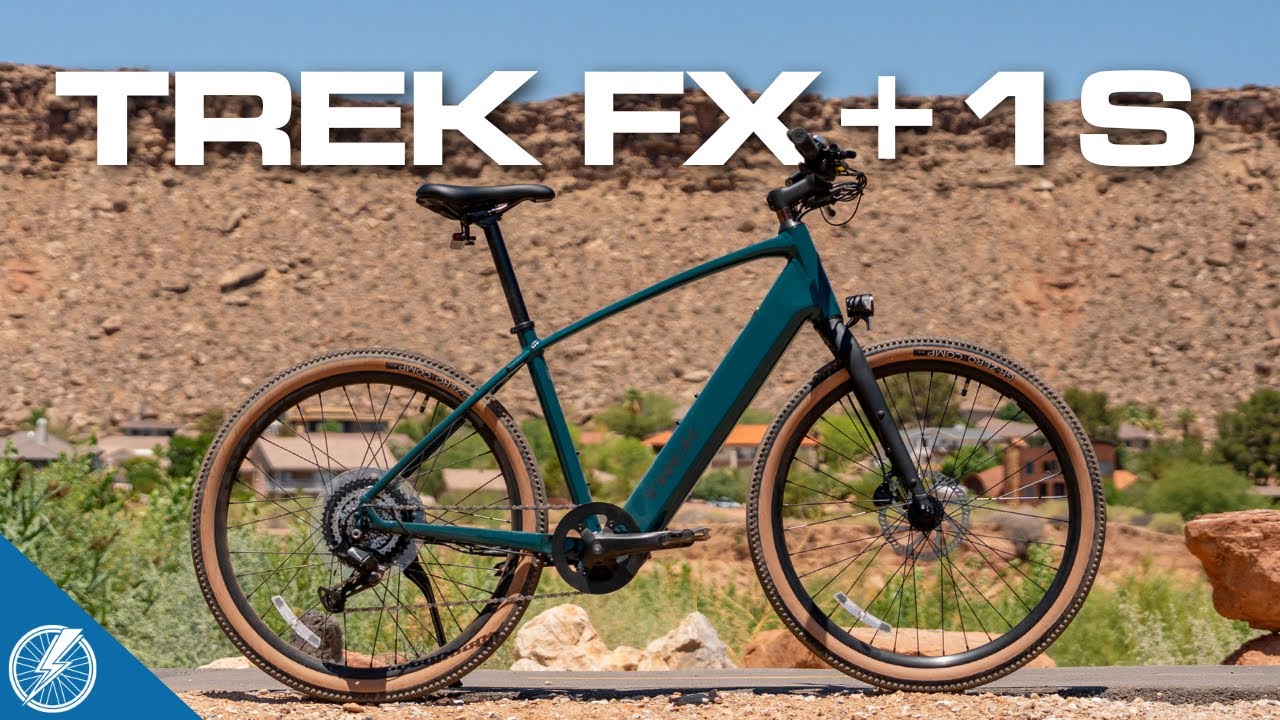
Trek FX+ 1S Review | Legacy Meets Affordable Lifestyle
The TRE FX Plus1S is kind of a gamecher. This brand’s previous ebikes stuck to pedal assist only, but this is one of two new models from TRE that includes a throttle, meaning that even one of the big dogs in the industry has acknowledged the popularity of ebikes that offer a more relaxed approach. There’s a lot more going on with this bike than just its throttle, however. So, what were our favorite features? Let’s take a ride and find out. Heat. [Music] Heat. [Music] [Music] Welcome to Electric Bike Report, where we perform realworld testing with every ebike we get our hands on. I’m John and I’ll be your host for this review. Before we get into the fun stuff though, I want to remind you to subscribe to our channel, especially if you’re in the market for a new ebike. We share data about every bike’s performance to give you a better idea of how it compares with similar models on the market. And while I’m not a betting man personally, I think you’ll want to be able to find your way back later on. And then, if we’re able to help steer you toward a bike, please do us a favor in return by using the link in the description below when you make a purchase to help support our time and effort. Those things out of the way, we’ve got a lot to talk about with the FX+1S. To start things off, there are two versions of this bike. The standard is the FX+1, which has a 20 mph speed limit for both its throttle and pedal assist system. The model we tested was the FX+1S, which has the same throttle speed, but this version can pedal up to 28 mph, making it a class 2 and class 3 ebike. Speed is really the only difference, but do keep in mind that we’ll talk strictly about the faster version of the bike that we have here. Either way, the pedal assist system is a really big highlight in my mind. The FX Plus1 has a 500 W rear hub motor with a torque sensor, which can give you more power when you pedal harder or vice versa. Even in the lowest assist level, the motor kicks out a pretty significant amount of power. We’ll see more about that later on. So, pedaling is both easy and responsive. I think it strikes a really good balance between giving you an active ride that still feels like an ebike. Another thing that stood out to me was the Trek Central app that pairs with this bike and many other Track models. It gives you the ability to tune the motor output and the torque sensors responsiveness. Plus, you can get turnbyturn navigation. You can track ride data. You can download maps to your phone so you always know where you are. And the map even shows a visual representation of how far you can ride based on your current charge level. This is one of the most useful apps I’ve tested, and I just think it really adds a lot to the overall user experience. The last thing I want to touch on before we get into the details is the bike’s comfort and handling. Like most City ebikes, the FX Plus1S has a rigid alloy fork, which helps to make its steering super crisp and precise. Unlike many similar bikes we’ve tested with relatively narrow tires, this one has 50mm wide tires which give it a lot more stability and cushion, the tires also have a unique hybrid tread pattern that makes them just as suitable for riding on dirt and gravel as they are for the street. Running through the FX Plus1S’s specs and components, the frame is made from aluminum. The motor I mentioned is manufactured by Hyena, and it’s paired with a fully internal 48vt 520watth battery. The bike’s drivetrain is an 8-speed with a 40 to chain ring, an 11 to 45 to cassette, a KMC chain, and a Shimano Essa derailure. It has a hydraulic disc brake system from Rush that pairs two piston calipers with 180 mm front and rear rotors. The tires I mentioned are the GR0 model from Bontrager. They’re 650Bx 50 mm, which roughly translates to 27 1/2×2 in. The tires are just one of many parts on the bike that are made by Bontrager, which is a subsidiary of Trek. That long list also includes the FX Plus1’s handlebars, its ergonomic rubber grips, its sport saddle and seat post, its plastic city pedals, and its stem. The bike has four frame sizes in total, and the specs for some of those parts change depending on the frame size you choose. The small and medium frames have some shorter components, while those under the larger frames have longer parts. So, the seat post is either 330 or 400 mm. The handlebars are either 690 or 720 mm, and the stem is either 80 or 90 mm in length. There’s also an integrated light system with a 60 lux headlights and a tail light with turn signals and brake lights mounted below the saddle. Moving up to the cockpit though, the bike’s rapid fire shifter sits on the right handlebar next to a module for the turn signals. And there’s a combined display and control panel on the left side next to the throttle lever. I’ve got a few final details before we move on. The FX Plus1S is UL2849 certified. We weighed our test bike at just under 50 lb. It has an advertised weight limit of 300 lb, which includes the weight of the bike. So, realistically, it can carry 250 lb. It comes in both mid-step and high-step frame styles with each having two color options. The high-step we tested comes in this green color called juniper as well as a black paint job called dark star while the midstep comes in juniper or era white. That should cover everything though. So, let’s keep things moving and get onto our test sections. [Music] Back in the overview, I mentioned that the FX Plus1S has a hydraulic disc brake system from Rush. We tested its performance in our brake test by riding up to 20 mph, applying the brakes, and then measuring the distance the bike traveled before coming to a complete stop. My fellow reviewer, Griffin, did this test, and he repeated the same process three times, and then averaged the results for a final score of 20 ft and 10 in. I compared that result with a handful of similar bikes we’ve tested. Those bikes had an average of 23 ft and 1 in, making the FX Plus1 S’s result over 2 ft shorter than average. Most similar bikes in the city category we’ve tested have used smaller 160 mm rotors, but this bike was on the heavier side in comparison. So, I was happy to see that it had larger 180 mm rotors to compensate. And to be clear, this bike is still relatively light in the grand scheme of things, but it’s larger than average motor and battery do add some weight. We’re not as familiar with these brakes as others, but clearly they did very well in this test, and I thought they felt great during my own time on the bike. I did notice that the tires seem to skid fairly easily, which makes sense considering the band of smooth tread down the center. But the fact that the tires are uncommonly wide also likely helped slow the bike down a bit faster than average. Bottom line, everything checks out here. So, we consider the FX Plus1S to be well equipped with safe and effective brakes. I performed our speed test with the FX Plus1S, which consisted of two parts. First, I pedal the bike along a flat section of our local shared use paths while stepping up through its three pedal assist settings. And second, I tested its throttle from a dead stop to see how quickly it could get up to 20 mph. Let’s go see how the tests went and then we can go over the results once we get back here to the studio. All right, we are here for a speed test on the FX Plus1S and uh starting things off with no pedal assist. You might notice that I’ve got a different app pulled up than usual. This is the Trek Central app that we’re going to be talking about quite a bit. Uh we’ve already touched on a little bit, but anyway, it uh gives you a little bit more granular control over uh monitoring your speed than just the single digits on the uh bike’s display here. So, you can see that we’re going uh kind of between 12 and 12 mph with only leg power. There’s a power meter here that shows you that, too. And you know, I’m definitely putting in a little bit of work, but nothing too crazy. Let’s go ahead and go up to eco, though, which is the lowest power level. And wow. Uh, yeah, that power really ramps up smoothly. The motor is super quiet. I don’t know if you’re going to be able to hear it. I’m definitely feeling it. Um, I can barely hear it, though. So, definitely feels fairly peppy and powerful in this setting. and obviously making a pretty big difference in speed as well. So, we’re going kind of between 16 1/2 and 17. I will say pedaling got very easy right away. All right. Yeah, that’s pretty consistent. Let’s go ahead and go up to the mid power level again. Ramping up very smoothly and pretty quietly. There’s a little bit more noise from the motor here, but it’s still just a very low hum. Uh, don’t know if you’ll be able to pick up on that, but yeah, speeding us up very quickly and easily up to uh, let’s see, 7th gear between 22 and a half and 23. That seems uh, pretty consistent. Yeah. Well, yeah. 22 and a half to 23. All right, let’s finish things off in the high power level. And the sensation of pedaling feels pretty similar, but I can tell that I’m moving a lot faster. I’m getting a lot more power. I am going to shift up to eighth gear here. So, okay, we are going around 27ish. Kind of jumping around a bit, but let’s see if we can reach 28. Put in a little bit more leg work here. All right. Yeah. And we are getting to that level here. Working for it a little bit, but not too bad. We are cruising pretty fast. So, all right. Yeah, everything looks good here. Let’s uh go ahead and check out the throttle. All right, the last thing to do here is a throttle acceleration test from 0 to 20. Let’s go ahead and start in 3 2 1 go. Oh, all right. Nice gradual start. Nice and safe and then picking up pretty quickly. 15 17 19 and 20 and maybe a little above. All right. Well, let’s bounce back to the studio. Before we get into the analysis, let’s quickly run through the numbers one more time. So, I started off with no pedal assist at an average of 12.4 miles per hour. And then with the motor engaged, I pedled up to 16.8 mph in eco, 22.9 in the midass assist level, and finally 27.8 mph on average in the high assist level. Looking at a graph of that data, you can see that my average speeds ended up in a relatively linear pattern, which reflects very consistent increases in speed and power. I really wasn’t surprised to see this show up in the data, though. Even by feel, I thought the three modes felt really well balanced and intuitive. As you can see in the video clip, I was really impressed with the nearly silent nature of the motor, and I really like that even the lowest assist level had some serious pep to it. I actually spent most of my time on this bike in eco mode, which isn’t something I can say about most bikes out there that I’ve tested. It was definitely fun riding at faster speeds using the more powerful assist levels, but I thought eco felt great for casual cruising. Then mid felt ideal for getting around a bit faster when I was in a hurry, and the high mode was best for reaching top speed and pedaling up steep hills, although I didn’t encounter too many that I needed that much power for. In the throttle acceleration test, the bike started gradually and then picked up speed steadily. So, it felt safe and controlled, but also plenty capable. All in all, everything looked great here as well. So, let’s keep things moving and find out how the FX Plus1S did in our range test. We tested the FX Plus1S’s range in two range tests designed to find its minimum and maximum range. We started off with a full battery and rode on our local bike paths until the battery died. And we used the eco assist level for one test and the high assist level for the second. The distances we ended up with were 33.4 and 51.9 mi, both of which are above average when compared to similar bikes we tested. The pool of bikes we used for comparison averaged 22.1 and 47.1 mi. So there was more difference between the high power test results and a bit less difference between the low results. On the high end, the main difference between this bike and others seemed to be battery capacity. The FX has a 520watth battery compared to the average of 345watt hours among the models we’re comparing it against. We stuck with the 20 mph speed limit on our shared use paths. So, we weren’t burning through as much power as we would have if we’d been pedaling faster. Because of that, it seemed to use about the same number of W hours per mile as those similar bikes were using for comparison. So, this bike’s bigger battery just kept it going longer. On the low end, the difference between results was smaller because of the above average power output in the Trek’s lowest assist level. Again, looking at W hours per mile, this bike was a bit less efficient than average, but its large battery still gave it a slight edge. A potential range of between 33 and 52 mi is great for a few reasons. First, Tre advertises a range of up to 50 mi, which is clearly pretty accurate. Second, most riders we interact with have commutes that are below 20 mi, so we’d expect at least a couple of round trips if you fall in that category. And then third, if you’re using this bike for leisure, you should be able to get in quite a few shorter trips before needing to recharge. Speaking of charging, the charger that comes with this bike is super cool and it’s worth talking about. It’s called the Easy Mag charger because it has a magnetic lead that connects to a port on the down tube. This is by far one of the easiest chargers I’ve used. It just basically sticks right on and I didn’t have to fiddle with it to get it to line up properly. It’s also made to be really convenient because it can mount to a wall. And it has a super cool light ring with bars that illuminate as the battery charges, so you can very easily look at it and see where the charge level is without having to turn on the bike. There are some other cool battery related features that we’ll talk more about later when we get into the Trek Central app. But I do have one downside to bring up that relates to charging. Now, this isn’t uncommon among city bikes, but the fact that the FX Plus1’s battery is fully internal means that it can’t be removed for charging, so you’ll need to bring the entire bike inside. But that aside, there’s one more cool thing about the charger. It puts out 2.7 amps, so it’s pretty quick. It can power up the battery in about 4 hours, so you won’t have to wait that all that long before you can hop on for another ride once the battery actually is depleted. And if you still find yourself with some range anxiety using only the standard battery, the FX Plus1 is compatible with a 250Wh external range extender battery that we estimate would give you another 16 to 25 mi based on our test results. [Music] Our new and improved hill test takes place at a location we’re calling the Devil’s Backbone. The route there is paved. It’s a half mile long and it has an 8% grade. So, it’s a good endurance test for an ebike. Let’s go see how the bike did when our rider Justin put its throttle and highest assist level to the test. And I’ll go over the results with you once we get back here. Good morning everyone. Today I am on the Trek FX+1 and it has a throttle. It’s been a long time since I Well, I don’t think they’ve ever put a a throttle on a bike. So, this is kind of momentous. So, we’re going to see if it makes it up. This style of bike generally does not. It felt decent out of the get-go. Um, we’re starting to slow down a little bit here. 14 mph, 13 mph through this first hill. Again, this style of kind of lighter weight city commuter bike doesn’t usually make it up on throttle. Um, newer test hill, so maybe I’m wrong, but in the bikes I’ve tested so far, that stayed consistent. Um, so this next section here, we’re about 13 mph. Holding nice and steady, actually. 12. Doing better than I expected out of the gate. Um, so 12 mph coming through the turn. I’m not going to have to slow down too much. Not going to have to break, but did pull off the throttle just a little bit. So, we’ll see. This might This might make it up the hill. Um, so hitting this first lamp post, still holding at that 12 m, 13 mph speed. Motor is very quiet. So, I’m loving that on this motor. Definitely hearing that hub clicking more than anything else. I’ll let you listen now. So yeah, I mean I’m down to 10 miles per hour. Um but definitely still moving and you’re just not you’re not going to hear that motor at that speed um very much. So if I I don’t think you’re hearing anything on the GoPro. It’s very light for me. But feeling pretty good. This is a longer test on throttle, which can be more stressful overall given that it’s just fairly steady consistently uphill. Um, but barring something crazy, I think we’re going to get a finish here. We’re going to get a score and be able to take this back and compare it to other similar bikes. So, well done on the Track FX Plus1 with throttle. All right, we are back out now on the Track FX+1. hit about 17 18 miles per hour before this first steep section on the pedal test. I am in sixth gear and we’re going to see how this this does. It did definitely better on throttle than I expected. Um I don’t have very high expectations on a again super lightweight city commuter like this on either of these tests. So far feels pretty decent as I hit the second steep section about 15 14 miles per hour. Going to downshift to fifth here. Feels a little more natural in that gear. I will slow down just a little bit. Tap the brakes to make this turn onto the bike path. Downshifted to fourth. shifted fairly smooth and do feel like I want to shift back up to fifth. Got about 13 14 mph through that first lamp post after the turn. Um motor is still very quiet. I’ll let you listen to that now. See, incredibly quiet, incredibly smooth on the responsiveness as well as I’m pedaling. Feels very natural. Um, so a little bit more than soft pedal as I’m climbing the hill, but not much more. Um, especially if I downshift and keep a higher cadence, I can go a little softer, which slows me down. So, I’m trying to keep a good balance and consistency across bikes, but overall feels really good. Very smooth, and I think we have pretty decent scores, especially for this style of a bike. So, we’ll go to the tape and check that out. Clearly, Justin was impressed, and so was I. This style of bike has typically had some of the slower results in our previous hill tests, but as we’ve covered, this one has a little bit more pep in its step than many others. Justin finished the throttle portion of the test in 2 minutes and 18 seconds with an average speed of 13.4 mph. His pedal test results came in a little bit faster with a time of 2 minutes and 11 seconds at 14.1 mph. We’re still in the process of building our data set at this location since we switched over from the previous spot called Hellhole Trail. I don’t have a huge number of bikes to compare to at this point, but those that I do averaged 2 minutes and 13 seconds in their pedal tests. That makes this one relatively average in comparison, but it’s important to consider that our pool of comparison bikes covers a variety of e-bike styles, not just those in the city category, and those others tend to be a little bit more powerful on average. It’s also worth pointing out that we’ve only seen a handful of bikes in this category that have throttles, and at least so far, the others we’ve tested at the Devil’s Backbone didn’t make it to the top. That puts the FX Plus1S in a great place, showing that while it’s not crazy fast when climbing, its throttle does have the power to do so. I mentioned that it’s possible to tune the bike’s motor output through the Track Central app. And when looking at that, the default settings for the highest assist level aren’t quite maxed out. I tested the FX Plus1 at our secondary location called Pilot Hill to see how much of an effect there would be if I cranked up the power output. There was only about a second of difference and 2/10 of a mile per hour between my results. So, by the numbers, it was about the same, but I did notice slightly easier pedaling after I made those adjustments. The bottom line here is that this bike is one of the best climbers we’ve tested in the city category. So, if you’re looking for a bike with a very manageable weight that’s still able to deal with big hills, this one is likely up to the challenge. And in many cases, it should give you the choice between throttling or pedaling uphill. [Music] Ride quality covers quite a few things that impact how a bike feels to ride. Starting with its sizing and geometry, but also including its tires, suspension, motor engagement, and user interface. Let’s go back out on the bike and go over some of the basics. I’ll add a few more thoughts back here and then we can dive into the details of the app later on. All right, let’s talk about ride quality here on the FX Plus1S. So, this is of course a light to midweight city ebike from one of the largest bicycle and ebike manufacturers in the world. So, you know, as you might expect for that, it feels really dialed in and good to ride, but we’ll kind of break that down a little bit further here. Uh, Tre offers four frame sizes for this bike. Uh, small, medium, large, and extra large. We are on the large right now, but the full recommended height range for all four models is 5’1 to 6’5. Uh the bike that we’re on right now, I know I’m 5’11. I’m right in the middle of its uh recommended height range and it feels right where I would want it to be. I’ve got great leg extension. There’s about 6 and 12 in of adjustment in your saddle height there. I don’t know if that applies to all models, but I would kind of assume so. Um, and then you know the reach is kind of right in the middle, right where I’d want it, so it’s not too stretched out or too cramped. And uh, depending on the frame size that you get, there are two different stem lengths. So, you know, that will naturally give you some adjustment there in your uh, reach. But if you want to make any other adjustments, you might need to swap that stem out. This is a standard threadless stem. Um, so there’s not really any adjustment in handlebar height or reach. uh otherwise, but you know, with the standard one here, the riding position is fairly sporty, not too aggressive, kind of again right in the middle, and I consider that to be a really comfortable place. So, also really like the ergonomic curve of the handlebars and the nice rubber grips. But anyway, uh moving on, there’s no suspension on this bike, which is pretty standard for this style, but you do get actually quite a bit of cushion from the tires. These are really interesting tires, actually. They are uh made by Bondragger. They’re a kind of hybrid gravel tire. So, they’re made to be smooth rolling, very efficient and quick on paved surfaces. They have a nice smooth band down the middle. But then the uh there’s there’s Navier tread on the sides to give you a lot more grip and stability and traction on paved surfaces. But they are 650B by 50 mm. So that’s almost 2 in wide. uh which is, you know, maybe more appropriate for like a or more standard, I guess, on on a commuter style bike. Uh so yeah, just feels really good here. Nice and stable, nice and cushy, but uh good handling on this bike as well. And let’s see, we’ve got I guess the motor is the last thing to talk about. So that’s the 500 W rear hub made by Hyena. And of course, that has a torque sensor here. So as we talked about, you know, it’s pretty peppy. gives you a lot of power, even the lowest assist level. Um, it’s very responsive. So, I’ve been just cruising around in eco, so that’s the lowest power level. There’s definitely more than enough power there to, you know, get you going comfortably. Um, but then even on the high end, you know, it’s super powerful, super speedy. Uh, but that’s not even with the motor’s full power. You can adjust that using the Tre Central app on your left. Uh, so, you know, speaking of the app, we’ve got a lot to cover there. Let’s go ahead and bounce back to studio for a few minutes and then we can go into more detail on the app. Touching back on sizing, I didn’t mention that this bike has a different size range for the midstep model. Instead of four frame sizes, there are only three there. So, that version of the bike fits riders from 5’1 to 6’1. And then with the exception of the extra-large frame that has a recommended height range of 5 in. The other three sizes fit riders within a 4 inch height range. The large size we tested is intended for those between 5’9 and 6’1. So again, I fell right in the middle of this one’s range. We’ve covered a bit about this bike’s predictable handling and its overall comfort factor, but I do want to bring those up again because they both really stuck in my mind as big components of this bike’s ride quality. I liked the saddle, the handlebars, and the grips. But I do want to mention that you’ll probably want to plan on upgrading the pedals. The bike comes with plastic pedals that work fine, but they don’t have the best grip. Trek has a whole bunch of options to choose from and a guide to help you find the right ones. So, you should be able to find something that fits your style. Otherwise, I think the FX Plus1S also strikes a really good balance between robust functionality and simplicity. Right out of the box, there aren’t too many bells and whistles aside from the integrated lights and turn signals that I have to say I was really happy to see. Outside of that, there are a ton of optional accessories you can add if you want to, but a lot of the big features included with the bike are available through the Track Central app. I really like the tech side of things. So, I enjoyed the app, but I think it’s great that you don’t have to get into that side of things if you just want a wellexecuted ebike that does the basics well without being over complicated. Now, speaking of the app, I want to walk you through all of its features and functions, but I do also have to mention that I occasionally had some difficulty getting the app and the bike to connect if I had the app open before I turned the bike on. Restarting both the bike and the app seemed to fix the problem, but hopefully that’s something the development team can work on. But regardless, there is a lot to talk about with the app, and it does a ton of things correctly. Let’s go back and go through all the details. All right, let’s go ahead and walk through the Trek Central app here. Now, one of the things that’s important to me when it comes to apps is I think apps should add something to the ride experience and I think this one absolutely does. We’ve got a lot to talk about here. So, uh starting off with the dashboard panel. That is one of five or sorry, four main panels within the app and those are along the uh bottom of the screen there. So, up at the top we have two tabs for the dashboard panel. There’s ready to ride and then there’s ride which is what we were looking at earlier when uh we had the uh just regular ride quality clip going. Um but back here if you hit this blue button that says let’s ride that’ll take you over there or you can just hit the tab there. But uh right here at the top we have the name of the bike. We have an indication that it is connected to the bike and that matches the Bluetooth indicator icon on the bike’s display over here. Um, we also have the battery percentage which uh matches right up with the display as well. There’s a little gear icon here. Um, this is relatively technical, but let’s go ahead and get into that. There’s, uh, there’s some really cool battery features here, battery and charging features that are are pretty uncommon, um, that you should definitely be aware of here. Number one is charge alert. So, basically, uh, if you want to get your charge to a certain level before you’re ready to ride, you can pop your bike on the charger, set this, and then you’ll get a notification on your phone when the charger level reaches that point. So, right now, we are set to 80%. So, if I was plugged in, I would get notified when uh the battery was at 80% if it was below that before I put it on the charger. Uh, over here, the extended life mode. I’m hoping to get some more information from our contact at Tre about this. I’m not entirely sure what all is going on here, but if you turn this on, it basically says that you’ll get a small reduction to your range, but that it will help to extend the battery’s life. Um, again, something kind of behind the scenes there going on that I’m not entirely aware of, but uh that seems useful. And then we have optimized charging, which basically if you tend to leave your bike on the charger more often than not, you can activate this so it’ll just sort of trickle charge over time so it’s not sort of flooding the battery with with charge which can then reduce its lifespan. Uh and then finally, we have a long-term storage mode. So lithium-ion batteries uh often times have like a sleep mode in case you’re not going to be riding for a while. So, um, this is exactly that if you’re not going to be riding the bike or or using it for a while, you can activate this and it will preserve your battery charge and also keep the battery healthy. Um, and then we have a huge list of data points here that I’m not really going to run through just cuz there’s so much, but some really interesting things. Just basically your battery capacity and health metrics. Um, just a lot of cool stuff to keep an eye on there. Back to the main panel though, like I said, we covered the let’s ride button. Over here we have navigation, which takes you over to the second uh panel in the app, the map uh panel there. So, I’m not going to do that quite yet. But then here we have the ability to tune your motor output. So, as you can see here, if we are looking at this, we have eco, mid, and high. There’s uh both a power and a pedal response setting for each of those. And you can see as I step through those that those will change. Um so, those are very easy to adjust with sliders. And then you can just hit this button to apply them to the bike. And then you can reset defaults if you need to. I’m not going to go through that process just cuz it takes a little while to sync with the display. Um, but you know, it’s fairly quick and easy and definitely recommend checking that out if you’re into the tech side of things. Uh, but then back in the main panel here, we have estimated ranges for all three of the pedal assist levels, as well as the throttle. And we also have some recommendations for tire pressure, which is basically determined by your weight. If you enter your weight here, uh it will kind of give you an idea of um a suggested tire pressure. Now, I will say that I do tend to prefer my tires quite a bit softer than these. So, um especially if you’re riding, uh you know, on rougher roads, if you’re doing gravel or dirt, that sort of thing, you you do probably want to have those aired down both for comfort and for traction. Um but at least that’s a good starting point. And then if you do want to sort of change that, you can kind of override this by going into this customized settings mode as well. Uh you can see that that opens up the uh yeah ability to enter numbers in those fields. Uh and then back here in the main panel we have an odometer reading. You can get service recommendations on the uh track website there and then you can unpair from the bike if you need to. But then going over to the map uh so obviously this is using you know GPS to show where we are. Now, uh, it’s got some things that kind of line up with the bike’s display, your riding mode, estimated throttle and pedal ranges, and the battery percentage. And then, uh, there’s something that’s not immediately obvious here that is really cool that I want to show off. So, if you actually zoom out quite a bit, you can see what Trek calls a range cloud. So, these are the boundaries in red that are drawn uh, you know, around the area that I am. So basically this first red line is the distance that I can ride to get down to half of the battery charge level. And then the thicker outer red line is the distance that I can ride to get to uh zero battery capacity. So that is a really cool visual way to tell how far you can go just by looking at the map here. And then of course you can also get turnbyturn navigation if you go in here. Here, I’m just going to pull up the closest grocery store. And you can see that this route runs right along the uh path that we are on here over to a street there. If I hit go,
take a U-turn,
then you can uh hear turn byturn instructions. So, and then to get out of that, uh just you can pause the tracking or just exit out of that completely. So over here under history, uh you can see just sort of the rides that I have tracked so far. Um there’s a way to import rides. I have not played around with that. Um but these are the ones that I have tracked using the app here. And then if we go into the fourth and last panel settings menu over here, you can once again get into the motor tuning feature. You have the tire pressure calculator. You have uh let’s see you the ability to change your bike name and get into the battery settings from here as well as connect things like heart monitors and whatnot. You have a rider profile which is just all of your sort of personal data. And then uh let’s see connected devices just a list of those. Navigation settings some options to play with there uh depending on your preferences. And then you can actually, oh yeah, one thing to point out there is that there’s an automatic ride tracking feature there. So you don’t have to do it manually. Um, but then this is really cool. There’s a maps function in here. So if you are planning to ride in areas where there’s really not service, you can actually download a map of the country that you’re in to your phone so that you kind of always have a handle on where you are. Um, but that’s really about it aside from some sort of backend administrative stuff. Let’s go ahead and bounce back to the studio and talk a little bit more. [Music] The FX Plus1S is a different kind of ebike for TRE because of its throttle and its relatively high power output when using pedal assist, but I think it’s still clearly a TRE bike for a few reasons. First, the sizing and geometry felt nicely dialed in, so the bike felt comfortable and ergonomic. Second, features like the MagSafe charger and the Trek Central app felt like a bit of a step up to the premium tier, which is really great to see at this price point. And third, even with the motor kicking out a good amount of power, the ride is still active and it can be suitable for those who want to get in a good workout. Looking back at our test results, the FX Plus1S did a really solid job all around. It checks all the boxes we typically look for, including an intuitively programmed pedal assist system and a user-friendly interface. It also has uncommonly good climbing power for its style along with great range and excellent braking performance. We identified only a handful of points of critique, which in this case are really just things to be aware of ahead of time. First, when charging the bike, the battery sealed nature means that you have to bring the entire bike inside. And second, we encountered some occasional pairing issues when using the Truck Central app, but we were able to correct for those by restarting both. Otherwise, this bike proved to be impressively comfortable and versatile. It could be a great option for those looking for a sporty leisure bike, exercise bike, or commuter. Its manageable weight makes it appropriate for those who want something that’s not too difficult to put onto a vehicle rack. Its tires are great for those who want to ride on dirt and gravel. I think it’s equally friendly for those who want something minimalistic and approachable, or those who like diving into the techy side with motor tuning and navigation. And of course, since this model can reach 28 mph, it’s ideal for those who want to get around a bit faster than the standard FX Plus1 can go. If you want to take a closer look at this bike, you can check out either our written review or this bike’s web page using the two links in the description box below. As a reminder, using the link to Trex website helps support our channel when you make a purchase, and we really appreciate that gesture. Let us know down in the comments section what you think of this bike and how you’d use it. As always, please also consider giving this video a like and making sure you’re subscribed. But thanks for taking a ride with me today. Again, I’m John with Electric Bike Report and this is the Trek FX Plus1S. [Music]
Pricing: https://ebrdeals.com/TrekFXPlus1S
Written Review: https://electricbikereport.com/trek-fx-plus-1s-review/
The FX+ 1S is a speedy, powerful Class 2 and 3 city e-bike from Trek.
One of its best features is its responsive and capable pedal-assist system. Coupled with an uncommonly strong (for its category) 500W rear hub motor, the FX+ 1S can cruise up to 28 miles per hour while offering an active and easy ride.
As we expected for its style, the bike has crisp and nimble handling. It also has an uncommon layer of cushion and stability, thanks to its 50-mm-wide tires! We liked these aspects of the bike’s tires, but we also liked their versatility; their combination of smooth and knobby tread is well-balanced for dirt, gravel, and/or paved surfaces.
A final highlight is the Trek Central app, which offers motor tuning, turn-by-turn navigation, tire pressure recommendations, and more! Users can take advantage of options to extend the battery’s lifespan, get notified when it’s charged to their desired limit, and even see a GPS boundary that represents the bike’s range limitations.
It’s a highly functional bike that’s easy to use. But how did it perform? See our full review for details!
#bike #ebike #electricbike #trek
00:00 – Intro
01:04 – Overview
05:54 – Brake Test
07:19 – Speed Test
12:35 – Range Test
15:45 – Hill Test
22:25 – Ride Quality
28:04 – App Walkthrough
35:29 – Conclusion